VOLUNTEERS

fullsizeoutput_104d

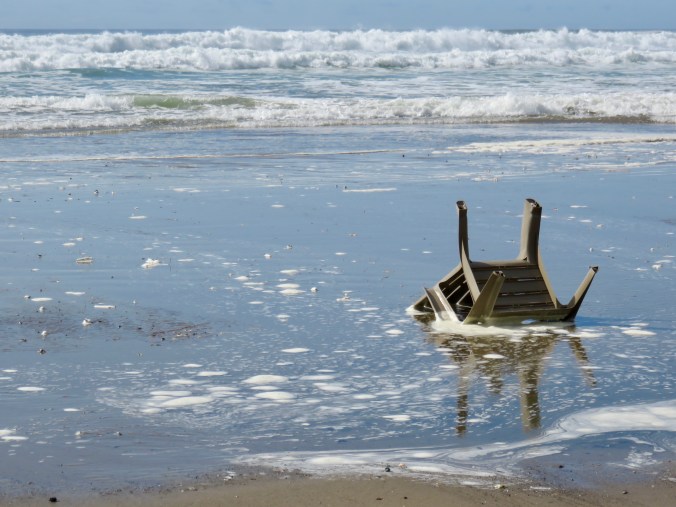
This is the chair that eventually traveled south all the way to the end of our beach, and then was tossed up on the basalt inner shore by the tide. Our Adirondack chairs are locally made of wood.

Looking west out over the ocean this afternoon, I can sometimes see Castle Rock, point-six nautical miles offshore. Then the fog folds it back into invisibility. We are both fond of this, I think, the cooling fogs, the way fog signals a very hot day someplace else but not here, at least not yet. Overhead, even when we first went out for our walk this morning, the sky shows blue, whisked by thin clouds, but north, south, east, and west over the ocean, the mist makes a pale mask on the landscape.

This morning we picked the plastic remains of (illegal) fireworks—some pieces are quite sharp—and four golf balls, our fourteenth Bic lighter of the season, plastic packaging and trimmings from cord and twine, candy wrapper, broken cutlery, unidentifiable objects lost off boats, broken beach toys. It’s what we usually find. I found glass melted and sharp from a beach fire. (Glass does not burn and neither does plastic.) Just as we turned for home, I found a sand-frosted disk of clear glass.

There are many dead birds. It is the season of juvenile gulls following after a parent, heads ducked in a vain effort to appear small when they are fully grown. Peep, peep, peep! they cry. Sometimes their parent leads them to food and walks away. Sometimes you can almost hear an adult gull sigh with exasperation. Get a life. The sea lion’s skeleton has finally come apart, and we saw a dead otter, which may have fallen victim to the unusual surf.

Yesterday, Gary went out and retrieved four beach chairs that had been caught up by high waves on the day before. The tide had not been especially high that day, but before the people picnicking on the sand south of us had to move, twice, he was already saying there was a danger of sneaker-waves. A true sneaker rages up fast and far beyond where you might expect. “Sneaker” because of that and because it is often silent.

The surf went from a single breaker in the morning to ten foot swells and many rows of breakers almost a half mile out on that day. It was a roaring sea with lots of plankton washing in from the recent heat and upturned colder water. The first sneaker swept up over the onshore sand bar that had been dry and untouched for weeks. A hundred-yard sweep of rushing saltwater. The next waves swept higher, all the way into the rocks bordering the green—the sort of massive sweep we expect in November not in summer. It was not yet even high tide.

This brings me to the chairs. A drunken party of tourists staying in one of the rentals a block east of the beach brought them down onto the sand early last month and then never bothered to return them. Four plastic chairs, two pistachio-green plastic Adirondack chairs with rounded backs and two tan plastic Adirondack chairs with fan backs. We hoped for a long time that someone would retrieve them or steal them, but no one did. Some visitors used the chairs and some pretended they were not there. The owners of the rental house closest to the chairs ignored them.

We certainly didn’t want them.

However, when we we discovered that one of the chairs had been swept a quarter mile south and then up onto the rocks, Gary went out again. He carried each of them into the front yard and hosed off the plankton. We have gathered up broken plastic chairs in the past. One way or another, he decided, we would be carrying these chairs up—either whole and still useful or broken into pieces.

IMG_4582At top, violets we did not plant in our front garden. They are what gardeners call volunteers, like the little spruce growing in the center yard and the salal coming up everywhere. Nobody planted it, it just grew.

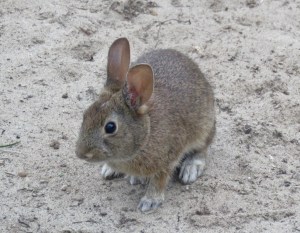
When we had our ocean-side deck removed earlier this year, most of what was revealed was bare, empty sand. The naturalized crocosmia (the orange montbrecia) came up immediately and the wild rabbits like to lift up on their hind legs, bite a montbrecia leaf halfway up, and then eat from there to the tip. They nibble dandelions down to the ground. Good bunnies.

Lately other plants have sprouted: lamb’s ears and wild roses and violets. The roses are prickly and I pluck them out with care, but the others are a lovely surprise. So far the rabbits have left the violets and lamb’s ears alone. We like to think they are gifts from the rabbits because we never shoo they out of our yard.

FREE ADMISSION

IMG_3616.jpg

When we were children the zoo in Seattle was free. There were no tickets, no guarded gates. You could walk in the main gate or by the elephant exhibit or from Lower Woodland or over by the rose garden on the south side. The Seattle Art Museum (then at Volunteer Park on Capital Hill) was free. I have photos of my brother and me on the backs of stone camels. The Seattle Aquarium was privately owned, but for a time my family had free passes because my dad worked for the Bureau of Commercial Fisheries and he knew the owner.

Writer Sandra Cisneros spoke about visiting the museum on the free day in Chicago as a girl. Access to such cultural sites without paying admission was a critical aspect of her childhood. Mine too. These places were beautiful and free.

It was what her family and mine could afford.

The Asian exhibit on Capital Hill is still perfectly clear in my mind’s eyes though I have not been there in over forty years. The elephant walking across clouds carved into pale jade. That spectacular collection has been undergoing renovation and will reopen next year. It will not be cheap to visit. Nearby is the brick tower I climbed in my teens and a conservatory where I recall the overarching tropical foliage, volcanic rock just inside the door to the right of the entrance, the cactus and rows of potted flowers. That glass house costs money to enter, a relatively modest $8 for the two of us if we went today because we are seniors. By contrast, The Burke Museum on the University of Washington campus, a place we used to wander in and out of without a thought, would cost us $40. The Museum of History and Industry, which was a favorite haunt in my childhood would cost about $36. The Pacific Science Center would cost us $48 for entrance but another $70 if we wanted to see everything. There are free days, usually once a month, for many exhibits, though not that one.

If we drove to Seattle (which Gary absolutely resists doing), the museums (some of them free one day a month) and conservatory (except on the first and third Saturday) will cost admission. The zoo has been on lockdown since Gary worked there in the 1970s. It was free when he started as a volunteer in the aviary, but admission was added while he worked in the commissary. This was particularly controversial at the time since admission fees did not go to maintain the zoo but into the general funds for the City. It costs $42 for a pair of seniors to visit today. Cheaper than the Pacific Science Center, more than the Burke. I don’t know where the funds go for all these attractions. I use Seattle as my example only because we once knew the city so well.

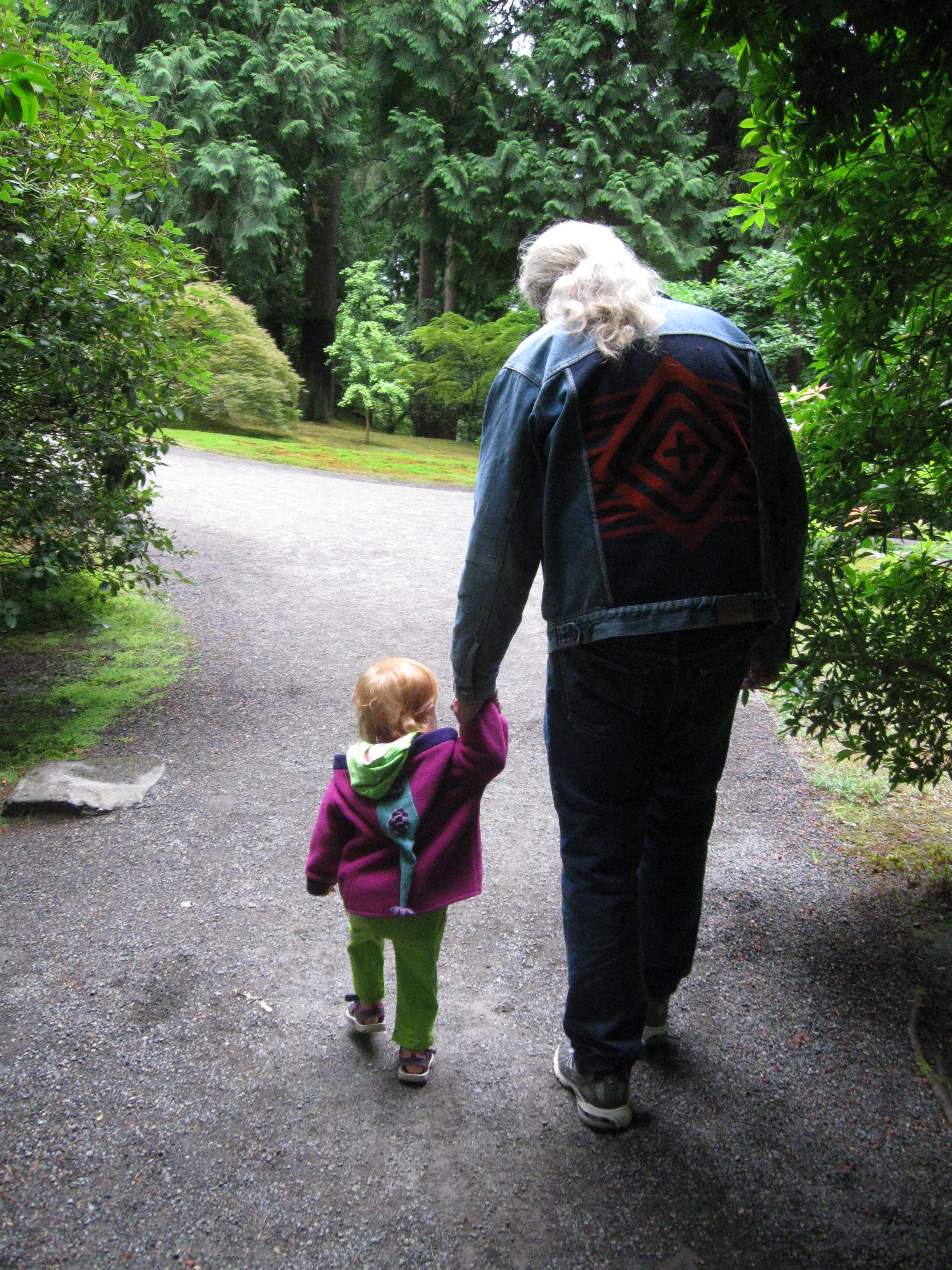
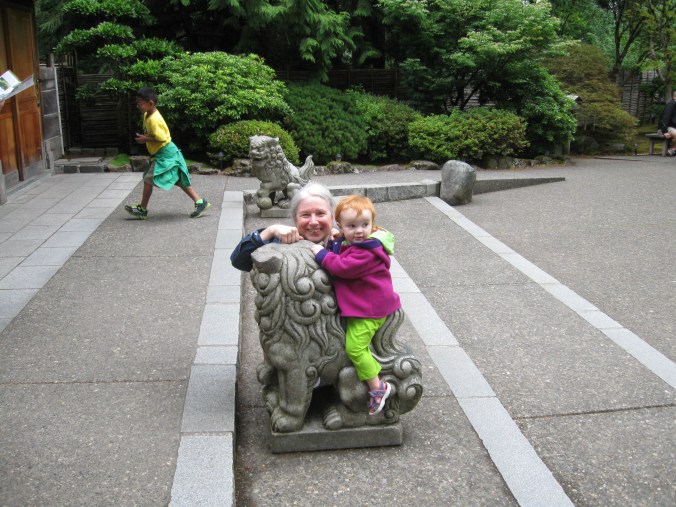
IMG_3624.jpgMore recently, when passes were on sale, we bought a family pass to the Portland Japanese Garden. We took our oldest granddaughter to these gardens several times when she was little, and she loved the “big fish” though she says she doesn’t remember anymore.

IMG_2021The gardens are crowded when we drive by, as we sometimes do on our way into town. For $110, we can purchase a senior family ticket to the Japanese Garden, and after concentrating on our house for the past couple of years, perhaps we will. Though it seems expensive, we can afford admission. Many families cannot.

I understand that people object to taxes and to paying for venues they never visit . . . and I think about the billions allocated for sports arenas, which are all about profits and competition and ritualized violence. And I think about the gilded screen with dozens of crows I saw as a child in Seattle, the science experiments, the wave machine, the Tiffany window—all those shared human cultural experiences I enjoyed as a child.

Public parks and museums should be free to the public, not restricted to those who can afford to pay. I wish everyone, every child, could experience what I did through public access. Very few can.


GARY’S PARTY

IMG_1016.JPG

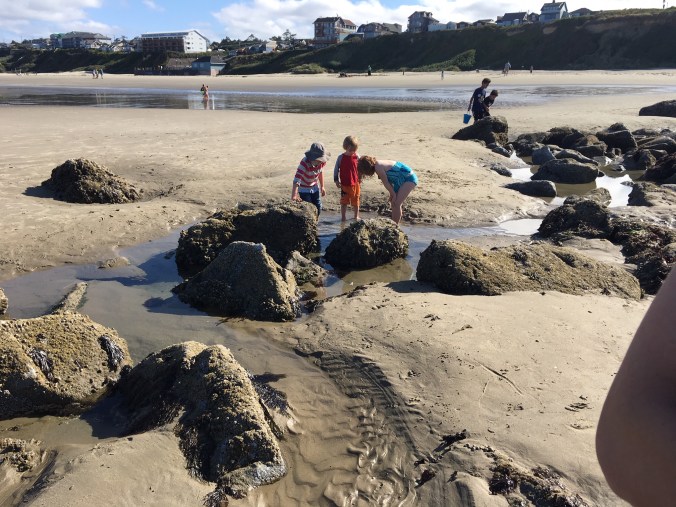
We almost always walk north. We went out before 7am for our walk this morning, before a quick breakfast and heading for home. But later in the morning two of our grandchildren and a friend’s son played in the tide pools, looking at hermit crabs. (Thank you, RO, for sending this.) Our three grandchildren enjoyed the party. The youngest stomped her feet and grinned. Such fun!

It was Gary’s 70th birthday Sunday, yesterday (it was also Lily Tomlin’s 80th and John at the Post Office had one and Barry Gibb became 72 and the guy at the market in Lincoln City turned 29). We drove down the coast in the morning, stopped at a farmers’ market, took our time. We didn’t have all that far to go.

We have been to the Sylvia Beach Hotel a half dozen times, staying in different rooms and enjoying the peace. We bring books or read what is lying about in this literary inn. I bring knitting. We walk on the beach and sit watching the ocean from the topfloor “Library.” Gary gets into the guests’ kitchenette before dawn and makes a pot of extra strong coffee. Not quite routine, relaxing.

We had made our reservation for the Emily Dickinson room and planned to have a meal across the street. No internet, no television, the Sylvia Beach is a peaceful Victorian on a bluff overlooking the ocean. Across the street is a great restaurant. Gary is particularly fond of the chef’s wife and had a photo of the car her dad drove in Australia. That was the surprise he planned. He had no idea people were coming until we came out of his favorite hotel to go toward his very favorite restaurant Ove Northwest. There was a friend in the doorway across the street. What is Rick doing in Newport?

We celebrated with our sons and their families and some friends. It is amazing that I managed to keep the secret for six months.

Gary’d never had a surprise party. He was stunned. He kept saying, IMG_4879How did you do this? In fact, I’m not sure Gary had ever had a proper birthday party before this one. He never had a proper party as a child. He claims I threw him a party forty years or so ago when we were in college, but I don’t remember.

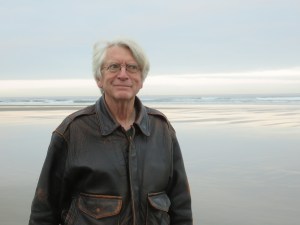
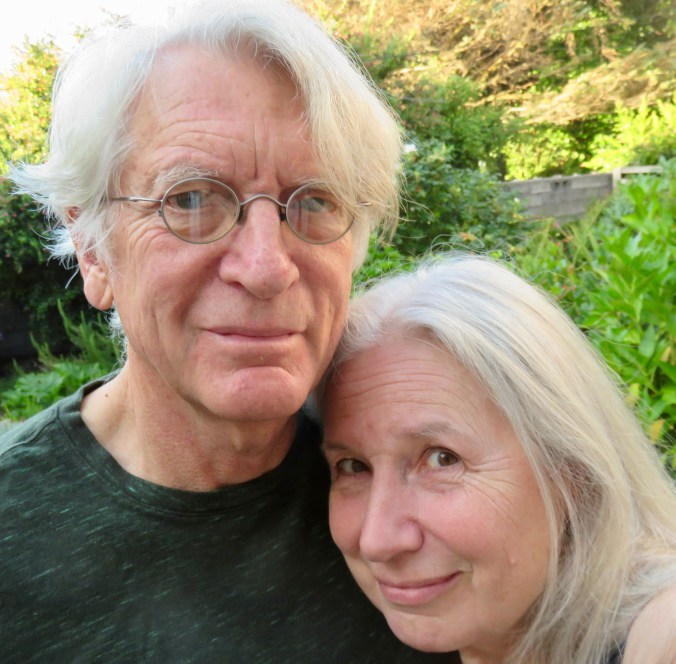
Gary is a self-effacing person, patient and kind under most all circumstances. He doesn’t ask for much or complain often. He loves cards and phone calls on his day. He smiles all the time but almost never for the camera. He was mugging for me this morning on our walk.

We’ll call this his first party. The very best. He could barely function when he began to understand what was happening. He just sat and looked stunned for at least an hour and Margaret kept his beer glass full. He was so surprised.

He says: Thank you. I love you.

IMG_4877.jpg

[Gary has read this now and complains that I have failed to detail my craftiness. Okay, I was pretty crafty. I am so very grateful for the people who were able to attend or who called or sent cards. He deserved this.]

THE COLOR PURPLE

IMG_1989 - Version 2

““I think it pisses God off when you walk by the color purple in a field and don’t notice it.”—The Color Purple by Alice Walker

My favorite pair of gloves are purple. They are not quite dark enough because I want the shade to conceal stains. That sounds practical, but I also prefer the shadows, which are not always practical. Just now I have fabrics spread out over the floor again. I am looking at a triad of deep purples and lime-sage greens and brilliant bittersweet, all batik. Waiting all over the floor because I have no wall space. Not practical.

My walls are painted pale tints of plummy gray, but what draws me to purple is the darkness. Purple has a royal association for many people, a sophisticated color. It might remind me of pain. As one example, I have been thrown from horses, kicked and bitten by them. People do die falling from a horse, but for pure suffering during recovery, I cannot recall anything more painful than that perfect purple-dark bruise risen on my shoulder that took a month to begin fading. That is what I think of first when I think of purple.

Violets have volunteered in our front garden. There is mostly only sand from where we removed the deck, the montbrecias coming up everywhere and mowed half down by the rabbits. (The rabbits have become large, and yesterday we watched one eat an entire dandelion—good bunny.) but just at the edge, between the expanse of sand and the hedge. a violet.

Many things that are called purple are not purple at all. Male purple finches have a reddish head. Purple prose is the overblown decorative fluff that gives English teachers a headache. On the other hand, blueberries are more purple than blue. The indigenous blue huckleberries make purple pies. Carrots were originally a purple root—the orange we know today is a sport that became so popular in Europe the original color is an oddity in modern markets. Few would consider purple carrots anything but fantasy. 

The tall flower spikes of Digitalis purpurea, as its name suggests, is usually light purple. When we were young, my girlfriends and I plucked the hollow flowers from foxglove spires as tall as ourselves. They bloomed on the edge of the woods and we slipped a glove onto each finger. We knew the flowers (and the stems, leaves, and roots) are toxic. Digitalis is the medicine my grandfather took for his heart, and too much can kill, but we ran with our purple-gloved fingers fanned before us in games. I always assumed that the foxglove of childhood games and that I saw along my drive to work each June was native. But it is an invasive species, just another European, like most of my ancestors. Maybe this is the source of my complicated love affair with purple.

The Purple Heart is a military medal for physical injury in the field of battle—implying nothing about the actions of the wounded, other than to honor the wound. An award for suffering.

Pretty purple things: amethyst and iolite and tanzanite and the opaque sugilite. The thick petals of orchids can be many colors, but the color “orchid” is violet. I have dyed wool lavender with iris flowers. That iris tint fades in sunlight. It is fragrance as much as hue: violets and lavender, the tuberose, iris, lilac scents. Somehow I associate purple as much with folly as with bloom—the pain bruises.

Yet, as a textile artist, it is the color I reach for, covet, value and strand in weaving. I choose to spice yellows or orange in a composition, to spark pinks or green. It is a hue that wants to shove gray around. And that is probably appropriate since purple has a long association with power. The ancient Tyrian purple dye worn by popes and sovereigns for thousands of years was harvested from the mucous of three species of predatory sea snails, known collectively as Murex. The fluid protects the unhatched eggs of the shellfish and drives off predators. It can be harvested by killing the snail, but also through “milking” the mucous gland of the creature. Rare but stubborn, the color, a clear reddish-violet to my modern eye, withstands fading through wear, light, and washing. The dye was already ancient when Aristotle, who was so right about some principles and so very wrong about so many particulars, detailed its production.

In the mid-nineteenth century, a British chemist invented the first aniline dye, originally called Tyrian purple and then marketed as mauve, a delicate, slightly grayed, reddish-purple. (Mauve pronounced with a long O, not a soft ah sound.) The first chemically created color ever. It is on the edge of being a cool color, found on the color wheel opposite yellow-greens. 

In youth I leaned to warmer colors—orange, vermillion, russet reds, dusty pinks, burgundy, and wine red. My preferences changed over the years and purple moved from a supporting role in accessories to center stage. This shift is reflected not only in what I wear, but in what I want to touch. I wore bellbottoms striped in black, lime, pink, and purple when I was fourteen. I dyed my hair purple when I was sixty, a joke on the old ladies of my childhood who used rinses to counter yellowing that turned their gray hair from murky yellowing gray to distinctly violet. 

Purple is the foil that makes paler, more timid tints dance. Purple is the look-at-me color, associated with power, with royalty, nobility, Lent, Easter, and Mardi Gras, but very rarely named as favorite. Studies suggest that it is a color preferred by artistic folk, more often women than men, older adults rather than younger ones, and that was the character of the room when I took a class taught by Jungians on Art Therapy. 

Sandra Cisneros had to fight conservative design review to paint her San Antonio, Texas Victorian home purple, a periwinkle blue, and pale blue-violet tint by my estimation, but the color proved to be historically accurate. There are painted ladies in San Francisco—not women, but the grand tall Victorian mansions of that city—painted in shades of violet. A favorite house in Seattle is a smokey violet shade I found on a paint chip called “Stetson” with a bright red door in the 70s before that became cliché. Hyacinth macaws are purple, and the queen of England is known to wear tints of that particular blue-violet. It is stitched into the border of a a sari or the facing of an Afghan dress. 

It makes a pattern in concrete sidewalks, city sidewalks built with glass “prisms” faceted to direct light to anyone working in the spaces beneath. Clear glass pavers were made with manganese to clarify the glass, but eventually the iron that once clouded the glass swaps ions with manganese and over years of exposure to sunlight, the clear glass turns purple. There are such sidewalks across the country in Texas and British Columbia, Seattle and New York City. Nearby in Astoria, broken pavers have been replaced. Many have been damaged over the years, but the surviving glass in sidewalks is generally quite purple. 

Violet is on the edge of wavelength in light that humans can see. Shorter X-rays and gamma rays and ultraviolet exist beyond the visible violet, just as microwaves and radio waves lie on the other side of the light spectrum beyond red. The rainbow shows purple inside the sweep to fairy gold. Some gifts seem the work of the supernatural. In The Color Purple, while discussing their view of God, Shug tells Celie she thinks God wants to be loved, “I think it pisses God off when you walk by the color purple in a field and don’t notice it.” We are supposed to appreciate the gift. 

We are supposed to appreciate the gift of that richness and precarious pleasure, the flower that blooms for a day, the shellfish that guards its eggs with purple mucous, the semi-precious gemstone, the pebble in the water, and even the fresh bump on an elbow, the toxic flower that cups a fingertip, the fine line between the violet we can see and the next shade over that is invisible to our eyes. There is beauty, but concealment too, a warning both ways. My purple gloves are meant only to protect my hands from the cold. In sunny weather I require some other protection. It is ultraviolet that burns our skin.

AMAZING NAMES

fullsizeoutput_fd3

“Not many things are orange . . .” Really?

On 10 September 2015, I created a folder on my computer titled COLORbook. My intention was to complete a series of chapters about color, an entire book of nonfiction about my personal and cultural understanding of color. The idea had been stirring in my head for a long time. My earliest essay about color I can find was created 2006 about orange. “The word itself traces its lineage from fourteenth century English, back to Old French or perhaps Spanish through the Arabic nāranj, the Persian nārang, and eventually to the Sanskrit nāranga, meaning orange tree, a word that might derive from an even earlier term meaning fragrant. Our word for the color orange and the fruit have an ancient co-existence, but the citrus fruit came first.” The color name or the name of a citrus fruit or acknowledgment of the incredible scent of fruit and flower, orange blossom.

Anyway, I meant to write a book about color. I had completed several chapters and begun thinking about sending them out when, probably in 2017, I learned of the book On Color by David Scott Kastan with Stephen Farthing. It was released last year and I have just begun reading it. I will have to stop soon. It is making me cross. The obvious reason is that I wish I’d written it and I am annoyed that I didn’t.

It’s probably for that reason that I am arguing with the book. There are marvelous lines like “The sensation of color is physical; the perception of color is cultural.” The book does a very nice job of explaining color as wound into perception and culture. Homer’s “wine dark sea” seems to trouble a lot of people including these authors who desperately want Homer to have said the sea was blue. Water has no color, but reflects the sky. Maybe saying the sky or sea were indigo blue seemed entirely unnecessary. I look at the ocean every day, for hours at a time. The color I remark upon is a deep green, which is not typical but a personal preference. Perhaps the wine reference refers not to hue, but purely to darkness, richness. A dark sea. I have seen that—even seen it dark and the color of wine. Color is very much a matter of context, both physically and culturally. The Kastan and Farthing book does a good job of introducing that confusion.

But then another sort of confusion: “Not many things are orange” the book states by way of explaining why the color orange was there, of course, but the color name of “orange” did not exist in English until the fruit arrived in England. There was no word for that color until the fruit. It was unnecessary, they suggest. (Really?) Chaucer refers to a color “betwixe yelow and reed.” (He knew how to mix paint colors? The connection is not so obvious as the authors claim. I have taught enough small children and older ones how to combine primary colors to make secondary colors to know that most do not see this without aid.) But the authors make a gigantic leap in claiming there was no need for the color name because not many things are orange? How about sunsets, rust, and hair we call “red” to name just three? “Not many things are orange . . .” Only autumn leaves, chickens and foxes, fire and flower stamens. Apparently the word was necessary in India for millennia before it reached the British isles.

[Fewer things are purple, but that word is very old in English, from the Old English word purpul from Latin purpura, from the Greek πορφύρα (porphura), the name of the Tyrian purple dye made from a Mediterranean shellfish. Maybe I will post my essay on the color.]

310euHZLD2L._SX328_BO1,204,203,200_.jpgAnyway, this is probably a better book than I would have completed, had I completed mine. Twenty-two pages of endnotes, so the scholarship is solid. The stories I found in my research seem to be mostly covered here, and my copy purchased at a local bookstore is a squarer shape than what I see on Amazon. A pretty thing.

Despite Crayola crayons and poster paints, Hazel Koenig at the University of Washington introduced me to color theory. Pink is a tint of red, brown is a shade of orange. Pigment combines three primary colors and black and white in ways quite unlike color in light (which achieves all colors from red, blue, and green light). The four-color printing process (cyan, yellow, magenta, and black) has always amazed me—how do yellow and magenta combine to make pure red? Amazing.

Some of my essays are here on my blog if you searched for them. “Color Blind” and “Blue Sky” for example. I also wrote about orange and hot pink and little black dresses, ten chapters in all for my COLORbook folder.

I never got to yellow because I left off writing new chapters when I understood that someone else had written and published my book. It is not the first time.

In 1995, I completed the first draft of a terrible novel, and then I began better one. This was called Clean Away (working title was Bitch Trial) about four generations of women in family facing similar struggles over and over and perhaps doing better and better at coping. The central character, the daughter and granddaughter of older generations and the mother of a younger one, finds her grandmother’s diary behind a wall in a tiny family house in Astoria. This reveals a scandalous secret and places her own life in context. I worked on that book for a few years and then abandoned it when I learned of a new novel with a similar plot. I read all the way through that one. It was very good. My book was funny and the other was not, but mine was never published.

I used to write funny. That got lost for a while. I blame my poor mother. (Mothers so often get blamed for everything.) By 2002 my mother’s health was undeniably failing and my husband and I took care of her, someone told me I was the “most dysfunctional person” he knew and stopped communicating with me, and I lost my sense of humor.

Perhaps I only misplaced it, setting it aside for best. Perhaps it was unnecessary at that time. Not many things are funny? Or perhaps humor may be returning.

Most afternoons I watch the sky change color, the darkening sky blue overhead and shifting to orange on the horizon without passing either purple or green. Amazing. “How we are named and what we are called” is a phrase that runs around my head. It titled a story about Arizona that I wrote twenty years ago. It is the paradox of naming and valuing what we name. It explores that power of naming and of un-naming as Ursula K. Le Guin imagines in her story “She Unnames Them” where Woman lifts names off living creatures, removing the burden placed upon them. Some species insist their names are theirs and pets demand their personal names, but all are assured they are welcome to keep whatever names they believe suit them.

English is not the final word, nor the oldest in the world. Imagine a color book written from the other side of the world. China’s imperial yellow, red wedding dresses, white for funerals. I would read that.

Orange is one of the oldest words because so many things are orange.

WASTED

fullsizeoutput_103b

Yesterday on our predawn walk north, Gary stood on a rock that usually rises above my head from the sand. This summer it is nearly covered. This is the deepest sand we have had in twenty years. In January of 1999, a storm-driven high tide dug the basalt from under the sand into a high ridge and took out far more sand than usual. It’s taken all this time to see it return.

Wasted. Not drunk or high, I’m talking about money.

Our biggest waste was “The Maples,” a piece of land just over two acres that my husband and I purchased in the early 80s when our firstborn was a baby. I have photos someplace of me holding him in my arms. Above us are the enormous bigleaf maples that inspired our name for the property. It was on the other side of the coast range, up the Nehalem Valley on a road called Anderson, and a stream ran along the north side. No houses I designed had yet been built, but I had great hopes for that property, purchased on contract from a widow.

And then the sale of our Seattle house fell through. What year was that? We’d accepted a very long escrow in return for a very large earnest deposit of $5000. That was in the fall. It was the following spring, early June, a week before the sale was supposed to close that the buyers told us they’d changed their mind. “No hurry” returning the earnest money.

And the money was spent on The Maples. We didn’t have it. We could not pay back the deposit, which was paid to guarantee that the buyers would not do what they did. Change their minds. I was pregnant with our second son, and we had counted on the sale closing in order to pay off the land because we really could not afford the house payments as well as the land payments.

And suddenly we were in trouble financially with contract payments on the acreage and mortgage payments on the Seattle house. Remodeling on the house I had inherited from my grandfather’s third wife. Renters had been turned out of the Seattle house, as the buyers requested, and there was some damage from the buyers opening walls and from the house lying empty for all those months. We had lost the rent and now had repairs to make before the house could be sold. Less than month before our second child was born, I was not in a position to drive back to Seattle and do the work myself. My Visa bill already did not bear thinking about. We had hard decisions to make.

We gave the land to the people who had bought the property next door, just gave it away. They would take over our payments and Tootie Anderson, from whom we purchased it, would not miss payments she relied upon, and we would be out from under one of those monthly payments we could not afford.

The Maples were gone.

Gary has a hunk of quartz crystals found at the base of one of those spectacular trees. Gary calls it our “thirteen thousand dollar rock.” That was what we lost in down payment and monthly payments on the property we gave away.

There have been other wastes. When I opened this page, I’d intended to talk about my husband’s dismay when he found that a coat he purchased a few years ago, an expensive cold-weather coat, was on sale for a quarter of what he’d paid. There are plenty of examples of wastefulness, wasted spending. Bad meals in restaurants. A pair of shoes I could not return after they gave me blisters. Fabric. A braided rug. Gary has bought CDs he realized he already had, or once had and did not like. Three incomplete sweaters that I will never finish. I have bought yarn I never used.

In our downsizing process, I let go of many projects I no longer wanted to work on. I sold a few hundred dollars worth of yarn for $90 and gave away my enameling kiln to a former student. I never heard from her afterward. Perhaps she didn’t like the yarn. I unearthed additional tools related to the kiln that I would like to give her. Perhaps the kiln did not work. Perhaps this is her own story of waste. sigh

But most of our “wasted time” was not wasted at all. It was lived. Dozens of stories and several novels consumed half a lifetime and that was not wasted time even though they are unpublished. But money. Money is not something we are supposed to talk about. For almost the whole of my life I worried about money, a habit encouraged by my mother who actually prided herself on being a “worrier.” It is a waste of time, I think.

A friend referred to travel by train as a waste of time. But on the one train trip I took as a girl, watching the countryside pass by was not a waste. Biking across a landscape is not a waste of time, running the Hood to Coast was not a waste of my time. Walking the beach this morning—we plan to walk south around the Cape—is time spent, not wasted. Time lived.

There is rain today, cooler temperatures began yesterday and I slept right through the lightening and thunder last night. Slept a good eight hours. Not a waste. Life.

fullsizeoutput_103e

This is also from our four-mile walk, looking south. Last year we could not walk between the Seal Rock and the headland—the gap above that is filled with sand. Last year it never filled in even by August and there were pools of water and barnacled rocks. This year that is all under feet of sand.


NO LIE

just for fun.


“On the Decay of the Art of Lying” is a short speech (or essay) written by Mark Twain in 1880 for a meeting of the Historical and Antiquarian Club of Hartford, Connecticut.

Observe, I do not mean to suggest that the custom of lying has suffered any decay or interruption–no, for the Lie, as a Virtue, A Principle, is eternal; the Lie, as a recreation, a solace, a refuge in time of need, the fourth Grace, the tenth Muse, man’s best and surest friend, is immortal, and cannot perish from the earth while this club remains. My complaint simply concerns the decay of the art of lying. No high-minded man, no man of right feeling, can contemplate the lumbering and slovenly lying of the present day without grieving to see a noble art so prostituted. In this veteran presence I naturally enter upon this theme with diffidence; it is like an old maid trying to teach nursery matters to the mothers in Israel. It would not become to me to criticize you, gentlemen—who are nearly all my elders–and my superiors, in this thing—if I should here and there seem to do it, I trust it will in most cases be more in a spirit of admiration than fault-finding; indeed if this finest of the fine arts had everywhere received the attention, the encouragement, and conscientious practice and development which this club has devoted to it, I should not need to utter this lament, or shred a single tear. I do not say this to flatter: I say it in a spirit of just and appreciative recognition. [It had been my intention, at this point, to mention names and to give illustrative specimens, but indications observable about me admonished me to beware of the particulars and confine myself to generalities.]

No fact is more firmly established than that lying is a necessity of our circumstances—the deduction that it is then a Virtue goes without saying. No virtue can reach its highest usefulness without careful and diligent cultivation—therefore, it goes without saying that this one ought to be taught in the public schools—even in the newspapers. What chance has the ignorant uncultivated liar against the educated expert? What chance have I against Mr. Per—against a lawyer? Judicious lying is what the world needs. I sometimes think it were even better and safer not to lie at all than to lie injudiciously. An awkward, unscientific lie is often as ineffectual as the truth.

Now let us see what the philosophers say. Note that venerable proverb: Children and fools always speak the truth. The deduction is plain—adults and wise persons never speak it. Parkman, the historian, says, “The principle of truth may itself be carried into an absurdity.” In another place in the same chapters he says, “The saying is old that truth should not be spoken at all times; and those whom a sick conscience worries into habitual violation of the maxim are imbeciles and nuisances.” It is strong language, but true. None of us could live with an habitual truth-teller; but thank goodness none of us has to. An habitual truth-teller is simply an impossible creature; he does not exist; he never has existed. Of course there are people who think they never lie, but it is not so—and this ignorance is one of the very things that shame our so-called civilization. Everybody lies—day; every hour; awake; asleep; in his dreams; in his joy; in his mourning; if he keeps his tongue still, his hands, his feet, his eyes, his attitude, will convey deception—and purposely. Even in sermons—but that is a platitude.

In a far country where I once lived the ladies used to go around paying calls, under the humane and kindly pretense of wanting to see each other; and when they returned home, they would cry out with a glad voice, saying, “We made sixteen calls and found fourteen of them out”—not meaning that they found out anything important against the fourteen—no, that was only a colloquial phrase to signify that they were not at home—and their manner of saying it expressed their lively satisfaction in that fact. Now their pretense of wanting to see the fourteen—and the other two whom they had been less lucky with—was that commonest and mildest form of lying which is sufficiently described as a deflection from the truth. Is it justifiable? Most certainly. It is beautiful, it is noble; for its object is, not to reap profit, but to convey a pleasure to the sixteen. The iron-souled truth-monger would plainly manifest, or even utter the fact that he didn’t want to see those people—and he would be an ass, and inflict totally unnecessary pain. And next, those ladies in that far country—but never mind, they had a thousand pleasant ways of lying, that grew out of gentle impulses, and were a credit to their intelligence and an honor to their hearts. Let the particulars go.

The men in that far country were liars, every one. Their mere howdy-do was a lie, because they didn’t care how you did, except they were undertakers. To the ordinary inquirer you lied in return; for you made no conscientious diagnostic of your case, but answered at random, and usually missed it considerably. You lied to the undertaker, and said your health was failing—a wholly commendable lie, since it cost you nothing and pleased the other man. If a stranger called and interrupted you, you said with your hearty tongue, “I’m glad to see you,” and said with your heartier soul, “I wish you were with the cannibals and it was dinner-time.” When he went, you said regretfully, “Must you go?” and followed it with a “Call again;” but you did no harm, for you did not deceive anybody nor inflict any hurt, whereas the truth would have made you both unhappy.

I think that all this courteous lying is a sweet and loving art, and should be cultivated. The highest perfection of politeness is only a beautiful edifice, built, from the base to the dome, of graceful and gilded forms of charitable and unselfish lying.

What I bemoan is the growing prevalence of the brutal truth. Let us do what we can to eradicate it. An injurious truth has no merit over an injurious lie. Neither should ever be uttered. The man who speaks an injurious truth lest his soul be not saved if he do otherwise, should reflect that that sort of a soul is not strictly worth saving. The man who tells a lie to help a poor devil out of trouble, is one of whom the angels doubtless say, “Lo, here is an heroic soul who casts his own welfare in jeopardy to succor his neighbor’s; let us exalt this magnanimous liar.”

An injurious lie is an uncommendable thing; and so, also, and in the same degree, is an injurious truth—a fact that is recognized by the law of libel.

Among other common lies, we have the silent lie—the deception which one conveys by simply keeping still and concealing the truth. Many obstinate truth-mongers indulge in this dissipation, imagining that if they speak no lie, they lie not at all. In that far country where I once lived, there was a lovely spirit, a lady whose impulses were always high and pure, and whose character answered to them. One day I was there at dinner, and remarked, in a general way, that we are all liars.

She was amazed, and said, “Not all?”

It was before “Pinafore’s” time. so I did not make the response which would naturally follow in our day, but frankly said, “Yes, all—we are all liars. There are no exceptions.”

She looked almost offended, “Why, do you include me?”

“Certainly,” I said. “I think you even rank as an expert.”

She said “Sh-‘sh! the children!”

So the subject was changed in deference to the children’s presence, and we went on talking about other things. But as soon as the young people were out of the way, the lady came warmly back to the matter and said, “I have made a rule of my life to never tell a lie; and I have never departed from it in a single instance.”

I said, “I don’t mean the least harm or disrespect, but really you have been lying like smoke ever since I’ve been sitting here. It has caused me a good deal of pain, because I’m not used to it.”

She required of me an instance—just a single instance. So I said—

“Well, here is the unfilled duplicate of the blank, which the Oakland hospital people sent to you by the hand of the sick-nurse when she came here to nurse your little nephew through his dangerous illness. This blank asks all manners of questions as to the conduct of that sick-nurse: ‘Did she ever sleep on her watch? Did she ever forget to give the medicine?’ and so forth and so on. You are warned to be very careful and explicit in your answers, for the welfare of the service requires that the nurses be promptly fined or otherwise punished for derelictions. You told me you were perfectly delighted with this nurse—that she had a thousand perfections and only one fault: you found you never could depend on her wrapping Johnny up half sufficiently while he waited in a chilly chair for her to rearrange the warm bed. You filled up the duplicate of this paper, and sent it back to the hospital by the hand of the nurse. How did you answer this question–‘Was the nurse at any time guilty of a negligence which was likely to result in the patient’s taking cold?’ Come–everything is decided by a bet here in California: ten dollars to ten cents you lied when you answered that question.”

She said, “I didn’t; I left it blank!”

“Just so—you have told a silent lie; you have left it to be inferred that you had no fault to find in that matter.”

She said, “Oh, was that a lie? And how could I mention her one single fault, and she
is so good?—It would have been cruel.”

I said, “One ought always to lie, when one can do good by it; your impulse was right, but your judgment was crude; this comes of unintelligent practice. Now observe the results of this inexpert deflection of yours. You know Mr. Jones’s Willie is lying very low with scarlet-fever; well, your recommendation was so enthusiastic that that girl is there nursing him, and the worn-out family have all been trustingly sound asleep for the last fourteen hours, leaving their darling with full confidence in those fatal hands, because you, like young George Washington, have a reputa— However, if you are not going to have anything to do, I will come around to-morrow and we’ll attend the funeral together, for, of course, you’ll naturally feel a peculiar interest in Willie’s case—as personal a one, in fact, as the undertaker.”

But that was not all lost. Before I was half-way through she was in a carriage and making thirty miles an hour toward the Jones mansion to save what was left of Willie and tell all she knew about the deadly nurse. All of which was unnecessary, as Willie wasn’t sick; I had been lying myself. But that same day, all the same, she sent a line to the hospital which filled up the neglected blank, and stated the facts, too, in the squarest possible manner.

Now, you see, this lady’s fault was not in lying, but in lying injudiciously. She should have told the truth, there, and made it up to the nurse with a fraudulent compliment further along in the paper. She could have said, “In one respect this sick-nurse is perfection—when she is on the watch, she never snores.” Almost any little pleasant lie would have taken the sting out of that troublesome but necessary expression of the truth.

Lying is universal—we all do it. Therefore, the wise thing is for us diligently to train ourselves to lie thoughtfully, judiciously; to lie with a good object, and not an evil one; to lie for others’ advantage, and not our own; to lie healingly, charitably, humanely, not cruelly, hurtfully, maliciously; to lie gracefully and graciously, not awkwardly and clumsily; to lie firmly, frankly, squarely, with head erect, not haltingly, tortuously, with pusillanimous mien, as being ashamed of our high calling. Then shall we be rid of the rank and pestilent truth that is rotting the land; then shall we be great and good and beautiful, and worthy dwellers in a world where even benign Nature habitually lies, except when she promises execrable weather. Then—But am I but a new and feeble student in this gracious art; I cannot instruct this club.

Joking aside, I think there is much need of wise examination into what sorts of lies are best and wholesomest to be indulged, seeing we must all lie and we do all lie, and what sorts it may be best to avoid—and this is a thing which I feel I can confidently put into the hands of this experienced Club—a ripe body, who may be termed, in this regard, and without undue flattery, Old Masters.


NOTE: I have made “corrections” for the sake of modern grammar, punctuation, and spelling, and suspect Twain would laugh about that. I realized as I did so that my youthful fondness for Twain might help explain other fondnesses—for the em-dash, as an example.

This essay is not so sharp as some by Twain; his humorous observations are almost sweet compared to the liars we know now who might be the worst kind, worst than the poor well-intentioned lady described: Some think they have a magical gift whereby speaking the lie turns it true.—jp
 

STEP 8: Done, sort of

fullsizeoutput_1035

BlueToo, the second blue-and-yellow quilt top. In life, it is an 84″ square, not a trapezoid.

I completed two quilt tops this month, and pieced the back of one of them too. To be perfectly honest, I have completed two quilts at once before. But this was especially fun. I could, in the simplest form, sew two lengths of cloth together to make a front and do the same for the back, adding an additional strip because the backing must be larger than the front to accommodate the machine quilter. In real life, it’s not so simple.

The theoretical simplest quilt would require at least ten or eleven yards of 44″ fabric. And in the old days when quilts were created to use up scraps of fabric (a practice not actually as common as the mythology suggests), a quilter would gather bits of fabrics for years from making shirts and dresses, wool pants and skirts. In practice, many quilts were made with specially purchased fabric or fabric dyed for use in piecing a quilt. All quilts result in ever smaller scraps. I have a small mound of blue-and-yellow scraps and thread trimmings from my work this month.

I make quilts from ordinary fabric and still hand-quilt such quilts on occasion because I really do like the look and the control. Most of my quilts these days are made of Asian batik fabric which is hand-dyed and boiled making a tight, smooth cloth that is not easily pinned, much less hand quilted. I took a hand-quilted batik quilt in to show a friend who owns a quilt shop. (“You hand-quilted this?” she said. “Didn’t your fingers bleed?” Well, yes, as a matter of fact they did. I could only work for a short time each day until my fingers were too bloody to go one without staining the fabric.) She’s the one who urged me to find a machine quilter. “No one hand-quilts batik.”

I made a small quilt for my mother from Liberty cotton lawn. I made quilts for each on my sons when they turned two and when they went off to college and when they married. My grandchildren have each received three so far.

Each of these quilts incorporate dozens of fabrics, a few thousand yards of thread, and often have pieced backings. The two shown here, except for the backing on one and a third of the backing for the other, were made entirely from fabrics I have collected in what textile people would call my “stash.” I have, let us say, several large plastic bins (and several smaller ones) filled with fabrics to use in quilting. These cottons are mostly purchased in quarter-yard pieces (about 9″ x 44″) and some of them are over forty years old. The newest are a few months old.

I made my first pieced quilt when I was pregnant with Alan, my first-born son. That was thirty-nine years ago. I took the bus to Spokane to visit a friend and she took me to a quilt shop where I bought small pieces of red on white and white on red prints of conventional cotton. The quilt I made was a double nine-patch. I backed it with one of my grandmother’s pilfered hospital sheets. Over the years since, I made an Ocean Waves and a Snail quilt. I have made variations on log cabin several times. Mostly, though, I make them up. I think through not only the appearance, but the construction of the piece—what must be done first and how.

All this planning is not the result of an orderly and methodical personality. I am what is called an Abstract/Random. I am inclined to mess and disorder and risk.

I had to learn how to be linear and meticulous instead of lazy and meandering because the things I wanted to make demanded those processes that from me. I draw thumbnails. I make lists. I stare and stare and lie awake at night figuring things out.

There is a skinny line in the quilt above, the dark blue between the grayish outside border the bluer inside panel. That narrow piece is called a “frame.” I am fond of frames in my quilts, but this one was not supposed to have one. When I realized it needed that narrow dark blue frame, I felt a kind of despair, just for an instant. I was not sure the backing I had would be large enough to add two more inches both ways.  Otherwise I would have to dig through my stash to find enough fabric to enlarge the already-huge backing for my already outsize pieced top. I laid the backing out on the bare floor and measured. Fortunately it was plenty big, though out of square and longer on one side than the other from the way it was cut from the bolt (not my fault, that).

Most of my quilts run around 80″ square or a bit larger. I meant to make a pink quilt for a twin bed once and it turned into a 90″ square. Things just got out of hand. Making a special size is another whole struggle for me. I made one for a king-size bed that was a nightmare. The size (106″ square) was more than I could manage and I swore I would never do it again. I would do it differently now but smaller pieces would be nice for a change. Doll quilts are fun. A hanging would be fine but I do not have space to hang anything. But smaller, perhaps. I could try out ideas without committing eleven yards. Or I might be ready for the plastic bin with silks.

I have been collecting silks the way dress-makers did in the nineteenth century: an entire bolt of 14″ wide kimono silk, scraps salvaged from saris and other projects. I have a couple of yards of orange silk velvet, pink charmeuse, crepe with red apples on green. Bits and pieces. They would all be interesting to piece and quilt. Slippery and shedding but precious and variable in texture. It is the shifts in texture that attract me. I once pieced fabric for a jacket—all sorts of textures including corduroy—in long narrow strips. I wish I’d kept a piece of that. The textures are what I want, in addition to the play of color and value. Something quite different. Soon.

I cast on a knitting project last night and completed a couple of rows in a fancy pattern—unlike me in knitting. I like to think I can start something new because the quilts are done.

But first, these pieces go for machine quilting and when they return in a couple of months, I will still need to bind them. So . . . not really done. Close.

fullsizeoutput_1037

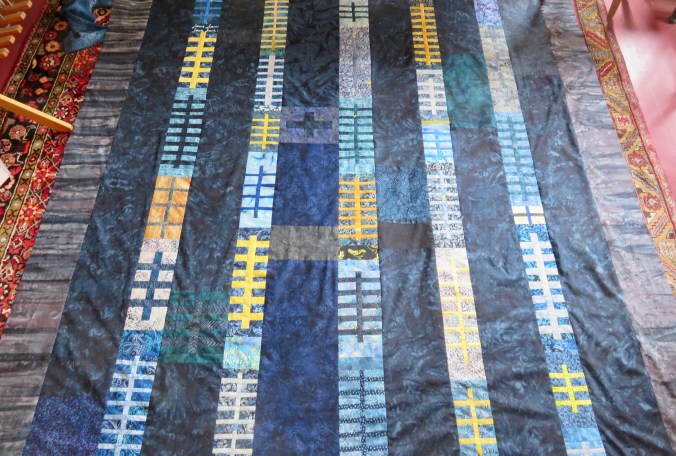
This is Blue Ladders, the quilt I originally set out to make this summer. I will negotiate with Linda Pinkstaff from Astoria Quilting about thread color tomorrow. Her advice is always good. I feel the need for a fancy quilting pattern here. We’ll see what Linda says.


REVISION

IMG_4653.jpg

I have a story under consideration just now at two literary journals. One of them has had it for well over a year. The other began considering it today. It is an important story to me for a variety of reasons and has received a good deal of praise from editors who “nearly” chose to publish it. Those personal rejections came from the more prominent journals. (It is some sort of irony that the journals who publish a larger percentage of submissions reject it quickly compared to the journals that accept only a fraction of one percent of submissions.)

The story matters to me, and that is why I keep sending it out. It is the reason I have restructured the story, changed the point of view, expanded it to over six thousand words and carved it back to barely three thousand. I have revised the story at least every six months for the past fourteen years. That is, I have dozens of drafts, some of them quite dramatically different..

I know when I wrote it because in 2005 I was admitted to an MFA program and this was the story I submitted with my application. It was the story that earned me a place in the program and that gave me my first response in an MFA workshop. I had experienced cruel feedback many times by then in various workshops and classes. I expected it. When the instructor objected to the twist at the end, I rewrote the story to reveal information early. The next editor found I’d tipped my hand too early. I moved things around again.

You get the idea.

A lot of life seems like that. You try to be polite and are accused of failing to address an issue head on. You’re more direct and someone’s feelings are hurt. Can’t you be more subtle? A little too small, too large, too fat, too thin, not beautiful enough, too clever by half. On and on. I get things wrong.

And then there are the people who stand by you and love you no matter what. You make mistakes and speak without thinking, you forget something that is important, or you insist on something that isn’t actually important at all. Or, at least I have done those things. What can I say?

My story is imperfect. My story is imperfect.

Back to work, honing my imperfect self, my imperfect story, the story of my life.

IMG_4792.jpg

‘Are we there yet?’

IMG_4718

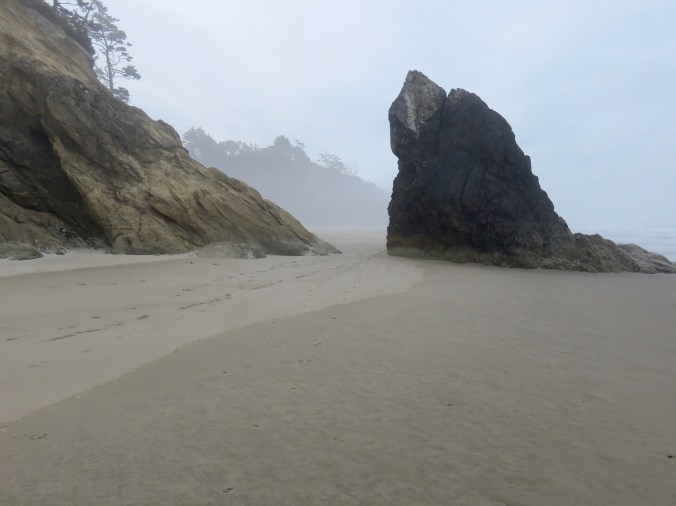
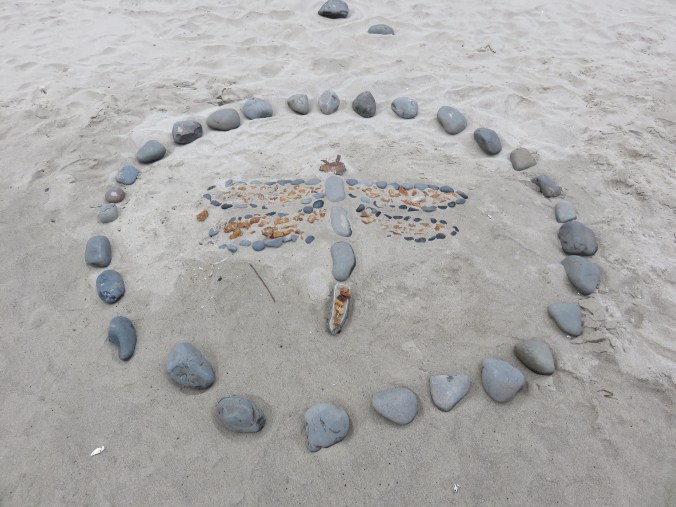
We found this about a mile and a half north. It had survived a couple of high tides, but not the one last night. It was gone this morning.

It’s one of those phrases. “Poor kitties” is another. I should probably list more, but two will do. Today is our anniversary. Forty-fifth, unless you count our time together as a couple, which pushes it to fifty. We have a lot of lines and inside jokes that no one gets but the two of us. We were laughing about that this morning as we walked. We were out for about an hour.

Nothing last forever, certainly nothing human. But we have lasted a very long time as a couple. Fifty years is a long time in people-years. Three or more lifetimes for a dog or cat. Thirty-seven thousand high tides.

Numbers.

Human beings are devoted to numbers. it is our fundamental technology, like nest-building for some birds. Spiderwebs. I recall being told that a mother cat licks each kitten by way of counting them. Perhaps. Certainly a mother cat keeps track of her kits. But cats care nothing for mathematics.

My English students complained about doing math in my class. I thought they should understand how many words they read in a minute, what a score of 67/90 points worked out to as a grade (74%, a C). They thought they should not have to deal with such calculation unless they were at the other end of the school in a math class. Once, when I passed back an exam worth 50 points, an Honors English student started to haul out his calculator. He was taking Trigonometry that term and needed a tool to calculate his grade? I about had a fit. Double your score and that’s your percentage! How do you not know that?

I was never one of those girls who are “not good at math.” I loved math in school. I still do. I use it all the time, numbers running through my head as I bake or sew, the way they used to run through my head as a runner. (When I could not compute minutes/mile on a run I knew I needed a walking break. Thirty seconds. Maybe forty seconds of walking. I would return to a run and recompute how much time I would spend on the distance.)

Hood-to-Coast is this weekend, that Mt Hood to Seaside relay. I ran it five times, 1996-2000, first out of the second van, about 16 miles total. My pace on a very good day running the beach or even highway hills in those days was 8.5 minute miles, but usually I ran a steady nine minute mile. I never got close to that on the Hood to Coast. In 1996, the temperature on my first 6.2 mile leg was 96°F, already rated “very hard” for hills and distance. I had never run in heat before, but I maintained a steady pace. The night run was another sort of revelation. I had never run in the dark before, and it was lovely. I calculated my speed throughout my three runs. Another runner commented that my first mile and my sixth were almost exactly the same speed. Oh yes.

My last long run was from home to school on the first day of in-service in 2011. I underestimated the distance by a half mile and I forgot to wear my new shoes. By the time I was into my sixteenth mile I ran slow and would have taken a ride if Gary had not lost me along the way. My shoes were flat and I damaged my feet that morning. My minutes/mile do not bear thinking about. I would never run further than four miles again.

Numbers.

Fifty years married. During that time, my husband and I have traveled together and apart, completed five college degrees, worked in a dozen retail businesses and for five public agencies, saw through life ten dogs and five cats and a conure and a parrot, raised two sons, lived in three homes, bought seven vehicles, but I will not count the times we each lost our tempers and did incredibly stupid, bonehead things for which we have been forgiven. The love does not take to counting.

This morning we took our walk. We walked north and then south to home again, about three miles. Sometimes we walked side by side and sometimes fifty yards apart. I picked up seven shells, he gathered seven bits of beach trash. We’ve missed our walk only a couple of times this summer. A few times we walked twice. Sometimes we walked a couple of miles, and on an ambitious day we walked five. I will be 67 in a couple of months, he will be 70 in eight days.

Those numbers do not matter at all, of course. That’s just our technology—a foolish way of measuring progress.

It’s about glancing up shore to see where Gary is walking. It’s about knowing he is there. It’s about the walk. Not about how far or when we arrive. We arrived a long time ago.

Happy anniversary, sweetheart.