HOW WE GOT HERE

I have tried to avoid politics, but I fear for my country. The assumption is that Trump will be acquitted this week.

“You know what else they say about my people? The polls, they say I have the most loyal people. Did you ever see that? Where I could stand in the middle of Fifth Avenue and shoot somebody and I wouldn’t lose any voters, okay? It’s like incredible,” Trump said on 23 January 2016. [Click the link—he said this, but his statistics in that speech are, of course, untrue.]

Below is from today’s comments section in The Washington Post.

“How the Republican Party got to this point.
1. McCarthyism: The beginning of hatred toward liberals and Democrats and the purging of liberals from the Republican Party.
2. Nixon’s Southern Strategy: Diving the nation by race by taking advantage of the 1964 Civil Rights Act by courting white segregationists into the Republican Party and purging out African Americans.
3. Reaganism: Building the Republican Party around white conservative Christians and purging all non Christians and non conservative Christians from the Republican Party.
4. Newt Gingrich: The beginning of gutter politics, hate mongering, and lying within the Republican Party.
5. Fox News went live in 1996 broadcasting with a blatant Republican Party and conservative bias. The propaganda component of the Republican Party was complete. At this point the Republican Party had primarily reached, racial (white), ideological (conservative) and religious (Christian) purity. There were no internal checks and balances remaining within the Republican Party, it had internally become a dictatorship.
6. Trumpism: Trump was never strongly affiliated with any political party, but he recognized the political apparatus that the Republican Party had built and the rage within the national conservative base over changing national demographics that threatened their newly found racial, ideological, and religious purity. With populism, nationalism, miss-branding of his opponents, and blatant lies, Trump took total control of the Republican Party. This included the House, the Senate, and the Republican National Committee. Trump then began purging anyone who opposed him within the Republican Party. Since all independence has been removed from the Republican Party, it no longer exists. It’s now the party of Trump with no internal checks and balance, much less any respect for the US constitution; the laws and freedoms it represents.

“Time to vote for our Constitution, vote blue, it’s the patriotic thing to do.”


Clinton was ultimately impeached for lying to the FBI about an extramarital affair. It was immoral but primarily a personal failure, not violation of our country. The current president is free to use congressional funds to extort personal political favors. There is no bottom.

This is not merely a party failure but failure of individual citizens.

I would add that I used to know moral conservative Republicans. I do not think I can say that any longer. And though I know decent people who still support this administration, these people have failed in the most essential way to respect the aspirational and on-the-ground goals of our nation. They have failed in their moral duty to support our Constitution. They have prioritized party over public decency. They have been pushed there by people with money. 

Money now has absolute power over morality. 

DOs & DON’Ts

fullsizeoutput_1172

What I do and what I don’t do. Most of my behavior is habit and thoughtlessness. I do what I was taught, what I enjoy, and what I assume is “natural” and not what I have considered long and hard and found to be wrong—unkind or harmful. Some activities are basic: food, drink, and shelter. Today: consider FOOD.

In 1990 I gave up eating most animal flesh. It had taken me a few years to convert or replace recipes focused on chicken and pork, lamb and beef, but I worked at it and early in that year I became a pescatarian. I generally called myself “vegetarian” because people rarely understood the more accurate term, and if I explained I only ate seafood they tended to go through a list, But you eat chicken? Right? Continue reading →

WOMEN’S WORK


cleaning1920-546x1024.jpg

March 1920 issue of the Delineator magazine, from http://thevintagesite.com/?p=611

A recent post on Apartment Therapy reviews how housework was done a hundred years ago. She describes following a housekeeping manual: “I Tried a 1920s Cleaning Routine for a Week—And It Was Nearly Impossible.” It wasn’t impossible, of course, but it was rigorous, with daily tasks and tasks completed on specific days. Monday was washing day. It was an entertaining read (and illustrated with photographs that do not come from the 1926 book).

“The good housekeeper must bring to her task of housekeeping every one of the qualities that make for a successful executive in the downtown business world.”

Brentnie Daggett, the author of the article, assumes the book was “written for professional housekeepers—teaching them how to take care of their clients’ spaces and manage their businesses at the same time” and that such a housekeeper would have the new gadgets such as an electric washing machine, vacuum cleaner, and dishwasher. She was wrong about all that.

First, the book was written for housewives not professional housekeepers, for married women whose profession was caring for their own home, not for hired staff. The illustrations in the article might depict a maid but should show a housewife wearing her apron, which she would certainly have worn while cleaning house. Most housewives learned their task from older women in their family, but sometimes a book was handy reference for tasks Mother did not explain thoroughly. I have several of these books, some of them quite expansive with chapters on dying cloth and stain-removal, on simple home repairs and pickles. Mrs Beeton’s Book of Household Management comes to mind.

The author of the AT article finds the cleaning process described in the Good Housekeeping book unworkable, even “impossible” yet she only does the morning tasks of breakfast and cleaning. She does try a bit of mending on Mending Day (Tuesday), but she does not mention luncheon, dinner, or entertaining. She also does not mention seasonal tasks such as canning.

Daggett uses an automatic washer and dryer, and I do not blame her for that, but it is very unlikely her great grandmother did. There is no mention of ironing. Untreated cotton wrinkles to a degree few young people would recognize today. In 1929, cotton fabrics were first treated with a solution of urea and formaldehyde, but it would be decades before wrinkle-resistant fabrics became common in American homes. In the 60s, all of our sheets were synthetic because my mother refused to iron sheets. I am 67, old enough to remember ironing my father’s shirts with an electric iron. The task took hours.

Most American homes would not have had anything electric in 1920, no washing machine or dryer, no electric iron, dishwasher, or vacuum. (As late as 1945, the majority of American homes did not have electricity at all.) I recall my step-grandmother doing laundry in a large room, necessarily large because it held multiple tubs of water, mangles and wringers I was warned not to touch. The clean laundry was hung outdoors on the lines strung in front of the vegetable garden.

Cleaning floors between full-on down-on-your-kees weekly scrubbing was accomplished by scattering dampened newspapers on the floor and sweeping them up with clinging dust. Carpets were taken outdoors to be beaten clean with what looked like a massive flyswatter. I had a vacuum cleaner when my children were small, and that took care of the carpets, but I also scrubbed the kitchen floor once a week.

“Clean enough to eat off the floor” was no joke. It was the goal.

Gas or oil lamps had to be cleaned once a week. My mother and her sister did this on Tuesdays during the summers they spent in the house where I now live. It had a wood stove and no electricity or indoor plumbing in the 20s and 30s.

Electric stoves were not in every home, and wood stoves had to be fed with wood that had to be cut and split and stored and carried indoors. The icebox mentioned in the Good Housekeeping book was kept cold with…ICE.

All this non-electric equipment was used every day and had to be kept clean. In the 20s there were no antibiotics and lifespans were lengthening less because of medical science than better nutrition and cleaner homes.

Unmarried people lived in boarding houses for most of the 20th century so that meals and cleaning would be provided and they could go to other jobs. Keeping house was recognized as a full time job and women who stayed home to keep house were on their feet all day, cleaning and cleaning and cooking and caring. And cleaning. 

My great grandmother Rosa [Garcia] Jackson supported her family by opening her home to boarders. She cooked meals and cleaned for pay and that supported her and her children.

My mother was also raised in a single parent household from the mid-30s. Her mother worked full time in a shipping office, but my mother and her sister and their mother all still had the housework to do after work and school. On Saturdays they rushed around to do all the “upstairs” housework in order to be free to attend a Matinee.

Housework was anathema to my mother for the very good reason that her mother never stopped. My grandmother took the bus into the city for her job and then came home to care for her daughters and the four-bedroom home she won in the divorce. She took no alimony and she was paying on time for the furniture her former husband had chosen. My mother avoided canning and embraced every “time-saving” household technique for the rest of her life. Think Campbell’s canned soup and instant mashed potatoes.

In my mother’s childhood winters, laundry was hung in the basement, a chore she hated so much that she used a laundromat throughout my childhood rather than have a washer and dryer in our home. Though she was a stay-at-home-mom throughout my childhood, housekeeping was a full-time job my mother was determined to escape. She was thrilled to return to paying work when my father retired early on disability and my brother hit his teens.

My mother recognized society’s devaluation of women’s work, and she resented it until she died.


more CORONA

from The Atlantic:

Wuhan’s coronavirus outbreak sounds scary. But information about its contagiousness requires context.

One oft-cited number in particular helps experts understand how quickly an outbreak could spread. It’s also easily misread.

R0 (pronounced R-nought) describes the average number of people a single affected individual will infect. Researchers estimate that this coronavirus has an R0 of about 2 to 3.

But plenty of external factors—such as how quickly cases are treated—can affect transmission rates. “A bigger R0 doesn’t necessarily mean a worse disease,” our staff writer Ed Yong writes.

One example: the R0 of measles? A whopping 12 to 16.

EAGLE

She was after a crab, though we could not tell this from where we were walking. There are rules about not approaching sea mammals and other wild things so we held back and went about our task gathering trash. In general, we are careful and respect the rules about not disturbing wildlife. We will cut short our walk or take another route rather than spook resting seagulls into the air.

Continue reading →

CORONAVIRUS

I knew about coronavirus only because of vaccinating my dogs back in the day. It often struck with parvovirus, another danger for dogs, and together they could be fatal in the early days. I knew people who lost entire litters. Soon after they appeared (in the 1970s), both canine coronavirus and parvo were added to the vaccinations I administered to my puppies.  Continue reading →

LET THEM EAT CAKE

33688037_10217044950302347_6133954008747868160_n

One of my favorite websites sent out a link to their recipe for confetti cake. It is made with artificial coloring (in the confetti), colorless artificial vanilla (for that true “box cake” flavor), egg white, oil, and cake flour (bleached). My husband and I must be the only people left in the world who have no nostalgia for cake made from boxed cake mixes. Truly, if you want those flavors, it’s easier and much cheaper to go to a (bad) bakery and order your birthday cake.

I worked in a wonderful bakery that made the Danish dough from scratch but used an “apricot” glaze packaged in gallon metal tins and took orders for “bakeoff” pies that  were premade and frozen off site and merely baked in the bakery oven. The ingredients? I could not even begin to say, but by my twenties I knew enough not to eat one.

Continue reading →

and MORE

fullsizeoutput_1183

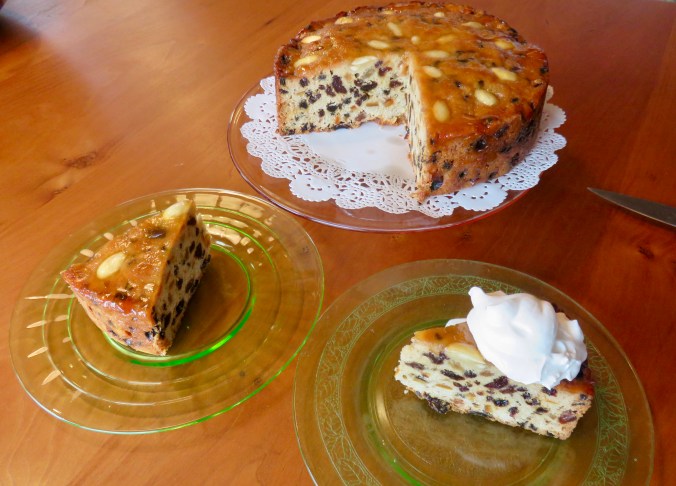
Gary loves fruitcake, even the awful gumdrop sort which I would not even use as a doorstop. I like the real thing. I made a traditional wedding cake for our wedding in 1974, a dark, aged cake from a nineteenth century recipe. This is what our family regarded as a wedding cake: fruitcake with white sugar frosting. That one was made with candied fruit from the Seattle Public Market, raisin and half orange peel punched from giant glass jars. It was a rich and aged cake, darkened with cocoa and brushed weekly with rum, but this is his favorite of all time. The Dundee cake is also made with “real” dried fruit, and a lovely golden color. Good luck aging it more than a few hours. I always use all organic ingredients.

Dundee cake

Continue reading →