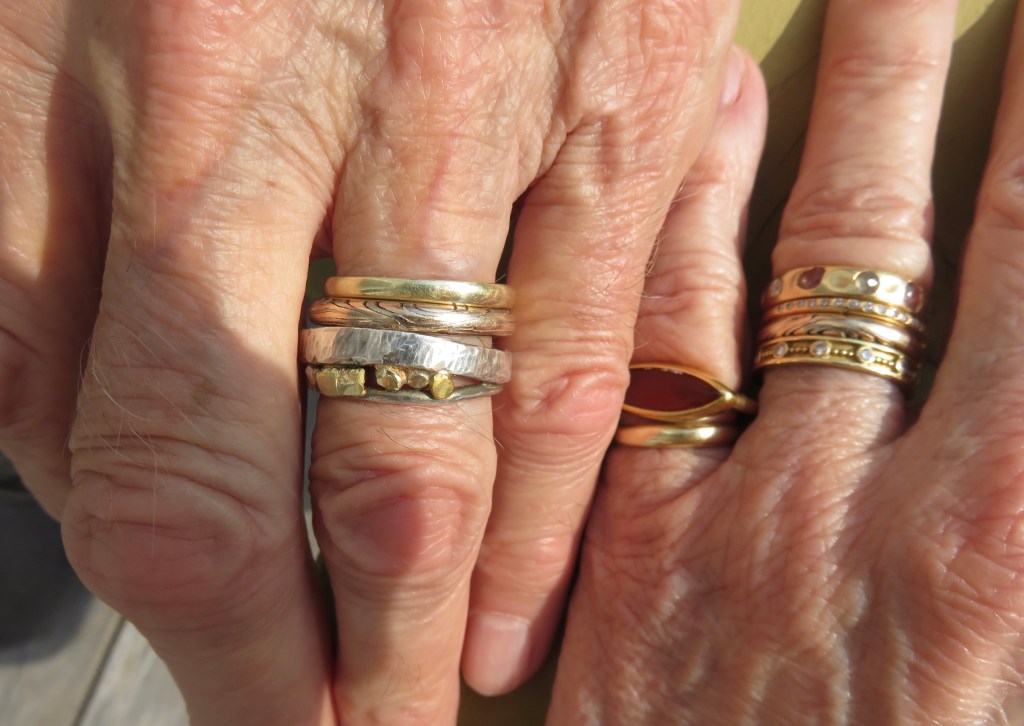
A couple of years ago, I took a class at the Portland metal studio, Ninety-Twenty. I wanted to recreate a sterling ring I’d made for Gary while I was still in high school in the fall of 1968 or maybe 1969. At the University of Washington, I would complete two studio art degrees by 1976. When we married after Gary’s graduation in 1974, I borrowed back Gary’s sterling ring to add a gold bead for the wedding. On our wedding day, my mother accidentally flushed our rings—the two-color gold bands and his updated sterling and gold ring. (She absolutely denied doing this.) I remade the gold wedding bands the following fall but not the sterling one. I don’t remember why. Gary suggests, “Maybe we were too busy.” Gary was working full time after graduation and I was both working and in school pursuing a teaching degree, my third degree in six years.
This is not quite the story of my life, but as close as I’m likely to get.
In 1976, I completed a 5-year Bachelor of Fine Arts (BFA) degree in Ceramic Art, studying with Patti Warashina and Howard Kottler and Robert Sperry in the Fire Arts building. In 1973, I think, I moved up the hill to begin working on a second BFA in the metal shop with John Marshall, a founder of the Society of North American Goldsmiths (SNAG). I had dear friends in both programs. I graduated with Honors and Phi Beta Kappa. My credentials would be unusual as a public high school teacher in that I had degrees not only in teaching but in the fields I taught—the BFAs in studio arts and the masters in writing. In case you missed it, that is rare. Most teachers have only a teaching degree. I have that too.
After completing requirements for my third degree, a BA in K12 Education, I began teaching art at girls’ prep school east of the lake, the school Mary McCarthy attended long before. Gary entered graduate school to become an elementary teacher. He was working at Tulalip on the Puget Coast Salish language program and tutoring Native kids in Edmonds. We bought a house.
His father was diagnosed with lung cancer, as mine would some years later. His brothers and sisters looked for Gary to help them process this illness, his mother’s need for support, and he left school. After Andy died, as my own father would die, the world seemed grim, unpolished and uncertain.
My grandfather’s third wife, the weaver Genevieve, left me the family home here on the coast, the fulfillment of my mother’s best friend Joyce’s horoscope reading that I would inherit money. Mom had insisted there was no money left to inherit. The house was not worth a fortune in 1978, but it was worth far more than we could have afforded to pay. My mother was furious the house had not been left to her, but she was not close to her father and we rarely visited him when I was a girl. I was close to Genevieve later and Gary and I often drove to her to visit. Gary was close to her second husband, and that’s how the house came to me. Gen left money to one relative of her own and to each relative of her deceased first husband. She’d been married to my grandfather for over 20 years and spent the last 17 caring for him after his series of strokes in the early 1950s. She’d worked all those years to pay for upkeep and taxes and to hire care for him while she worked as a nurse, Head Nurse at Seaside Hospital, and teaching nursing in Longview.
Cash came to me, as well. We thought at first that we would purchase land well outside Seattle, room for a garden and for our Afghan Hounds to run. There was a farmhouse well north of Seattle, a holly farm east. Gen’s attorney had not planned well enough, as it turned out. The cash from her estate leftover for cash bequests all went to taxes because I wasn’t a blood relative. We still had the beach house. We talked through options and abruptly decided. We would move to Oregon in June 1979, after the end of my teaching year at Forest Ridge, and started our family, the decisions arriving simultaneously. Two children since the location is remote, with forest and shore to play on and one another to play with. I would stay home since there was no immediate opportunity for a position teaching Art in the county. Gary did not get the job working for the local water district we had counted on, but went to work in north Tillamook County at the Mohler Co-Op Store, first as counter help and stocking, then assistant manager, and then manager for many years. A lot happened during that time that steered me and scared me. It took a year for me to get pregnant. Money was tight. Our neighbors were most all in their 70s.
Raising children is one scary and exhausting role. When a friend from Fire Arts with an MFA in Ceramic Art visited after the birth of our son Alan in 1980, she asked how it felt to “have given everything up?” She meant that I’d abandoned being an artist for being a mother. I thought I was only taking a break from Art, not giving it up forever. My friend had divorced in order to avoid children and have, instead, a life in art. It never occurred to me that I had to choose only one. I served her and a sculptor friend lunch, and after they left, I cried.
Yes, it’s easier to have a creative life without the need to earn money or the commitment to a spouse or to raising children. Look at the authors whose wives managed everything from typing and editing to raising the kids and providing an income. Look at the artists who starved or married money. Children are a full time job, earning a living is a full time job, and making art is a full time job. And then there is sleeping… I sacrificed an hour of sleep each night when I began writing too. I promised myself when we decided to have children that when they were grown and out of college, I would return to grad school and earn my MFA. I thought, in the beginning that it would be a Master of Fine Art, probably in enameling.
In Marshall’s program, I’d done everything from raising a sterling cup to reticulation and casting and forging and chasing, making my own tools, enameling, etc. (I did plique-au-jour, a technique you have to be a little bit insane to pursue.) I once had credible portfolios of work in both ceramic sculpture and fine metals, though this was long ago. I thought I’d moved on but would return. An incident when I tried to start up again as an artist in metals stopped me. My enameling kiln was a graduation gift from my parents and I hadn’t touched it.
The upstairs of my grandfather’s tiny short-term rental was, for us, a longterm rental. We’d managed an apartment building during college for cheaper rent. Short term rental was my grandfather’s way of paying the bills. We wanted a full time tenant in that apartment. Rent paid our property taxes and utilities, and after our taxes doubled one year, still covered that tax. The downstairs apartment stood empty. Mom would use it later after Daddy died and while I worked on her house in Cannon Beach. I set up a studio in the kitchen of that unit, put a TV and VCR in the living room, and set back to work. I pulled out the kiln from our bedroom closet, and the Thomsen enamels, mortar and pestle, sifters, and sheet copper. I began with small pieces, tests of enamel on copper. There were techniques I’d perfected years before at the UW. Stenciling and firescale. I had already completed several 2″ squares when, removing an enameled piece from the hot kiln, my toddler son crawled under the open kiln door. I turned off the kiln, unplugged it, and carried both my boys back to the house. I never went back and gave the kiln away.
That’s how I chose quilting, which has pins and needles, but nothing close to 1350°F. Textiles are women’s work, and I honor that legacy. I also have always appreciated usefulness. “Art for Art’s Sake” was a popular slogan when I was an art student, but Art History and Anthropology classes showed me how this notion of pure Art (for its own sake) is a rather modern and elitist notion. Art has historically embodied function. Whether useful in daily life, in aiding memory, in teaching, or in service to faith, Art functioned in human society. We know this has been true for tens of thousands of years.
Antique quilts are beautiful, but they also tell a story of the maker and her life and of the people of her community and society. The Renaissance seems to have been the tipping point in Western Art, when uselessness became the point. They drew a line between decorative and “true” art. Rich people could afford to commission beautiful and useless things. They gather art for its own sake and as proof of power and success.
I would argue that humanity has always appreciated beauty. Art should not be “mere decoration” on the wall but part and parcel of our life, our values, and our reality and imagination. When we cut art from its function, we don’t make creation better, we make it superfluous. We are drawn to creation. It’s why we art.
I’ve done many things since moving to Oregon. I worked in a bakery and taught adult art classes, subbed in kindergarten through 12th grade classrooms all over the county, drove to dog shows and judged an A-Match for Salukis, served as President and on the Board for several nonprofits, canned peaches and became a better cook, designed and knit sweaters and pieced quilts, designed houses and remodels and drew for an architect, judged field trials for sighthounds all over the US and Canada, completed a teaching certificates in Social Studies and later in English K-12, taught Art and English and Yearbook, and wrote and published poems and essays and short stories and novels. Our sons grew up and went to college and married and had children. That’s where we are now.
Over the first years we lived here, many of our elderly neighbors died. We have ourselves become the elderly neighbors. As most of the houses around us have been remodeled and converted to short-term rentals, we rent both my grandfather’s apartments in order to afford the taxes. In my 70s, I looked back to a previous skill. Deciding to return to my former metalwork was intimidating. It’d signed up for classes at the old School of Arts and Craft in the west hills of Portland several times once our boys were in school, but the metal classes I wanted were always canceled, and the school had closed.
But then, I found the inheritor of that program’s tools and equipment and signed up for a “stacking ring” class. I owed Gary a ring.
I was, I’ll admit, scared witless to reenter a metal shop almost fifty years later. It was intimidating to “know” how to do things I hadn’t done in such a very long time. I felt supported by the instructor, but also felt the preference to figure things out alone. I was once very fast, but was I still strong? I was slower and hesitant.
My old tool chest was rusted only on the outside. I found metal scraps, un-cast waxes, solder and files, pliers and snips. In the Ninety-Twenty class, I made what was assigned and then on a second visit, turned to Gary’s ring. I fiddled the design just a bit, and worked from round wire—flattened and shaped—while the original had been made using sheet sterling I only filed. Making a perfectly round sterling or gold bead is simple: heat it till the metal melts and it rounds itself. Making oddly-shaped “nuggets” is trickier.
The result fits Gary’s hand. I found scrap gold from our wedding rings in a tiny envelope. I used it to create the gold organic-blobs. It is nothing like what people are making today, but very close to what I created all those years ago, and in advance of our 50th anniversary last month.
Will I return to that well-equipped shop to do more metalwork? I don’t know.
 IMPERFECT PATIENCE