cover yourself I’ve got you covered that’s a great cover you’ll need cover
June was an eventful month, and I have a few photos to prove it. My MFA residency happened in Forest Grove and I went by a few times. We both caught a cold (tested) which caused us to miss our dental appointments, but we were healthy for our yearly medical. I am eating better. So is Gary. Both of us lost a couple pounds.
It was hot in Portland, mid-90s while we were there. It was also unusually hot at the beach for a couple days, high 80s. The heat at the beach is troubling. We’ve lived here since 1979, and hitting 80° used to be an extraordinary event. We prefer the cooler temperature. This past week makes me feel things how are changing.
An elk ate apples in the garden across the street and then I ran past it twice yesterday on the beach, a rabbit grazed the yard, and the raven couple have a youngster big as them.

I approved the proofs for my novel and should have it in hand in about a month. I owe my readers and authenticity editors copies. I figured out Venmo Wednesday and while obsessing over that, my bread over-proved. Several friends on Facebook bought copies. I hope they like the book! If I sell enough, I’ll print another next year.
A former student now living overseas is coming by, maybe even tomorrow! Seattle friends are visiting for the 4th, and other friends later in the summer, we hope. I’ve been asked to serve on the board of a nonprofit, something I haven’t done in a while. I am running short distances. I promise only a ,mile (ten-minute miles!); when I feel the urge, I’ll bump my distance to 2 miles.
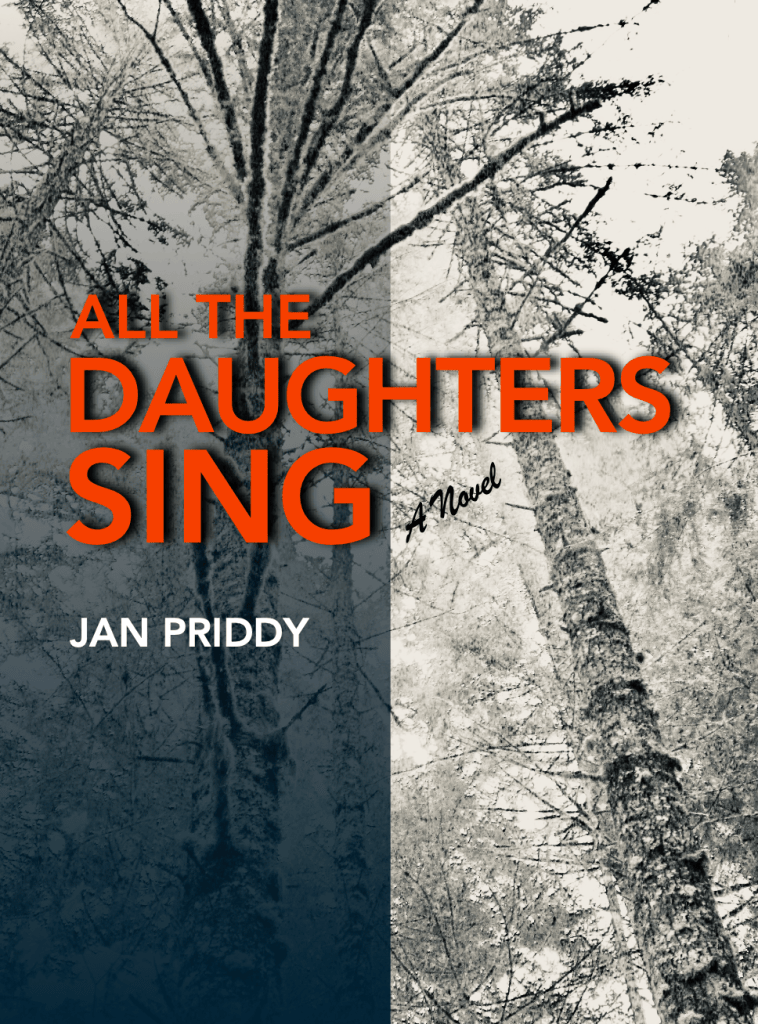
My novel will be shipped this month. I am waiting eagerly for 100 copies of ALL THE DAUGHTERS SING to arrive. I read it through twice right at the end. Found a brief pet passage had been brutally cut [by me] and put it back. Read through the proof and found another typo. I‘d butchered it specifically in order to submit to a press, and then I thought: I can’t go through this process again, not with this book. And I finally had a cover Gary and I both liked.
About the cover. I have designed covers for journals and booklets, pamphlets, and advertising. Designing pages was what 12 years of advising Yearbook was all about. I used to warn my students that if they let me sit down in front of their computer I would take over their page; they’d seen me do it. Most were careful to keep me standing while I answered questions or brainstormed a solution to an issue. Our yearbook won awards year after year—that was all the students. Original layout, folio, photos. Our captions were long and interesting. Bonus for funny. We did some crazy stuff: metal cover, a plex cover window, numbered the pages back to front for the turn of the century.
I design covers for fun. While working on DAUGHTERS, every time I met a self-imposed goal or a deadline, I rewarded myself by designing covers for the book. My laptop is stuffed with a hundred (maybe plural). I had permission to use a particular contemporary painting, but the press I first worked with put the painter off, and I’m afraid she’s still not speaking to me. Searching Wikimedia, I found art by women in the public domain. I am oddly fond of one that uses a nineteenth century French naturalist’s painting of two dead birds. Cave paintings. Landscapes. Hildegard. I experimented with my own photographs. Gary consistently preferred the cover I finally decided to use. him: “I like that one.” me: “How about this?” him: “I still like the other one.”
I judge books by their covers. I discovered poet Dorianne Laux because of a cover. I found Wicked when it was first released, A Brief History of the Dead, Black Swan Green, and Till We Have Faces. I picked them up for their covers and have spent hours admiring the faced out covers at Powell’s Book Store, more hours on Goodreads doing the same thing. In college, I found The Rite of Passage by Alexie Panshin while cruising shelves, looking for science fiction written by or displaying a woman on the cover. Somewhere I have a photograph of nine covers of that novel, most of which are hopeless, showing, for example, a blonde and green-eyed girl. On the first page the narrator introduces herself as Mia Havero, and describes dark eyes and short black hair. I used to share those silly covers with students sometimes, and offer them a strategy for deciding about a book: read the first page, check out page 135. Then decide. I won’t pick up a book with a bad cover.
The truth is that I can barely stand to hold a badly designed book. My judgement is taste, personal opinion, and preference. But sometimes the cover is just bad. I am reading a book right now that is so ugly I have to steal myself to pick it up even though I’m eager to read it, have waited years. Gary suggest I cover the cover with brown paper. Unfortunately, the interior is as bad.
On the other hand, I am still hanging on to a terrible novel because the cover is gorgeous. I’ve thought of cutting the cover and ditching the book. But books are precious artifacts to me. I regret how I struggle to annotate or otherwise make obvious that I’ve read a book. Unless I’ve bought it used or loaned it, my books look brand new. My books receive better care than I give myself.
When a well-published friend opened the proofs of my novel, he promptly complemented the interior design. “You took some time,” he said. I did.
I’ve tried, but do not enjoy audio-books. Twenty years ago, I listened to The Year of Magical Thinking, and went about crazy backing it up over and over because I am accustomed to rereading as I read—not to mention I’d have to pull over each time.
I was labeled a non-auditory learner decades ago, by myself. The only reason I took good notes during college lectures is because if I didn’t write things down I would remember nothing. I rarely read over my notes, it was the action of writing that did it for me. I’ve read ARCs [Advance Reading Copy) for reviews, and find I really dislike reading on screen. I can do it, but it wears on my eyes, and I miss the tactile experience of pages under my fingers.

I went looking for that photo of nine book covers on my computer and scrolled past thousands of photos of our grandchildren, the house and we remodeled, the beach, my weaving and quilts, landscapes and sunsets, cakes I baked for birthdays. I got distracted by my loaves of perfect sourdough and birds.
This week, 54 years ago, Gary and I moved into a tiny apartment, walking distance to the University of Washington where we were student, me in Art, him in Anthropology. We also both worked at the University Book Store, me in the music shop, him in Receiving. I have always paid attention to covers.

I just finished this brilliant debut novel and I’m confident that it will be the best novel I read this year. My last two favorite reads were nonfiction from last year. Most years I read 52-70 books—poetry, novels, short stories, and nonfiction. Some just set me spinning in a good way. This one, for example, “asks who gets to inherit tomorrow’s utopia,” a question I’ve asked myself. This novel will be released in September from Stelliform Press in Canada. That face and the leaves…
Waring’s title comes from a speech by Ursula K. Le Guin, “Hunger,” which I used to teach from her fabulous essay collection, Dancing at the Edge the World. I don’t have her book in front of me, but Le Guin begins by quoting her own translation of Neruda talking about Machu Picchu, first as a glorious building, and then asking who suffered in order to make it happen? Le Guin asks the same question and the line I always underlined is something like: “No house is worth living in that has for its cornerstone the hunger of those who built it.”
 IMPERFECT PATIENCE
I suspect that you have eidetic memory–an ability to hold onto memories visually would be one way of describing it. I was told I had this working at my first bookstore job, in my late 30s. I worked nights, sometimes with the owner. People would rush in, looking for something they’d seen held up in an author interview on TV, or reviewed in some book review. They couldn’t remember the author or title, but it was about [something generalized] “…and it had a blue cover.” If I had read the review, or had shelved the book (always drawn to interesting covers, or reading the book flaps to learn a little more about its contents), I usually knew to go to a certain aisle, a specific shelf, and sure enough, I’d find the book. This happened a few different times before I wondered out loud “How do I always know where it is?” after the the sale had been made, the customer had left, and I was alone again with the owner. She answered with two words: “Eidetic memory.” She had it as well. I wish I’d known it a lot earlier, as it explained why I seem to have a longer, more detailed memory than others in my family, and can usually find things that have been mislaid by others by saying, “the last I saw them, they were…” [ on some specific table or room]. Not to be confused with “photographic memory,” which one of my teacher’s brothers had, and could cause headaches of cognition and mental “filing” of foreground and background.
…And speaking of photographs, those different covers you collected, reminded me of people looking for books they’d read in childhood or in high school/college, and wanted to read again. They’d come into Powell’s, and NOT want the cover that had some version of the movie poster (intended to catch the eye of people who had seen the movie Before reading the book.) We always seem to want the fairy tales with the same illustrations as the ones imprinted in memory.
LikeLiked by 1 person
Thank you for all this. Yes. My counselor in Junior High told me my “visual memory” was what made French so hard for me. I managed Bs in class but it was conversational French and when I finally saw how the words were spelled I was quite literally shocked. [Don’t get me started on Welsh and Gallic.] Forgive me for skipping right to the movie covers, which I generally dislike as well. The worst movie version was Winnie the Pooh. My father read winnie the Pooh to me as a child with voices, one of the most vivid and charming memories I had of him. Yes, “had.” Disney wiped it out completely, that memory. Horrible versions of my father’s voice and his was just gone. There’s probably some odd trick of my memory that explain how the treasured voice was overwritten by the commercial film version. I think I might have cried about that.
LikeLike
OH, YES. I have some of those same feelings about how a movie (voices or casting) can differ so much from memory. It ruins the movie for me. One example is a movie that uses Vivaldi’s entire “Four Seasons” as its soundtrack, and I hated it. I refuse to associate mid-life, middle class angst experienced by couples vacationing together over the years with music that I associate with the natural world conjured by that orchestral, energetic music.
I had the same problem with Spanish that you did with French. I was taught to read & write–in both English & Spanish–when I was four years old. In high school I thought taking “conversational Spanish” would be an easy A. But we had to do homework that was repetitious writing of the same sentences, over and over. Boring! I was glib, speaking in class (the profesora was impressed with my vocabulary and ability to explain my complicated family with “mi primero padre biologicol y mi papa segundo)–forgive the spelling & lack of accents here–but I never took the time to do any of the rote homework, only passing with a lowly D.
LikeLiked by 1 person
The counselor suggested I wait till high school to take language since our local public high school still offered Latin. Reading the words aloud was weird, but I was complimented on my accent My teacher was so disappointed I didn’t do the third year, “But we’re reading Cicero!” After a year of translating the Gallic Wars, I was done and I was mostly lazy my senior year.
LikeLike
You were lucky to be able to take Latin in high school! I wanted to take it (not for any academic aspirations, but because poets & writers I admired had it in their wheelhouse from older decades of required study.) My particular high school offered Japanese and other languages, but not Latin. I was all over the map during my senior year, so I understand the “laziness.” I did “gen ed” classes, only focused on graduating at 17, and afternoons that year as an Intern-for-credit (two classes, all afternoon every day) working in a pilot program as a teacher’s aide in the same grammar school I’d attended. My counselor advised SFV state college, but I couldn’t afford it, and had already skipped classes to go there to hear Bobby Kennedy speak, and attend “Teach Ins” about the war in Vietnam. I considered it “high school with ash trays & parties.” Then a friend advised community college, which was free, and would take me with a 2.1 GPA. That’s when I learned the significance of one’s GPA, transcripts, using office hours & tutors, withdrawing instead of dropping out, etc. The beginning of my education in earnest. I also want to say (again) that I appreciate being able to write to you (in email or in response to your Blog), because I’m “meeting” memoirists (as guest speakers) in a summer workshop I’m taking, whose blogs I’m reading, and I’m unable to respond with a comment unless I’m a paying subscriber. I understand “supporting” other writers (especially women writers), but I also have to shell out close to $9,000 for having my teeth fixed (having a permanent bridge installed.) So taking the workshop was an expense, and the guest speakers are a great “bonus.” But money is tight! Suddenly I feel as if the opportunity for an ongoing “conversation” with other writers requires that I “pay” for it, or join other screen platforms (Instagram, etc), which takes away from writing time. I’m seeing this more often with publishing, contests, and promoting one’s work. I may have to “pay” to post a review copy of Janice’s book to a women’s online platform. Nothing is free! It reminds me of the closing lines in an early Joni Mitchell song: “…Another man reached out his handAnother hand reached out for moreAnd I filled it full of silverAnd I left the fingers countingAnd the sky goes on forever without meter maids and peace paradesYou feed it all your woesThe ghostly garden grows”
[from “Nathan L Franeer” in Song to a Seagull] Hugs,~mimi
LikeLiked by 1 person
“Song to a Seagull” was what I sang while I was in labor, for three days with my first.
It is a struggle to balance broad participation with personally meaningful action. More than 25 years ago, I deliberately cut my sleep schedule from 8 hours/night to 7 hours of sleep/night. There were not enough hours in the day to be mother, wife, teacher, and writer. [Now I struggle to regain that old sleep habit!]
It’s a familiar quandary that you mention expenses. Those paid sites make me delete, delete, delete. I totally get that experience of people assuming I can afford things I cannot possibly afford. Just this morning I commented to a writer-friend that I felt sometimes people think I have money, which is untrue and embarrassing because I am proud of my humble background. When I was young and first noticed how people assumed that I could afford what they could, I assumed it was my diction, which was once quite good. Maybe now it’s because of our beach house, which I could barely have afforded to purchase when I inherited it and would not now be able to buy. It’s a family place I swore never to sell—with what it’s worth now there are many things I could do if I sold it, but I promised never to do that, and I try to keep my promises.
LikeLike
You didn’t say what you thought of the cover of The Hunger of Those Who Built It. It’s not a cover that would make me pick up the book and read the first page.
LikeLiked by 1 person
Nor would I. I trusted the press which has published several excellent books I’ve read including a Le Guin winner. I don’t think it’s an ugly cover but not the least compelling to me either. You’d have to trust me on this one. The significance of social clues, nationality, and status is disturbing in its accuracy, and that’s another reason I loved this book. I feel the author nailed how a person with an impoverished background negotiates the world of the rich and entitled. She’s quite aware of her vulnerability, something I’ve experienced though only late in life have I figured out what was happening in some social situations. [I tried to read another book so badly designed that I had to put white paper over the cover and even then the interior is bad too—]
LikeLike
le quatorze juillet is just an ooze away
I hope we make it to and thru
cause so far its no good
and as the Temps said
the band played on
LikeLiked by 2 people
How can we blog readers purchase your book?
LikeLiked by 1 person
You can find more information about the novel and ordering it on the DAUGHTERS page shown in the menu bar.
ALL THE DAUGHTERS SING will be released August 2026, in a limited edition of 100 copies. There have been 31 copies of 100 preordered and promised as of 2 July 2026.
To preorder, send your address, $20.00 + $5 for US shipping to Jan Priddy, P.O. Box 1442, Cannon Beach, OR 97110. You may pay via check or use Venmo (3124 is the other number you might need). Outside the U.S., please email me for a shipping estimate: andpride@gmail.com
LikeLiked by 1 person