I understand from reviews that at least some readers and professional reviewers are relieved that Sue Prideaux in her new biography, Wild Thing, exonerates Gauguin’s egregious sexual relationships with girls and women because the times were different. How nice. [The French, among others, have long struggled to recognize sexual exploitation of female children, not to mention adults, but there has never been a time when misogyny and outright cruelty were not objectionable to those who suffered. It’s one thing to acknowledge that bigotry such as antisemitism and racism and sexism were tolerated and even encouraged by those in power; it’s quite another to insist that these attitudes and transgressions went unnoticed, that such bigotry was somehow rendered benign because a few declared it was.]
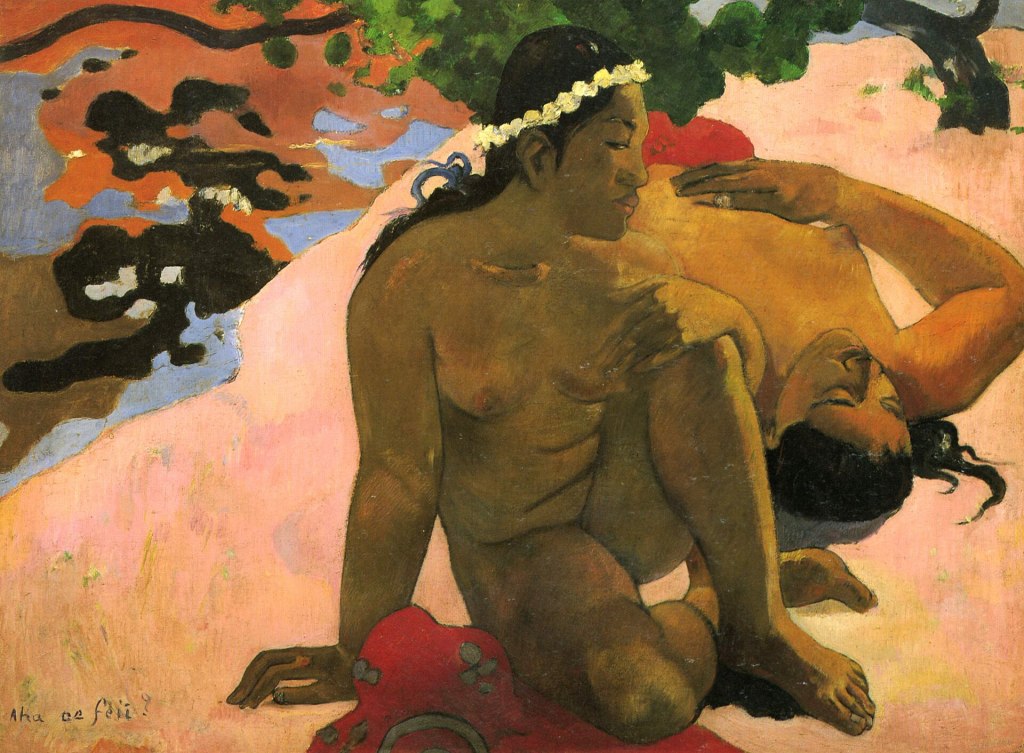
In Gauguin’s day, The age of consent in France was 13, which does not make the relationships he had moral by the standards of that day or this. (It’s still only 14 years in France, and force or coercion must be proven to prosecute for raping a 15 year old.) Gauguin’s Tahitian “wife” bore him children. This makes some people a “little uncomfortable”? Tehura was 13 and Gauguin was already past 44 when he took her and began fathering her children. He repeatedly abandoned girls such as Tehura and women and the many children he fathered—when would this be considered acceptable behavior? As Gauguin approached the age of 50, he was briefly back in Paris with a teenaged girl on his arm.
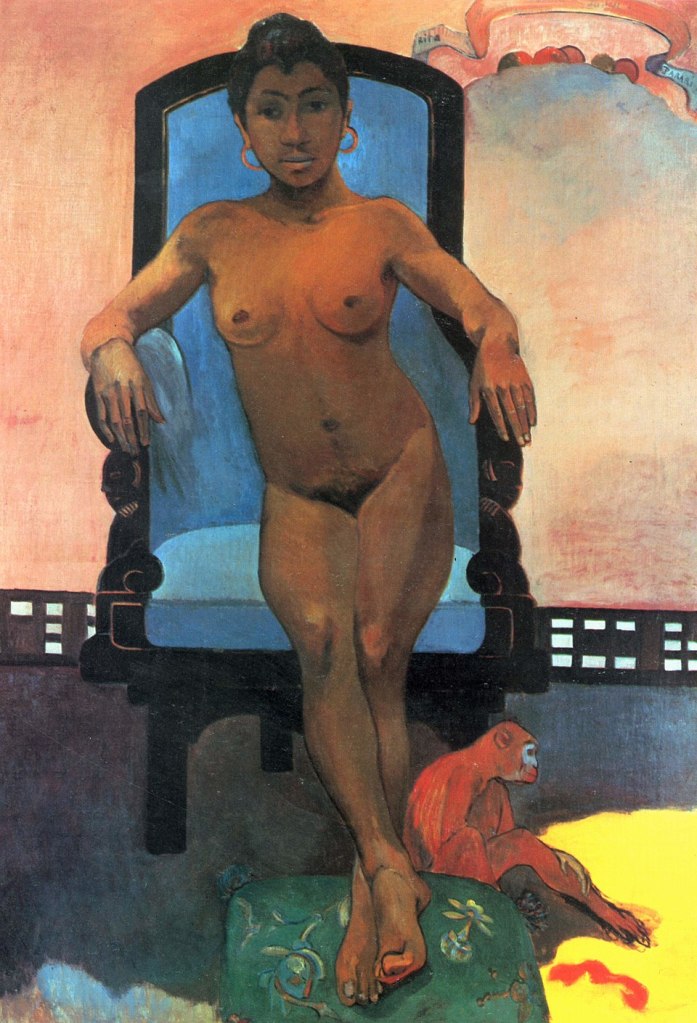
Paul Gauguin, Annah the Javanese, or The Child-woman Judith Is Not Yet Breached (1893)*
The title of this painting? The monkey at her feet? Perhaps it’s worth mentioning that in nearly every painting of a French person I have ever seen, Gauguin’s models are clothed. His brown models are sometimes clothed, more often not.
.
For the record, pedophilia has nothing to do with the age of consent; it is sexual feelings of an adult directed towards children. Overt sexual acts directed toward children. A person of 13 is a child. I hope we can all agree that adults exploiting children is wrong.
Gauguin’s illness and relationships beg the question whether his Danish wife Mette-Sophie Gad had troubling reasons for leaving her husband, beyond his failure to support her and their five children?
When Jerry Lee Lewis married his 13 year old cousin, she too, was over the age of consent. Americans did not approve, and he had to cancel a performance tour. He did nothing illegal, but his audience was rightly troubled. Thirteen is still the age of consent in many US states. Very young girl children are allowed to marry with parental consent. I have to wonder: Why?
Plenty of terrible things have been legal in the past and some remain legal. That doesn’t make them right or excusable. It doesn’t mean that thoughtful people fail to recognize they are wrong. It means that insensitive and cruel people do not mind exploiting others. It means they did what was convenient or profitable to themselves and set aside the inconvenient necessity of making a moral choice. They made excuses, they shrugged and did not care if others suffered. Slavery comes to mind. Beating a child bloody. Child marriage.

Does Tohotaua seem comfortable posing?
Further, there is still argument about whether Gauguin passed syphilis around to many women—Europeans did. That he was not treated with mercury for the disease is no proof either way. There was no safe cure at the time, and the oft-prescribed mercury “cure” was know to cause horrific side effects including insanity. Gauguin had personal experience and considerable personal antipathy toward mental illness. He was quite ill in his last few years and died at 54 in middle age.
Some people get a free pass for their ugly behavior, some are saddled with mythology that enhances their reputation or distorts the reality of their lives. Much of what is popularly believed about his contemporary, Vincent van Gogh, for example, is questionable. There is little doubt that van Gogh suffered from both his own troubles and the mythologizing of his contemporaries. Gauguin’s treatment of van Gogh was at best unkind, at worst deplorable, though in Gauguin’s version of the story he makes of himself a hero. [I was distressed when I looked up the stories of the relationship between these painters. Gauguin was aided by van Gogh, but refused to return the favor, turning his back on a friend when their relationship was no longer useful to him.]
I love Gauguin’s paintings, have loved them all my life, but then I went to art school. He was a vile, selfish human being. And his paintings are beautiful. Both can be true.
My parents had a print of this painting in the hall when I was young. I thought it beautiful. I still do.
Paul Gauguin, Nafea Faa Ipoipo? (When Will You Marry?) 1892, oil on canvas

- Images from Wikimedia are in the public domain
- Prideaux is a name my father believed was connected to his family, that our name Priddy may have derived from Prideaux. My genetic ancestry suggests it is possible.
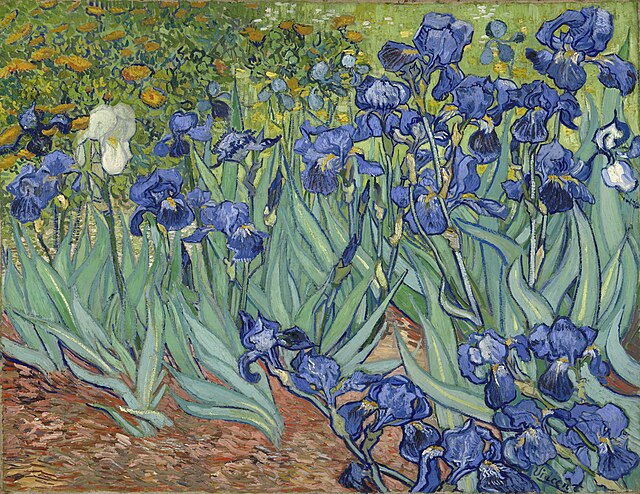
Vincent van Gogh, Irises (1889)
 IMPERFECT PATIENCE
I have always loved his paintings. One of his portraits reminded me of my sister Teri. Woman is fully clothed. You are right two things can be true at the same time.
LikeLiked by 1 person
probably while everyone was concentrating on how wonderful his sketches were , he was behind the curtain doing jimmy Savile jeffery Epstein moanings and thinking this must be ok because I’m getting away with this and god hasn’t struck me down yet
and was only able to exploit the vulnerable because of his entitled male privilege. what a sicky! and this brings us to our current caca-in chief…,
LikeLiked by 1 person
Can you suggest a good biograpy of Vincent van Gogh? And I agree, Gauguin’s behavior toward young woman was immoral and disgusting.
LikeLiked by 1 person
I should be able to recommend a good bio for van Gogh, but I haven’t read a full bio. We studied him in Art History classes, a documentary, articles… I suspect that some of his messy reputation (the ear, mentally ill, etc.) is at least partially inaccurate. Have I read a good bio? I don’t think I have. This one has his own letters with biography added to contextualize his writings: The Letters of Vincent van Gogh, by Vincent van Gogh, Ronald de Leeuw (Editor), Arnold J. Pomerans (Translator)
LikeLike
So here’s something I struggle with: Gauguin’s paintings are beautiful, but he was a vile excuse for a human being. Both are true, as you say, but does knowing that Gauguin was vile make his paintings less beautiful in your eyes? I’m asking because I struggle with continuing to appreciate the work of once-favorite writers and musicians when I learn that they are not the nice people I thought they were. Admittedly, I’m thinking of artists who haven’t behaved as badly as Gauguin, only that they shared unpopular views. For example, they make statements against COVID vaccines. I find it difficult to separate the artist from the individual. So, I have several CDs of Eric Clapton’s work but after he started spouting off against vaccines, I haven’t been able to comfortably listen to his music. Maybe I should blame social media 😉 I was clueless about his social views until I read about them on … what was it called? … Twitter. Still, while I understand that Clapton has a “right” to express his opinion, the undermining of vital public health effort disturbed me. Like I said, I haven’t been able to listen to those CDs since.
LikeLiked by 1 person
Consider this: During the McCarthy Red-Scare Era, “suspected communists” were black balled, unable to work, and their art [writing, visual, musical] ripped from curriculum and public view. It is why the New Criticism was created, to allow an audience to appreciate the creative work without accepting the creator. To argue that it is not the person that we admire, but the creation and that creation stands apart from the creator.
That said, yes, I often have the same struggle. I can admire the beautiful landscape and fishing scenes in MacClean’s A River Runs Through It, and that stunning last page that he reads in a voice-over in the film. At the same time, he was a racist, sexist, and capable of simultaneous and blinding guilt and denial.
Once in a while I feel vindicated. Cormac McCarthy is a powerful author, but I always felt he treated women characters (when there were any) barely as objects. Looking at recent revelations concerning his personal life, I can see that literary indifference for the real-world cruelty he lived. I had already stopped reading his work by then.
I often hear egregious behavior and written scenes excused as “of their time.” But treating people decently isn’t a recent moral code, and we have always had people speaking out against every evil in our society. It’s not as if someone woke up yesterday and announced for the first time in history that gender equity is only fair and right.
As to Clapton. My husband feels something close to what you are describing. He has stories. Van Morrison has similar views. But there are plenty of despicable musicians and other creatives he or I could name. (Famous painters are not the only guilty group.) Money and fame and power are dangerous to the soul. Certainty about ones own genius serves success but does not serve humility, that rare virtue.
LikeLiked by 1 person
This is it: “treating people decently isn’t a recent moral code.” New Criticism was still the preferred approach when I was an older undergrad, but when I went to grad school, things were shifting. I remember when I had a draft book review workshopped. I had written it in the preferred third-person, omniscient narrative, but my group said it was boring, that they wanted to know that I—the writer—thought of the book. I was devastated at first (boring????) and then completely rewrote the review which was eventually published. So … that was satisfying. Still, that desire to “know” the writer has made it difficult since to separate the writer from her work. I guess I just have to live with my dimmed view of some authors and musicians I had once loved 🙂
LikeLiked by 1 person
Ouch. I was taught to write lit crit that way in high school, too. Objective, unemotional, academic. However, my first term at the University of Washington in fall 1970, I was required to take an English class. I was a studio art major and working my way through and I resented the requirement. Halfterm there was an essay due. I was writing about Huck Finn, I think, and just thought, what the heck, I wrote a “voicey” piece in first person because I loved Twain. When the instructor handed it back to me, she explained my good fortune as they had been informed in her department that summer to allow first person essays or I would have failed.
Twain wasn’t perfect either. I can forgive a great deal from the authors I love. In literature, I haven’t had many writers ruined. I will add that I took only four undergraduate English classes at the UW in the early 1970s, that first one wasn’t great but was the best of them. Two of them were awful, and the fourth I can’t even recall. I took graduate level English classes in the 1990s at Portland State and had the opposite experience—wonderful teachers, every one.
LikeLiked by 1 person
Wow, glad you had good timing with that essay! Failing it because you wrote a first-person essay seems a bit extreme. I always enjoyed taking literature classes, often wondering if there was any way I could earn a living by reading and writing. My professors thought that meant an academic career. Ah, no. I wasn’t that good of a student. I got good grades but I struggled with requirements. And professors were so different. One professor at San Francisco State kept giving me middling grades because he felt I paraphrased too much; another SFSU professor gave me the honor of being his “student of the semester” because of an essay I wrote on Emily Dickinson.
Interestingly, at San Francisco State, I read a ton of Shakespeare for my BA, including a semester-long class. No disrespect to Shakespeare but 🙄 San Francisco State was considered a “lesser” university compared to Berkeley; yet, the curriculum for my MA at Florida State University practically mirrored that for my BA.
If I could go back … San Francisco State offered a BA in World Literature. That would have been fun. As it was, I spent about four years reading the same works over and over.
LikeLiked by 1 person
She was a kind prof. I suspect she would have handed it back and had me revise.
Your educational journey in English sounds much better than mine. I had terrific Anthro classes (except PhysAnthro), great Architecture History classes, including a series I had to be signed into because it wasn’t my major. My best luck was in the Art Department where I spent most of my time. There were maybe fewer that a dozen big names in Ceramics at the time and I studied with three of them at the UW. In Metals I was also fortunate with John Marshall. Hazel Koenig for Design, Richard Proctor… It was a powerhouse school. A great Law class. Botany was wonderful. In English, not so much.
The most likely way to make a living with writing, from my observations, is nonfiction. Creating documents, instructions, press releases, etc. for corporate America pays well.
LikeLiked by 1 person
I’m not looking to make a living off my writing now. Well, not unless my Social Security is taken away from me. Yeah, I had a solid English foundation, but then I went into public health. 🤷🏼♀️
LikeLiked by 1 person
Yes, we’re all a bit worried about Social Security.
LikeLiked by 1 person
My husband insists I recommend Blues Breakers with Eric Clapton. It was recommended to him by an Icelandic friend in 1966. You probably already have it.
LikeLiked by 1 person
No, I don’t have it so thanks for the recommendation.
LikeLiked by 1 person
My husband reports that Clapton had severe, and extremely rare, but terrifying reactions to the Covid vaccine. He was afraid for days (the first time) and weeks (the booster) that he would never play again. And then he was fine. My husband forgave him, but later (without boosters) Clapton was down for months after getting Covid itself. My sister-in-law opposes vaccination because her younger son was one of the rare few who suffered a (brief) reaction to childhood immunizations. She also blames vaccination for her son’s autism. And that is pure nonsense.
Both my husband and I are old enough to remember the devastation caused by those childhood diseases before vaccination. I knew a girl had been overseas when the polio vaccine came out and, unprotected, contracted that disease. She’d had seventeen surgeries by the time we were teens, and still needed metal braces to stand and walk, painfully.
LikeLiked by 1 person
Yeah, there’s so much misinformation out there about vaccines. The thing about public health is that when it works, people think we don’t need it. Like refusing to get a measles vaccine because nobody gets measles anymore … until now. Folks refuse to understand that the viruses are still out there.
I know people who have gotten sick from COVID vaccines, but I also know people who died from COVID. I opt for the vaccine. At least it gives me a chance.
LikeLiked by 1 person
I definitely fall on the side of opinions about the author affecting my choices. I can think of a few who have not aged well. A) There are so many options out there, I’ll just go read something else. B) I have been accused of being black & white in my thinking. Once or twice.
LikeLiked by 1 person
There is always something wonderful but untainted to read instead. I was a student and a teacher and sometimes the choice was not mine.
LikeLike