This morning, I read a column, “Dividing assets in your will can split siblings. Here’s how.” at The Washington Post, about the damage that can result when a parent favors some child or children over others or cuts a child from their will, especially without explanation. Aside from permanent rifts that can result between siblings, there is also the lingering unresolved hurt. A comment from an attorney reports that his experience is that giving more to dysfunctional [addicted, mentally ill] children is common. However unrealistic, many parents hope to equalize situations that are out of their control by gifting one child more than the other in life or in their wills. Some felt permanently injured by fathers who seemed to have abandoned them in favor of a second family. Some inheritors in control have corrected an imbalance as best they could. There were a lot of issues.
I could relate.
My mother was deeply hurt that her mother left everything in the control of her step-father, who tried to be fair by sharing assets with Mom and her sister, but this never was enough for her. When her estranged father died, he too, had left everything to his third wife who had cared for him for the seventeen years after a series of strokes left him initially bedridden.
When that step-mother died, she left the beach house to me but only money to my brother and Mom and my aunt, this resulted in another rift. My step-mother started me weaving as little girl, I visited often, and later we traveled across the country together. Her second husband [who loved Gary] urged her not to divide her estate evenly between her relatives and her first husband’s, but to give the house to me, so that “She and Gary will move here and raise a family.” [It’s what we did.] She divided the money between one of her relatives and her first husband’s relative. But since I got the house and my brother got only money, Mom was furious. She promptly gave my brother thousands of dollars she’d inherited to partially redress that imbalance.
My mother was meticulous about giving exactly the same to my brother and me. If she bought me a dishwasher that she insisted I needed, she gave the same amount of money she’d spent on me to my brother. We spent a lot of time together and Mom loved to shop, and often offering to buy things for me. I often declined her offered gift even before I understood my brother would receive a check to keep things even.
Her estate was split evenly between us. There are reasons this might be viewed as unfair—he had no children and I had two, he was not the one who talked to her every day but once a month or less often [I was not the one who made her cry], I was the one who designed her house and oversaw the building and ordered and tiled her bathroom and kitchen backsplash, Gary the one who stopped by on his way to work and made her coffee in the mornings, and we were the ones who rearranged her furniture and moved her in and out of assisted living four times, we and her grandsons cleared her home after it was sold. He was not the one who looked after her at the end. That was me and my husband. He gave her a second-hand computer and set it up twice, and he drank and used drugs and refused to visit more often. I had her company and affection first hand and he chose not to be around. Even so, I didn’t expect more, and my brother did. Before we emptied her house after it sold when she accepted she couldn’t live alone, I gave him first pick of her possessions when she moved to assisted living that last time. He also had his first choice of her estate after she died. He still shouted he’d been cheated.
Never mind. I did what she wanted. Mom thanked me for that in the last days of her life: “You always did what I asked even when I know you didn’t approve.” We both laughed about that. I held her hand.
I have followed her model. We have tried to split our attention and funds between our sons. Most of what my mother left me went to them. Our sons will inherit equally. One of them calls almost every day, but he has a special needs child and a wife who has discovered they is queer. The other was the one who moved our furniture and set up our phones, who is there when we need him to do what needed doing. They each do what they can. We love them both differently; we love them both the same.
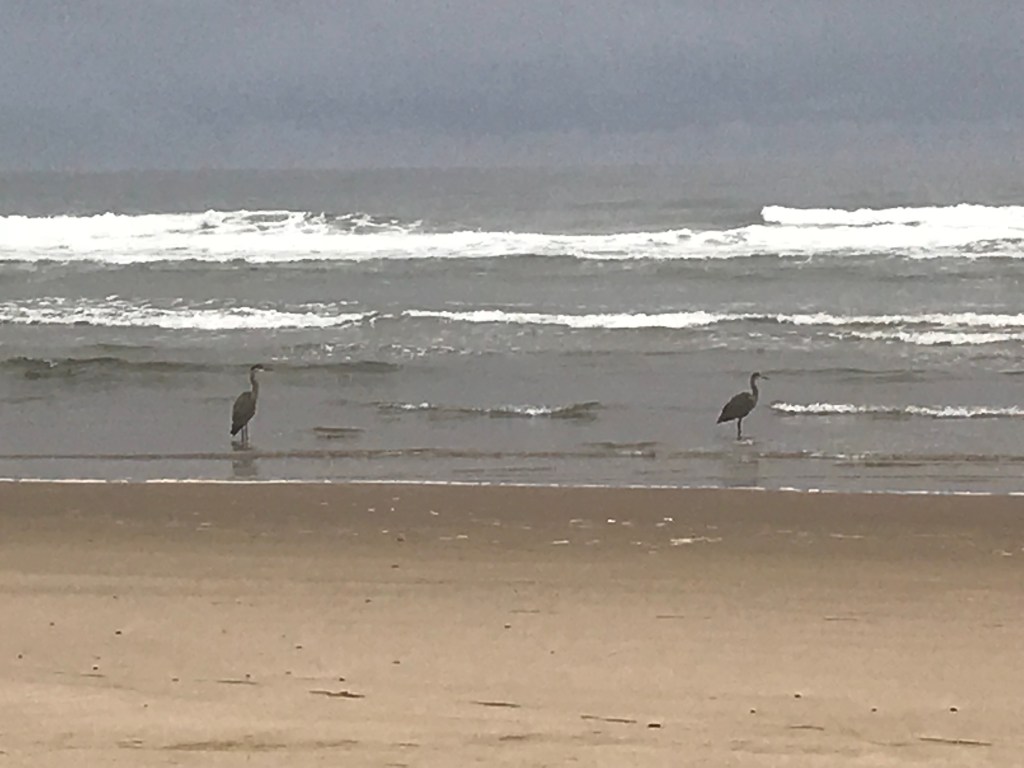
Some days when we look out at our shoreline on the coast at dozens of tourists lighting fires on a windy day or playing volleyball or teasing gulls to get the photo they want, and we wonder why we still live here. Other times, early in the morning or in the drizzle in what my mother called “beach weather” under gray skies, when the beach is empty except of locals we know, we remember why. It is the most beautiful place in the world to me.
My husband and I expected our grandchildren might spend entire summers here the way my mother and her sister did. The way I would have been colas to do as a child. I imagined slumber parties in the Cat Room designed with that in mind, kids hiking the logging trails to the east, and playing in tide pools on shore. Maybe boogie-boarding or surfing. We thought our grandchildren would find a home on this shore in the way their fathers had. That hasn’t happened. They are here for a couple of days and then eager to return to real life in the city. They don’t seem to feel the attachment to the beach we hoped for and even expected—the connection I always felt as a child and teenager and adult even before living here. It’s taken us a while to see this familiarity with the coast on the part of our grandchildren will never will happen, and accepting this has been the greatest challenge for me personally as I age.
Our adult children and grandchildren have lives of their own choosing. We can suggest and point to opportunities, we can assist and offer options, but we can’t force a direction. We don’t get to live others’ lives for them or to choose their paths. That was never our job as parents. I am reminded. Each of us gets to make our own way. We love all three grandchildren and hope they have beautiful and meaningful futures, even if those futures never include daily walks on this shore. They are interesting people, all three of them, and they have a future of choosing because they are loved. We are grateful for that.
 IMPERFECT PATIENCE
These situations are always so tricky.
LikeLiked by 1 person
Mom’s rules were clear and as fair as she could make them. It worked well enough for me that I will follow her lead.
LikeLike
as Ringo sang ya gotta pay yer dues if you wanna sing the blues and ya know it don’t come easy—love is work but worth it because in the end it is what matters—the interesting paths taken or not to get to the here makes the ears ring with the sweet sound once heard connects us to the great mystery—as the Roma say we enter into life with an empty hand and that’s how we leave
LikeLiked by 1 person