I am reading poetry by Danusha Laméris. The first volume chosen by Naomi Shihab Nye, The Moons of August and her second Bonfire Opera. I ordered these chapbooks after reading one of Lameris’s poems, “Incha’Allah.”
I don't know when it slipped into my speech
that soft word meaning "if God wills it."
Incha'Allah I will see you next summer.
The baby will come in spring, Incha'Allah.
Incha'Allah this year we will have enough rain.
Dorianne Laux calls out “language clear as water and rich as blood.” Naomi Shihab Nye, who chose this collection for the Autumn House Poetry Prize, writes: “Damusha Laméris writes with definitive, savoring power—in perfectly weighted lines and scenes. Here is the tragedy of loss and grief, and the gorgeous and fearless determination to find glory in survival.”
I met Naomi Nye at The Flight of the Mind, many years ago now. I woke at 5:30am every morning I slept away from home in those days. (I was writing fiction that summer with Charlotte Watson Sherman.) I warned the other women who shared my room on the McKenzie River, “I wake early but I will carry myself out of the room as silently as I can.” They sucked a breath. But then the other women were all in Naomi’s class and at their first meeting she told them how she rose before her chickens to write poems. That evening they looked to me, “How early did you say you woke? Will you waken us?”
[Naomi Shihab Nye would not remember me, but she read my favorite of her poems, “Jerusalem,” and spoke to me after my reading on another evening. I will always remember her.]
Jerusalem
        by Naomi Shihab Nye

        “Let’s be the same wound if we must bleed.
         Let’s fight side by side, even if the enemy
         is ourselves: I am yours, you are mine.”
                        —Tommy Olofsson, Sweden

I’m not interested in
who suffered the most.
I’m interested in
people getting over it.

Once when my father was a boy
a stone hit him on the head.
Hair would never grow there.
Our fingers found the tender spot
and its riddle: the boy who has fallen
stands up. A bucket of pears
in his mother’s doorway welcomes him home.
The pears are not crying.
Later his friend who threw the stone
says he was aiming at a bird.
And my father starts growing wings.

Each carries a tender spot:
something our lives forgot to give us.
A man builds a house and says,
“I am native now.”
A woman speaks to a tree in place
of her son. And olives come.
A child’s poem says,
“I don’t like wars,
they end up with monuments.”
He’s painting a bird with wings
wide enough to cover two roofs at once.

Why are we so monumentally slow?
Soldiers stalk a pharmacy:
big guns, little pills.
If you tilt your head just slightly
it’s ridiculous.

There’s a place in my brain
where hate won’t grow.
I touch its riddle: wind, and seeds.
Something pokes us as we sleep.

It’s late but everything comes next.

Naomi Shihab Nye, “Jerusalem” from Red Suitcase. Copyright © 1994 by Naomi Shihab Nye. Reprinted here without permission.
Then today, I read “The Bedouin Dress” by Danusha Laméris. [I typed “song” in the next sentence, but I mean poem but it is a song.] The song is about loss, about how we hold on to what is only memory, how we guess at others’ sorrow and memory, how our lives are joined sometimes by the objects we hold and treasure even when they are gone from us.
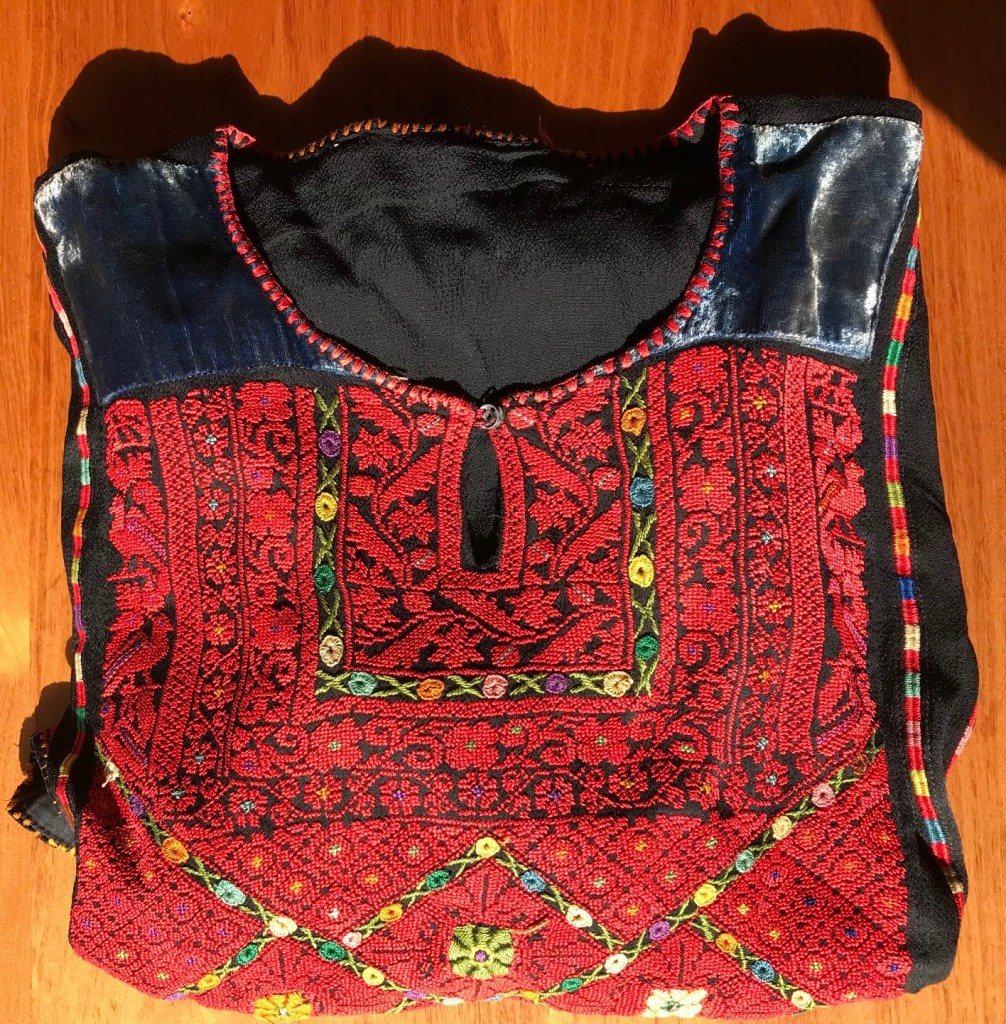
I was married in a Bedouin dress in 1974 to man who did not go. I purchased the dress from a marvelous shop that doesn’t exist anymore in the University District of Seattle, La Tienda, where I worked for a few days until the owner realized I didn’t know how to dress a window. But I was there when the Bedouin dresses were unpacked, all black with red stitches across the chest fronts, in vertical bands, around the neck and sleeves and hem, to keep out evil. The one I liked had blue velvet on the shoulders and birds in the embroidery. The shop owner liked it best too, but she was tall and I am small and so I had it for my wedding that summer fifty years ago.
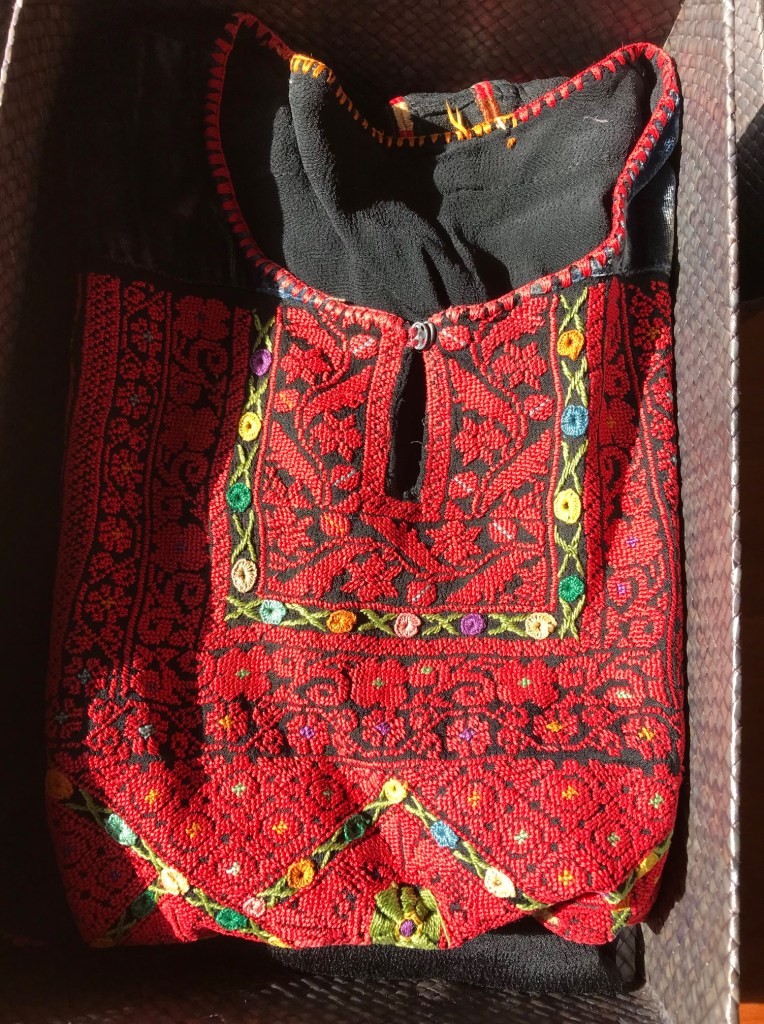
In the Laméris poem, her mother’s Bedouin dress hung on a hanger in a closet in a house that burned to the ground. But for most of fifty years, mine has lived in a woven blue box.
It was an old dress fifty years ago, “old” in the way your grandmother’s empty perfume bottle is old: well made, beautiful, precious. It had been remade several times, the breast embroidery panel specifically carried over from an older dress onto the one I wore.
My father kept his uniform, was proud of his service in WW2 but didn’t tell war stories. He told about K-rations, about hanging his gas mask on the back of a jeep, about the Lennon Sisters singing when he finally arrived home instead of staying on to study in France.
On this day 55 years ago, Gary’s dad dropped him at the induction center on Magnolia in Seattle. It was a Thursday, and Blood, Sweat and Tears were singing Laura Nyro’s song “And When I Die” on the radio. [We would later see her in concert in Seattle. She was a miracle.] Gary took his draft physical and was classified 1Y (later reclassified to 4F). He walked out of the building and kissed the sidewalk. He called a friend from a pay phone and walked downtown with a handful of others who had been processed together. It is a day he celebrates every year.
When I told this story on Facebook today, men told their own stories of the draft, of parents who had served but did not support that war.
I cannot imagine Gary in the military. He should have been a conscientious objector or he might have declared himself gay or lost another thirty pounds—we knew people who did those things. Instead, he showed up and went through the physical and was spared. It was a terrible, ugly war, more terrible but as ugly as any. War is humanity’s ugliest invention—man’s most brutal and irrational invention. We have friends who never recovered from Vietnam—certainly many more Vietnamese never recovered. My father served in WW2 in France and Germany (his unit was the first to liberate a German concentration camp from the west—he would not talk about that), and in some ways he never recovered. When my school used to do a Veterans Day event with workshops, the men who came and spoke in glowing terms about their service had never been anyplace more dangerous than Germany in the 1970s. One man who had volunteered and served in the Middle East during the Gulf War shook his head. He said his experience was different, and he could not recommend the military to anyone. I am always conflicted about thanking military personnel for service. Most of my former students never saw action, including one in a military band who traveled all over the world performing. One was raped by men in her unit. Some died, and I grieve for them. Some came home and must live with experiences no one should have to remember.
But I am luckier. To pretend otherwise would disrespect others’ sorrow.
I still have my wedding dress kept safely in a pandan box. The box shows its age but the dress survives. It might have been lost in our move to Oregon in 1979, might have drowned in 1984 when we remodeled our house and it rained without a roof, might have become the victim of mice. It lives and so do I. My greatest suffering was childbirth and I got a lovely gift at the end of my hours and days of labor. [Three and a half days for the first, twelve hours for the second.]
We each hope for a good life, for the blessings of healthy children, safe loved ones, a future. Meaningful work. Rest. Joy. We all find some sadness because no one escapes tragedy, deaths of loved ones, disappointment. It’s only how we trudge along in faith and trust the good will come.
Incha’Allah I will see you next summer.
 IMPERFECT PATIENCE
Jingle bells, mortar shells,
Viet Cong on the run.
Oh what fun it is to spend Christmas Day in Viet Nam!
Learned this from my ex husband who spent his time in the Marines. He never recovered.
I would love to read everything that you have written.
LikeLiked by 1 person
Thank you, Mary Jo. I honestly don’t think anyone recovers.
I will update about my novel, as it goes along. The press demands the right to rename, have final say on the cover, etc. This is standard in publishing, but a little scary for me.
LikeLike
well here we are another D-day
80 years have passed
and what have we become?
where are we now and where are we going?
our ears are ringing with the questions
that should have answers
to take us forward not backward
killing for peace is not working
imagine is shining hope
like a lemon tree surviving in the desert
LikeLiked by 2 people