A writer I know recently asked for opinions about sharing writing in public or with the public. It’s wonderful that writers share work. It’s extraordinarily helpful to have feedback and to use that to encourage further work in revision or something new. Pure glory to have our work well-received.
My thoughts about sharing drafts begin with the goal, which for most writers is to improve our writing. I hope that’s the goal. We need an objective reader or listener to help us locate weakness and strength and to ensure the writing is accomplishing the work we hope it is accomplishing. Most of us hope for praise, but if that’s all a writer is looking for, the rest of what I have to say will not be helpful.
What these was really about was sharing work in draft form, She was clear about that. She wasn’t talking about public readings sharing on a blog.
It is entirely my opinion, but having sat through formal readings of brand new work in need of work, work that was far longer than the time allowed, or that was deeply troubling either for the subject matter or for the careless manner it was shared—writers must have consideration for their audience. The writer is asking for help.
[My favorite abusive reading story was during the old Haystack readings. My husband still talks about the time when, after his reading, an author invited a friend up to the podium to read something he’d written the night before. This took us more than a half hour past the end time for the reading, and was so dreadful and boring that I slipped a book out of my bag and began reading. A well-published writer sitting behind me read over my shoulder! Seriously. Everyone was too polite to just get up and leave, but that was what we all wanted to do.]
NEVER share brand new work. NEVER EVER. Wait to share work that has reached the point where you are stuck in revision or hope it’s close to done, not the first (or third) draft. The purpose of reading a writing draft is to advance the work, not receive praise for our courage sharing.
- We owe it to our readers to share something we have sat with for awhile and already revised to whatever perfection we can achieve independently. Imposing a shoddy draft that might have been revised over another week (or twelve) is inconsiderate and a waste of everyone’s time.
- We owe it to ourselves to receive feedback that extends beyond the obvious stuff we’d have noticed on our own without input. We want help with what we can’t quite put our finger on, the missing detail, the leap that leaves the listener stranded, confusion or contradiction, the implication we failed to hint at (or the one we never intended).
SHARING ALOUD: Read work aloud to an audience that you have read aloud before. At least read to the dog or a mirror and you might catch issues; locate places where you stumble are begging for rethink and revision. You will time yourself so that you know how long the piece takes to read. (You will need to read more slowly than is comfortable. Your listeners cannot flip back to reread a sentence if it went by too fast to be clear). Do the work you recognize needs doing before you ask for help.
When I was teaching writing and we shared in class, students sometimes wanted to explain or apologize for a piece. My standard response was “Shut up and read.” The joke was intended to take testing out of the message: We do not want to hear about how it’s terrible [begging for compliment?] or that you wrote it last night [never ever] or whatever. Just read.
The exception: Warn your audience if the material is explicit.
SHARING PAGES: If you are sharing your work in print, you should, again, read it aloud and meticulously correct typos and misspellings, stumblings and flaws you can fix on your own. Again, do the work you recognize needs doing. Offer the best you can. If your reader finds typos you might have caught on your own, they are likely to focus on them instead of the other issues you actually need help recognizing and addressing. That’s a waste all around. Allow your readers to be helpful by preparing the best version you know how to share at that time.
The best feedback comes from a reader who has no preconceptions about the work. That happens only in the first reading, and you only have one “first reading” from someone whose opinion you value. Make the best of that opportunity.
Finally, everyone occasionally violates these rules that I mostly learned at The Flight of the Mind from publisher Ruth Gundle. All of us should try harder to respect our audience and what they can offer. We need feedback. We ensure that such sharing is as productive as it can be by bringing the best we can to the table.
 IMPERFECT PATIENCE
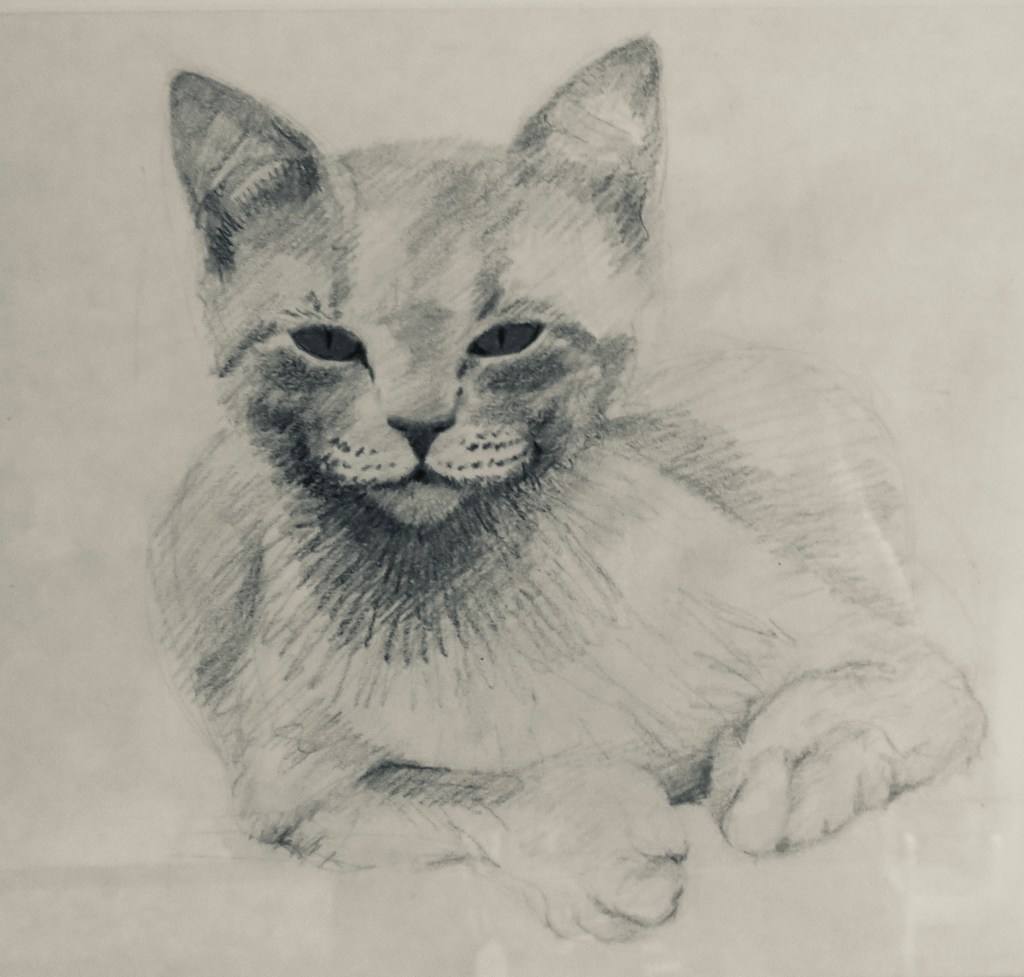
I am a reader not a writer. Still interesting though. Did you draw the cat?
LikeLiked by 1 person
Yes, that’s a pencil sketch of our cat Zora, who went over the rainbow bridge many years ago now. I took the photo though glass, so it’s a bit wobbly and you can’t tell her eyes glint. [“Shut up and show.”]
LikeLike
Gorgeous. Our Anna started coming downstairs last week! She hasn’t been down since Yuki joined us!
LikeLike
Just write the book already—is the cat in it?
LikeLiked by 1 person
You know, I have a book with a cat—there’s a very important cat the novel version of “The Promised Hour.”
LikeLike
I always get up and leave, anything, if I’m not enjoying myself. You see, I have come to realize that life is very short and my time is very valuable. Same thing with reading. If it doesn’t catch my attention and make me want to know more, then I put it aside. Love your cat sketch. It is wonderful.
LikeLiked by 1 person
Thank you! She was a “difficult” cat and lived to be nineteen.
LikeLike
Yes, I agree. A writer should make the piece the absolute best they believe it can be before bringing it to a writing group. Stephen King said he never workshops a book until he is done with the whole book and has let it sit for some time. When I workshop a short story, I’m often told, “This is so polished.” Then I get useful information on the other matters of the piece that may be problematic, which are very helpful to me. I agree that as a reader I can get distracted by a writer’s first-draft mistakes that I know will disappear in later drafts. I also know that when I write a short story chunks of the story will be cut down the road and other chunks will appear, as I decide about what makes the story move forward. So, when I’m asked to give feedback on a very rough draft, I often wonder what will be cut or what will be added. Being part of a writing group is both rewarding and frustrating.
LikeLiked by 1 person
Exactly! Thank you for this. As serious writers, we want confirmation that future work on a piece is worthwhile but are looking for responses about where that work is needed.
LikeLike
For this & related reasons, I have given up on writing classes & groups. Too much therapy, not enough story.
LikeLiked by 1 person
Ha! It takes a while to develop the thick skin capable of hearing what needs to be said. On the other side, as a reader I will say that finding typos I know I marked in a self-published book was disheartening.
I would love to find a writing group. I have tried several over the years, and yes, some focus too much on coffee and treats and comforting, not enough on story. Others fade out from lack of interest. I envy people who have continued to work for years in a small group… I always hope they will invite me in, but alas! It’s likely just me. Though I mean to be both fair and kind, I think I must be very difficult to get along with.
LikeLike