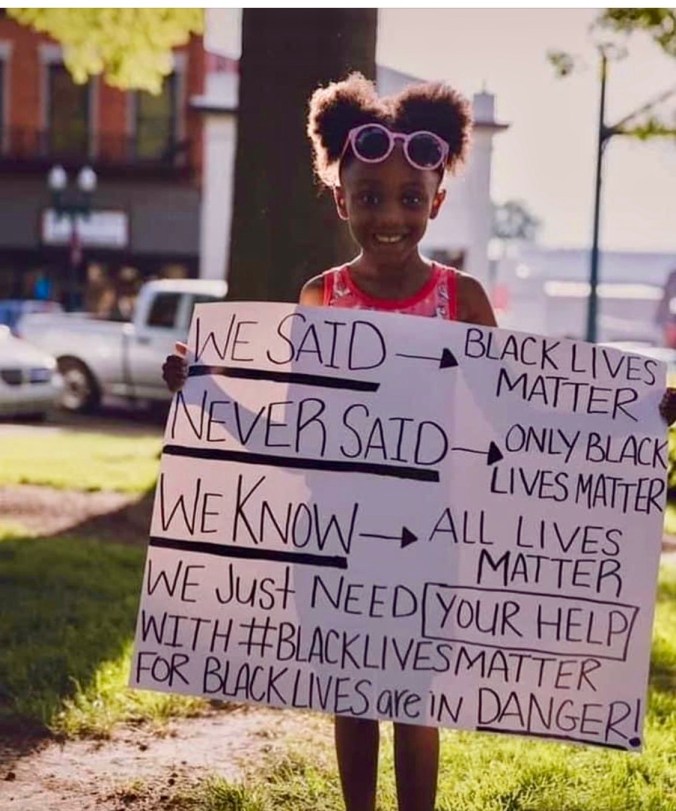
Just to be clear.
A story comes to mind from a friend who was struggling to understand Why Are All the Black Kids Sitting Together in the Cafeteria? It’s the title of a book by Beverly Daniel Tatum, Ph.D., useful to educators trying to understand how to help all their students.
My friend told the author during a break in a daylong workshop that she did not understand why black students felt singled out.
Tatum said to my friend: “You have a teenage son?”
“Yes, two,” she said.
“Could your son shop at, say, Nordstrom?”
“Sure. I sent my youngest to return a blouse to Nordstrom just the other day.”
“If I sent my son to Nordstrom, nicely dressed and well-spoken, he would be followed everywhere he went in the store.”
That made sense to my friend. That certain click of understanding.
It’s not that Nordstrom hires particularly racist store detectives, it’s that black people are distrusted in our society. They have to behave perfectly just to do things most white people never think about twice, like walking into a department store with a blouse still wearing its tags and carrying a receipt. They are followed. They know they are being followed. They know they have done nothing wrong, but being singled out makes them uncomfortable anyway. Wouldn’t it make you uncomfortable?
He can not put his race down like a conspicuous tote bag race and go on with his shopping.
If you do not think this mild example that made so much sense to my friend is typical, I assure you it is. I’ve seen it. I’ve seen a lot worse. Tatum knows every mother of a black son in this nation has been forced to explain the facts of life. Here’s what you do; here’s what you must not do. It is humiliating, but by now we have all seen photos of black men being shot in their own cars, black men shot for a misdemeanor, or suffocated on the street. A mother wants to spare her son harassment and embarrassment. She wants to keep him safe. She wants him to live. Stop, move slowly, do as directed, keep your hands where they can be seen, speak calmly. And even this may not be enough.
Heather Cox Richardson wrote yesterday: “Protests continued for a tenth day today in the face of ongoing police brutality. That statement is going to anger some readers, but hoo, boy, the images of the police attacking peaceful protesters and journalists are going to be in textbooks in a few years, and our great grandchildren are going to ask how on earth this happened.”
The Guardian reports that yesterday: “Police in northern California fatally shot an unarmed 22-year-old who was on his knees with his hands up outside a Walgreens store while responding to a call of alleged looting, officials said.” Sean Monterrosa was a native San Franciscan who had worked at the local Boys and Girls Club. “The last person killed by Vallejo police was Willie McCoy, a 20-year-old who had been sleeping in his car in February 2019 when six officers fired 55 bullets in 3.5 seconds. One of the six officers who killed McCoy, a rising rapper in the Bay Area, had previously killed an unarmed man who was fleeing on his bike. Another Vallejo officer killed three men in a five-month period and was subsequently promoted.” One of those men was white and autistic.
A disproportionate percentage of unarmed and innocent people shot by police are people of color. You can look that up. I did.
The Scientific American reports the number of police killings in the U.S. each year, about 1100—and of officers deliberately killed in the line of duty, about 50 (about another 50 die accidentally of such causes as heart attack or auto accident while on duty).
“Online news site VICE News obtained data on both fatal and non-fatal shootings from the country’s 50 largest local police departments, finding that for every person shot and killed between 2010 and 2016, officers shot at two more people who survived. Extrapolating from that, the actual number of civilians shot by the police each year is likely to be upwards of 3,000.”
CityLab reports “In the U.S., African Americans are 2.5 times more likely to be killed by police than white people. For black women, the rate is 1.4 times more likely.”
From The Washington Post: “Since The Post began tracking fatal police shootings, blacks have been shot and killed at rates significantly higher than their percentage of the overall U.S. population. Blacks make up about 13 percent of the population but 23 percent of those fatally shot by police since 2015. For shootings of unarmed people, blacks were 36 percent of those killed.” In 2016 American “police killed 38 unarmed blacks and 32 unarmed whites. Whites accounted for 49 percent of all 2015 fatal police shootings, while blacks constituted 26 percent. The academic researchers found that blacks who were fatally shot were twice as likely to be unarmed as whites.” [my emphasis]
Are white officers no more likely to shoot black civilians than black officers? There’s a lot of argument about that, but in the end it does not matter. Black people die disproportionately at the hands of police. Proportionate to their population, unarmed, innocent of crime, and kneeling with their hands up, they are more likely to be shot and killed.
from The Atlantic: “Police brutality is a decades-long problem, one that predates this administration. But President Trump made it worse, my colleague Adam Serwer argues in a sweeping new piece. He gave the police permission to be brutal.
“This administration rolled back Obama-era police reform. In 2017, Jeff Sessions, Trump’s then-attorney general, ended the Justice Department’s oversight of local police departments.
“Trump personally holds ‘few ideological convictions as consistent as his belief in the redemptive power of state violence against religious and ethnic minorities,’ Adam argues, recalling the president’s 1989 comments about the Central Park Five—and his continued refusal to acknowledge their innocence—and his travel ban targeting Muslim-majority countries, among other things.”
The answer to Tatum’s question: “Why Are All the Black Kids Sitting Together in the Cafeteria?” At a guess? For safety.
It needs to be repeated: Black lives matter.
 IMPERFECT PATIENCE
Excellent post Jan! Today is Breonna Taylor’s birthday today. She would of been 27.
On Fri, Jun 5, 2020 at 7:06 AM IMPERFECT PATIENCE wrote:
> janpriddyoregon posted: ” Just to be clear. A story comes to mind from a > friend who was struggling to understand Why Are All the Black Kids Sitting > Together in the Cafeteria? It’s the title of a book by Beverly Daniel > Tatum, Ph.D., useful to educators trying to understand how t” >
LikeLiked by 1 person
#SayHerName
LikeLike
June 5 1969 draft morning soviet space junk Nixon —51 years later why can’t we all just get along— do what you can to stop the madness
LikeLiked by 1 person