There are literal black swans. But the expression “black swan” when not speaking about birds means something else.
A black swan is an anomaly. It is the thing that careful observations and experience tells us cannot happen… and then it does.
For example, living in 18th century England, I could have looked at literally hundreds of swans, maybe even have seen every swan in Europe. Every single one would have been white. And it would have been reasonable for me to conclude that “Swans are white. They are all white. Every single swan I’ve seen in my lifetime has been white and therefore swans are white and no other color.” I would have made a rational and reasonable assumption based on extensive experience. Then a British naturalist came back from Australia in 1790, a continent I hadn’t even cared existed, and announced: black swans!
Who knew that everything I assumed was proper and normal could flip over in an instant?
That’s a fairly simplistic example of what some scientists call a “black swan problem.” This is something else: a newer idea called “black swan theory”. We humans are too reliant on prediction, too trusting that the world unfolds in some reliable and predictable order, when in fact, our world is closer to random chaos (if I can use that term without evoking chaos theory, which is something else). Two black swans.
An entry in Wikipedia explains it like this: “The [black swan] theory was developed by Nassim Nicholas Taleb to explain:
-
- The disproportionate role of high-impact, hard-to-predict, and rare events that are beyond the realm of normal expectations in history, science, finance and technology
- The non-computability of the probability of the consequential rare events using scientific methods (owing to the very nature of small probabilities)
- The psychological biases that make people individually and collectively blind to uncertainty and unaware of the massive role of the rare event in historical affairs
“Unlike the earlier philosophical ‘black swan problem,’ the ‘black swan theory’ refers only to unexpected events of large magnitude and consequence and their dominant role in history. Such events, considered extreme outliers, collectively play vastly larger roles than regular occurrences.”—“Black Swan theory” Wikipedia
The older “black swan problem” was a simple matter of logical deduction. That’s what I did in my 18th century example: Every swan I have every seen is white, therefore all swans are white. Then I discover even a single black swan and my theory about all swans is destroyed. The revelation of black swans is not even dramatic enough to count as a black swan in black swan theory where black swans are game-changers.
Black swan theory concerns something more dramatic than an error in reasoning. Taleb describes an event that for good or ill shocks people experiencing it, could not reasonably have been predicted, and dramatically impacts lives. However, in hindsight people struggle to rationalize what has occurred as a predictable event (which is isn’t). Think 911, or perhaps the discovery of antibiotics. Taleb’s argument is that while we can not, by definition, predict black swans, we should understand that we can’t predict the most transformative events we will face. In the mean time, we should work hard to minimize the disasters and exploit the gifts they bring. These things will happen.
Most of this theory is over my head, I must admit. I have Taleb’s book, but have only paged through and not studied it.
[NOTE: There is limited assertion just now that covid-19 is a black swan. Since intelligent people in medicine and government the world over were predicting a pandemic in the near future, it really does not make the cut.]
The concept, however, of events that cannot be predicted and how we respond to them is interesting, even for this philosophical amateur.
Maybe that’s because I am a grandmother.
Most of a child’s day, when it’s an interesting day, is made up of black swans. (For literal black swans too.) Babies know their parents and their own room and bed and clothing. But consider: every time something new happens—mom has curry for lunch, someone sprays perfume, a new song plays on the radio, radio!—it’s a brand new thing that they’ve never experienced before and could not have predicted. Black swans everywhere from the baby’s perspective.
Although newborns should be protected from unnecessary exposure to germs and disease, children who lie in a crib all day in a quiet room with little hustle and bustle fail to develop normally. The newest theories of encouraging childhood development all emphasize exposing them to many colors, textures, and experiences. Further, there is ample evidence these days that an excessively clean environment actually leaves children susceptible to allergies.
By the time they are a few years old, most children have been exposed to a great variety of sights, sounds, tastes, smells, and environments. They have begun to understand “normal.” The normal clatter and roar of the city is no more disturbing to an urban child than the normal sounds of birds and wind-blown branches are to a child-raised in the country. Eventually they come to understand and anticipate patterns of behavior and speech that the adults around them have been demonstrating for their entire lives.
And then one day, out of the blue, parents announce they are divorcing—tragedy—or the child hears an opera—a gift. Black swan, black swan! This is the way the world changes fundamentally and forever for a child. This is not a black swan event for the world, but on an individual level, the world changes.
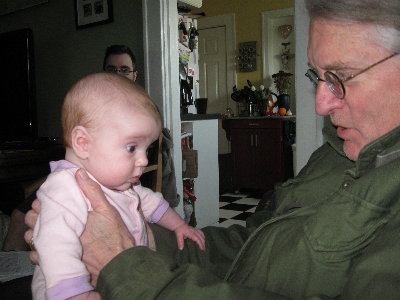 Taleb is concerned with international events, events that impact large numbers of people. Read the book and see what this is all about. In the mean time, my husband, who was certain that becoming a grandfather was not a good idea, took one look at Ruby as an newborn and—BLACK SWAN!—the world changed. He could not have predicted, could not have planned for how one little baby changed everything. Epiphany. Marvelous joy! Going on nine years . . . still amazing.
For the record: this wasn’t a surprise for me. I know who I married.
First mother swan swimming lesson for newborns 2006 Ibirapuera Park”
 IMPERFECT PATIENCE
woodland park zoo black swan raccoon dead bird raccoon trapped set free in the wilderness you who are smarter than me black swan glows inshallah
LikeLike
It’s very easy, and very human, to forget that (theoretical) black swans come in the good variety as well as the bad, thank you for reminding us.
LikeLiked by 1 person