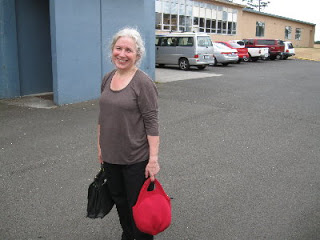
After my 15-16 miles—happy, but hurt.
In August 2011, I ran from my house to school.
It would be the last good run of my life. And it was not good.
I had been training all summer for my second official half marathon that October. I ran long one day a week, working up to 12.5 miles, and 3-6 miles other days, including hills. I was conditioned, but I underestimated the distance to school. I believed I was running about 13.5 miles that day and figured I could take my time and manage that stretch. I’d covered that distance before. The run turned out to be more than 2 miles further than I’d expected. Even so, I might have been okay except that my new runners were sitting in a box at home—saved for the Portland Half Marathon, still six weeks away. I ran the first 5 miles on sand but as soon as I turned off the beach, I realized my shoes were dead flat. By mile eleven on pavement, I was hurting. By mile fourteen I was struggling.
LESSON ONE: Know what you are doing.
I began running after my eldest son ran with the cross country team because the boys and girls teams were so cheerful and supportive of one another. I’ve read plenty of books about running, written by runners, and I was a runner for nearly twenty years, covering a modest 3-6 miles at least every other day.
At the age of 41 in 1994, I began training over a distance less than a third of a mile. I started April 1st. It was a joke on myself that accepted the likelihood I would not be running for long. My plan was never to hurt myself. I am not a believer in no-pain/no-gain. That’s a crock. Pain is an indication of damage. I didn’t want to hurt myself. I wanted to get in shape. I ran every other day and added a couple of hundred feet each day. This schedule of running every other day allowed my muscles time to heal. By August I was able to run strong for six miles. When the cross country team began practicing, I ran with them and could keep up with all but a handful Varsity boys. I was not fast, but steady and capable of distance.
When I set goals for myself, I intend to promise only what I am certain I can complete. When I make a list of task, I pace myself, allowing for flexibility but also for serious deadlines.
LESSON TWO: Make reasonable, doable, consistent plans.
Despite my good planning, I made other mistakes at the beginning. I did not buy any sort of running gear for myself and chaffed my legs between my thighs on cuffed shorts. I didn’t have a running bra. My running shoes were hand-me-down sport shoes that were a full size too small. No muscle pains from my early training, but blisters and sore feet.
LESSON THREE: Buy or borrow the right equipment.
Once I began working with the cross country team, I picked up race strategies. When I was covering distance, I maintained a steady pace. There was a sweet spot between one and four miles where running felt almost effortless. Right at the beginning and after the first four or five miles, my effort increased. Another had to do with “running strong” right through the finish line. In other words, resist the temptation to slow when approaching the end, even if I am doing well enough that I believe I could.
When I near the end of a process—the end of the school year, for example—I push myself to sustain my pace. In other work, this is one of my greatest challenges. Sustain attention, quality, and detail right through the end.
LESSON FOUR: Run through the finish line.
I was not yet 59 years old when I had my last “good” run. I’d become fond of a vision of myself hobbling along at age 72. I gave myself time, went back to running slowly and over short distances. I was careful, but my feet were ruined. I got orthotics and wore larger shoes all day until I could walk without pain. By 2013, at age 61, I accepted that I would not be running again. It about broke my heart.
I considered biking and swimming, belly dance and yoga and gave up. Walking stuck.
There is a memoir about running by the novelist Haruki Murakami, where he describes trying to run at a pace in his middle years that he never trained for in his youth. The entire time I read that section I shook my head. As we age, some goals become unrealistic. I’m not happy about it, no one is. I have a neighbor who is in his mid-70s and still runs the beach. It’s true I can walk faster than he can run, but I admire his spirit and his willingness to continue doing what he loves, even if he has to slow down.
Most of the activities I have enjoyed in my life are still fully available to me. I quilt and weave and go to films. On my morning walk I can see to beachcomb. I read a book every few days, though I need better light to see the page. I lost the habit of 8 hours of sleep at night when I was an overworked high school English teacher. I nap instead. I am careful about what shoes I wear and how hard I pinch because my hands and feet are inclined to ache. I no longer run.
Could I do more? Hubris needles me to answer yes, but common sense wins. I will do what does not hurt me, and that is more than I would have expected for a woman my age.
LESSON FIVE: Accept your limitations.
 IMPERFECT PATIENCE
I’m walking now. Got to get my wind back. I huff&puff now. Used to be able to walk to work when I had no bus money. 5 miles in 1hr.15 minutes. I read this offerring suggestions(silly me)like never run a marathon in new shoes or walk around after your done(Coach Crowley). My brother excelled in running. My dad did it for doctors orders. He’d walk to the park to walk and see an older man with a cane going there too. As soon as he turned into the park he put the cane on his forearm and took off running. Told dad he did it for health
LikeLike