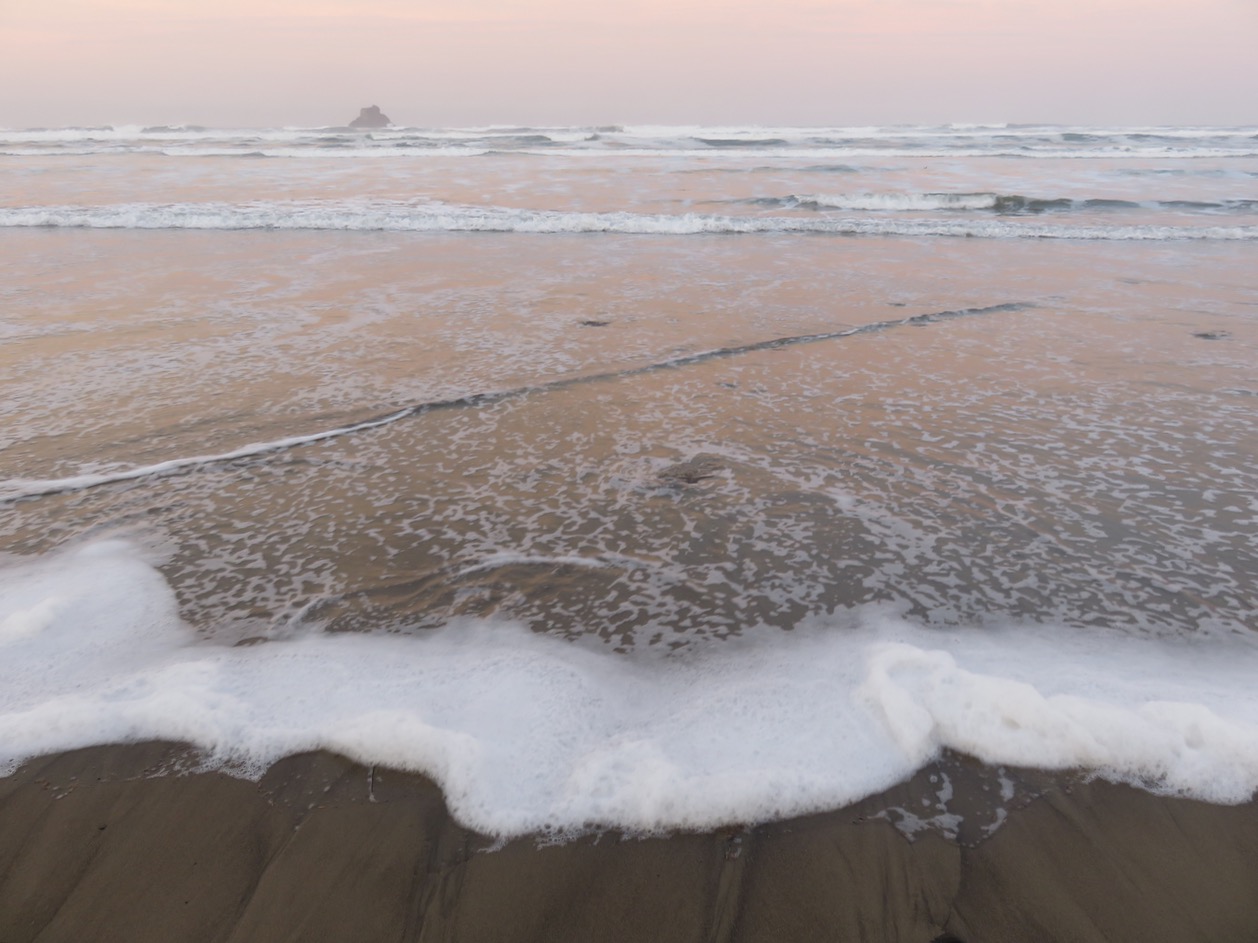
There is a major front moving in. Gary has come up the stairs twice to tell me about it. Perhaps two inches of rain. He will need to buy the whipping cream today—how much did I need? Three quarts. The tide sweeps up nearly to the hedge and he suggests we might get a walk up Shingle Mill rather than on the beach. And that reminds me of a very old essay . . .
Hoo-hoo-a-hoo Hoo-uh-oo! We heard the owl at the far end of our run on Shingle Mill that morning. It was the first day of Daylight Savings Time and this meant we were running in the dark again. It also meant we got to hear the owl. And my two-day headache finally left me.
We live at sea level and the Pacific Ocean is right outside my window. On a Thursday night we watched the news about the 8.9 earthquake in Japan (since upgraded to a 9.0), checked the estimated time of landfall in Hawaii and our coast. The news had pictures of a ten-foot wave sweeping across agricultural fields, smashing into building, carrying cars like so much driftwood. Ten feet might not sound like much, but that wave had the weight of the entire Pacific behind it. Nuclear reactors were off-line. The early estimates claimed 25-35 dead, but we already guessed this would increase ten-fold by morning, and again ten-fold, and perhaps again. But it was also clear that the wave would not hit here until after 7am and since we are always up between five and six, we went to bed.
We would have slept through the night and begun packing up in the morning, but a well-intentioned neighbor called to alert us at 2am and so we were up three hours early. School was cancelled, and this had been on the news hours before the call came. By then waves hit Wake Island and Midway. Hawaii was hit, but the estimated wave was less than four feet for our stretch of coast. More bad news about the Japanese nuclear power plants. The tide would be mostly out so that the estimated four foot wave, if it came, would look like a sneaker, nothing threatening. A local geologist was interviewed by a Portland television reporter, and it was all he could do to keep from laughing at all the fuss. “People can evacuate if it makes them feel better,” he said. Horning is a smart guy and I trust him, but better safe than sorry, and we’d already planned to leave.
The warning siren began blaring right at the time we were putting the dogs and cat in the cars. That was good news—no way anyone could miss hearing the Arch Cape alarm unless they were deaf. An hour before the time a wave was expected, we had packed up and evacuated ourselves and our pets to St Peters’ parking lot.
Through all this Gary and I were calm. An hour past anticipated landfall for the first wave, we went back home and unpacked.
During all this several things went well locally: We had many hours to prepare. We packed and left. The warning system worked. Oregon Department of Transportation (ODOT) reopened the Dennis Edwards Tunnel to allow visitors to return to Portland without detouring construction.
What didn’t go well: ODOT posted nothing, absolutely nothing on their website about the tsunami warning. I found out the tunnel was open from Facebook and later the news. The news stations reported the most dangerous scenarios over and over, and often showing images from Japan with a “live” label on screen while interviewing—voices only—locals about the threat to the Oregon coast. People turning on the news understandably feared the images went with the interviews. Many people were unnecessarily frightened. Friends from Seattle emailed to ask if we had an emergency kit in our car. Others thought the entire situation was blown out of proportion.
It wasn’t.
In January of 1700—Tuesday evening, January 6th, to be precise—the Cascadia subduction zone dropped, causing an earthquake magnitude of approximately 9.0 off the NW coast of the US and Canada. Scientists can be precise about this event because while none of the people living then on the Oregon coast actually wrote it down, the Japanese recorded details of the 5 meter tsunami that struck their coast. That’s about 16 feet. People died.
That earthquake and tsunami was just the most recent in a series that have struck our coast. Until recently the general advice was to get to 50′ above sea level and we probably had a couple hundred years before another big quake would strike. But then the Seaside School District asked State of Oregon geologists to have a look at cores and advise us about where to move Cannon Beach Elementary, which is sited along Ecola Creek, just off the beach. The school can evacuate to 50′ in less than 5 minutes—they practice. The discoveries of the state geologists put the wave height at up to 100′ and frequency closer to 300 years than 500. We are overdue just now for a big one and that is why my school district, with four of our five schools barely above sea level, is scrambling to relocate and build a new campus higher up in the coast range. These buildings would also serve as staging for relief efforts and emergency housing when the next big one comes.
When that quake comes, if I am home, at least parts of my house are likely to collapse. I do not count on getting my car out of the garage, nor that local roads will be free of fallen structures and trees. I will grab the dog’s leash, stuff the cat into her carrier, change into runners, and I will run. I will not carry even the most practical of emergency kits. I will not take extra drinking water or food or my favorite pieces of jewelry, the family photos or blankets or any of the sentimental or practical items we carted over to the church the other day. There won’t be time. I will have only a few minutes to run to higher ground—best case scenario suggests 20 minutes total, and I will have spent part of that time fighting the cat to get her into the carrier. In a worst case scenario I might have only 5 minutes to climb 100’ above sea level and I will not make it.
If I’m at school during the quake, I will likely have a couple of dozen students in my room, and over a mile to run just to get to the base of a hill. There is a backpack in my room that I am supposed to carry, but I am old and small and the reality is that I do not want to carry 20 pounds of emergency items for over a mile. I might do it, though. I am a stickler.
Wherever I am when it hits, there’s a fair chance my husband will be someplace else. We have tried to figure out where to meet. Neither of us is hesitant to walk from wherever we might be, but getting from one place on the coast to another will be torturous. I figure I can run the highway from Seaside to my home in less than three hours. It’s about 14 miles and I ran a half marathon last fall in awful weather in a little more than two and a quarter hours. But after a quake, that highway will be mostly gone because it’s at sea level in low places, tumbled with rock in high places, and already sliding downhill any place above sea level. Bridges will have collapsed. Mud and downed trees, the drowned wreckage of human constructions will make barriers. Owls will always find their home, or a new tree. But if I head for my tsunami-swept home nothing along the way will look familiar, and I will likely need a day or two to get there from Seaside, if I’m lucky enough to find Arch Cape at all.
If I were a girl of sixteen, Friday would have been a holiday off from school. But I am closing in on 60 and even a false alarm gets me thinking too hard. The adrenaline left me exhausted and achy and reconsidering. The next day I had a headache, and it wasn’t until this morning, three days after Japan’s quake, when Gary and I decided we were going out for a run despite the rain, that my headache is finally gone. It returns as I consider the future. Grim reality.
There is the stretch of flat road we often run, the road we ran this morning. We run laps east, west, east, and when I am headed toward the ocean its voice sometimes comes up strong like an animal roaring over my head. I always think of a tsunami when the ocean is in full throat; I consider where I would turn to find high ground, and that I do not have time to escape that massive rush of water.


 IMPERFECT PATIENCE