MISTRAL

It’s been many years since I took a class from Ursula K. Le Guin and in one of them she talked about the Chilean poet Gabriela Mistral. She was incensed at how little work of hers was available in English. After all, Mistral was a Nobel laureate, and her work was important. Le Guin had majored in French in college, but over the years she indulged in translation. (I taught a speech from one of essay collections called “Hunger” from a speech she delivered to a fundraiser-luncheon. In it she translated a poem from the Spanish by Pablo Neruda. Students struggled sometimes with Le Guin’s short speech, even to identifying the main idea, which was hunger, as set up immediately by the title.) She determined to study Spanish to do justice to Mistral. Other readers will judge how well she managed to maintain the music and meaning of this poem.

NOTE: On the Poets.org website, the translation is listed before Mistral’s words. I have placed the original Spanish first.

La Contadora (The Teller of Tales)
     by Gabriela Mistral 
    Cuando camino se levantan
todas las cosas de la tierra
y me paran y cuchichean
y es su historia lo que cuentan.

    Y las gentes que caminan
en la ruta me la dejan
y la recojo caída
en capullos que son de huella.

    Historias corren mi cuerpo
o en mi regazo ronronean.
Tantas son que no dan respiro,
zumban, hierven y abejean.
Sin llamada se me vienen
y contadas tampoco dejan…

    Las que bajan por los árboles
se trenzan y se destrenzan,
y me tejen y me envuelvan
hasta que el mar los ahuyenta.

    Pero el mar que cuenta siempre
más rendida, más me deja...

    Los que están mascando bosque
y los que rompen la piedra,
al dormirse quieren historias.

    Mujeres que buscan hijos
perdidos que no regresan,
y las que se creen vivas
y no saben que están muertas,
cada noche piden historias,
y yo me rindo cuenta que cuenta.

    A medio camino quedo
entre ríos que no me sueltan,
el corro se va cerrando
y me atrapa en la rueda.

   Los ribereños me cuentan
la ahogada sumida en hierbas,
y su mirada cuenta su historia,
y yo las tronco en mis palmas abiertas.

    Al pulgar llegan las de animales,
al índice las de mis muertos.
Las de niños, de ser tantas
en las palmas me hormiguean.

    Cuando tomaba así mis brazos
el que yo tuve, todas ellas
en regalo de sangre corrieron
mis brazos una noche entera.
Ahora yo, vuelta al Oriente,
se las voy dando porque no recuerdo.

    Los viejos las quieren mentidas,
los niños las quieren ciertas.
Todos quieren oír la historia mía
que en mi lengua viva está muerta.

    Busco alguna que la recuerde
hoja por hoja, herbra por hebra.
Le presto mi aliento, le doy mi marcha
por si el oírla me la despierta.


Mistral's "The Teller of Tales"
        translation by Ursula K. Le Guin

    When I’m walking, everything
on earth gets up
and stops me and whispers to me,
and what they tell me is their story.

    And the people walking
on the road leave me their stories,
I pick them up where they fell
in cocoons of silken thread.

    Stories run through my body
or sit purring in my lap.
So many they take my breath away,
buzzing, boiling, humming.
Uncalled they come to me,
and told, they still won’t leave me.

    The ones that come down through the trees
weave and unweave themselves,
and knit me up and wind me round
until the sea drives them away.

    But the sea that’s always telling stories,
the wearier I am the more it tells me...

    The people who cut trees,
the people who break stones,
want stories before they go to sleep.

    Women looking for children
who got lost and don’t come home,
women who think they’re alive
and don’t know they’re dead,
every night they ask for stories,
and I return tale for tale.

    In the middle of the road, I stand
between rivers that won’t let me go,
and the circle keeps closing
and I’m caught in the wheel.

    The riverside people tell me
of the drowned woman sunk in grasses
and her gaze tells her story,
and I graft the tales into my open hands.

    To the thumb come stories of animals,
to the index fingers, stories of my dead.
There are so many tales of children
they swarm on my palms like ants.

    When my arms held
the one I had, the stories
all ran as a blood-gift
in my arms, all through the night.
Now, turned to the East,
I’m giving them away because I forget them.

    Old folks want them to be lies.
Children want them to be true.
All of them want to hear my own story,
which, on my living tongue, is dead.

    I’m seeking someone who remembers it
leaf by leaf, thread by thread.
I lend her my breath, I give her my legs,
so that hearing it may waken it for me.


From Selected Poems of Gabriela Mistral: Translated by Ursula K. Le Guin. Copyright © 2003 Ursula K. Le Guin. Courtesy of University of New Mexico Press. Published in Poem-a-Day on September 27, 2020, by the Academy of American Poets. Pulled from The Academy of American Poets online site.
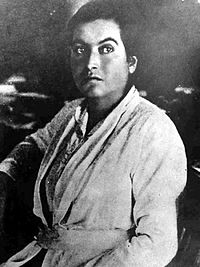
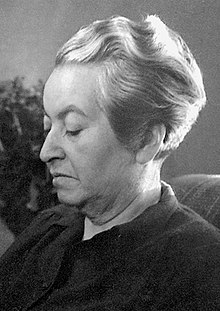
The Chilean poet, Gabriela Mistral, also known as Lucila Godoy y Alcayaga (1889-1957), was the first Latin-American writer to receive the Nobel Prize in Literature (1945). Born to a family of teachers, she mentored Pablo Neruda who would also with the Nobel. Unlike him, however, not enough of her work existed in translation to English.  (A bi-lingual edition by Doris Dana published in 1971, 272 pages, and some translations by Langston Hughes.) Ursula K. Le Guin studied Spanish in order to change that. 
As a younger woman

Mistral may be most widely quoted in English for Su Nombre es Hoy (His Name is Today):

We are guilty of many errors and many faults, but our worst crime is abandoning the children, neglecting the fountain of life. Many of the things we need can wait. The child cannot. Right now is the time his bones are being formed, his blood is being made, and his senses are being developed. To him we cannot answer ‘Tomorrow,’ his name is today.

—Wikipedia
Gabriela Mistral 1945.jpg
In later years
Most mornings…

THE ODYSSEY

51INarXj18L._SX327_BO1,204,203,200_.jpgTranslations are a bitch.

If readers—especially those with no great interest in other cultures or mythology—want a fast-moving, understandable fantasy tale, this might be just the ticket.

I want history and truth and anthropology. I want art. This translation is modestly literate and probably relatively accurate. Despite imposition of semi-iambic pentameter and use of modern expressions, it does nothing fancy or self-promoting. It is easy to read. Is it an accurate translation of this ancient poem?

I used to explain the challenge of translating poetry to my students this way: You have the form (the structure of a poem in rhythm and rhyme), the meaning, and the music. In translation, there may not be a simple word meaning exactly in English what it means in the original. Wilson is concerned that prose versions become longer. She’s right about that, prose does tend to become wordier. However, making the lines shorter than the original defies my understanding. When is it ever possible to consistently and accurately translate in fewer words than the original language? Thus, reading back and forth between translations, I found information missing from Wilson. To maintain her line-by-line translation she was forced to leave things out.

Plus all words gather baggage through cultural connection and acquired connotation. (The young woman in the beautiful long white dress—is she a bride, an unmarried young woman, or in mourning for her father? Is the story American, Vietnamese, or Chinese?) If something must be sacrificed, do you choose form, meaning, or music?

I would give 2 stars for music (maybe only 1), 3 stars for meaning (maybe 4, maybe only 2), and 2 stars for form. Also mostly 4 stars for her introduction, though even there . . .

I wanted to love this translation—I expected to love it. It is the first translation by a woman. I prepared and took notes. I read the introductions to several translations in preparation, beginning last year. Once I had Wilson’s translation in hand, and began reading I felt I was missing details and worked back and forth between her translation and Penguin’s Rieu translation, which is wordier prose but includes line numbers on the side. Each has its flaws.

What I liked about the new one: Wilson provides a lengthy introduction that includes how the poem has been viewed in the past, when and how it might have been composed and first written down, and how other translators have approached the work. In this introduction she points out specific misunderstandings and provides critical cultural context. References to dogs, for example, especially in relation to the actions and appearance of women, do not have the same connotation they would in modern English. A dog-like face is not ugly, but suggests something else (perhaps devotion, or a need for attention). Wilson has her doubts that anyone named Homer existed. She provides some evidence that the epic is much older than usually assumed. She works hard to provide a poem-like translation. Wilson points out that prose translations inevitably become longer than the original. This attempt to provide a straight-forward translation in iambic pentameter cuts length and makes for fast reading.

What I did not like: The attempted iambic pentameter. Most of this translation is in 10-beat lines but some is not, and much of it is not in iams at all. The challenge of fully conveying meaning in fewer syllables than the original was beyond this translator. (Homer’s dactylic hexameter, which I do not claim to understand, has a longer beat line.) With the aid of an actual poet, she might have managed it, but I am convinced meaning would have been distorted in the effort. Wilson also claims, and so do other introductions (I read four) that no one person could have composed and memorized twelve thousand lines. That is a foolish assumption since many oral societies, even within historical times, have managed just that. And her effort to use terms familiar to modern audiences includes “scot-free” among other colloquialisms that seemed out of place in such a setting, not to mention I would guess many young readers would not understand them all, thus undermining the attempt to make the text more “relatable”. In her introduction, she also dismisses the possibility of the composer having been a woman.

While she is likely correct that the composer was a man, I found part of her argument against a female bard short-sighted. A woman, she asserts, would not have adequate knowledge of the battlefield to support the detail found in the poem. But I find nothing in her translation (or any other) of battle scenes that could not have been pieced together from post-battle remains, guesswork, and survivors’ accounts or tradition, by a woman or a blind man. She also fails to note the ordinary household details, meticulously described, which would have been equally inaccessible to a male poet and far less likely to have been preserved by men. In the end, I argued with her assumptions about gender. She inadvertently, reopened the question for me. Would any man go on and on about household textiles spun, dyed, woven, and cared for exclusively by women? [NOTE: Robert Graves assumed the epics were written by two people, The Odyssey by a woman. His novel Homer’s Daughter, based on this assumption, was not particularly successful, imo, but there you are. A woman should have written it. He missed most of the more convoking details that would have convinced me.]

No introduction I read focussed adequately on how several “inconsistencies” support the elite quality of the actors in this story. The men eat only meat and drink mostly wine except under severe hardship. Though there is frequent mention of gardens and orchards, the characters do not eat fruits and vegetables. The faces of significant characters, men and women and even including some suiters, are described as “god-like.” Men are bathed and their skin oiled, their clothing is wool, fine-spun, and frequently purple. In fact, though many dyes would have been available, purple is the only color mentioned. Men may wear mantels of purple, sleep under blankets of purple, and women spin purple-dyed fleece. If that last is accurate, that the fleece was dyed before spinning, then it was first washed before dying. It would have been oiled before it could be spun and there is a passage that references oil dripping from a weaving, a detail translated differently in each version I checked. Some translations specify olive oil, others do not. Use of precious olive oil to spin the wool is unlikely, but intended, perhaps, to convey the elite status of the characters. Failure to appreciate how people lived and spent their time results in shallow understanding and translation. The purple dye comes from a Mediterranean shellfish, tyrex, the “royal purple” first discovered during the Bronze Age when this story is set. The displays of wealth in use of meat and oil and purple dye and descriptors using the term god-like all promote the stature of the cast. These are not ordinary people, but people of rank.

A swineherd is addressed directly by the narrator, “You, Eumaeus” and he becomes one of Odysseus’ three supporters in the slaying of the suitors, a rare character who is named, but not an aristocrat or of immortal family. More important, I suspect, he first greets Odysseus on his return, treating him with the proper care and respect, though he does not recognize his master. He does what is right and proper and due to a stranger. The Penguin translation claims the composer so loved his creation, he honored him in this way. I would argue that here is a commoner, a slave and swineherd, who is important to the story. The rare use of direct address acknowledges this.

Every introduction I have read has emphasized the oral roots of the poem. Wilson writes that The Odyssey may have been composed from an oral tradition, how and when it came to be written, and how the text version might have altered any previous spoken version. Yet, not enough is said about the nature of the oral tradition. Every high school English teacher will tell you that iambic pentameter aids the actor in memorization. I have heard actors in Ashland, Oregon, describe how memorization was much more challenging when they worked on a modern play after Shakespeare.

But poetic rhythm is also an aid to the listener. Just as the form aids the performer, so form and repetition aid the listener who can predict and appreciate sound when it is held in a poetic form. While the reader might reread, turn back a page, as I frequently did while studying these translations, the listener must grasp the story in the moment it is told. Homer (whoever that person or persons might be) tells and then reviews the telling, caps each character with a descriptor of his or her heroic trait. Penelope is prudent, Odysseus is cunning, for example. These words preface their names over and over again regardless of how the characters behave in the scene. Most translators vary these words but also frequently leave them out entirely. On the page, they seem redundant. To the ear, they are a formal reminder of the characters we are hearing about: ultimately, even if he is foolish in leaving his starving men with the cattle, Odysseus is a cunning hero.

The Penguin edition also speaks of how the story was composed, assuming it is fiction. Even Wilson likes to comment on characters as creations. From a modern perspective, this is sensible, but tradition is always based in fact. Everyone assumes these are very ancient stories, likely already old before The Odyssey was first spoken or written. Yet many details remain in question, despite what seems to me to be obvious. Penelope, for example, is the subject of a great deal of speculation. When does she recognize her husband returned after 20 years? Does she recognize him early on and keep this to herself? Even Wilson describes her actions as confusing. Telemachus is frequently described as immature.

Here is my teasing out of the story from a broader (Penelope’s) perspective: Odysseus was about to go to war. Before he leaves, he tells his wife he hopes to see her again, but if he dies, she must raise their infant son to manhood and then remarry. This backstory is a part of what we find in The Odyssey. After 17 years, suitors for perhaps-widowed Penelope begin to arrive, her son is not yet a man, and she concocts the deception involving weaving a shroud for her husband’s aging father. She weaves by day, unweaves by torchlight in the night. After three years, she is caught out, betrayed by a slave. Over a hundred suitors arrive and would like to have her and the kingdom she has managed through this long absence. Telemachus as an unprotected minor is at risk. The disguised goddess Athene sends the boy off to visit other survivors of Troy, and this accomplishes two things: it introduces the young man to his peers who are then in a position to support his claims, and it keeps him out of the clutches of men who would kill him and take his inheritance. Their avaricious intentions are clear because, we are told repeatedly, taking his wealth is what they are already doing by eating and drinking the wealth of the household. They plan to murder Telemachus. Though she is described as beautiful, marrying Penelope is primarily a political tactic.

Penelope hides herself from the men when she can, but also keeps each one dangling with messages when she cannot hide. Her position is precarious. Eventually she must either choose a new husband or abandon her son to the ambitions of these men. Either way, stalling remains her best option. When Telemachus returns from his travels, she announces she will marry the man who can do what her husband once did, string his massive bow and thread an arrow through the handles of a dozen axes. None is able to string Odysseus’ bow, much less use it, though his own son comes closest to accomplishing the feat. Does she hope all will fail and thus she will buy more time for the son who is stronger than her suiters, nearly as strong as he will ever be? Or does she recognize Odysseus? It is worth noting that when men lie in this story, this deception is immediately called out in the poem. If Penelope were lying, the poet would have told us. Instead, Penelope has been stalling from the beginning as she protects her son in his childhood, but now she must fulfill the second part of her obligation to her presumed-dead husband. There is no mystery here. Penelope is a dutiful wife. As a widow, she must remarry. Does she love her absent husband and mourn for him? Absolutely. Everyone, everyone cries in this story. Men cry from fear and loneliness and loss. Penelope cries for her absent husband. Her sincerity in grief is never in question. She has done her best to fulfill her husband’s directions.

I have not found any gloss or introduction that deals with these issues.

A recent The New York Times review of Robert Alter’s 3-volume translation of the Hebrew Bible by Avi Steinberg, describes how Alter manages to both respect the poetry of the original and honor the meaning of the original as none has done before. In part, he does this by breaking convention:

Alter told me about his decision to reject one of the oldest traditions in English translation and remove the word “soul” from the text. That word, which translates the Hebrew word nefesh, has been a favorite in English-language Bibles since the 1611 King James Version. But consider the Book of Jonah 2:6 in which Jonah, caught in the depths of a giant fish’s gut, sings about the terror of near-death by water. According to the King James Version, Jonah says that the Mediterranean waters “compassed me about, even to the soul” — or nefesh. The problem with this “soul,” for Alter, is its Christian connotations of an incorporeal and immortal being, the dualism of the soul apart from the body. Nefesh, to the contrary, suggests the material, mortal parts, the things that make us alive on this earth. The body.

“Well,” Alter said, speaking in the unrushed, amused tone of a veteran footnoter. “That Hebrew word, nefesh, can mean many things. It can be ‘breath’ or ‘life-breath.’ It can mean ‘throat’ or ‘neck’ or ‘gullet.’ Sometimes it can suggest ‘blood.’ It can mean ‘person’ or even a ‘dead person,’ ‘corpse.’ Or it can be ‘appetite’ or something more general: ‘life’ or even ‘the essential self.’ But it’s not quite ‘soul.’ ”

But, I asked Alter, doesn’t “soul” help dramatize the scene’s intense emotion? I mentioned another instance of the word nefesh, the terrifyingly evocative line from the King James’ translation of Psalm 69: “For the waters are come in unto my soul.”

“Oh, yes,” Alter said, with a smile. “That one does have a certain emotional resonance to it. But it’s not what the poet had in mind. And, I would add that the line ‘for the waters have come up to my neck’ … is also rather dramatic.”

. . .

Alter regularly composes phrases that sound strange in English, in part because they carry hints of ancient Hebrew within them. The translation theorist Lawrence Venuti, whom Alter has cited, describes translations that “foreignize,” or openly signal that a translated text was originally written in another language, and those that “domesticate,” or render invisible the original language. According to Venuti, a “foreignized” translation “seeks to register linguistic and cultural differences.” Alter maintains that his translation of the Bible borrows from the idea of “foreignizing,” and this approach generates unexpected and even radical urgency, particularly in passages that might seem familiar.

It is this sense of an ancient text that I miss in Wilson’s translation. She has so thoroughly domesticated Homer that he is entirely lost.

What did I want? What do I want? Perhaps a three-part text: the original Greek, a translation, and footnotes on the side, on the same double-page spread. This modern nonsense of endnotes where I must flip to the back to find comments and then not find an explanation of a term of history when I do look is exasperating. I want literal translation as well as poetic translation. I want consistency. If names have literal meaning, either choose to translate or footnote (Wilson endnotes one time, translates another—give me both but in parallel). If “his face drained of color” makes more sense to readers because it is the conventional phrase used today, I still want a side note explaining that the literal translation of the Greek means his skin turns “yellowish green” because I have seen that. I have seen death.

Or perhaps I want something more straight forward and difficult: I want art. I want poetry.

Someone, please, do for Homer what has been done for Shakespeare or, more precisely, what Robert Alter has done for his Bible. It is a lot to ask. I know.

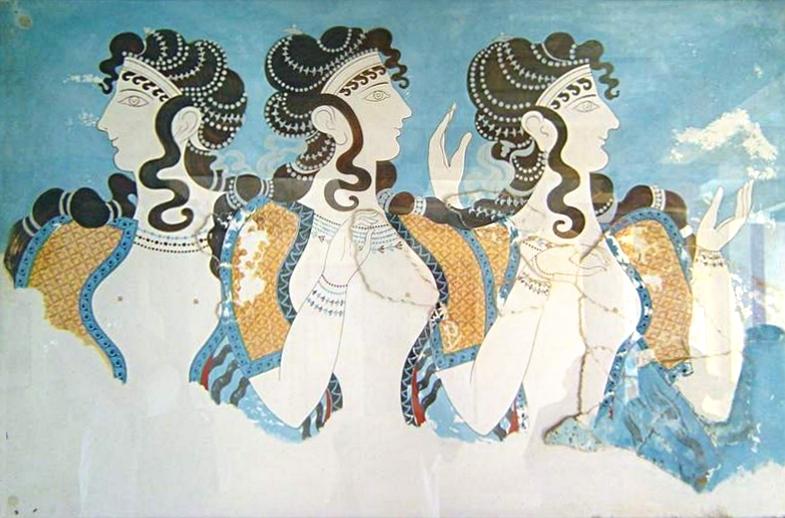
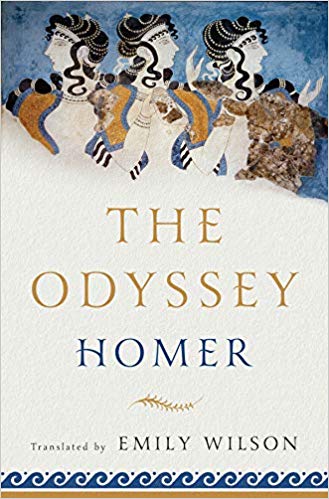
The cover art is gorgeous—one of my favorite Minoan mural paintings, but from a period and culture completely unrelated to the story. Like this translation itself, it is an attractive choice and it is wrong.
THE CANON

[from main page, CLICK TITLE above TO READ THE ENTIRE POST] 

Minoan_Queens_Fresco.jpg

This is the “Minoan Queens,” one of my favorite frescoes from Knossos on the island of Crete, a mural from a civilization flourishing between the 27th and the 15th centuries B.C.E. The image appears, quite inappropriately, on the cover of the Wilson translation of The Odyssey. It is beautiful but in no way reflects the time or the culture of Homer’s Greece. Most scholars believe the epic works attributed to Homer were created late in the 8th century B.C.E., several centuries after the fall of the Minoan Empire, which was, in fact, not quite Greek. (Wilson makes a case for The Odyssey a few centuries earlier, but it’s still a clear miss.) The peaceful seafaring and trading society was long gone by Homer’s day. Some guess that this wide-reaching Mediterranean society was egalitarian in terms of gender. They worshipped a goddess. They kept no weapons of war. Very different from Homer.

The canon is the essential literature that we assume everyone ought to read. In the twentieth century the Western Canon came under attack for being too determinedly dead, white, and male. Mostly dead. It has broadened somewhat since the days I was in school and read dozens of stories and novels by white men. There was not one novel or story written by a woman or person of color. I read The Diary of Anne Frank, but even Shirley Jackson’s story, “The Lottery,” was not in the curriculum of my school.

I found A Raisin in the Sun as a teen and was blown away by this story of racial injustice and poverty. I determined to provide a broader view of the world to my own students and for twenty-five years I assigned texts by men and women of color,  from Africa and the rez, and yes, from white men.

I was also writing my own stories and was assured again and again that if I continued to do good work, it would find recognition. Maybe so, but I have not found that to be true for other writers, and I question whether the canon is or has ever been representative of the best.

A great many dreadful books remain in print, and Zora Neale Hurston was out of print for decades. She did, of course, find her way back into print, but almost accidentally. The resurgence of appreciation of her work was the result, partially at least, of a single fan who found a copy of one of her books in a library, went searching, and wrote up her discovery for a new magazine called Ms. The fan was Alice Walker, author of the Pulitzer-winning The Color Purple, which is also a block-buster film. Walker championed the out of print novel of Hurston, and now that novel is widely read. I taught it for years.

It would be optimistic to assume that every novel as fine at Their Eyes Were Watching God would gain publication and remain in print, but I suspect in this case this is not the result of some magical efficiency in our system of evaluating and choosing great works.

What we most treasure is what we are told is good, what we are forced to read, and what others helps us to appreciate. That does not diminish the book we’ve never heard of, the one aging and unread in the school library, or the book we do not have the background to immediately understand. What we love in books can never exceed our experience, and our experience is limited.

Somewhere in someone’s attic is a novel written out in longhand, typed, or word processed—just the one copy—that you and I will never know but which might have changed our lives.

I was reminded of this truth recently as I began reading through a third complete translation of The Odyssey, the prize-winner by Robert Fagles (1996). I have already read one version that makes no pretense at replicating the poetry of the original, but places line numbers in the margin so that I know where I am in the original (Rieu, 1991). The other translation did its best to manage the original line-for-line in iambic pentameter, so that it offers precisely the number of lines as found in Homer’s Greek (Wilson, 2017). Fagles offers line breaks and stanzas in the appearance of poetry, and he numbers his lines, but his line numbering is of his own lines, not Homer’s.

Unfortunately, I am not interested in Fagles’ line numbers; I want to compare his translation directly to the other two. In some of the twenty-four “Books”, his line 190 is a line or two off of the original shown in the other two translations, other times it is off by a dozen or more. I must scan for Homers 7:107 to find the weavers’ oily cloth on line 123. I am still not certain if the oil used is from olives or some less precious source. One translation offers olive oil, but Walker, gaming determined to keep 10-syllable lines (which she often fails to achieve)  and the other poetic version, do not offer a type of oil:

…their hands fluttering like the leaves of a tall poplar, while soft olive-oil drips from the close-woven fabrics they have finished. [7:106-7 translated by Rieu as prose]


with fingers quick as rustling poplar leaves,

and oil was dripping from the woven fabric. [7:106-7 translated by Wilson as “iambic pentameter”]


fingers flickering quick as aspen leaves in the wind

and densely woven woolens dropping oil droplets. [7:122-3 translated by Fagles as poetry]

[I think, ironically, the prose is the most musical. Wilson’s poetic translation is awkward and not iambic pentameter. Homer sometimes dropped a syllable in his 12-beat line for emphasis, Wilson adds a syllable, but I cannot say why. The word “fabric spoils the rhythm and might have as easily been translated as “cloth.” And Fagles, oh dear, the alliteration nearly becomes a tongue-twister. Where is the poet-translator when most needed?]

Was it olive oil that dropped from the cloth and not some common oil? This matters, because The Odyssey includes many such details of wealth to emphasize the elite position of the principle characters. Class and position are continuously emphasized in details of food and clothing, gifts and weaponry. Odysseus is expected to be treated well as a stranger, but the fictional birthright Odysseus invents is immediately used in support of this treatment. We are not dealing with ordinary people, we are dealing with favorites of the gods.

One introduction dismissed the possibility of a woman composing these epics because a woman would not have been adequately familiar with warfare to tell about it in The Iliad. I wonder how a blind man would have known any of it? How would he have known so many details about housekeeping and weaving and the dyeing and spinning of wool, all of which are covered in great detail in The Odyssey. Never mind, I will accept that it is unlikely that a woman of this period could have composed these epics. I have other quarrels.

Each introduction I have read, has focused on the challenge of understanding Penelope’s purposes and feelings. On the basis of only two translations and several introduction, no Greek, and my own experience and research, do not find Penelope’s actions the least bit opaque. She was commanded by her husband when he went to war: raise my son to manhood and remarry. She has stalled the suitors until Telemachus is grown and then, much as she would prefer not to, she will marry. How is this inscrutable? No action by Penelope contradicts these goals. When another characters swears faith but privately conceals deceit, Homer’s words reveal the lie. Penelope follows the promise to her husband. She will do whatever she must to safely raise her husband’s son and then she will remarry. She is not happy about remarriage and she misses her husband, cries over his absence. These are an absolute constants. Homer is not cagey about the secret feelings of anyone, not even Penelope.

Today, we might find such loyalty rather bizarre, but Penelope is not mistress of her own fate, she is a loyal member of her husband’s household. She does her level best to abide by his wishes.

This is a story of blind obedience, of absolute rank and privilege. We might want to believe Greece is the birthplace of democracy, but it was a brutally stratified society in the days The Odyssey was told, and a few centuries in the golden age of Athens, it was little improved. Only land-owning men had rights, and there was punishment for overstepping position or dressing beyond what was defined by law. Slaves had no rights. Servants were beaten. Failing to follow instructions lead invariably to death.

The Odyssey is not a nice story.

There are other details of form that are addressed in introductions, but rarely translated—the names of main characters, for example, are routinely prefaced with an epigram that denotes their essential character. Certain passages such as the oft-translated “rosy fingered dawn” are repeated each time in the original Greek, but most translators insist on varying the language, and lose the original oral patterns in the process.

When a translator abandons or adds detail in order to create a palatable text in another language, ignore characteristic repetition, or utilizes contemporary idiom, are we reading Homer or some other version, like a “based on” Hollywood movie?

Never mind. The Odyssey concerns a culture mostly dead—and it would be unreasonable to expect every student to learn Greek in order to read the epic in the original. People did, though, as late as a hundred years ago. The story is not completely beyond our understanding. You might recognize the bombastic egotism of Odysseus—and then you might wonder why anyone considers this braggart a hero. The motivations and values of its characters are worthy of study for how they are different from the motives and values of most of us.

This rather far-fetched and nasty story rarely taught in public schools, and then usually only in excerpt. The Cyclops story Odysseus tells in Book 9 is a favorite and most familiar. And there are other monsters and magicians and dangerous sea voyages and butchery that go on for twenty years. Odysseus’ journey is appropriately nasty, brutish, and long. Only Odysseus survives, and he survives, according to his own account, by superior wits and the aid of the gray-eyed goddess Athena.

I am not done with The Odyssey. It is a different world and it carries the reader to a different place. There is still the rest of Fagles for me to read and then Chapman’s Homer (1616), which ignores any attempt to follow or mark Homer’s lines. But it is beautiful.


But all had motion apt, as Aspen leaves.

And from the weeds they wove, so fast they laid,

And so thicke thrust together thred by thred,

That th’oile (of which the wall had drunk his fill)

Did with his moisture in light dewes distill. [7:141-45 translated by Chapman as poetry]

Translation, as I have said before, is a bitch.

But despite my devotion to understanding Homer, without learning the necessary Greek, I cannot help wondering what other great works I am missing. What has the canon left out?

Might there have been equally adventurous and more egalitarian tales of Homer’s age? Perhaps. No high school teacher I know has ever assigned The Monkey, for example. I have read only bits and pieces myself. In translation, neither is a favorite, but each is has been enormously influential. I found Sappho n my own and read her work when I was 15. I found many authors who were not in the canon.

What texts did we miss? What else was written that might more closely reflect our values?

It is widely assumed the The Odyssey is a vital and necessary and supreme piece of our literary canon. And so it is true. But how do we know what else might have held its place? As one example, in it’s day Romola by George Eliot was regarded as her greatest work. I have never met anyone who even pretended to have read it, though many are familiar with Middlemarch. Who decided that Middlemarch was Eliot’s greatest work?

I return to the question about the canon: Do we base greatness on what has been recognized throughout time, what was most treasured in its own day, or from what we have to choose from? And do we accept the texts that reflect our values or merely attempt to squeeze our current values into old stories?

Are we reading the right texts?

If I had another life, I would study Greek and produce a strange, rhythmic story meant to be spoken in all its brutish glory.

SaveSave

SaveSave

SaveSave

SaveSave

SaveSave