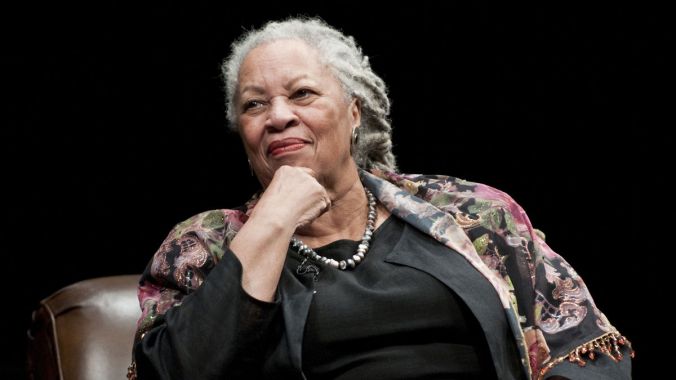
TONI MORRISON

For many years I taught The Bluest Eye in the second term of Junior English. Chris Gilde taught The Color Purple in the senior year, another incredible novel about the black experience in the United States, and a provocative read, a beautiful read. He played jazz and introduced other cultural elements relevant to the novel.

A tall door rises up into this nothing; its hardware is heavy, secure. No bell invites your hand. So you stand there, perhaps, or move away and, later, sticking your hand in your pocket, you find a key that you know (or hope) fits the lock. Even before the tumblers fall back you know you will find what you hoped to find: a word or two that turns the “not enough” into more; the line or sentence that inserts itself into the nothing. With the right phrase, this sense becomes murky, becomes lit, differently lit. Through that door is a kind of freedom that can frighten governments, sustain others, and rid whole nations of confusion. More important, however, is that the writer who steps through that door with the language of his or her own intellect and imagination enters uncolonized territory, which she can claim as right- fully her own — for a while at least.—The Source of Self-Regard by Toni Morrison

I wish I could have taught Beloved in the senior year, but I never did. Instead I did my best to introduce the voices I never heard in my own k-12 education—the stories of women and and people of color, Native peoples and immigrants from around the world.

When I was allowed, I taught stories and novels and poetry from many continents. Things Fall Apart by Chinua Achebe was life-altering for me and I enjoyed teaching it. If I read it aloud, even less attentive, less skilled students were drawn in. I would have liked to teach the Indian novel Nectar in a Sieve by Kamala Markandaya, but did not find an opportunity to add it to the curriculum.

The Junior year was traditionally focused on, and at first mandated to focus on U.S. literature. The novels and memoirs I tried were not always successful. Ceremony was a challenge, but A Yellow Raft in Blue Water and Black Swan Green were great favorites. I taught and love still Adventures of Huckleberry Finn. My students loved that novel only if I read it aloud. Bright students generally skim more often than read and lost patience for jargon and slang if they had to read it on their own. They had more patience with Their Eyes Were Watching God. For many years students loved The Catcher in the Rye, though I never did quite love it. Ironically, The Bluest Eye was harder and painful, but it was the one novel I was likely to hear about later. Students in college often wrote their thanks for the introduction to Toni Morrison.

I taught four to six novels every year to high school students, at least a dozen short stories, newspaper articles, a month of poems in the spring, and writing, writing about everything. Students completed four to five essays in multiple drafts each term. They wrote an on-demand essay each week. We wrote fiction and memoir and poetry.

An easy class only teaches students they are weak. Demanding their best reveals how grand their best can be.
 

COMMIT TO ENDINGS

IMG_1704 (1)

I struggle with endings, with hitting the balance between hope and regret. Despite wanting my students to listen carefully, review assignments, and take extra time to perfect their work, I am impatient myself. I always wish I’d done something different, pushed harder, and accomplished more.

Monday, I had my students over for a party at the end of the year. I haven’t done that in years. I think they had a good time and we ate and laughed some. I sent them out on the beach while Gary and I cleaned up, and they came back after a long time, grinning and sandy.

They asked me if I wasn’t glad the school year was over.

I almost never am.

These are graduating seniors, with summer plans of work and travel and college classes in the fall.

I always wish I had more time, that I could have their full attention for another month in order to, as my mother would say, “whip them into shape.”

The truth is, I am slow to get to know my students, and then I value them as people. I wanted them to work harder and mostly they did. They made no more mistakes than I did in high school, but expectations have not been set nearly high enough. They have coasted too much.

An administrator complained to me the other day that these current high school students are afraid of things being too hard, that their parents do not want their children to struggle, and that even some teachers find it impossible to set high standards because doing so makes more work for them too. Everyone wants to make education easier, as if that were possible or even a good idea.

Throughout my teaching career, I have been asked to articulate my teaching philosophy. After 40+ years, I would say it comes down to this: Set a high standard, support incremental growth, and demand excellence. When we show them they can accomplish beyond their expectations, they are capable of pushing on. When we make the work easy, we are telling students that “easy” is all they are capable of accomplishing. We reinforce their belief that struggle is equal to failure.

Many years ago, I heard Kylene Beers speak at an NCTE Conference. I’d been heading into the conference room next door, but the presenter in that room stood outside her door: “Go see Kylene. You’ll be glad, and I am presenting again in the next session.” I took her advice. One of Kylene Beers’ key points was to reveal struggle as a good and natural process. “I struggle when I read the tax forms. I struggle when I read Toni Morrison.”

The choir teachers from my son’s high school days were exceptionally demanding. Do it better, be stronger, try something even harder! Sometimes those teenaged singers would listen to their songs and be simply amazed at how excellent they sounded. They produced professional performances. They gained confidence and ambition as a result of that demand to do the harder thing, that insistence that they do it and do it and do it again, until they have mastered themselves.

Learning is struggle, struggle makes us strong, strength makes us better.

My teaching is done for the time being and I must return to my own work. I still have a warp to wind, a quilt to complete, and a story that wants editing.

This week: Slow down, do better, amaze myself.