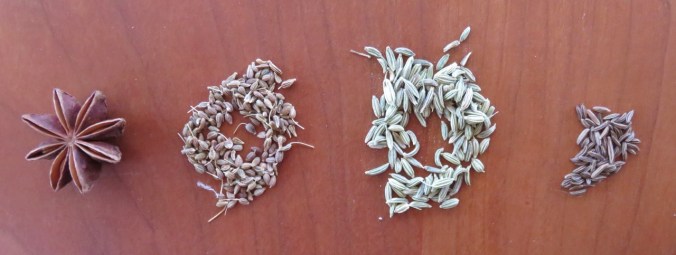
STAR ANISE ANISE FENNEL CARROWAY
So. If apples are a fruit, and pineapples are also a fruit, then pineapples are a kind of apple. And pineapples are surely similar to pinecones? Then pinecones must also be apples!
Don’t worry, it’s not logical. It’s just the way my day has gone.
I had a peculiar experience today while searching in Whole Foods for aniseed (anise) to bake a seed cake for my students. I reviewed all of what they had. No anise. I found a hapless produce worker and, after apologizing for talking to him when I knew it was not his area, complained that “I can’t find what I want.”
Another employee appeared at my shoulder. “What are you looking for?” He sounded more annoyed than concerned.
“Aniseed.”
“Anise? You want anise? That’s the same as fennel.”
“Is it?”
He pointed to packets of star anise and other packets of fennel. I thanked him, though he still seemed somewhat cross. I got all the way to check-out with fennel seed before I remembered I’d made this mistake before. It’s easy to assume that they are related, but fennel seed and anise, not to mention star anise are not the same spice. Not quite.
Star anise (Illicit serum), found inside a fruit, originally grew on small evergreen trees in China. I have eaten it in tea, but never baked with it. According to Wikipedia it is “a highly fragrant oil used in cooking, perfumery, soaps, toothpastes, mouthwashes, and skin creams. About 90% of the world’s star anise crop is used for extraction of shikimic acid, a chemical intermediate used in the synthesis of oseltamivir (Tamil).” It is sometimes used in the west as a cheap substitute for aniseed.
Aniseed (Pimpinella animus) is from a flowering annual plant native to the Eastern Mediterranean and SE Asia. Wikipedia says it “is widely cultivated and used to flavor food and alcoholic drinks, especially around the Mediterranean. It served as a carminative in herbal medicine.” I love it in pastry.
Fennel seed (Foeniculum vulgar) comes from a member of the carrot and parsley family found originally in the Mediterranean. The bulb at the bottom is a delicious vegetable I frequently add to dishes. But no, fennel is not the same as anise. They are not even in the same genus, though Wikipedia points out: “In North American supermarkets, it is often mislabeled as ‘anise’.” (I swear I did not post that.) See above. Do they look the same to you? Trust me, they do not smell alike.
Caraway seed (Carum carve) from another member of the carrot family native to western Asia, Europe, and North Africa. I’ve used this in seed cake, it taste nothing like the others, and is most often found stuck between my teeth after eating caraway rye bread. I put it here because, up close, the shape of the seeds resembles fennel more than aniseed does and because seed cakes are more often made with caraway. The plants of caraway, anise, and fennel all look similar when in flower, to be entirely honest. But they are not the same.
Wikipedia and my nose tell me that fennel, both seed and vegetable, anise, and even star anise all smell somewhat like licorice. (Caraway does not.) While both fennel seed and star anise are sometimes substituted for anise, the scent and flavor are distinctive in each. They are not identical, and none of them are true licorice, which comes from the root of an entirely unrelated perennial legume plant found in southern Europe and some parts of Asia (Glycyrrhiza glare).
Who knew?
Tomorrow I will bake the seed cake. Photos to follow, if I am successful in emulating the delicious flavors of the Pearl Bakery’s gibassier pastry. I have candied citrus peel on purpose.
 IMPERFECT PATIENCE