
As a child, I thought I would one day have many horses. This is one of my horses.
When I was a teenager, my mother was buying and selling antiques. She reported the income as coming from both herself and my dad because, having worked for the feds and before that for a college, he did not have many years in the Social Security system. In other words, he qualified for a federal pension but not for Social Security benefits. Mom wanted to ensure he could have both so my dad was a partner in the resale business of antiques and collectables. Today, she would have done this via Ebay; in those years, she attended flea markets and antique shows.
This was a good lesson for me as a teenager, to see someone planning ahead.
Talking about money is uncomfortable. I get that. It is for me too.
Some in my parents’ generation were diligent about preparing for retirement. They may have been particularly motivated if they faced particular challenges related to race or religion or divorce, humble upbringing or handicap. There was also the fact of growing up in the Depression, which tended to instill a sense of monetary insecurity and need for preparation. And the G.I. Bill had sent a generation of Americans to college who would not have had that opportunity in previous decades.
The G.I. Bill was initially conceived primarily as a home-buying incentive for returning veterans. The educational portion was tacked on at the end, but it might have created the most dramatic shift in American culture.
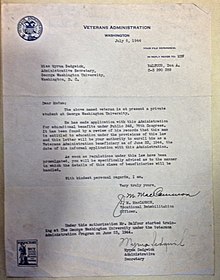
Don A. Balfour was “the first recipient of the 1944 GI Bill.” Veterans Administration letter to George Washington University.
On June 22, 1944, the Servicemen’s Readjustment Act of 1944, commonly known as the G.I. Bill of Rights, was signed into law.
During the war, politicians wanted to avoid the postwar confusion about veterans’ benefits that became a political football in the 1920s and 1930s. Veterans’ organizations that had formed after the First World War had millions of members; they mobilized support in Congress for a bill that provided benefits only to veterans of military service, including men and women. Ortiz says their efforts “entrenched the VFW and the Legion as the twin pillars of the American veterans’ lobby for decades.”
Harry W. Colmery, Republican National Committee chairman and a former National Commander of the American Legion, is credited with writing the first draft of the G.I. Bill. He reportedly jotted down his ideas on stationery and a napkin at the Mayflower Hotel in Washington, D.C. U.S. Senator Ernest McFarland, (D) AZ, and National Commander of the American Legion Warren Atherton, (R) CA were actively involved in the bill’s passage and are known the “fathers of the G.I. Bill.” One might then term Edith Nourse Rogers, (R) MA, who helped write and who co-sponsored the legislation, as the “mother of the G.I. Bill”. As with Colmery, her contribution to writing and passing this legislation has been obscured by time.[Wikipedia]
Like slightly more than half of World War Two veterans, my aunt (Marines) and my father (Army) used the G.I. Bill to gain a college education. Both went to the University of California at Berkeley. They were first generation. My mother was too young to have served during the war, but she lived with her sister and after the war also attended UC Berkeley before her marriage.
The Bill was not perfect. It suffered from the bigotries of the day, stumbled, lapsed, but has been renewed in recent years. It still looks like opportunity for many young people seeking to serve their country and find a better life.
There used to be a popular fiction, the Horatio Alger myth, that encouraged a belief that in America anyone can rise. Indeed, many have come to our country to find a better life. Many have found that better life, but actual wealth tends to run in families. We do not live in a fluid society. Children born into affluent families may achieve actual wealth (Gates), but the rags-to-riches story is rare to nonexistent. (Riches-to-rags is an easier move. There is plenty of research documenting how a single generation brought up in privilege can squander wealth.) Most people shift slightly up or down in class, work and earn slightly more or less than the generation before them.
It has never been easy to shift social classes, and there is deep resentment among the wealthy, hence derogatory terms such “Nouveau Rich” and “social climber.” Research suggests that active resistance has grown. Social mobility is less likely today than is has been in the middle of the last century. My mother’s mother had hoped to attend college and according to family stories was accepted to Reed College, but was unable to attend when she and her sister were forced to support the family due to a strike. Later my grandmother was an office manager in a shipping company, a single mother supporting her daughters. My own mother attended college only until she married. I have four college degrees, and my sons have four between them.
What we are given is ultimately less important than what we assume we are entitled to pursue. I assume my grandchildren will attend college, and because of such assumptions about their futures, they likely will. My parents assumed as much for me. My husband attended college only because I did, not because anyone in his family had ever attended college or because anyone in the educational system encouraged him. He graduated in 1974 with honors and Phi Beta Kappa. His work has rarely relied on that education directly, but a look at his bookshelves reveals a man still interested in his own education. I am proud of him—he is interested in knowing.
Assumptions about my own life have also flexed. I thought I would teach till I was in my 70s, but a year of lingering illnesses forced me to retire at 62 when there was “no money” to offer me a half-time teaching position. I have not been sick since, though I do still teach two college classes each year.
My husband and I have three pensions between us, none of them enough to pay rent, but adequate together with Social Security, which we each paid into since the 60s.
My mother was determined that she and my father would enjoy a secure retirement. In practice, life did not proceed in the manner she hoped for. My father was forced to retire early due to rheumatoid arthritis. He died of lung cancer before reaching my age. My mother moved alone to a coastal town in Oregon, and her contractor underestimated the cost of her retirement home by a factor of three, so she went back to work part time for a few years.
We do what we can and hope for the best.



 &PRIDE Press