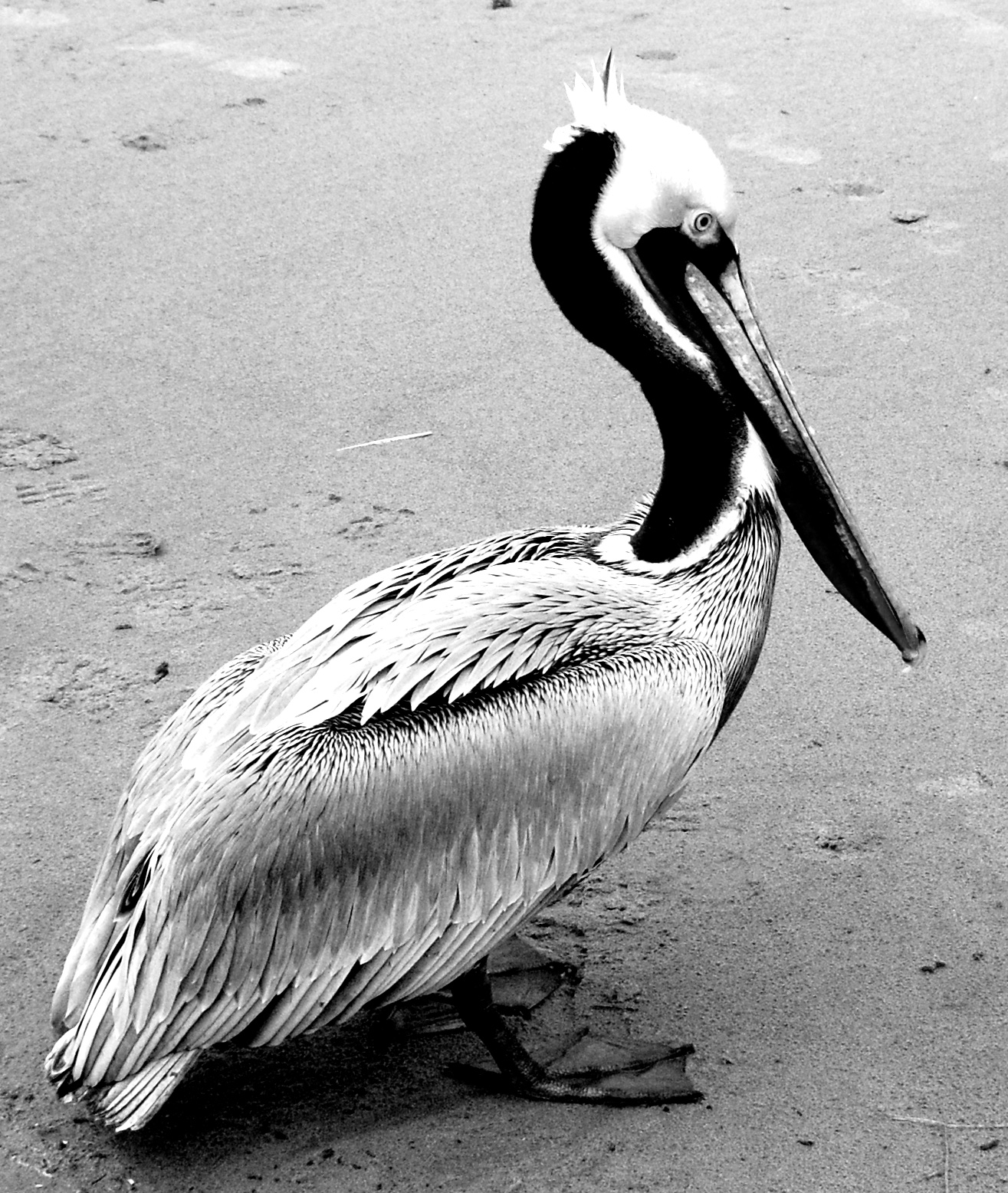
MY FAVORITE BIRD

Six months ago, Gary and I stopped drinking altogether. Gary tells people who ask that he stopped because I asked him to as a birthday present. Okay. Maybe. It saves money, spares us hangovers, and mostly preserves our minds. We would deal with the pile of diapers, the alcove deep in gin bottles, and the damage—the work cleaning up the mess in our rental ADU had only just begun. For years, Gary talked to our longtime tenant most every day, sometimes for an hour or more. He’d been afraid the man would kill someone or at least himself driving drunk. Fortunately, he survived. We finished the repairs and improvements right at the beginning of last month.
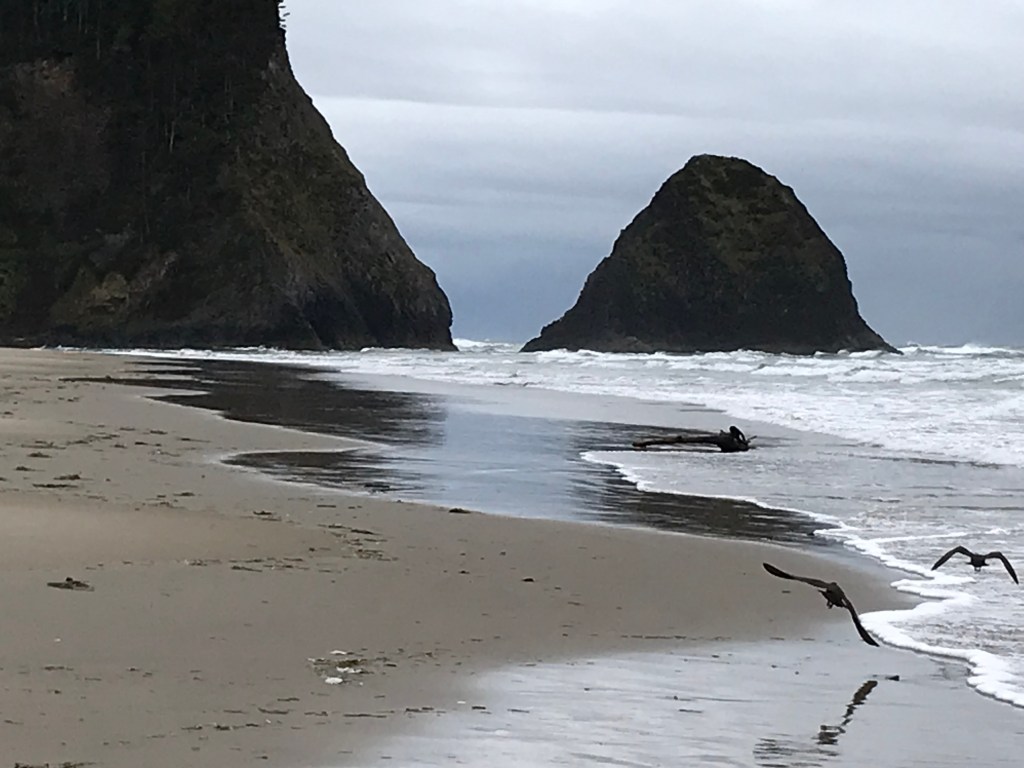
Three black oystercatchers (only two visible at lower right)—the parents who nest nearby, and this year’s juvenile has flown out of the frame. They are my favorite bird.

Yesterday, we disagreed about how far to walk before heading out for the day. I said four miles, Gary lobbied for two. We were a few hundred yards out when the hail began. If we’d waited ten or fifteen minutes, we wouldn’t have been wet by the time we scampered home!

I’m running a mile every other day now. Not easily, but I’m making quicker progress than I had any right to hope for. I started with a challenging half mile on the April Fool’s Day—yes, a joke on myself and also the anniversary of my first run decades ago. I’m starting from scratch—no condition at all. Last year, I injured my feet doing very long planks, and then again while on my hands and knees working on that rental. Gary pruned (butchered) the escalonia in order to give the new tenants a broader and clear view of the ocean. Apparently, they don’t look west and hadn’t noticed. sigh I’ve been walking daily but had been injured out for most of a year. At my age, “coming back” is not a given.

The other morning there was only the gale wind and a little rain. Tuesday, there was a “dust devil” in the sand just up shore from where we walked. We walked about four miles, all the way to the waterfall just south of Hug Point. The rain started right then and poured all the way home, right into our face with a full gale. A dead owl, we think, lay in the tideline, head naked, short and dark hooked beak, dark flight feathers well over 12″ long, barred tail. By the time we got home, we were soaked and cold, had oatmeal for breakfast, curry for dinner, and went to bed early. But this morning I managed my planned 1-mile run. Best I can tell, I’m managing miles in under 12 minutes, which is not bad considering everything. My realistic goal is a 5k run by August. My “secret hope” is to do the Bridge Crossing in October again. That’s a 10k, 6.2 miles, and usually bad weather, but I’ve done it several times. At least Gary I expect to do the Zoo walk/run in Portland on Thanksgiving—that ranges from a 5k to 6k, with no warning in advance of distance—and we can walk as much of it as we choose. I ran it last fall.

In the mean time, Gary is playing his guitar as I began writing this post on Wednesday morning. That alone could make me cry. It’s been too long, his fingers sore and cracked, but he rested after our soaking walk, and maybe he’s back. He’s taken each one out and tuned it, played a bit. He says his guitars are “not in bad shape. I don’t see any bad things.”
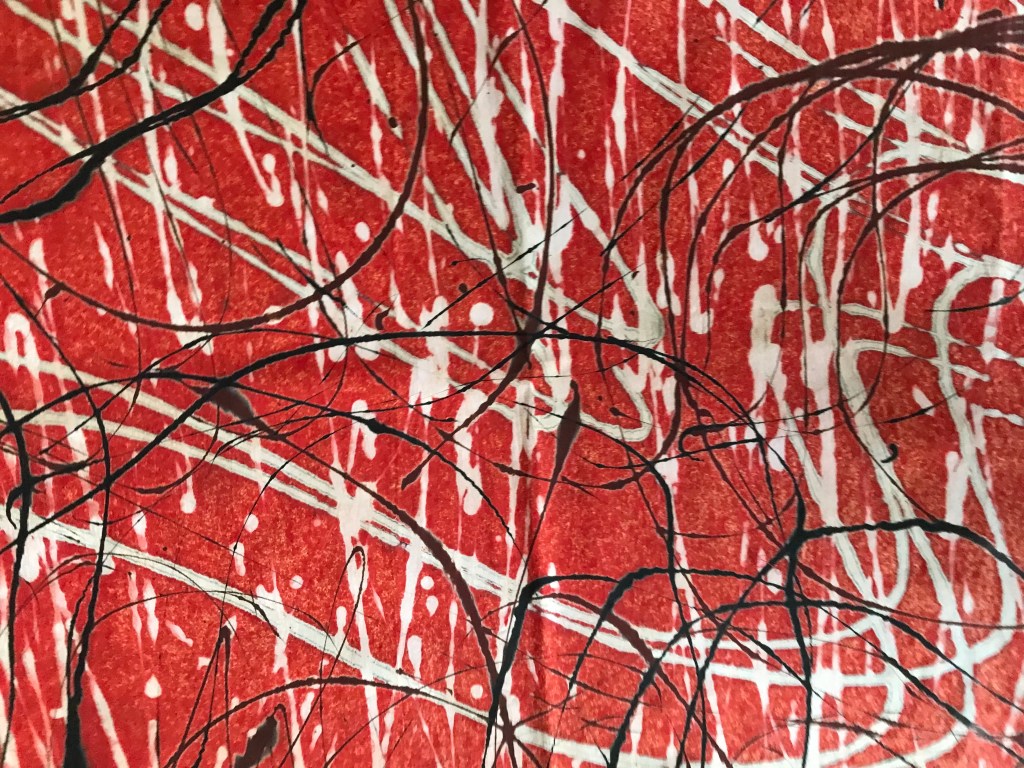
The focal fabric of my next quilt, “Otherland II”. This is a hand-dyed “batik” and I’ve studied on it for a couple of decades, maybe, trying to decide how to cut it. It’s just so gorgeous on its own. Last month, I thought I’d cut triangles—a design I’ll save—because this will zigzag.

.

It’s a rare fabric, not stenciled or printed, but with both color and resist hand applied—spaced and dripped—and similar in process to the fabric in the quilt top waiting for quilting in my closet. I hope to be able to have this new quilt and the earlier “Otherland I”, below, machine quilted this summer.
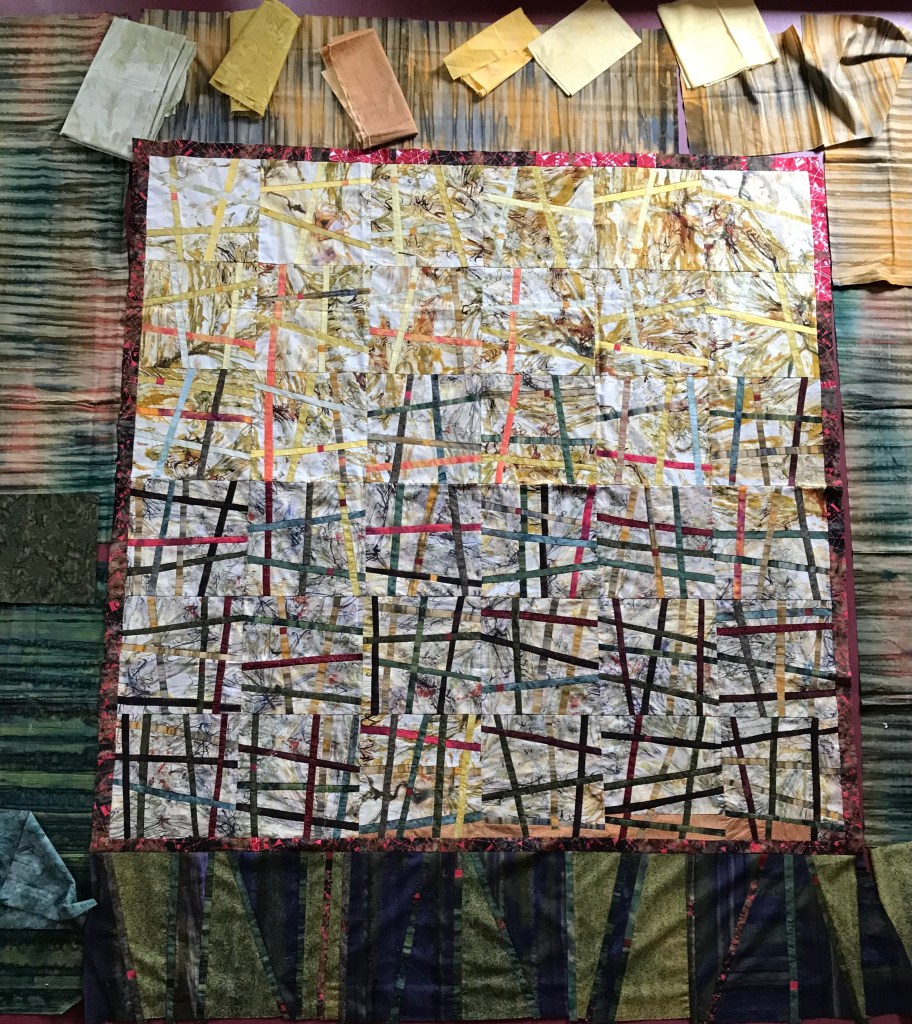
Shown in progress. The center of “Motherland I” is done but only the lower portion of the wide border—with fabrics laid out for top and sides of the border. All the batiks used here are atypical. The background fabric in the center panel in not actually “batik” but another more hands-on technique. This top is complete and waiting with the backing fabric for me to spare the money to have it quilted.

In other news, I have chosen a press for self-publishing my novel. No money for it at the moment since it all went on repairs, but in the fall, perhaps. I am thinking of my birthday in October. A friend has given me notes on my ghost story, so there’s that to work on.

The sun is peaking through.

ALL THE DAUGHTERS SING

At least five years ago, I typed out the first draft of a story in which nearly all moveable life on earth had died. It was too long and when I tried to cut it back to below five thousand words… it got longer. Then it became a novella with over twenty thousand words. I managed to shave a couple of thousand words. The next draft, completed during National Novel Writing Month in November 2021 (whoops, during 2018!), was a full length novel. (NaNo requires 50k but I wrote over 75k.)

Terrible things are happening. I am not unaware, but today, only the wonderful-in-a-good-way news. I have reasons to feel amazed at my good fortune.

We both looked at this sky and felt amazed—it was more impressive in person, of course, but that plume of cloud over Castle Rock!
Continue reading

BREAK A LEG

IMG_5234

Some of this story is fiction, but it doesn’t matter which parts because that’s not the point.

When you are seventeen, riding a borrowed bicycle, you are stuck by a car and suffer what they used to call a compound fracture. You could search online for what they call that kind of break today.

Continue reading

BIRD STORIES

CSC_0322

In the last week: band-tailed pigeons and Eurasian doves, Steller’s jays and a single scrub jay, robins and goldfinches, red-wing blackbirds, song sparrows, hummingbirds, crows and ravens, bald eagles, red-tailed hawk, black oystercatchers, gulls, whimbrels, Canada geese and brown pelicans, and a mixed flock of semi-palmated plovers and dunlins (this latter with distinct dark bellies—I wish I’d had my camera). Gary calls the black birds with bright eyes “cowbirds”, but I wonder if they are the same as a bird called a Brewer’s blackbird? They are new in our neighborhood.

The other day I watched three pairs of Canada geese herding 15 goslings across tidal flats fifteen miles south of my home. One pair had 8 babies, one pair had 4, and one pair had 3, and the tender care of both parents was genuinely touching. I was at the dentist having my teeth cleaned, but everyone stopped what they were doing to admire the three families.

There is a story there.

At least twenty years ago, my writing partner Rebecca Olson noted that my stories always had birds in them. I had not noticed. It is my husband who loves birds. As a result, I think about birds more than I would otherwise.

That impulse to focus on birds has resulted in stories. I imagined children falling asleep and becoming owls; then the owls fall asleep and slip back into being children. My story “If It Were True Owls Dream” was accepted for publication by Liminal Stories and will be available online in July. The first day I sent it out was to Shimmer and the editor E. Catherine Tobler rejected it but urged me to send it to Liminal. I owe her for that excellent advice.

Most recently, I began a science fiction story wherein I imagined all the birds in the world dying. I originally meant it to be a short story, but the early draft grew longer and longer and more and more complex. I have drafts that are nearly 20,000 words long. This fell into three parts, one in the near future, one hundreds of years later, and a third part even further into the future. Then I worked just on the first section, which was also the longest at nearly 10k. A friend urged me to cut most of it, which I did.

I had the idea of the vanished birds, but also other ideas about veganism and overpopulation. Then it became a story of about 6,000 words that began working as a story. It was not done, of course. Not in four drafts or ten, since I have only been working on it for a few months, but still. It is science fiction and it is about birds . . . and mostly about life on Earth.

I carved back that shorter story and carved back some more. It is less than five thousand words now and maybe it works. Probably it lags in the middle because my stories often lag in the middle, and there is not enough action—there is never enough plot in my stories.

There are usually birds.

I want another story, and I have one, but it is not quite figured out. “On Cherry Street” is about a young woman returning to the house where her mother died. She is very much aware that crows are watching. Birds again. I still don’t know what it is trying to be. Is it a horror story? I’ve not explored horror. Is it magic realism? This story is about four thousand words and I am not even sure what it is about.

Back to thinking. Back to visualizing.

When I create a story, as when I create anything, I need a solid visual. This is true when I am piecing a quilt or, just recently, designing a program cover for an event. Most often what I am creating must be complete in my mind before I actually make it. Even the weaving where I deliberately provoke randomness and choose yarns that vary in color, I have a vision. When I was painting, I would spend far more time imagining what I wanted to create than actually painting it. The stories are harder as I build them up and tear them back down on the page.

Creative work is like that. How and what we create must be first born in the imagination. Only when that vision has grown can the work be realized for others to see. Sometimes the ideas come home to roost.

There is always the danger they will simply fly away.


DONE/NOT DONE

Eight hours, then six hours the next afternoon, then a day off, then another seven hours revising my 2016 novel after working my paying job. I have queried it more times than I am willing to admit and under four different titles. (The husband of a friend suggested the title last week that I think has stuck.) I have written eleven drafts of this novel. It has drifted up and down between 75 and 82 thousand words. Two agencies are interested. I just queried another agent, and I have sent out 22 story submissions this year. In March, because clearly I have too much time on my hands, I committed to writing a 40-page novelette and a new poem each day in the month of April.

Ask me how that’s going.

I have a few lousy poem drafts and 21 pages of a science fiction short story that is already too long and does not want to be novelette. (We’ll call it the “pigeon” story, because it does actually have a pigeon in it for about a page.) I really do want to put the pigeon story aside because it gets more strange and complicated every time I think about it. And anyway, it’s done. Isn’t it? Sixty-five hundred words is long enough and I should stop. Shouldn’t I? Or maybe it’s only that I do not want to give it another 20 pages. It’s a lot more work for a story that is strange without being actually horrifying, and which no one will like, right? Maybe I am even afraid of what will happen if I do write more? That is entirely possible. I am not sure if there is a market for stories this long, and the story itself is creeping me out more than a little bit.

Like so much of what I write, this one, the pigeon story, starts with a story about birds. I have another creepy bird story that already wants work. It has crows. Maybe I can set this 21-page pigeon story aside and work on the crow story for a few days. The owl story is going to be published. I am afraid to look at it again. Heaven help me, I know I would begin to revise.

My husband and I went on our first actual vacation in fifteen years last month—all the way to Victoria in Canada. Both of us are familiar with Vancouver Island and Victoria from our youth. Gary had Unitarian friends there when he was a teenager and I used to show dogs and stay with friends on the Island.

We did not take a device capable of accessing the internet with us to Canada. For three nights and four days, we were out of touch. Even the flip phone did not work since we were out of the country.

I had been busy sending out work before we left and several pieces were being held—short-listed for further review. I did not think about them. We napped, walked, ate, looked in shops, talked, admired views, and napped some more. I finished reading two books, but I did not even write in my journal or take photographs. It was a lovely time, and I fell asleep in the car while my husband drove most of the way home.

As we neared home, I took over driving because the bridge over the Columbia River is four miles long and he Gary hates driving across. I confessed to him that if I did not have some sort of positive response to my writing when we got home, I was going to be sad. He replied with suitable gravity that he expected that.

While I was reviewing two hundred unread emails, I found the good news I hoped for. And while responding to acceptances of the owl story and the crow essay (not the crow story, which is something else), a request for a full manuscript of my novel arrived from an agent I have queried in the past.

Yes, a very good day. I was happy and I congratulated myself and my husband and I drank a full bottle of sparkling wine. Yes. Yes, we did.

And without in any way dismissing the glory of this good news, these three successes, I do not believe I “have turned a corner” in my writing life. Everything will not go well from now on. It may immediately go back to mostly unsuccessful. For example, no journal will choose to take the story that three journals are currently considering—even though each has held it twice as long as they usually hold work. (The longer they have it, the better—it means that a first reader liked it well enough to pass it on, and the second reader too.) It’s likely that all three of the editors thinking about liking my story will decide they do not like it enough to publish it. That happens all the time, often enough that a website online tracks not just the text of form rejections, but also the text of “higher tier” rejections. I mostly submit to journals and magazines with an acceptance rate somewhat below 1%. I am submitting to journals which show hundreds of submissions but no acceptances at all in the stats at Duotrope where I track my submissions. Yes, I could make it easier by sending work to smaller journals, but if I wanted easy, there are other things I could be doing rather than writing stories with birds in them.

Nothing is changed because I have recently had a story and an essay accepted. My mother always warned me about getting my hopes up. I have been up there before.

There was the year I won a Literary Arts grant, was accepted into an MFA program, and had a story published by Calyx. This was followed by hard work on my MFA and then . . . nothing. My mother died. I could not write at all but dwelt on one story day after day without making any progress. Three years passed.

There is no corner a writer can come around and find everything easy and neat. Writing is not like we might have hoped, like maybe the man in the White House thought everything would go his way, once he won the electoral college.

Real life, even if you get away with telling lies or you write fiction, is messy and out of control. If you told the truth or wrote nonfiction, it would still be messy. Poetry? Messy, messy, messy. Right up to the moment the poem sings.

This is what I know about success:

  • success does not last, but good writing does
  • acceptance is glorious—celebrate when it comes
  • nothing good can last, but neither will the bad
  • count rejections because they will come anyway (I already have 33 this year and my goal is to have 100 for 2018)
  • sometimes the “dream market” is the only one with readers smart enough to appreciate your best (A prize-winning story of mine was rejected by tiny journals before finding publication with a better one. This happened twice.)
  • failure was at the beginning and so it shall be at the end

Almost 400 years ago, Hobbes claimed life is “nasty, brutish, and short.” Writing should not be like that. But the struggle is long and exhausting. Reward seldom comes when we need it most. People misunderstand, but I know for certain that I am never certain about what I am doing. The writing is messy and personal and haunts me awake and asleep.

In case it’s hard to tell, I am enjoying myself quite a bit just now.