An imperturbable demeanor comes from perfect patience. Quiet minds cannot be perplexed or frightened, but go on in fortune and misfortune at their own private pace like a clock during a thunderstorm.—Robert Louis Stevenson
Locals mostly hate the Fourth of July. Too many people, loose dogs, and illegal fireworks going off at all hours. During my run this morning, a dog charged me, barking deeply, and the owner didn’t even apologize. But also a great many brown pelicans, sand all the way around Hug Point, and Gary built a fort. Some bad news, but good food. Education.
There were dozens of brown pelicans onshore in front of our home when we went out about 6:30. We did not approach but took zoomed-in photos. By the time we got home there were people and loose dogs scattered across the beach, and the pelicans had gone off for the day.Continue reading →
The best advice my mother ever gave, and these were words she said to me hundreds of times: Think how the other person feels.
She meant to help me be a kind person. As a child I went to Unitarian Sunday school. Later I attended worship at many churches and temples and houses of worship. Though not religious, I wanted to be a good person. I wanted a clean conscience and self respect. I think that’s what my mother hoped for. Mom meant for me to consider the struggles, trials, and pain of other people and how that influences their actions toward me. She did not mean that I should consider myself last, but thinking how others feel has helped me consider motivations and sometimes allowed me to be kinder to myself. It certainly has forced me, sometimes, to behave better.
I thought I was done posting. I hid my posts in April, then opened them again a month later. And now I try to post. Gary says it’s good that I post. This past week has been especially…. hard? painful? heartbreaking? Is there a word strong enough to explain? Lately, as I walk Portland streets and see someone smoking, I have said out loud: You have known your whole life that cigarettes are poison. These are times when saying anything to a stranger might result in being shot in the face. Safer to post here.
Throughout my life, I have been prone to periods of profound sadness. This is one of those times. I think it is a rational response to the situations just now.
The greatest advantage to living long is knowing things will be better, that I will feel better after a while. I know this, though I do not feel it. I know it’s true.
I will feel better. Maybe nothing will improve, but I will manage.
There are people in the world who built a cellphone large enough for a horse. They taught horses to use it to text messages. (There’s a video showing all this on the website.) The horses might not see the point, but horses play. I suspect most animals have a sense of humor.
We did not walk to the Portland Rose Garden today, as we often do, but I saw a huge cascading rose outside a flower shop. Flushed with tiny white single blossoms, it grew twelve or more feet up and arched over the door of the shop and the sidewalk. The owner of the shop had no idea what variety it was. “It’s a volunteer that’s come up through a crack in the pavement.” She says it sets hips, tiny and red. I will return to collect seeds.
Below, a poem.
BOTANY LAB
by Jan Priddy
A generation ago in my Botany lab,
my partner bends over specimens, scalpel
poised like a paintbrush. He slices flowers
perfectly in half; my turn to peer
through the microscope. I count stamens
and ova. As I draw diagrams, search
for proper names in the text,
I do not notice silence
until it’s broken. Someone,
also hunched over high black counters
and flower parts, asks the air, What sets
human beings apart from the lower animals?Tools comes an answer from across
the room. Aren’t we the only species
which makes and uses tools? We decide
not, since Goodall documented chimpanzees
fishing for termites. Playing, I hear my partner
assert. Man is the only animal that plays.
I look up from the sexual organs of plants
and smile. I think he’s wrong, though I am
not the first to say it. My dog plays with me,
says another Botany student. But my partner
argues with pets. They are domestic animals,
tainted by association. Fawns, we offer,
adolescent lions. Juveniles, he shakes his head.
Adult otters swim purely for fun, we counter.
Porpoises leap in the wakes of ships, squirrels
play tag in trees, foxes pounce on dandelions.
His forehead puckers, scalpel painting the air.
Really?
Under my microscope, a five part flower,
many stamens, fleshy calyx-tube.
Family Rosaceae,
genus Rosa,
species multiflora,
precisely like
the illustration in my text—
a local flower I see each day.
“Botany Lab” was first published in StringTown, 2001
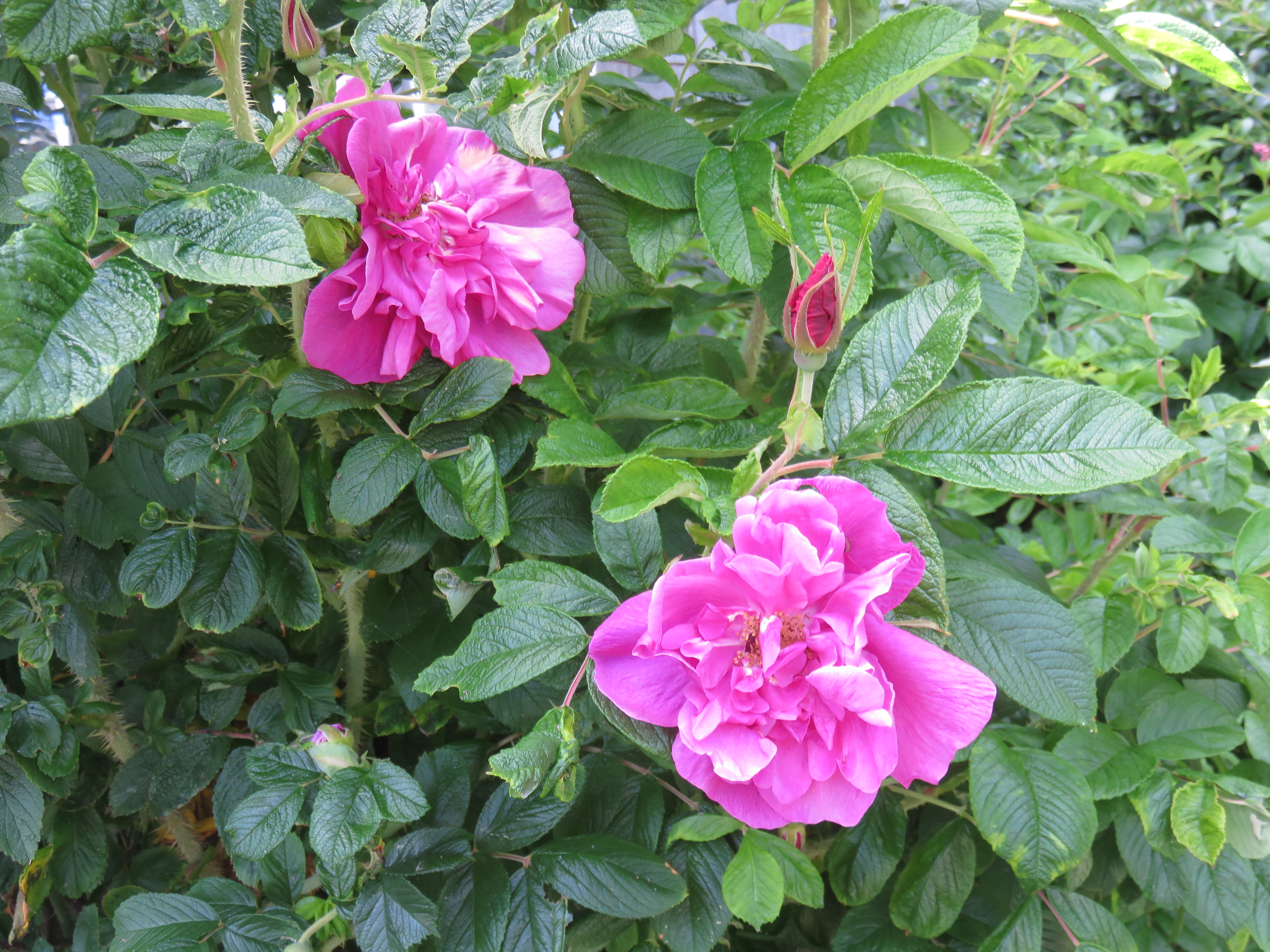
The semi-double Hansa is a rugosa rose. This one is planted on the east side of our property. I took it as a volunteer from my mother’s garden. The rose it sprang from is no longer there, and ours has to be cut down from over seven feet high here, where it is also sending out plants to fill the bed.
Oregon is home to the City of Roses, Portland, where there is an official test garden and several beautiful public rose garden parks. My grandmother had roses planted along her driveway, mostly memorably Oklahoma, a deep dark red.
Here on the coast, however, salt and wind and cloudy days are a bit of a challenge for hybrid teas and the other well-known roses. What does well here, aside from the wild roses that we fight from taking over, are mostly the rugosas, which require no special care, are disease resistant, and shade tolerant. I counted ten varieties of rose in our garden. The raccoons takes the best hips, and our tenant eats the hips from Hansa.
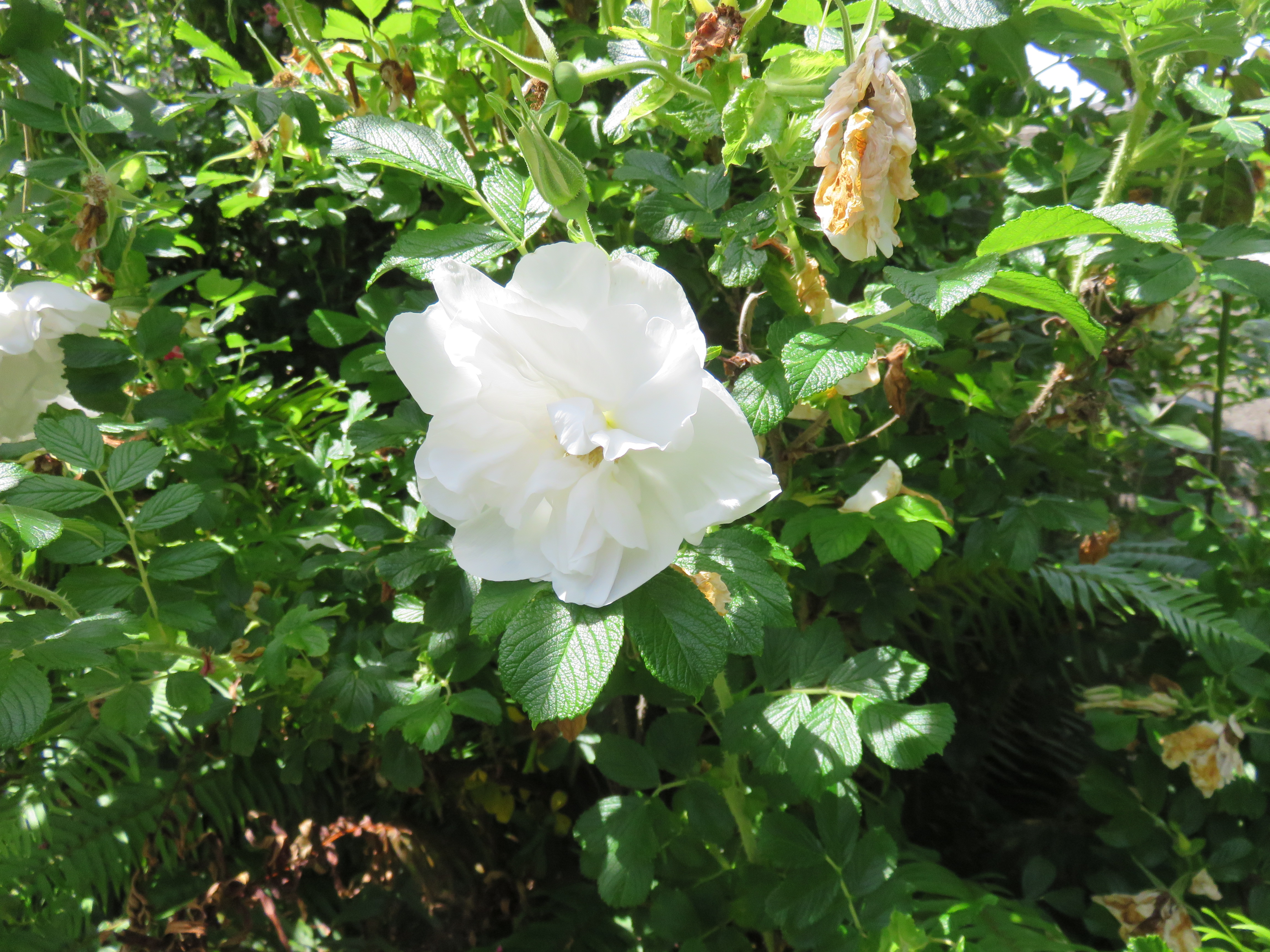
Double De Coubert is another rugosa, marvelously scented. It has long been my favorite. We also have a rapacious single white that would happily take over the world.
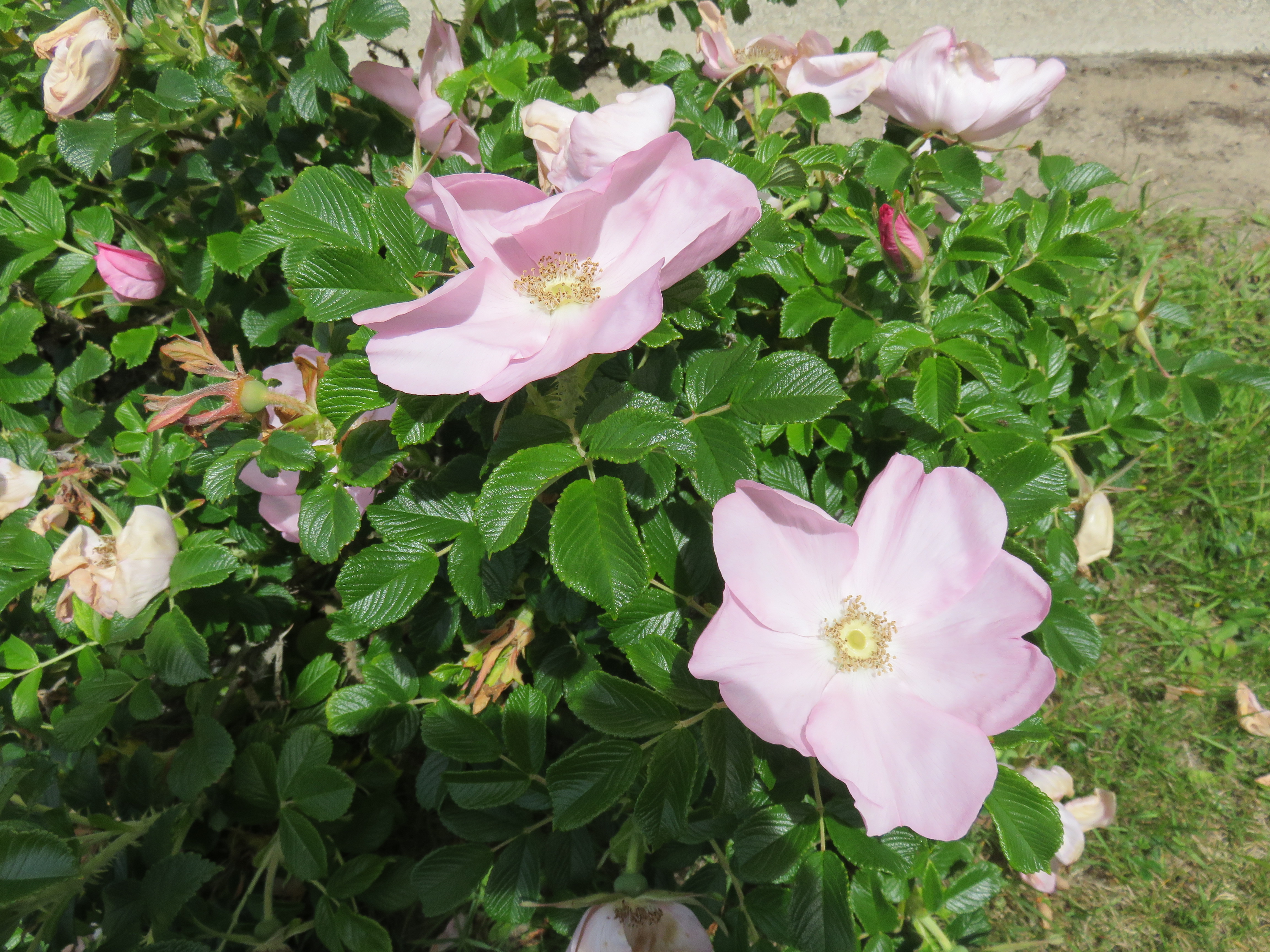
We think most years that this low-growing rugosa in our front (ocean-side) yard has died. It is the last to leaf out, but then blooms for a long time. The flowers don’t look impressive in a photo, but they are five inches across, their spicy scent fills the yard, and the hips are spectacular. They are little small red apples and a chipmunk gets them every year.
This little beauty was a risk this early spring. It is not a rugosa, but I could not resist the photograph showing the dark burgundy eye and bright stamens. Then it bloomed!
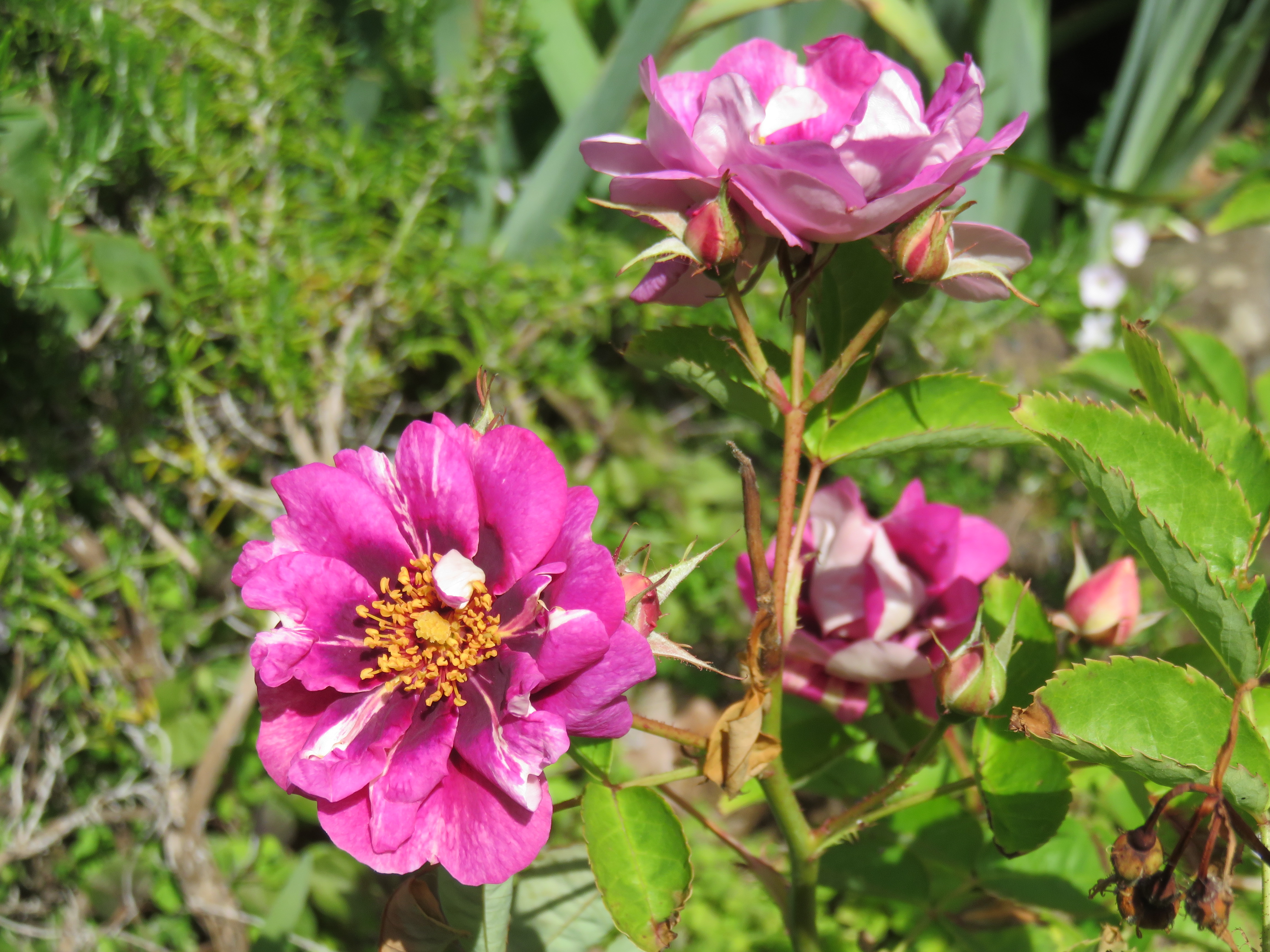
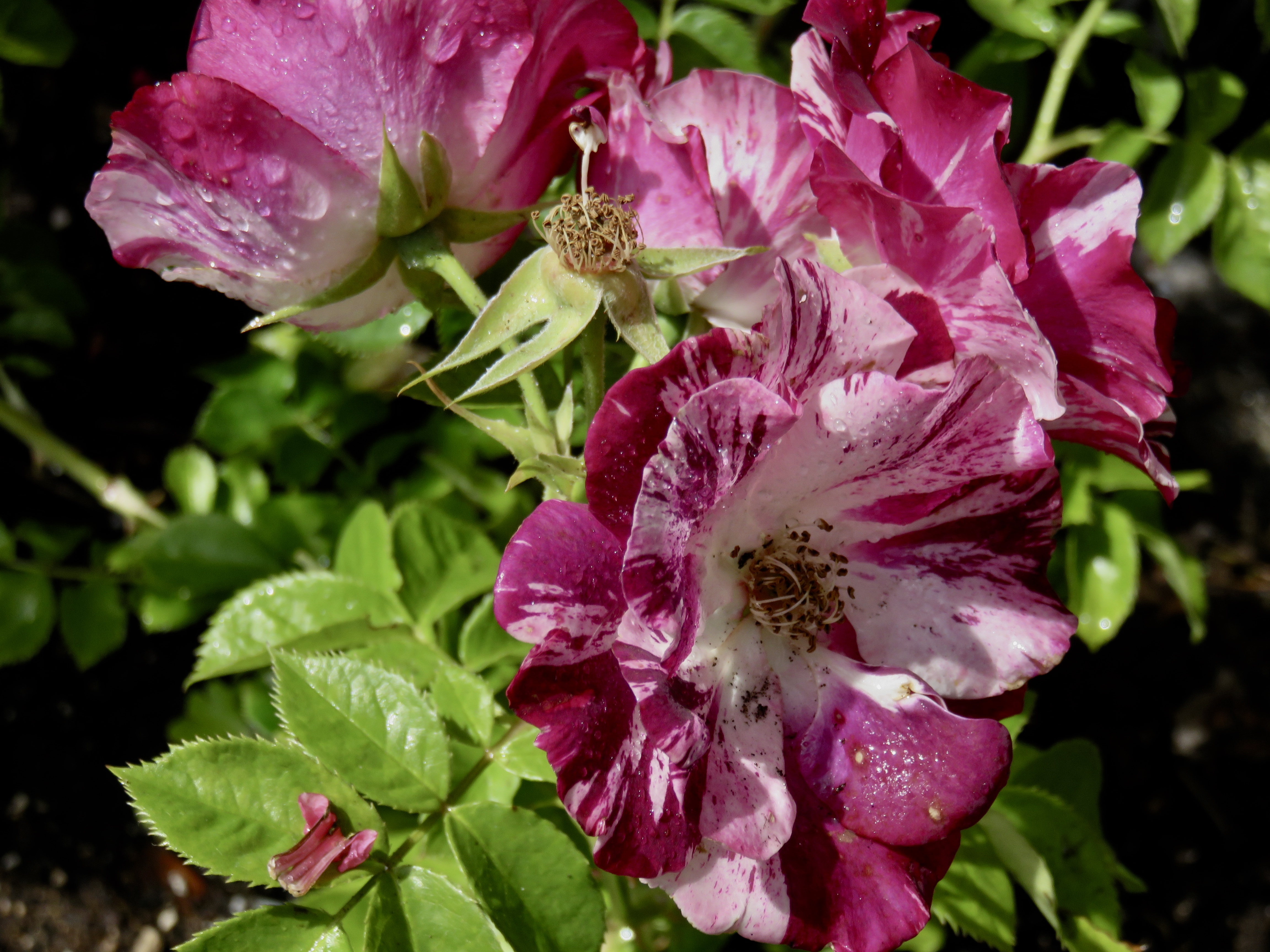
This rambler has medium-sized flower, good scent, and it is striped. I adore stripy flowers, and the colors are just right. The last striped rose did not survive, but this disease-resistant, shade tolerant variety seems determined. We will build it an arbor if it does. The tag says it reaches 12-14 feet.
It is June and the garden is lush: “Everyone looks like a great gardener in June.” I can’t remember who said that, but it’s true. We look brilliant.

 IMPERFECT PATIENCE