LOOKING AHEAD

I have a cold and our building fire alarm woke me just after 4am this morning. I would have liked sleeping a bit longer. But since I was up and a neighbor sent me a link to his father’s obituary, I looked up my father’s obituary and found my grandfather’s obit and naturalization paper (I was 8 when he died, which explains why I have so few memories of him) and my great grandmother’s obit from 1918 in the Daily Astorian. He was 75; she was 60. My other great grandmother, Rosetha [Stiles] Pride was 90 when she died. The last time I tried searching for family, I didn’t get far. Now, if I cared to, it seems I could easily trace my entire family. Instead, I’m looking forward.

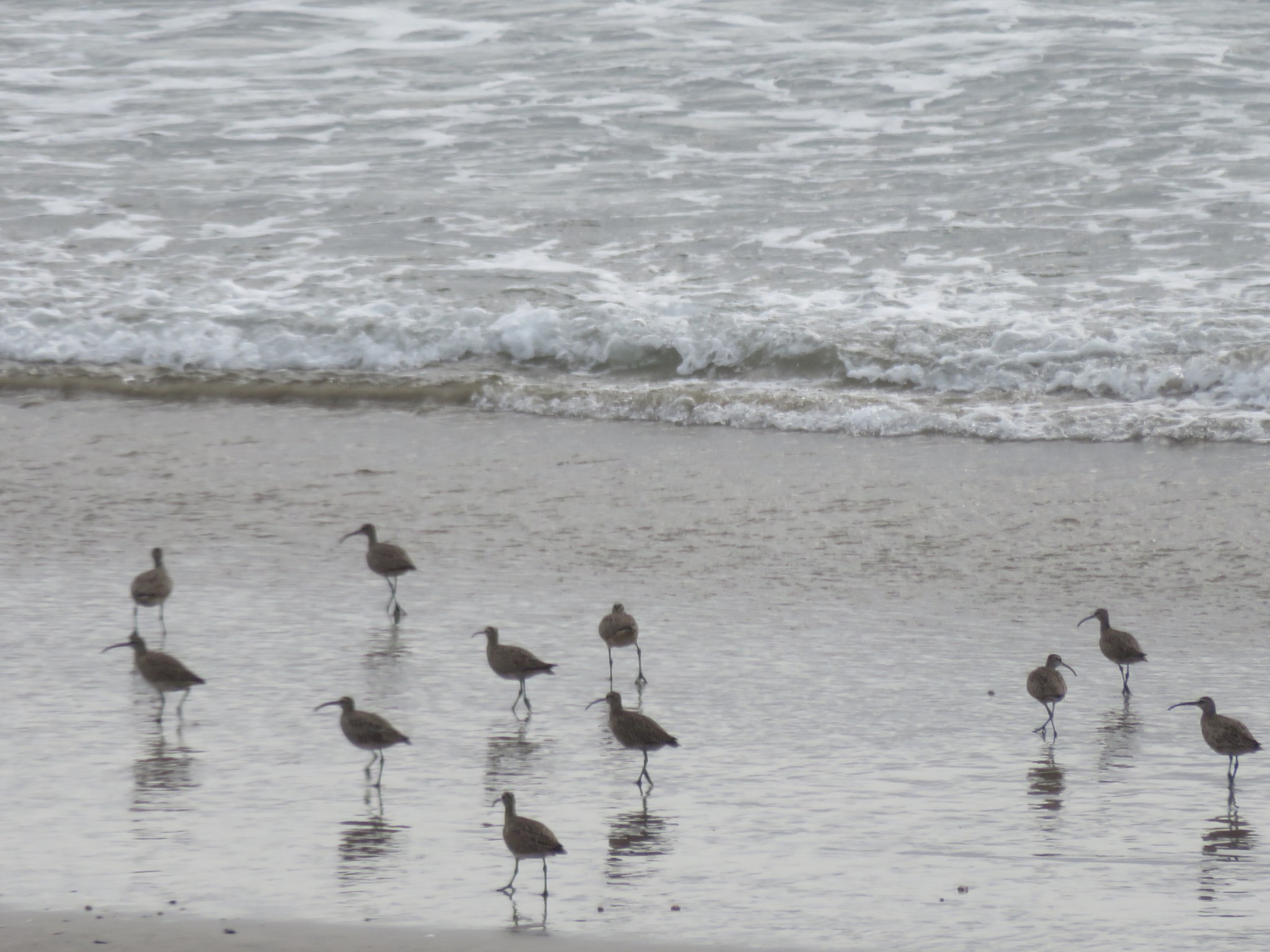
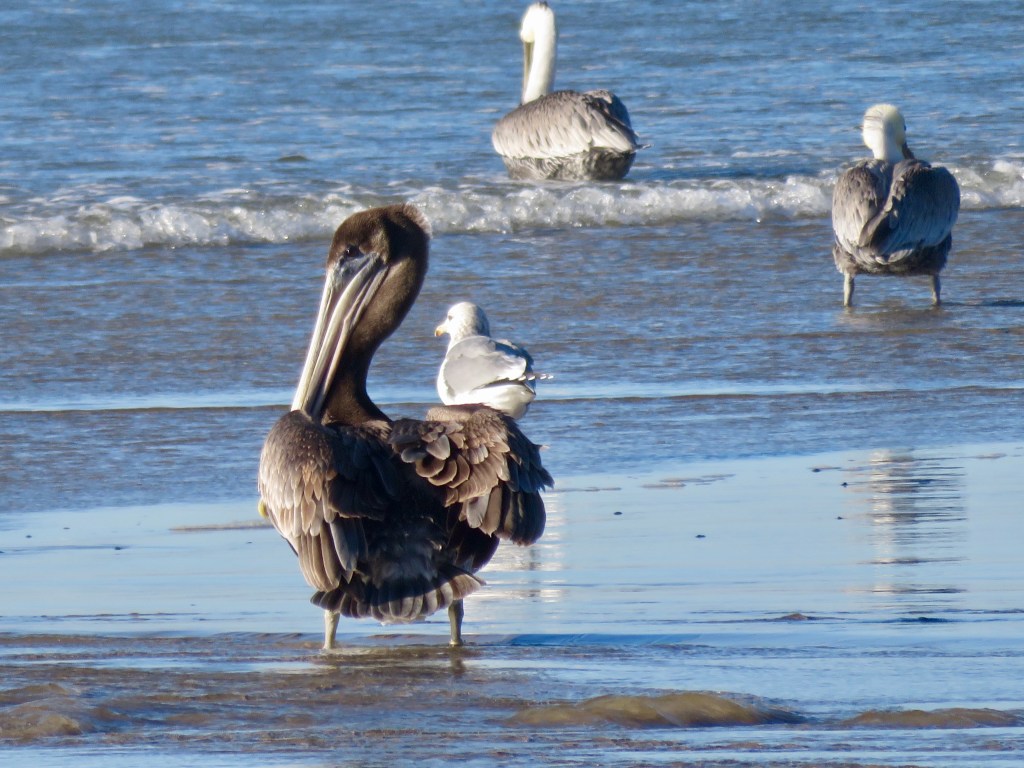
Brown pelicans have been around but not in numbers at the moment. We saw a thousand gulls onshore a few weeks ago. Yesterday morning the local black oystercatchers brought out their kids, and we saw a tiny shorebird that I couldn’t identify. We’ve seen whimbrels off and on. The bald eagles have flown overhead and a few buzzards down in Falcon Cove the other day. Osprey, Cooper’s hawk, crows, and ravens, finches, robins, starlings, sparrows, the native banded tail pigeons and the invasive Eurasian doves.

It’s hard to write about my recent decision without being depressing or sounding depressed. I’m coming to terms. A much more talented friend declared they were done writing, but they still write. A longtime friend sold their loom. Other friends purchased century plots. Someone moved into a retirement home that also offers assisted living. Planning ahead. My husband and I bought our little condo in a Portland neighborhood where we can walk everywhere, a place with view of sky, an elevator building with no requirement to climb stairs, a place where grocery stores are walking-distance and groceries can be delivered, where local restaurants are across the street and around the corner, and we talk to people in the building. Life goes on; sometimes differently. This is our next life.

Continue reading

NEXT?

IMG_2882

Yesterday morning ravens came to eat the stale bread we threw out. An eagle flew low over our heads, and we found the pile of abandoned “treasures” dumped from some child’s bucket. It must have looked like food. Only two gulls stood in the stream. The sky was bright blue all day.That afternoon I counted twenty-eight whimbrels.

There are even more this morning and we are walking out as this goes post goes live. I like thinking someone will read this while we are a couple of miles north on the sand.

To prepare for today’s post I checked back four years ago to the first time I (almost) retired.

I entered a classroom as a teacher-in-training in 1975, had my first job later that next year at a private girls’ prep school. After moving home to Oregon I worked as a substitute teacher for a long time in the English Department, but I quit teaching altogether this past March. I taught high school for over thirty years, and I substitute taught for another decade.

Each April morning between about four and about seven, I spent writing. I do this sitting up in bed. Some days I went right on writing for the rest of the day. It was a busy, reckless month. We went away for two nights. More recently, windows have been open sometimes this week. The ocean is always calling. Today we will get our longer morning walk.

Another retired teacher asked me recently what I would do now that I am retired? It is a good question for which I have no answer. Will I do something new, or merely divvy up my time in a slightly different way? I suspect the later.

What I miss is community. During the past month, various workshops, and my MFA program, I found that writing group I feel I needed. . . . At least for a month or couple of years or a few days at a time, but not regularly. What I have are a few people who will, if I ask not too often, read my work.

My original writing group was twenty years ago and it was only me and one student. B was the first sophomore we skipped over Sophomore English into the most rigorous junior class. This was pretty much necessary since she was, in skill and ability, far beyond her peers. She needed the challenge. She was the one junior in my senior class as well, and one day I walked out of the Faculty Room and there she was coming out of the Library. “Do you want to write together this summer?” I said. She agreed. We thought we would try writing a novella, just for the challenge because it is longer than a story and neither of us had written anything long. We weren’t even sure what a novella was, so while I was busy ending the year in yearbook, B researched.

After school ended in mid-June, we began writing and meeting weekly to share and respond to each others’ work. Neither of us wanted to look bad to the other. We worked hard. The manuscripts forged ahead, the stories growing beyond what we’d expected from ourselves, beyond our early goal of seventy pages or so of a novella. I discovered what a messy process I have, and B discovered she could do anything.

By August we each had a full length novel. Since I had a publishing connection, our books were read by HarperCollins. They liked B’s quite a lot. It was far the better of the two. (A senior editor wanted to see more, but HC was about to undergo a transformation and this went by unexplored by B.)

B has published since—poetry and academic writing, books, magazine and journal articles. She is a professor of English and much in demand. I have had publications too.

Later, I nominated a student for a writing award, which she didn’t win. But she went on to an MFA in fiction.

A third student was for a time a respected slam poet. And a fourth student completed an MFA in poetry from a program that rejected me twice.

Many of the students I had the pleasure of working with for a term or the better part of a year, have gone on to careers in education, the military, the government, and various professions and occupations in the private sector. Many of them earn more than I ever have. Many are smarter and more talented than I am. They are good in their various fields.

Someday they will retire too.

I receive emails about submission opportunities almost every day, but I rarely send out fiction anymore. I don’t know what I will do about writing. Duotrope shows many fiction submission in the past 12 months, but these were nearly all agent queries about the most recent novel, and now that is completely rewritten. I am not sure what to do about that. I have other work to submit, but that will take some organization. The poems too. I keep thinking I should print them all off and see what I have. There is a warp on the loom, waiting to be completed. Two quilts fight in my head. I have worked on a pattern for a grandchild’s cardigan.

Several times I have joined writing groups in the past twenty-odd years. More than one fizzled. Another decided fiction was too much trouble. Another turned out to be social, and I did not want to drink wine and smoke dope. (That word, “dope.”) I don’t know what  new thing will be that I pass on to.
That word “passing.” We pass tests, pass by, pass it on, pass Go, pass through, pass as something we’re not, pass out, pass under or around, pass over, pass away. Time Passes. So many ways to leave the building.
FORGIVE THEM

The New York Times has an article this morning that is misleading about Oregon’s public retirement system. Many readers are furious. One wrote:

“As a Republican in Oregon I weep regarding the Mary Walsh piece on Oregon´s public sector pensions. It is to a large degree a rehash of periodic attacks by the state´s largest newspaper, the Oregonian. As it reported recently 9 of the top 10 pensions were either for physician-administrators at Oregon Health Sciences University or football coaches. The convoluted retirement system described by Walsh reflects a combination of rosy assessments, a willingness of successive state governments (including Republicans) to use the pension system to solve other problems such as reframing salary raises as future pension benefits, and the state’s idiotic constitutional requirement that income tax revenues above estimates two years previously must be returned to taxpayers rather than used to cover obligations such as future PERS benefits. Oregonians face pressures on services precisely because they voted to return to their pockets funds they had already paid out rather than channeling them to backfill a foreseeable commitment. This is what passes for financial prudence in Oregon. Walsh does not mention this, presumably because it is inconsistent with the narrative she wishes to promote. There is no reason for highly-paid administrators to be part of this system, nor for athletic coaches to be pensioned in the same fashion as corrections officers or state foresters. But beware of manipulated critiques. Note: I am not now nor have I ever been a member of PERS, nor is anyone in my family.”

I retired in 2015 at age 62 because during my final year of teaching English full time I was ill, twice, for 3-4 weeks at a time because of overwork. My district could “not find the funds” to allow me to continue working 2/3 or 1/2 time so retirement became my only option. I have been healthy since retirement, but I have not quit teaching. I still spend several hours each week as a volunteer in that school and also teach one class for two of the three terms.

My PERS pension is less that a third of what I made teaching despite working for this district since 1979, the first eleven years as a substitute teacher while my children were young.

ALL teachers in Oregon were forced into the new pension system when it was implemented, though the money I paid into the old one remained there. For the last years of my teaching I paid into the new system.

Yes, I paid into my retirement. And in addition to what I receive today from my work under the old PERS system, I also receive the princely (and variable according to the market) sum of about $350/month under the new system. This pension will end after 20 years.

I have 6 years of undergraduate education with three degrees, and 7 years of graduate school with a terminal degree (MFA). Thus I am qualified to teach K-college in four subjects. My former students from a small, rural, and poor school district have gone on to become doctors and lawyers, engineers and entrepreneurs, authors and dancers and more. They attended Duke and Pepperdine, Stanford, Harvard, Brown, Chicago, Columbia, and my alma mater of The University of Washington and Pacific University.

Oregon tried to renegotiate payments to retirees, but the court would not allow them to do this. Instead they forced all employees onto the new system, not just new hires. This detail is reported in the article inaccurately. Those hired under the old system kept that pension, but could not pay into it (many teacher, for example, accepted flat salaries for years and also paid into PERS). EVERYONE was required to work under the new system when it was instituted.

Like most retirees in my state, I am tired of being blamed for fiscal irresponsibility and the outlandish benefits paid to a few high fliers. My pension was reduced several times from what I was originally promised. My expectation that it not be reduced further is reasonable and only fair.