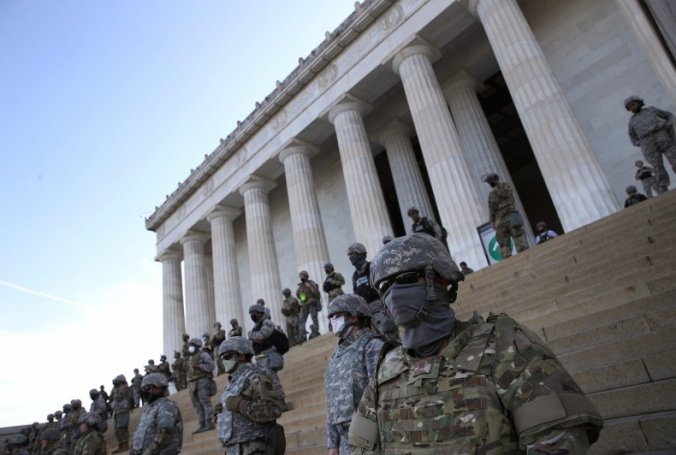
“Dozens of National Guard troops were positioned on the steps of the Lincoln Memorial on Wednesday night . . . The appearance of a band of troops at one of the nation’s most iconic monuments came as protests escalated throughout the nation in response to the police killing of Floyd, an African American man who died in police custody in Minneapolis.”
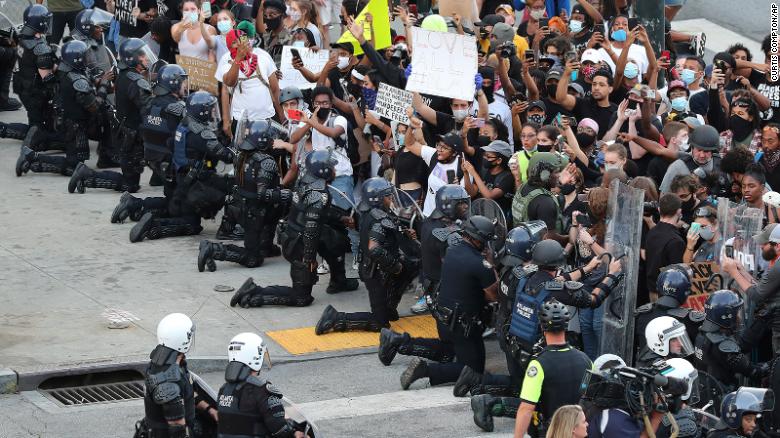
In the video I watched this morning, a man on his knees before armed and shielded guards asked for reform. “I just want reform. Reform. . . . Will you shoot me?”
In what world does a man have to get down on his knees to beg for simple respect, for fairness, for justice? For all.
In what reality, other than a YA dystopian nightmare, does the Lincoln Memorial resemble Tiananmen Square?
Maybe some are too young to remember that such visions were once something white Americans thought only happened in Other Countries, dangerous autocratic countries ruled by bullying dictators and communist regimes gone vile.
Maybe, some actually think that man who defied Chinese tanks was asking for it?
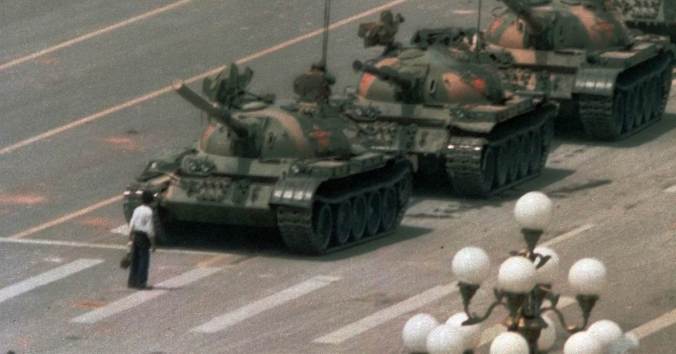
“Set off by the death of pro-reform Communist general secretary Hu Yaobang in April 1989, amid the backdrop of rapid economic development and social changes in post-Mao China, the protests reflected anxieties about the country’s future in the popular consciousness and among the political elite. . . . On June 5, the suppression of the protest was immortalized outside of China via video footage and photographs of a lone man standing in front of a column of tanks leaving Tiananmen Square via Chang’an Avenue. The ‘Tank Man’, as it became known, became one of the most iconic photographs in the 20th century. As the tank driver tried to go around him, the ‘Tank Man’ moved into the tank’s path. He continued to stand defiantly in front of the tanks for some time, then climbed up onto the turret of the lead tank to speak to the soldiers inside. After returning to his position in front of the tanks, the man was pulled aside by a group of people.
Although the [identity and] fate of ‘Tank Man’ following the demonstration is not known, then-paramount Chinese leader Jiang Zemin stated in 1990 that he did not think the man was killed. Time later named him one of the 100 most influential people of the 20th century.”—Wikipedia
I could, and do blame a national failure to prepare and national irresponsible and careless and largely absent leadership. I acknowledge that those in the White House have interfered with progress rather than led the way, but surviving this pandemic is also about us all. It’s not enough to blame Trump for his failures if we fail to do what little we can to ensure we and our nation survive. It is not enough to assume a vaccine will solve the problem—it certainly is not a time to pretend the pandemic does not exist.
If everyone, absolutely everyone, did what they were supposed to have been doing during the past couple of months, the United States would be like New Zealand, which had zero new cases in the last ten days. Instead, most people cheat a little bit or a lot. Too many Americans think the rules do not apply to them personally. We like to brag about our “rugged individualism” and claim we have the best of everything. In truth, this is is our entitlement speaking. A month of rigor and we might be clean. Instead as a result of carelessness, we live in the United States, where despite a call for people to stay home and maintain social distancing for the past ten or twelve weeks, over two hundred thousand (200,000) Americans were diagnosed in the past ten days, and over nine thousand died. Many of them were health care workers, grocers, and meat plant workers because of lack of proper protective gear, unmasked customers, and unsafe working conditions. People of all ages, ethnicities and in every state have died in the United States at the rate of about five in one hundred cases. The relative death rate is much higher for people of my age, for poor people, for people of color, but no one is immune.
Armed men invaded state capitals to demand their right to move freely despite the pandemic, and they were encouraged to do so by man incapable of leadership. Contrast that with unarmed citizens using the First Amendment rights to assemble, demand redress, and report on these events are tear-gassed and clubbed. Both risk their lives. I know which group earns my sympathy and respect.
“Where’s the bottom?” cries Beneatha in A Raisin in the Sun. (She is the younger sister of Walter Lee Younger, hoping to defy her tenement upbringing and her sharecropper grandparents and become a doctor.) Where, indeed, if we fail in our civic duty? What can it mean to be patriotic if citizenship demands sacrifice we are unwilling to honor? Some have given their lives for our country, yet we are unwilling to stay safely at home? We choose to attack those who merely want justice, those who look like they might expect fairness?
It is more than our bodies that wander while seeking the promised land.
A former student, recently become a doctor, admits “there has been a lot of hostility towards Asian-Americans and I am lucky that this has not affected me as much, but I fear for my family members and other members of the community. I aspire to be a positive representative for Asian-Americans and to help break down that hostility.”
She was an excellent student, and insisted, since before she even began her medical training, that she wanted to help those who struggle to find good care. She since recommitted to working with under-served populations. May she be granted the freedom to fulfill her goals.
Put a knee to the ground instead of on anyone’s neck.

 IMPERFECT PATIENCE