RUNNING A RACE

The Great Columbia Crossing, a 10k run mostly on the Megler Bridge, limited entries this year to 3,500. It filled last month. We started on the Washington side at Dismal Nitch, ran west a mile to the first suspension section on the north side of the Columbia River, over that and then south three miles on the flat portion which is really not a “bridge” by my reconning. It is an elevated two-lane highway. Then the highway tips upward for a killing hill (okay, killing for me—I could not run that hill 20 years ago and not today either) and over the suspension bridge on the Oregon side, down a long curved ramp and a final mile or so, west and east, at the Port of Astoria.

I’d run it before, meaning to take my time, but hustling in the face of the crush. I had much the same intentions of not hurrying this morning. I would not run that awful hill in the fifth mile. I would not.

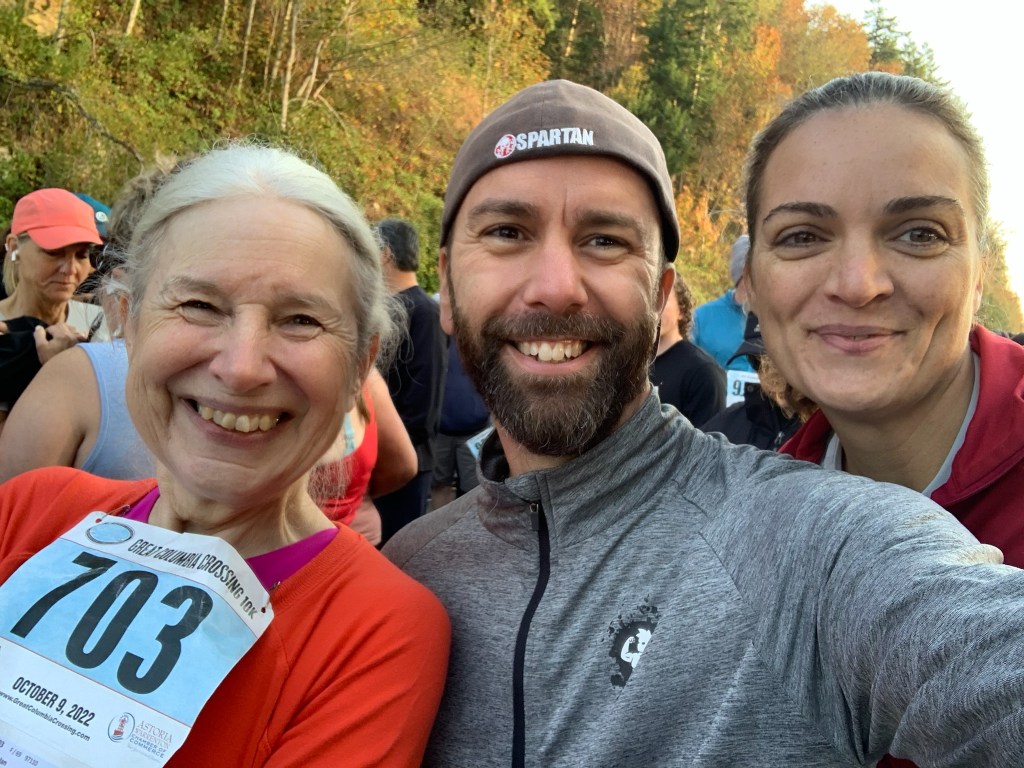
Before the start at Dismal Nitch on the Washington side of the Columbia River. Andrew is a former student who graduated with my older son in 1998. He recognized me first. Another student Nora (SHS 1996) ran up and gave me a hug before the start. I saw each of them again on the Washington side in my last half mile! (Andrew’s photo with his girlfriend at right)
Continue reading

RANDOM FACTS

IMG_3392

Years ago, long before non-GMO became a common label on foods, before Safeway even had an “Organics” section, and before “gluten-free” became a thing, a junior came to class with an idea for her research paper. “It sounds interesting. They are altering the genes of food,” she said about the NPR broadcast she’d listened to on her way to school. ”

“What do you think about it?” I asked.

“I don’t know,” she said. “I want to find out.”

Her eventual essay included the word “Frankenfoods” in the title, so we can see where that led.

Over the years, students rarely choose to write about topics they begin by knowing little about, but those papers are most often the best. Writing a research paper should be as much about finding out truth as proving it.

Changing our mind is probably one of the greatest struggles any of us have. We get an idea in our head and simply cannot move. For a teenager to research a topic with an idea already clear in their head about what they want to say is pretty typical. For a reversal to occur is rare indeed.

Recently, a junior was writing about forcing sports teams to change what some perceived were racist logos. She argued this would be unnecessarily costly and inconvenient, would destroy honored traditions and history, and anyway, “racism” was not the intent and probably not even effect of these logos. She got through two drafts, and then the day before the next draft was due, the one that was supposed to be done other than minor word-smithing, she came to see me after class.

“I have a problem,” she said. “My thesis is wrong, or anyway I disagree with my thesis. I made a mistake and now I don’t know what to do.” She had, the night before, read an opinion piece about the damage racist stereotypes, including the images used as sports logos, do to young people living on reservations. Such images preserve and inflate prejudices and contribute to a sense of exclusion and hopelessness for children already living in poverty and on the margins of society. “I’ve seen that,” she said. “It’s true.” She had worked as a volunteer on a reservation.

“Change your thesis,” I said.

“But I don’t have time to start over.” She sounded surprisingly reasonable, given her sense of her dilemma. This had to feel like a disaster in her world and she was struggling to maintain her calm. She began to rattle off all the arguments that supported her original thesis.

“But one article convinced you that you were wrong.”

She nodded.

“So use everything you already have, and then show me how you were convinced. Concede everything—inconvenience, costs, fan outrage—and show me how there is something more important at stake. It convinced you; convince me as a reader.”

She did it too. Changed her hook, reversed her thesis, fiddled her body paragraphs, and concluded with a bang. Her argument was logical and emotional, reasonable and persuasive.

It can be done. We can change our minds.

Long ago, another junior showed up before class, the day before a draft of the same assignment was due. She was in tears. “They have to shoot them,” she wailed. “They have to do it as a symbol, and the sea lions aren’t even the real problem.” She had been writing a paper to argue against killing the sea lions that were eating salmon at the base of a dam spillway. She could prove that the sea lions were not the cause of dwindling wild salmon populations, but she also came to understand that the issue was not as simple as she’d hoped.

Another student, in his senior research paper (SRP) was struggling to prove his thesis, that welfare recipients should be drug tested as a condition of receiving public assistance. Why should people on public assistance be allowed to abused those funds? The trouble was that drug-testing had been tried and had proven that few people do abuse drugs and it cost a great deal more to test for drug abuse than was gained by cutting such people off from public services. Ten or twenty times more. There were also issues related to privacy and other forms of public assistance and contracts that he did not even want to address. He had not changed his world view, but he did change his point of view on this particular policy.

Students have proposed legislation that was eventually adopted (hat off to you, Russell for advocating pleasure boat pilot licenses), as well as the use of artificial turf, graphite bats, and golf carts during tournaments. I read about forty essays on allowing or banning abortion, most of them on both sides rather hysterical and unconvincing, before I banned the topic altogether. One senior cried so hard every time she tried to work on her pit bull essay that I chose to put that topic, too, on the banned list.

Religious arguments? Mostly banned. When a student used Thomas Jefferson’s faith as part of his proof that we are a Christian nation, I suggested he had better read the work of our third President. When his mother argued that no Christian ever owned slaves, I gave up trying to reason with her. In order to use a faith-based argument, you would first have to convert your audience. I was teaching in a public school.

I readily confessed the obvious. I have opinions. I am opinionated, but I am more interested in the writing. I have been convinced by students, and even when I am not convinced, my purpose is to evaluate their skill, not to make them agree with me. One of my all-time favorite essays, one I still recall vividly and with respect, was written to support preserving “under God” in the Pledge of Allegiance. It was a hot topic one year because of a California lawsuit. Three students wrote supporting restoration of the original form of the Pledge. Two wrote supporting the current form. One of those last was brilliant. I still don’t say “under God” because my mother taught me not to, but I respect and honor that student’s essay. Her exploration of the history and implications of the Pledge were more complete than anyone else. She won me over.

It is one of the side gifts of teaching researched persuasive essays: I learn a lot. Sometimes I find I know random facts I cannot even explain. I have no reason for knowing about water rights and road-building, statistics about rape and fishing, the costs of medical insurance and how many student athletes are injured by sport. Part of scoring their papers involves reviewing their research, verifying their claims, checking for additional overlooked aspects of a problem. I read a great deal.

And as determined as students are to avoid interviews, talking to the right person will yield solid facts and details available no other way. Even so, the right questions of the right person are critical. A student asked an engineer working with nuclear power via email what health risks were associated with nuclear power? The man emailed back that he was “unaware of any health risks.” The student quoted this as proof that nuclear power was non-polluting and harmless. I had to break it to the student that “he may be joking.” An engineer would not be the right person to ask about health issues, and he needed to research nuclear accidents. Plus, you know, the long term effects of The Manhattan Project . . . “Look it up.”

I am a good researcher, and with the internet and experience evaluating sources, it is surprising even to me what I can find out if I look hard enough. The key is a willingness to look beyond what supports my prejudice.

Skepticism is a good thing, I have found. Finding multiple sources to confirm the same information is important. Avoiding the crazies. Doing the math. Recognizing that a minority opinion is not necessarily wrong. But it isn’t necessarily right either. What’s worth arguing is never simple.

In the face of personal experience, we might alter our perspective. In the face of evidence and logic, we must be willing to consider other perspectives.


WHITE

IMG_2860

Skim milk and new snow, American’s teeth, the inside of most apples, stratus clouds, locker room towels, fleet trucks, bathtubs, coconut flesh, porcelain, chalk, sugar, bleached flour, drawing paper, Jockey shorts, daisy petals—loves me or loves me not?—, picket fences, the whites of their eyes, the fog line beside the highway, and the sign that warns “Do Not Pass.” 

I am granted the option, but I do not decline to acknowledge my race on the forms. I check the box Non-Hispanic Surname Caucasian, though All of the Above is closer to truth. My great grandmother on one side was from Mexico, and on the other was perhaps Blackfoot. I was never made to suffer for their color or languages. I am white. My relatives spoke English before I was born. My mother’s skin was pinkish, her eyes were blue, her hair was pale. All my dolls had pinkish skin and blue eyes and blond curly hair. They did not resemble me in any detail. I dismantled them, pulled apart their arms and legs and removed their heads, studied their soft plastic joints, reassembled them in different order, used nail polish remover to wipe away their red lips and their dimpled pink cheeks, filled their bodies with dirt, left them out in the backyard rain. My childhood fury is what I conjure to remind myself what it means to stand before the master narrative and find myself excluded. No President has been a woman. It is not true that the masculine implies the feminine, as I was taught in school. 

The White House, white nights, doves, frosting, feathers, pinprick stars, white chocolate, white out.

In the Western world, white is the color of innocence and brides, and what we name white diamonds in her ring is a colorless stone, clear like the raw white of a fresh egg. In the East, white is the mourning hue, not unblemished but the unadorned and empty void. In most Asian nations, brides traditionally wear saffron or red. 

In light, white is all colors, in pigment it is the absence of color. White is a matter of perspective. White opals are valued for the color sparking their interior. A white paper is the concise and authoritative guide to solving a problem. Black Friday is the biggest shopping day of the year—the day retail goes solidly into the black and makes a profit. White imperialism, black power. Black heart, white swan. How we are named and what we are called. 

Sun-bleached shells are white. In death, barnacles leave behind a white anchor and sand dollars I find on the shore are never white until they have passed dying and been thoroughly scoured by sea and light. The perched bald eagle I stood below this morning on my walk has white feathers on her head and also on her tail, but her heart and wings are clothed in brown.

Colors show on white. The pale page reveals the dark text, like the stripes make the zebra. It is the words that register, not the paper. 

The leader of a workshop on teaching about race assured her audience that race did not exist. Scientifically, we accepted she was correct, but she was speaking to public school teachers. She compared distinguishing between black and white to believing Asian people could be recognized by country of origin. She said that Japanese and Korean and Chinese people looked alike. You know she was white. I told her: You grew up in the Dakotas; I grew up in Seattle. It would be unwise to tell a Korean American she looks Japanese. Not being able to see the difference between Italian and Swedish or Indian and Chinese heritage shows you have not been paying attention. Physical anthropology aside, telling my students that race does not exist is unhelpful. Race exists in my country. It is a social and political reality. Yes, we invented it, but it will not go away because we pretend it does not exist. Race and gender are the first things we notice about a person. That is my country. This is where I live. 

Dress shirts, bleached cotton, froth on the leading edge of every wave, white supremacists, white lies, fresh bandages. 

I do not decline to answer because that seems a shameful way of pretending that, all things being equal (they never are), being white is something or anything other than an advantage in my country. I am fortunate, I am privileged, I cannot deny this. I am white. 

Most pearls are not true white, but tinged cream or pink. The most valuable pearls are those with color, the South Sea pearls in aubergine, amber, and smokey gray. My mother’s skin was not white and neither is mine. We are white but not white. The white ermine turns to a brown stoat in response to longer hours of daylight. A white elephant is the gift you have no use for. Polar bears show yellow shadows, a white Russian is only white on top, a great white shark is only white underneath, white lies are what we tell to avoid getting into trouble, and white water is the dangerous but thrilling stretch of rough river where we want to almost drown. White names are the ones discarded by slaves when they took back their freedom to identify themselves. That is not my people, they are my people. On white nights the sun never goes down. In a white out, your life is at risk from cold and confusion. 

Race stands between people, makes us suspicious of motive and genuine affection. It should not matter, but it does. Race matters. Sometimes the racial fog between people bars friendship because the advantaged (me) and the other (them) cannot see past. White means I might be asked where I am from, and I can respond with the names of countries people have learned about in school, not a continent or region they cannot identify on a map. White means I glow in the dark. If I were a white male, white people would assume I earned my job and forget that my father might have friends, HR was hiring someone who looked like him, or I work for bigots. If I were a black woman, I would not be allowed to speak at all. 

Hospital sheets are not all white anymore. White chicken meat is not white and the dark is not so very dark. Pork is the other white meat and it is not white either. White is bleached, white is dead, white is blinding bright. Some Arabian horses are born dark chestnut or black and silver with age to gray and sometimes appear pure white, but these horses all have black skin underneath. 

All skin is colored except pink albino skin that reveals the blood flowing inside us all. 

Lives matter. I do not need to say that. Black lives matter. That needs to be said aloud.

My President was not white. He is a person of color, the child of a broken home but also fortunate to have grandparents who paid for private schools. His culture is mainstream not ghetto, not poor. He did not wait on the porch on paydays for groceries to enter his kitchen. He did not walk to school in flip-flops because he had no other shoes. Advantage is a relative thing. When they were in high school my sons walked into shopping mall stores and they were not automatically followed by Security, but I would bet money both Barack and Michelle Obama had that experience as a teenagers.  

The steady hum of white noise puts us to sleep.

I do not decline to answer. I am answerable. I have no answers, I listen. Times change but not fast enough. We are a nation of many skin colors. 

We are all shades of human.

NOTE: This essay was originally published in an anthology about race. The editors of that collection failed to provide the copies they were contractually obligated to provide to authors (or any other renumeration).