ON NOT CONNECTING DOTS

fullsizeoutput_1129

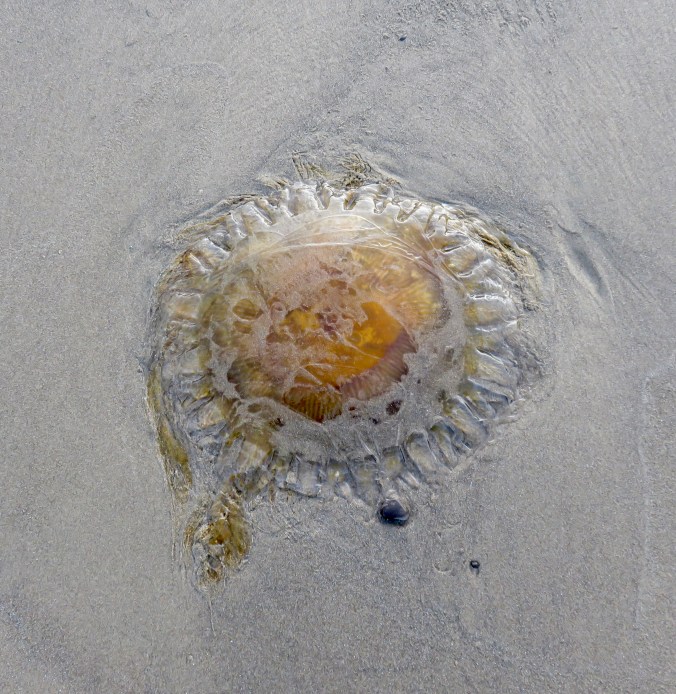
It was the orange jellies I was warned against as a child. The clear ones tended to be a couple of inches across when I was young. The orange ones were six or eight inches. This one is closer to eighteen inches. No, Daddy, I didn’t touch it.

We had such a wonderful Thanksgiving that I am embarrassed to think of it. I told Tammy on the beach this morning that I didn’t feel I deserved such a lovely day. She said, “It’s best not to connect the dots.”

Our drive over was uneventful—good news given forecasts of snow and ice. We walked in Forest Park with our younger son’s family, checked into a hotel, had dinner with our older son’s and his wife’s family, and then went back to the Kennedy School for a long soak in their pool. It was very cold and the soaking pool is outdoors. Bamboo and fats and palms rustled overhead, but the water was perfectly warm. We slept well, had breakfast and drove home again. Snow on the verges but no ice on the pass.

We also had an opportunity to drive in the city. Always an adventure. We were honked at twice, each time while waiting for a pedestrian in a crosswalk. People gave us exasperated looks for driving too slow—barely over the speed limit. (I have come up with a new safety rule about speed: drive at the posted limit plus 20% and other drivers will not throw up their hands.)

Today I received a link to a fascinating history of automobiles in the U.S. Apparently our “love affair with the automobile” began where Groucho Marx declared it so in a documentary financed by the car industry. Early on there were perfectly functioning electric cars and people walking, on horseback, or driving were not in such a rush. Most hated the new cars that only the wealthy could afford. All Americans would pay for the roads these drivers demanded.

In his 1896 essay making the case for electric vehicles, Salom decried the fumes associated with the internal combustion engine: “Imagine thousands of such vehicles on the streets, each offering up its column of smell . . . and consider whether such a system has general utility or adaptability.”

Instead of thousands of such vehicles, we now have more than a billion. Had the desire of working Americans for safety been prioritized and their enthusiasm for public space been respected, transport might have designed on the basis of public good rather than private enrichment. If that had happened, the planet would look very different today.

Instead, a relatively small number of entrepreneurs successfully campaigned to reorganize the country—and subsequently the world—so that their particular business model might succeed.—“The Car Culture That’s Helping Destroy the Planet Was By No Means Inevitable: On the Relentless Campaign to Force Americans to Accept the Automobile” bJeff Sparrow

Today is the last day of NaNo and I have over 53 thousand words. I think they are mostly in the right order, though I might have to flip chapters 19 and 23, which are both flashbacks and probably need to be in chronological order. I have marked the five chapters I need to develop further. Overall, it is way too short, but I think once I develop another plot thread (plot!) and those five short chapters, I might get to a more desirable length. I aim for 70-80k words.

fullsizeoutput_112bThis morning we went out for our beach walk on last night’s high tide line where we expected to find trash. We did and brought it home, and I found three pieces of glass, some shells and frozen jellyfish. When I was a girl, jellyfish were rare. I might see one orange jelly six or eight inches across in a half mile walk. These days we see dozens or hundreds, both blue and orange and ranging from an inch up to two feet across.

It was sunny and cold this morning, and we were glad to be out and home.
 

unAMERICAN

60b587cf-b5f5-4c1b-8d37-7173c7b1cc69.png

We have been enjoying the BBC production of Victoria. At the same time, I am mystified by Americans’ obsession with royalty.

The radical Chartist Movement is featured in the current Victoria series. It is well to appreciate that what these people asked for should not sound radical to Americans. They were asking for what seems perfectly rational and reasonable today. They asked for rights we should take for granted. That anyone would dispute these demands sounds about as outdated and absurd as arguing whether women have souls. (Yes, this happened repeatedly, and even in America.)

The Chartists’ six main demands were:
• votes for all men;
• equal electoral districts;
• abolition of the requirement that Members of Parliament be property owners;
• payment for M.P.s;
• annual general elections; and.
• the secret ballot.

It’s all taken for granted today. (Payment for M.P.s would have allowed ordinary working men to run for office without starving. Wealthy men who then held these positions could afford to attend Parliament because they had no job; they were rich.) At that time, rich men had complete control beyond the Crown. This was considered right and proper because they believed a person’s position in society was ordained by God. If you were born a tenant farmer, God meant for you to work hard all your life and to do as you were told. If you were born to an aristrocratic family, you were supposed to be respected, bowed to, and to be the ones doing the telling.

This is not an American value. We’re not supposed to believe that some people matter more than others at birth. The Declaration’s insistence that “all men are created equal” was a radical departure from Old World God-ordained dogma. Americans are not supposed to believe that some people are born inherently more important or privileged  than the rest of us.

And yet, according to a recent headline, America’s favorite redhead is a British prince?

Why do we care?

It is unAmerican.

Is it a harmless fantasy? I refuse to believe that such assumption of inherited entitlement is “harmless.” Indeed this belief undermines the very ideals of every modern democratic society. Yet we cling to this pretty story, especially for girls, this notion that the story of a pretty princess, born to power matters.

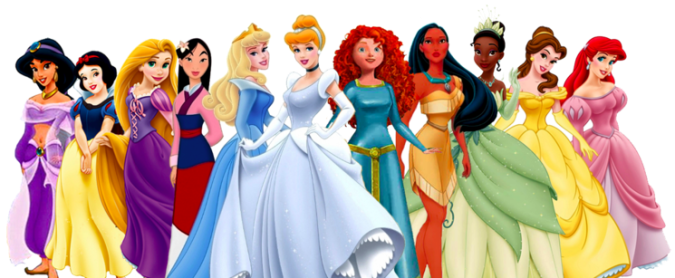
The princess stories, even the more empowered princess stories are unAmerican. Why feed this propaganda to our daughters? The “princess” is a woman who, by accident of birth alone, matters more, is valued more, who possesses greater power and influence and personal importance.

Did you miss it?

That’s unAmerican.

Americans are not supposed to stand for such nonsense. We’re not supposed to believe that some people are born to rank and privilege. Our nation is founded on the belief that we are all equal at birth. Our destiny is not infinite, but neither is it defined by our birth. Someone, please, inform Disney.

True, our founders, most of them, even the ones who wrote the words, believed some people mattered more than others, and those founders had been born to superior rank and actively perpetuated their own privilege. But still . . . in theory, they recognized a better world. They recognized ideals beyond their current existence.

And in that better world they imagined, a Queen is merely a wealthy woman, poorly educated, and participating in an archaic system of privilege and posturing. Princes are mere men who have done nothing personally noteworthy other than being born.

And the “princesses” in those stories? However decorated and enlightened, however brave or capable, however dressed or redressed, whatever their race or ethnicity—they are mere girls, never even women, just pretty female children born to rank.

It is a subtle indoctrination. It is propaganda.

And that, my dears, is unAmerican.

It is fundamentally wrong.

#FACEBOOK

Pendiri-WhatsApp-Dukung-Gerakan-DeleteFacebook.jpg

My husband and I don’t do Twitter. I have a Pinterest account, but no one in our family does the other social media. But for nine or ten years, maybe longer, I was on Facebook. I had over 1600 “friends.” They are actual friends, family, former students, former classmates, artists and writers.

I began phasing out use of my Facebook account early last summer. I nearly deleted my account this winter, but changed my mind at the last moment. I figure most people do that—change their minds. It’s hard to let go. I deactivated my account months ago and I did not exist on FB just now, at least as far as I knew. I had been afraid to check. FB will turn your account back on if you access it, even accidentally. That happened several times a few months ago.

So this is it, folks, I am back to thinking about deleting my account permanently. Or not.

I was fully aware of what I was getting into when I joined. The ads at the side made clear to me that Facebook was selling information. I found promoted stories in my feed every day. During the 2016 election campaign, I found horrible stuff in my feed and told it to go away. It did go away. I am not a good customer for conspiracy theories and wackjob political stories. I verify facts.

So now that everyone is a little hysterical, I can’t help feeling terribly disappointed in those 50 million accounts that were hacked. But my disappointment is not with Facebook—which is only trying to make a buck (or a few billions)—but with users who read the ridiculous trash on Facebook and apparently shared it. Facebook isn’t a site created in order to allow us to communicate with people we like. It was created to make a profit. Those ads on the sides were not a clue? The crazy “promoted” stories didn’t tip people off?

Yes, my schizophrenic relative believes Michelle Obama is a transvestite. Another believes in Obama’s death camps. The “Lock her up!” line was the favorite of many people who seem not to have noticed that their darling Trump has now, genuinely, done all the things we were supposed to lock her up for.

(Remember those crimes that were supposed to make us angry at Hillary?—Wall Street connections, private email servers, questionable charity?—those are Trump stories, my friends. The White House cabinet is stacked with Wall Street people; Trump’s family—I had to define “nepotism” for my seniors last month—members use private email servers in the White House; and only a lout like Trump would use his charity to purchase an enormous portrait for his golf course club house, a portrait of himself.)

I read the news every morning. I know more about what is going on than the latest shooting. I read science stories, political stories, art stories. I double check stories.

I trust (and so can you) any story that is covered by The New York Times, The Washington Post, The Guardian, and NPR. If I want a more conservative slant, I check The Wall Street Journal, The Hill, and The Christian Science Monitor. If I want a more liberal slant, I check Mother Jones or even The Nation. If I don’t want to read opinions, I don’t have to. I can stick to straight news. I can even check the news wire services who supply facts to everyone: the AP and Reuters.

Many of the stories I found on Facebook over the years, including on the pages of people I like, were nonsense—total trash and nonsense, some outright propaganda and a lot of irrational scare tactics. I mostly ignored those stories. Sometimes they made me angry. Sometimes the juxtaposition of someone I liked spouting nonsense disturbed me so much I could barely stand to be on Facebook.

It’s why I left.

However, even if I don’t miss Facebook, I do miss my people.

So there is my problem, or problems: I miss my peeps, I miss the family posts and news of former students, the art and writing news of friends. I miss sharing what I am doing each day. I miss posting news of my posts here on my Facebook page. I’d like to think I might have a book to promote on Facebook some day, and I would like to be able to do it.

Like everyone, I would like to boast about what makes me proud—recent publications, beach finds, grandchildren . . . on Facebook.

It would be ironic, wouldn’t it, if I returned to Facebook just as everyone else leaves?