HUNGER

I have read Berkeley Wellness Letter for years. In their latest report they applaud the new Canadian dietary recommendations.
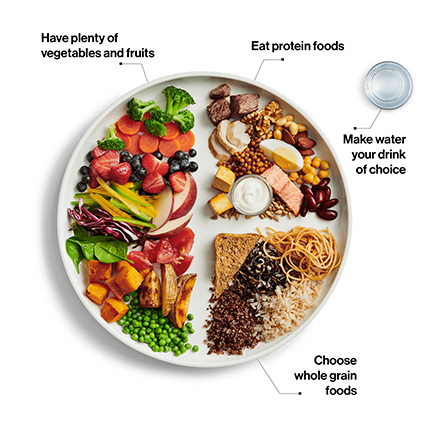
Canada food guide-1.jpg

“Canada has done away with the dairy category altogether (instead including dairy as just one of many sources of “healthy protein foods”) in favor of reminding people that water is the best beverage overall. Its previous guide advised two to four servings of milk (or milk alternatives) a day, depen­­­­ding on one’s age.”

The USDA continues to emphasize meat and dairy in diet because “unlike Health Canada, whose sole mission is to improve the health of Canadians, the mission of the USDA is not only to safeguard the health of Americans but also to promote agriculture production (including meat and dairy foods)—which is a conflict of interest.”

Intense lobbying has created the plates Americans are encouraged to eat. Advertising supports the industry paying for it. Advertising and industry-biased research has fed us a pack of lies.

We have lost faith in dieting as a way to control or lose weight because the soda industry has devoted millions to convincing us, often through bogus research, that changing what we eat (and how much) will not work. Hello. What we eat matters. What we eat, how much, and when does impact our body weight. Exercise is critical for a healthy body, but what we feed ourselves matters most of all.

I share this in full knowledge that I eat badly, that I should lose weight, and that baking rugelach and cake is one reason I have gained weight over the past year. We have been vegetarian/pescatarian for decades, and there is little chance of our abandoning dairy any time soon (cheese!) but we hope for small stage changes toward more vegetables.

The colorful illustration above does not represent how my husband and I eat. It is entirely different from how my family ate when I was a child. In those days our plates were half brown (meat), a quarter each green or yellow or orange (peas, corn, carrots) and a quarter white (potatoes). In my childhood a salad meant chopped iceberg lettuce and Catalina dressing (sweet). Dessert was something large, sugary, and baked, cut into four pieces. Sweet drinks vied with whole milk (or powdered milk in lean times). It was a diet driven by culture and industrial interests, not health. Our meals were all too valid and sweet.

“Eat food, not too much, mostly vegetables.”

The very concept of meals has disappeared in our country. We eat all day, though recent research strongly suggests that we are meant to feel a bit hungry each day. Breakfast is intended to break a fast of at least 12 hours. We are meant to feel and to be empty. People all over the world literally starve, but Americans are deeply afraid to feel hungry and so we snack and nibble and “graze” all the hours we are awake. We encourage our children to develop lifelong habits that will impact their health and shorten their lives.

The way we eat is not healthy. I should have seen this coming when the sleep surveys I have been completing online began asking me not only about hours of sleep, sound, lighting, and how quickly I got out of bed in the morning, but also how many nights I went to bed a bit hungry. Never, I responded. But then I wondered and sure enough the research began to come out.

Eat within a 10-12 hour window, between 7am and 7pm, for example. Or between 7am and 5pm. Fill our plates with vegetables. A little grain, a little protein. (Protein is actually easy to come by. Almost everything we consume contains protein.) One large meal, ideally earlier in the day. One very light meal, ideally the last of the day. (Or first like the French, back when we envied how they were all so slender.) Give your gut a rest overnight. Feel genuinely hungry for a few hours. No, you are not “starving” when you feel a bit hungry. Each day I hope to experience just a little “hunger” because my body needs a rest from eating.

Berkeley Wellness Letter also warns that by midcentury “the world will have nearly 10 billion people. One looming challenge will be how to feed them healthfully and without wreaking even more havoc on the environment. Our current eating habits, especially in wealthy Western countries, are responsible for creating an excess of greenhouse gas emissions that contribute to climate change, largely due to our penchant for red meat and other animal foods. What’s more, the typical Western diet plays a major role in obesity and other chronic health problems; meanwhile, millions of people elsewhere are undernourished.”

I need a break from feeling full.

I need a different fullness: Full of hope. Full of passion. Full of intent and wonder and admiration and love. I am hungry for conversation and compassion and kindness. I am hungry for productivity and purpose.


on another note: Today is Zora Neale Hurston’s birthday.

BIRTH RIGHT

IMG_4630

The beach is empty when we go out most days. On weekends there are crowds sometimes. Houses owned by people who do not live here sometimes have a dozen or more “guests.” The world is more crowded, but it doesn’t have to be.

I have always supported abortion rights because I believe all children should be born wanted. No child should be born because their mother made a mistake or a man did or because she had no choice. Despite statistics suggesting that many (or even most) pregnancies are unplanned, it has always seemed to me that a person should not ever be born into this world because of an accident.

In 1976 Adrienne Rich wrote, “We need to imagine a world in which every woman is the presiding genius of her own body. In such a world. . .sexuality, politics, intelligence, power, motherhood, work, community, intimacy, will develop new meanings; thinking itself will be transformed.”

An article posted today suggests another reason that birth control and abortion rights are critical:

I simply could not have existed, as I am, in any other preceding time or place. . . I could have been a professional writer at any period since the 17th century in Britain or in France. But I could not have combined this latter with a life as a sexually active woman until the introduction of contraception.—Angela Carter

The third excellent reason, perhaps the most critical reason, comes up in most articles discussing women’s health. When given the choice, women have smaller families because they can do better for two children than for six. For every kid who grew up in a large family, loving every minute there is an overworked parent. For every one of those happy-childhood kids there are a dozen with worse memories, with fewer opportunities, with hunger and necessary neglect. Often the boy of the family is spoiled—so common it is a cliché—because for some reason the parents know that child is the last. Hysterectomy, in past generation, was a common stopping point.

Paley had an abortion when she was married, pregnant for the third time, unwell, and “exhausted with these two tiny little kids; it was just about all I could do to take care of them. . . My whole idea in my heart had always been to have five, six children—I loved the idea of having children—but I knew I couldn’t have this kid.”

The planet could do with fewer humans in it. World population has quadrupled in my lifetime and is chairing ahead toward ten billion before the end of this century. The depletion of resources, global warming, starvation, disease . . . population is always controlled. Better women had the choosing and control.

Yet this morning I read in a national newspaper that Japan is alarmed that women are choosing not to marry and have children. The author puts blame this on a culture where women are expected to shoulder the burden of housework, childcare and elder care. It is possible that men are making the same choice, but the article did not explore that possibility. It is possible, too that overwork makes marriage and child raising a challenge for almost everyone in Japan. Yet, throughout this discussion, the fact remains that Japan is seriously overpopulated, that it is as highly vulnerable to global warming as any country. (Tokyo will not likely be under water in fifty years, but Shanghai and many European and American cities will be. New Orleans anyone?) It cannot produce all the food it needs to feed its population. People choosing to remain single and without children, despite inconvenience to the labor force, is probably good news.

Birth control, reproduction as a choice instead of as a burden is an inevitable result of opportunity. And not everyone wants that opportunity to be available, particularly not for women. Barefoot and pregnant was very much a strategy for keeping women down.

“What men frequently do when they want to manage and govern women,” Toni Morrison has commented, is to “focus on their babies—whether they’re having them or not having them. Reproductive organs become the focus.” Adrienne Rich wrote that “Women are controlled by lashing us to our bodies.”

My community is far more populous than it was when I was a little girl or when my mother was small or before that when only one person lived here alone in the nineteenth century. Of course, he is rarely counted because he was a Native person. None or one or two children. That is what we are entitled to. Having a large family in this world today is a sin against the planet and our future on this planet. I believe that, have believed it since I was a young girl and first understood the population bomb. I watched the woods and pastures where I had played be paved over, split level homes springing up like dragon’s teeth in a terrible mythology.

Give us emptiness. Give us land not relegated to “highest and best use” which translates as development and dollars. Give us wild place of beauty and possibility.

A little peace and quiet please.