An imperturbable demeanor comes from perfect patience. Quiet minds cannot be perplexed or frightened, but go on in fortune and misfortune at their own private pace like a clock during a thunderstorm.—Robert Louis Stevenson
I witnessed a baby seal playing in a tide pool. I was too close when it came to the surface from swimming in forward rolls. I backed away fast as I could. Mamma would be out fishing. A while back a woman refused to put her dog on leash. The dog chased a baby seal and I couldn’t stop it. There are federal laws protecting marine mammals from any direct or indirect interference —“including harassment, hunting, capturing, collecting, or killing”. “You’re too close if an animal starts to stare, fidget, or flee into the water. Even if you don’t see these reactions, keep yourself and your pets at least 50 yards away (1/2 a football field). Keep your dog on a leash around seals or sea lions to prevent bites to the dog and the seals or sea lions. And never feed or attempt to feed a seal or sea lion—it’s harmful and illegal.”
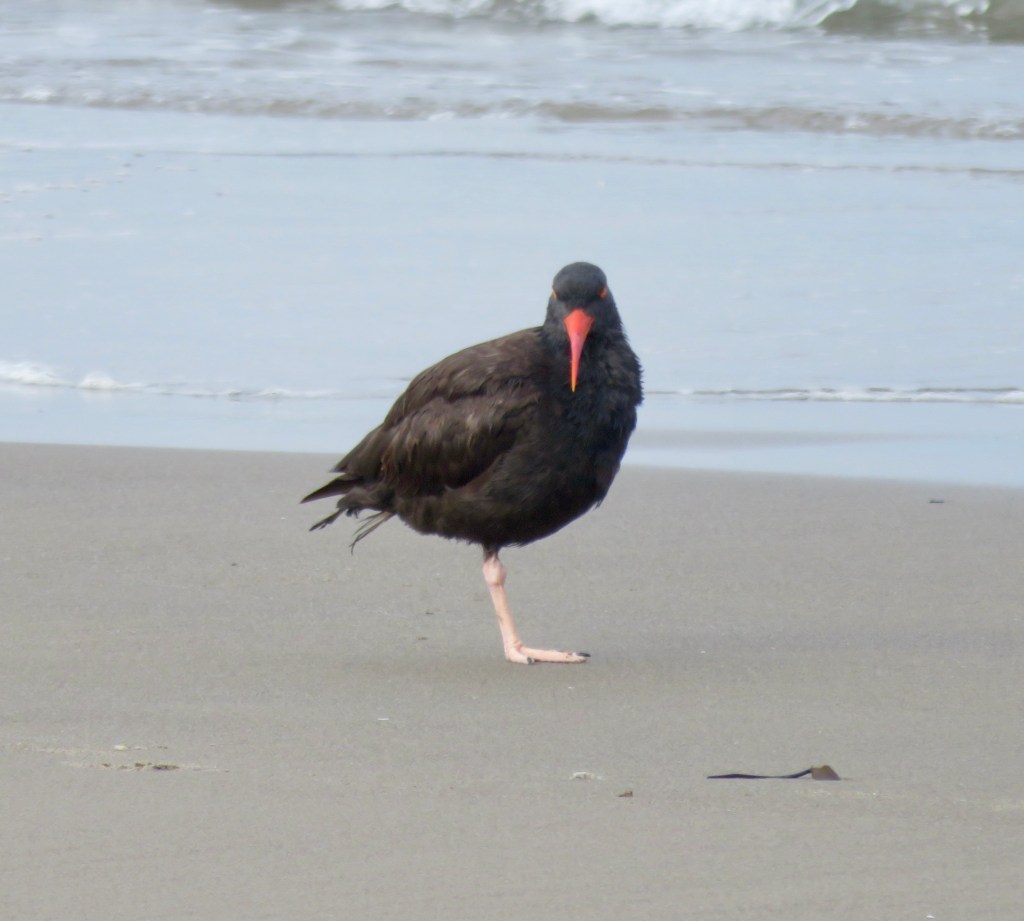
This is a black Oystercatcher and I am a long ways away from it, using a zoom to get this shot. My husband and I are partial to this species and their distinctive call. [It stands on one leg in the photo, but has another tucked up.] The pair north of us have successfully repopulated our shore. We see five at once these days. One time the parents made quite a fuss to distract me from their youngster, who was forty or more feet above me on the rocks. I still backed away so as not to further distress the parents.Continue reading →
It’s been many years since I took a class from Ursula K. Le Guin and in one of them she talked about the Chilean poet Gabriela Mistral. She was incensed at how little work of hers was available in English. After all, Mistral was a Nobel laureate, and her work was important. Le Guin had majored in French in college, but over the years she indulged in translation. (I taught a speech from one of essay collections called “Hunger” from a speech she delivered to a fundraiser-luncheon. In it she translated a poem from the Spanish by Pablo Neruda. Students struggled sometimes with Le Guin’s short speech, even to identifying the main idea, which was hunger, as set up immediately by the title.) She determined to study Spanish to do justice to Mistral. Other readers will judge how well she managed to maintain the music and meaning of this poem.
NOTE: On the Poets.org website, the translation is listed before Mistral’s words. I have placed the original Spanish first.
La Contadora (The Teller of Tales)
     by Gabriela Mistral
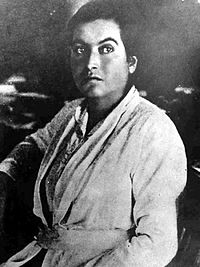
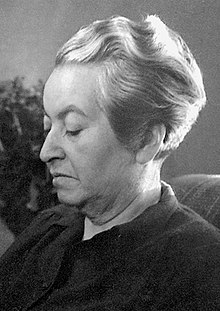
The Chilean poet, Gabriela Mistral, also known as Lucila Godoy y Alcayaga (1889-1957), was the first Latin-American writer to receive the Nobel Prize in Literature (1945). Born to a family of teachers, she mentored Pablo Neruda who would also with the Nobel. Unlike him, however, not enough of her work existed in translation to English. (A bi-lingual edition by Doris Dana published in 1971, 272 pages, and some translations by Langston Hughes.) Ursula K. Le Guin studied Spanish in order to change that.
As a younger woman
Mistral may be most widely quoted in English for Su Nombre es Hoy (His Name is Today):
We are guilty of many errors and many faults, but our worst crime is abandoning the children, neglecting the fountain of life. Many of the things we need can wait. The child cannot. Right now is the time his bones are being formed, his blood is being made, and his senses are being developed. To him we cannot answer ‘Tomorrow,’ his name is today.
Gary is downstairs listening to a CD from The Searchers, his favorite group from the 60s (they were still playing a year ago). I have spent several days working on a poem for a local event. (With my luck they will not like it, but honest, I couldn’t write a cheerful “pandemic” poem. Others will.) As I sent it off as an email attachment I had word that the gallery is taking down the show the end of the month. They did not sell anything of mine (or from two other people). Yes, disappointing. But the poem . . . here’s the first stanza:
 Birds fell from the sky this past
 summer, a warning as defiling as riots
 and bloody marble, the risk of living
 in dangerous times when all times
 prove dangerous.
Waves washed up into our hedge this morning, but it settled back for our afternoon walk.Continue reading →
Allegretto Lentissimo

Rain on our rooftop, dribbling, draining down
the side of the house and across the concrete
walkway my grandfather poured, all of this new
moisture pouring back toward the sea. The air
moves counter-tempo, slow rolls from ocean
onto land, a white mist upon thirsty soil, smoke
overlaid, rain gathering, silencing fetid reek
with wet. I am so very grateful for the patter
on skylights, the cooling air, the way my husband
wraps his arms around me as we look to changing
weather. Chosen, explored and confronted, it might
promise something beyond metronome ticking,
the warning of this new pattern, this heat. Dim
puddles from our past and of our future. Time
passes through like wind over water.
Crime tenting cities—my side,
your side, my vision, yours.
Sometimes there is a right side.
Sometimes truth clamors beside
us, riding our hearts, crying,
crying in the night to be heard.

In the sweating darkness,
the red lights scream brightness
against the tender stars, the sirens
and screaming, sweat dripping
salty into open mouths,
their righteousness unbolden.

Is there never a time when violence
does not excite, when tears
fail to touch the rim of our glass?
Everything shatters, everything ends,
is that the truth we long to hear
or the angels of our better nature?

So dear to clearing fog, a mist
rises before us as we walk north,
and to the west there is a stone at sea,
a waiting monument to patience,
a vision, a warmth of community.
Our witness crowds the horizon.


 IMPERFECT PATIENCE