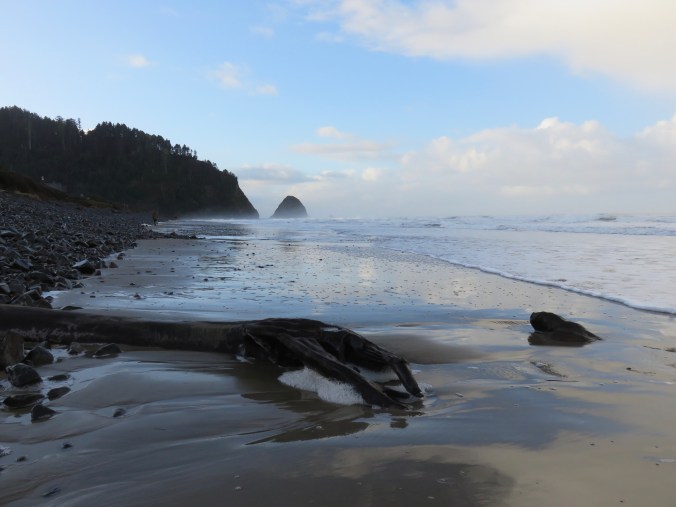
Sometimes the tide reveals the remains of a long-lost forest. This log in the foreground is waterlogged, usually buried under sand and rock, and probably hundreds of years old.
My husband and I made two simultaneous and life-changing decisions in 1979. We would move to my family’s property in my home state of Oregon, and we would begin a family. We had been living just a few blocks from the Woodland Park Zoo in Seattle and often spent time in the wild Lower Woodland area east of the zoo. Gary had worked in the zoo ands recently returned to college for a masters degree in education. He planned to teach elementary school. But the illness of his father threw his family into chaos and too much of the emotional burden seemed to fall on him. His sisters called most evenings, his youngest brother is mentally ill and his older brother, in California, did not make the trip north for the funeral when their father died.
Our new home in Oregon offered the ocean, the broad beach, and a forest behind our backs. Both Gary and I had grown up playing in wild places. It felt right that our children would have that same opportunity. Recent research suggests our choices were fortunate for the future mental health of our sons.
Urban residence is associated with a higher risk of some psychiatric disorders, but the underlying drivers remain unknown. There is increasing evidence that the level of exposure to natural environments impacts mental health, but few large-scale epidemiological studies have assessed the general existence and importance of such associations. Here, we investigate the prospective association between green space and mental health in the Danish population. Green space presence was assessed at the individual level using high-resolution satellite data to calculate the normalized difference vegetation index within a 210 × 210 m square around each person’s place of residence (∼1 million people) from birth to the age of 10. We show that high levels of green space presence during childhood are associated with lower risk of a wide spectrum of psychiatric disorders later in life. Risk for subsequent mental illness for those who lived with the lowest level of green space during childhood was up to 55% higher across various disorders compared with those who lived with the highest level of green space. The association remained even after adjusting for urbanization, socioeconomic factors, parental history of mental illness, and parental age. Stronger association of cumulative green space presence during childhood compared with single-year green space presence suggests that presence throughout childhood is important. Our results show that green space during childhood is associated with better mental health, supporting efforts to better integrate natural environments into urban planning and childhood life.—from the recently U.S.-published Danish study: “Residential Green Space in Childhood Is Associated with Lower Risk of Psychiatric Disorders from Adolescence into Adulthood” by
Both Gary and I thrived in a generation that allowed children to run free. We ran and walked and biked sometimes for miles. We followed trails in woods or scanned the desert, climbed trees or rocky cliffs, swam in local ponds and sloughs, and experimented with all sorts of dangerous stunts.
It is a wonder we are alive. Perhaps.
Or maybe these early childhood opportunities are the reason we are alive. No one should fall for the fallacy that various threats to childhood are something new. There were bullies in my childhood. I nearly drowned in tiny Echo Lake. Gary and his friends stretched a rope across a road in the absurd attempt to catch a truck. I climbed so high into a tree in the cow pasture that the top flopped over, leaving me upside down and close to a hundred feet in the air.
Yet, here we are.
A man up the street used to strip his children and beast them with a strap. The hunting dogs kept in a pen in the back yard of the house across the street were widely viewed as dangerous. The adult son of the owner of those dogs was in prison. The pastor living in a brand new house behind our back yard famously piled up old furniture in the empty lot, poured lighter fluid over it, set it alight, and drove away with his family. This was 60 years ago. I know children have always been at risk both from experience with my peers throughout school and from reading.
My experience also suggests that hovering over children encourages their misbehavior and fears. I built a fort in our yard when the boys were little, a distraction from the beach, which was not a safe place to play when they were very small. The threat of a sneaker wave was very real and I did not allow them out on the sand without being there myself. On the other hand, I found that my sons would hang off their new fort in the most dangerous manner while I watched. I realized they assumed I would protect them from harm. This was true even when they walked along the railing eight feet from the ground and while I was not close enough to catch them. They seemed to have some magical faith in rescue.
If I went into the house and watched from behind the blinds where they could not see me, they stopped hanging upside down and balancing on railings. It took me a while to figure this out. Maybe it isn’t always true.
Whenever our children were doing something they shouldn’t, the best response was distraction. Gary was especially good at this. Are they throwing the little plastic animals? Gary will have them lining up all the plastic pigs. They want our attention, but pointing that out is not useful. Young children want our attention, not to hear about the psychology of their needs.
As a grandmother now, I mostly keep my observations to myself unless I am asked. (I am not usually asked.) I wish my grandchildren had a wild wood in their front yard, but their parents take them often to play in parks. I wish my sons had studied behavior modification and educational theory that urges only positive reinforcement and redirecting attention rather than relying on threats. But they do pretty well without my help.
I suppose most people do.
 &PRIDE Press