TIME & TIDE

IMG_5815.jpeg

Three of the local whimbrels. Eight have been out in front of the house for the past few days. A loose dog chased them off but the returned soon enough. They are after sand crabs, I think.

“Time and Tide wait for no man” is how the saying goes. It is a recommendation against procrastination and as I am reading Patrick O’Brian’s naval novels (for the third time) I understand the reference. However . . .

We waited for the tide to turn so that we might have our walk. It was past dawn, though if the sky were clear we would not see the sun for at least two hours. Out we went a half hour past full but the stretch of rocks were were most interested in searching were awash and we often had to run up shore to avoid getting wet.

There were fourteen whimbrels further note on the shore, and when we returned home there were four plucking sand crabs from the wet sand.

We saw no one, only the tracks of one earlier walker, and perhaps that person went out last night. Their prints vanished in the waves.

We found the ocean and we gathered and we were fortunate to be together.

This evening we watched “Shelter in Poems” from the Academy of American Poets. You might find it here: https://www.crowdcast.io/e/shelterinpoems

After a false start with no sound, the poems start at about ten minutes and forty seconds in. I would like to say that if you can listen to Merwin’s “Thank You” without tears you are not quite human, but that sounds like a dare to some people. I will say that I taught many of these poems, I was grateful to hear them and to discover others that will carry me on.

Assignment #5: color poem

IMG_5713.jpg

Three shawls woven on the “Carnival” warp.

This last assignment is poetry. Below are two 20-minute poem prompts. Choose.

IMPORTANT: My 20-minute exercises were inspired by prompts provided in the back of Dorianne Laux and Kim Addonizio’s marvelous craft book, The Poet’s Companion: A Guide to the Pleasures of Writing Poetry (W.W. Norton, 1997). Their original exercises are much better than mine. (You should buy the book.) 

1st option: Metaphor & Simile 

COLOR: What it is & what it’s like

DIRECTIONS:  Write in response to each bulleted item in order:

  • Choose a color such as blue or yellow or red, black or white, violet—whatever. Keep your color in your head for now and don’t write it down on your page.
  • Without including the name of your color, make a list of 6 things that are that color. 
  • Now stretch and add three more things to the list that are the color, then three more, but these should be more complicated things that you have to explain in a phrase—“a four day old bruise” might be yellow, but it’s not the first thing most people think of when they think of that color. (But still don’t say the color.)
  • Complete the sentence: If [someone famous—name them] had a [something—name it] it would be [write your color]. 
  • Complete the sentence: When [name someone] feels [some emotion—name it] in his/her sleep, she/he dreams [describe your color, again without naming it]. 
  • Complete the sentence: When I am [name an emotion] I feel that [describe an object or a place you care about]  is [name your color]. 
  • What does it sound like? “It sounds like…”
  • What does it smell like?
  • What is the texture of your color? 
  • When or how is it terrifying? 
  • When or how is it loving?

Revise, rearrange, & rewrite your list. There’s a poem on Bracken‘s “Hopelings” (sparks of hope in the time of social distancing, which are each lovely in themselves) that might have begun with this assignment called “A Pair of Gloves” by Rebecca Hart Olander. I urge you to click the link and have a quick read.


2nd option: Persona

The River-Merchant’s Wife

        by Ezra Pound

While my hair was still cut straight across my forehead

I played about the front gate, pulling flowers.

You came by on bamboo stilts, playing horse,

You walked about my seat, playing with blue plums.

And we went on living in the village of Chokan:

Two small people, without dislike or suspicion.

At fourteen I married My Lord you.

I never laughed, being bashful.

Lowering my head, I looked at the wall.

Called to, a thousand times, I never looked back.

At fifteen I stopped scowling,

I desired my dust to be mingled with yours

Forever and forever and forever.

Why should I climb the look out?

At sixteen you departed,

You went into far Ku-to-yen, by the river of swirling eddies,

And you have been gone five months.

The monkeys make sorrowful noise overhead.

You dragged your feet when you went out.

By the gate now, the moss is grown, the different mosses,

Too deep to clear them away!

The leaves fall early this autumn, in wind.

The paired butterflies are already yellow with August

Over the grass in the West garden;

They hurt me.  I grow older.

If you are coming down through the narrows of the river Kiang,

Please let me know beforehand,

And I will come out to meet you

   As far as Cho-fu-Sa. 

This poem is an English rewrite of an Italian translation of a Japanese translation of a very famous Chinese poem. Depending on who you talk to, it’s a mediocre translation of a great Chinese poem or a great poem inspired by a conventional Chinese original. I have talked to two Chinese-born American poets who gave me these widely diverse opinions. 

Regardless, this is a persona poem—written by a man from the point of view of a child bride who has grown to love her husband. At the end she promises to come as far as it takes (Cho-fu-Sa might as well be the moon) to reunite with her now beloved husband.

Write a poem in which you briefly describe defining moments in your relationship with another person. You might consider choosing a parent or friend as well as a lover. You might choose, as Pound does, to inhabit the character of someone other than yourself. In any case, these moments you describe should demonstrate an evolution in your relation to that person. Your initial response, how you came to know the person, how you came to care for and miss their absence. Address that person directly as “you” in your poem.

NOTE: At each stage you may improve the poem. Weird revision strategies later this week!

ASPIRATION

IMG_3588

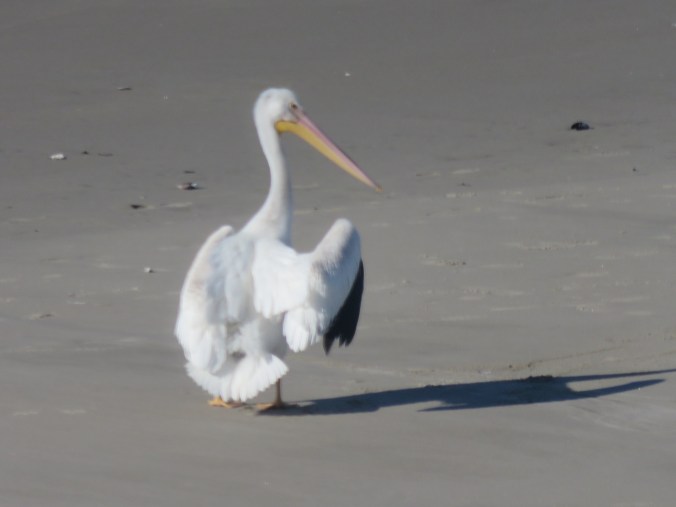
This is not one of “our” pelicans. Our pelicans are Brown Pelicans. This is an American White Pelican, snowy white with black flight feathers. Handsome, but this species does not belong on our beach except in passing. The Browns sometimes stay from spring until late fall. 

NaNoWriMo offered me a very specific goal for three years: 50k words in 30 days. I wrote over 70k. During April, National Poetry Month, I wrote the draft of a poem each day + posted poetry prompts for several years running. Here I am blogging. One of my longterm goals was to be published in Brevity Magazine and that happened three months ago. I have also set goals for reading—fifty-two books this year, and I was done by October.

Now what?

I like a challenge, and though I never take dares from others, I like making them for myself. I like challenging myself to do something hard, something within my ability, but a little beyond my comfort zone. Maybe a lot outside my comfort zone.

For next year, I am thinking about committing to a regular post of a very specific type for 2019. What got me thinking about this was the story I wrote for my grand children about an angry rabbit. And then I wrote a downright creepy story about a space traveler trying to leave Earth, titled “The Tatooed Girl.” This story is my contribution to a class effort they don’t know about yet. We are all writing stories triggered by The Mysteries of Harris Burdick, and next week I will create a little booklet of them. It is my Writing 121 warm-up assignment, and I generally write whatever my students write. My story started with the knife in the illustration with the pumpkin. My story was uncharacteristically violent.

Then this morning I wrote another weird little story about a boy reaching out to grab a little girl, and his hand disappears. Where are these coming from? Maybe this is the result of spending all of my NaNo month working on “Impossible Stories”? Maybe it’s because I am reading slowly through Ghostographs: An Album by Marian Romasco Moore. Very weird, very wonderful, and highly recommended—I want it to last!

My brief stories for class are about 500 words, which is what I assigned for my students, and therefore what I wrote myself. I went over that length and had to carve back again and again, and I still think the “The Tattooed Girl” story wants to be a lot longer. That’s something I can address later.

In the mean time: could that pelican above be a changeling? Is that too easy? No princes or princesses in my stories, so how about a genetic mutation, a Very Smart Bird? Maybe that bird is entirely self aware and a philosopher?

So now I am thinking: Could I do this on schedule? Could I post a story a week, or something, and have fifty-two weird little stories by the end of the year?

Would anyone read:

  • a weird little story every week?
  • a fairytale?
  • a fable?
  • a horror story?
  • All of the above?
  • None?

Anyone have an opinion?

POETRY + 10

sojourner-truth---abolitionist-and-feminist.jpg

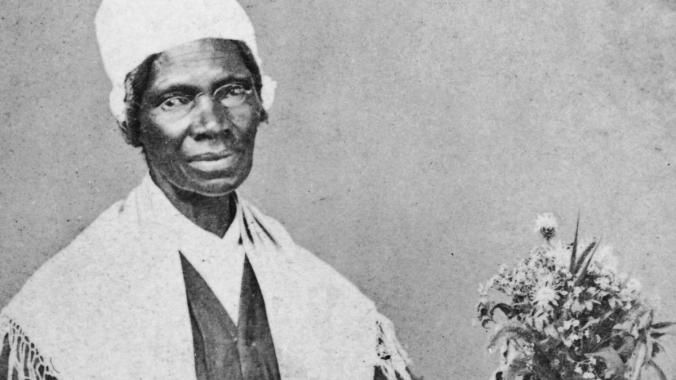
Sojourner Truth

A friend has posted news of a Texas charter middle school that asked students to brainstorm a “balanced” list of the pros and cons of slavery. This is what is meant by “false equivalency”. All I can think of on the pro side? I am not on that side. On the con side, slave owners sacrificed their souls. On the con side is a lengthy list. There is no balance possible, it is a demented assignment.

April is National Poetry Month, and my students and I have been stealing 20-minutes out of our class to write bad poem drafts. They are only bad because they are so young. (The poems, not the poets.) Twenty minutes might get something started, but after we complete several such drafts we will revise just one. Maybe that one will break our hearts.

This is also Confederate History Month in five U.S. states. (There used to be six.) I refuse to go look up which ones still celebrate the most deadly conflict in the history of my country, and I do not want to guess. I can only assume that the legislators of these states have so little to be proud of now that they must perpetuate a fictional glory in the past.

Why is this a problem? Let me count the ways.

  1. The Constitution was ratified over a four year period. Delaware was first in 1787. Southern states ratified in 1788, except for North Carolina in 1789, the year before Rhode Island, which was last in 1790.
  2. Southerners were notable authors of our Constitution, and states’ ratification means each state agreed to the terms outlined therein.
  3. The Constitution of the United States makes no provision for state succession.
  4. The most notable feature of the Confederacy was its support of slavery. (Seriously, if you didn’t learn that in school, consider that the textbook that taught you about the Civil War was produced by white apologists in Texas, not people with actual history foremost in the sights. When I was a girl, the books still insisted on calling it “The War Between the States.” My father would roll his eyes, take a deep breath, and correct what they were teaching me in school. I am sorry he was not there to do that for you.)
  5. The Confederacy was in open rebellion against our nation—treason anyone?
  6. Men from my husband’s family, like so many, fought on opposing sides.
  7. The south lost.
  8. Why not Civil War Month?
  9. I am so heartily sick of hearing about how monuments to southern generals need to remain standing in order that we not forget our past.
  10. Remind me, what past are we trying to remember?

My husband and I each have relatives who fought with the South in that war. We imagine they were honorable men and believed in their cause. We also accept that they were wrong, terribly wrong in that choice. However badly the North behaved after the war, they did win it. And slavery, well, there is no supporting a government determined to preserve a bald, unwarrantable usurpation of human rights, and long after most of the Western world was busy outlawing the practice.

It is a paradox for us, of course, but not really a challenging one. We can both feel interest and connection to our past, and yet recognize the abomination of the system they struggled to uphold. We feel no guilt for slavery. We were not born then. No one we have ever met was alive then. our personal identities are reliant on our own actions, not the actions of relatives who are mere photograph and documents. There is no need to belabor one of the uglier passages of our nations’ and families’ history.

It’s called letting things go.

Go write a poem. Consider the words, the verbs and intentions; couch ideas in concrete images. We are a proud country, but what should we be most proud of? Surely not open family discord, bomb blasts, and butchery. Choose something that saved lives, choose what preserved natural landscape. Hold out a hand and pull someone out of despair.

SaveSave