READINGS

I used to require my college writing students to attend:

MFA in Writing Residency Brings Top Writers to Seaside for Nightly Readings in January

BeachThe Pacific University Master of Fine Arts in Writing program hosts readings by top contemporary writers during its 10-day residency in Seaside. The series offers a rare opportunity to hear these writers read on successive evenings. Free and open to the public, the evening readings begin at 7:30 p.m. and take place from Friday, January 10 through Friday, January 17 at the Best Western Ocean View Resort, located at 414 N. Prom in Seaside, Oregon.

This year’s lineup includes Kwame Dawes, recipient of the Windham-Campbell Prize and Pete Fromm, five-time winner of the Pacific Northwest Booksellers Literary Award.

7:30 p.m. at Best Western Ocean View Resort in Seaside, OR

Jan. 10 — Marvin Bell, Claire Dederer, Pete Fromm
Jan. 11 — Ellen Bass, Jack Driscoll, Debra Gwartney
Jan. 12 — Frank Gaspar, Scott Korb, Mahtem Shiferraw
Jan. 13 — Chris Abani, Mike Magnuson, Mary Helen Stefaniak
Jan. 14 — Claire Davis, Valerie Laken, Joseph Millar
Jan. 15 — Sanjiv Bhattacharya, Shara McCallum, Kellie Wells
Jan. 16 — Kwame Dawes, Cate Kennedy
Jan. 17 — Molly Gloss, Shelley Washburn

The authors who are reading also teach in Pacific’s low-residency MFA in Writing program. For more information about the writers or the MFA in Writing program, contact Shelley Washburn, MFA in Writing director, at 503-352-1531.

REMEMBERING

fullsizeoutput_ba4

It was a Saturday in June. My husband has been talking about that day 11 years ago when I was completing my last MLA residency and my mother was dying. I did not know this about my mother, and he says now how he remembers how happy I looked when I gave my speech. I had been chosen as class speaker. Claire Davis spoke that day too. There was a bagpiper. A friend sent champagne, which I forgot in the dormroom refrigerator after he told me, he was in such a hurry to drive home.

This evening, I went looking for the speech, not sure my new computer would open that old file, and here it is. It makes me cry to read it over. Gary says he “had a little cloud” over him when he heard it that same time. He enjoyed it more just now.

Here is what I told my graduating class:

ART SAVES LIVES by Jan Priddy

Good afternoon.  On behalf of the class of 2007, including those tethered to their lives far away, I welcome students, faculty, honored guests, friends and family, the interns, Amber, and Shelley—oh, Shelley—who is a writer and sparks this magic that happens to us.  We are grateful to one another for the help along the way, for reassurance and emails, Art Barns, phone calls, and other metaphoric hand-holding.  We thank you all.

I used to have a bumper sticker on the back of my car that said:  Art Saves Lives.  I was sorrier to lose that slogan than I was, eventually, to lose the car.  Because here we are saving our lives.  Here.  All together.  And we are a part, all of us here, together we join a long line of readers and writers, of people who value language and who need to write.  We add our words to those who came before.  We claim them:  Sappho and Shakespeare, Emily Dickinson and Mark Twain, William Stafford and Ursula K. Le Guin.  All part of us now.   

Last year Peter stacked books on this podium solidifying the reason we are here.  Art on the page.  We all want to transport our readers with words, carry them across time and space to meet people and feelings and ideas.  We should be humbled, but our goals are not humble.  We want to change the world with our imaginations, one word at a time. 

We are writers.  Crafty people.  For two years we learned our craft from those before us.  Words are our tools, and I know from studying with David that each word matters.  Valerie taught me to shape my imagination.  We know dialogue is important, Pete, and that we share the world with other people, Marvin.

We’ve savored Dorianne’s smoky Juliet, followed Claire’s frog down the throat of a child, and reconsidered John’s take on Job.  A hawk ruptures Sandra’s window and Pattiann hands us sex on a cloud.  Jack plunges us under the ice and Craig mourns a child.  Judy’s natural disaster drives us to community and Ellen soaks us in honey and pins us to the wall.  Joe’s porcelain throne gleams in imagination.  So do our fellow students. 

But I am a story teller and most of my ideas come attached to stories. 

Here is a story:

In 1836, a recently widowed visionary, remarried.  With his second wife he fathered seven children, preached, taught, found academic employment, and wrote in his study while a large household revolved cautiously about him.  Quiet.  Don’t disturb Papa, he’s working. 

Most of us scramble and bargain for writing time, often finding it only in slivers and odd hours, between the detritus of day-to-day responsibilities and paying work, wedged between the insistence of people who rely on us to put their demands first behind our human need for rest.  How lovely to sit behind a door, working until we are ready to stop, parishioners anxious and waiting, our loved ones tip-toeing past the door—Quiet, don’t disturb the Writer. 

But we are not writing sermons that come crashing into the world with authority and an eager audience, we are not Calvin Stowe, that mystic composing in his study, and most of us have never even heard of him. 

It is his wife we know—the wife who bore the seven children and ran the house and did not, in her day, enjoy legal recourse to law, the right to vote, or a paying occupation.  The woman who provided Stowe with a room of his own, didn’t have one herself.  Harriet Beecher Stowe.  It is her writerly story that more closely resembles ours.  Harriet Beecher Stowe, nearing forty years of age and with a newborn seventh baby, began writing Uncle Tom’s Cabin at the kitchen table while running her household. 

The little lady who started the Civil War, Lincoln called her. 

Harriet Beecher Stowe lived to see slaves freed in America and granted citizenship.  She saw her own 85th year, but no other writing of hers had the impact that Uncle Tom’s Cabin had upon the world, but then again, neither has the novel of any American since. 

I wonder:  Was she scared?  Did she wonder if her words would run out?  Did she call herself a fraud and suffer writer’s block?  Was it possible for her to have imagined, with a household bustling, interrupting, and tugging at her, that the words she struggled to pen would change the world? 

Maybe we are writing our own transformational books at our kitchen tables and we don’t even know it. 

Few of us have sheltered space or devoted congregations.  We are not Emily Dickinson or even Calvin Stowe.  We are poets scribbling lines while we wait for laundry to spin, composing in our head on a run; we are novelists running sentences across the ceiling before sleep or rehearsing stories in the hour, the rare hour, children are preoccupied; we are memoirists and essayists getting up to make the coffee and losing ourselves in words when we have so much to do.  We hear voices.  We stare into space and forget where we are and what we’re supposed to be doing.  Hopefully this doesn’t happen while we’re driving to the grocery store. 

We cannot know the influence our words might have on that still-imaginary audience.  We only know we want to do it—this writing.

With so little outside our need, without free time or a room of our own, the leisure and space that all human beings deserve and crave whether they are writers or not—what have we? 

We have words.  We have each other.  We have imagination.  I’ve been using that word a lot.  We can’t know what we cannot first imagine.  Time, curiosity, stolen moments, and imagination.  We’ve had two years of community and permission.  We have only just begun to find voice on the page.  We look up from our table and out at the world, and, bending to our page agin we’ll write what we understand of it, or admire, or deplore, dream, fear, hope.   

We can read and think, write and reason, feel and sing, and always question, and do this honorably and diligently and during every moment we breathe.

People have been asking us all week what we’re going to do now that we’re graduating.  The only answer that matters is:  Keep writing.  We’re not done with our work at the kitchen table.  Whether we transform the whole wide world, or our own private corner, Art saves lives.  I know it’s true.  I think it’s why we’re here.  We’re saving ourselves. 

BECOMING

IMG_3182

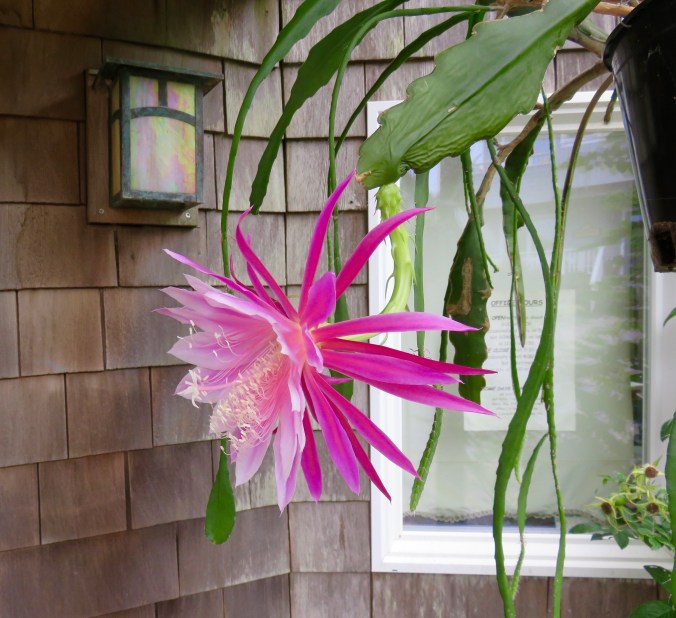
Our tenant, Greg, brings his cactus outdoors when it blooms, a rare semi-yearly event.

One day my favorite design teacher, Hazel Koenig, saw me walking to a metals class in the Art Building. She stopped me to ask if I would be willing to help out at a state art education conference. That would have been about 1974. Later, she got me my first teaching job. I thought of myself as an artist, and I still do. My work space where I write and make things is not a “craft area” as someone recently called it. It is studio space, work space. Calling myself a writer was harder somehow that calling myself an artist. I was exhibiting while I was still in high school. It took years to become a published writer of fiction. I had many articles published in dog magazines, I didn’t count them.

Calling myself a teacher also took time. I came to teaching relatively late in my arts education. I had avoided thinking too much about how I would make my living. I was in a five-year BFA program, most of the way through a BFA in Ceramic Art, when I “moved up the hill” from the Fire Arts building to the great facility in the Metal Arts wing of the Art Building on the Quad at the University of Washington.

From 1970 to 1976, I was a student at the UW. By 1974 or 1975, I was thinking about my future in a more realistic way. I toyed with transferring to a Botany major. I considered the law. I had wanted to be a an architect since I was no more than 11, but somehow failed to pursue it, though I took the non-major architecture history series from Gustav Pundt and then finagled my way into the majors-only series. Later I would make a decent supplementary income drawing plans for clients and for an architect.

Anyway, somewhere along the way, I realized that I was always teaching. Maybe I liked telling people what to do. Maybe I was good at explaining things. Maybe teaching was the creative and professional outlet that I needed. Maybe I was still under that favorite delusion that I would have “three months off every summer” and time to do my own art. That last one for sure, and even working half time as an art teacher, I never got “my own work done.” Teaching is more than full time work.

Even as a student, I knew classroom management would be my greatest challenge. Part of my educational preparation was brief field assignments in classrooms from Kindergarten through high school. When it was time to begin a longer term field placement, I asked for middle school. It was the hardest assignment and the right choice. I earned a k-12 certificate and later taught Art at a girls’ prep school for three years.

Then I moved back to Oregon and my husband and we began our family. For a few years I drew plans for clients and Jay Raskin. When I looked at teaching opportunities on the Oregon coast, I chose Social Studies as a second subject endorsement. I learned to write essays in my SS classes, how to reason and think. I began coursework, but then took an NTE exam and was awarded Social Studies certification.

I subbed for teachers all over the school district, our children were born and graduated and went off to make their lives. After substitute teaching for 11 years, I taught English for 25 years, earned an MFA in writing, and now I teach only two college classes, Writing 121 and Writing 122. I have my 10 weeks of summer and then another 12 weeks in the fall without teaching. In November, I write a novel. I am not inclined to do nothing. I will be busy Winter and Spring with my two college classes.

All this summer, Gary and I have been sorting possessions. We are each of us the end of the line. I have personally cleared the possessions to my parents, aunt, step-grandmother, and even my step-grandmother’s second husband’s brother. People gather unto themselves. Going through tiny professional pins with my son, Ian, I found I had no explanation for the pin from the carpet business in Portland, the mysterious Mason’s pendant from a hundred years ago. I know how they came to me, but there is no one to ask why they exist or what they mean.

Today, we went through the “treasure chest” and the linen closet together, and eliminated a great deal of “stuff” we didn’t need. Blankets and sheets and linens, bits of wrapping paper and ribbons from past holidays. The habit of my mother and her mother before her: keep what might be useful in the future. But I do not think I will ever want that rest of the red eyelash yarn I used to wrap packages a dozen years ago. There is also the joy of finding things I’d forgotten I possessed, the occasional gift I do not remember ever having.

Then I sorted my jewelry. The small jewelry box is completely empty, while the other is neatly sorted. The ladies in my family are going to do well this Christmas.

A necklace I used to wear every time I flew needs to be restrung. I have been putting that off. It is a luck piece, plain elephant ivory beads. I like to think the ivory did not come from a slaughtered elephant, but that is not a story I possess. I only know the beads are nearly 200 years old and when I was in a plane, I folded my hands over their smoothness and stroked them for comfort.

I finished the last of the blackberry crisp this afternoon. I sipped a half glass of wine as a reward for my industry. I feel enlightened.

When I go looking for something, I will know where it is, but I also know the greater value I possess. I know myself to be teacher, writer, artist.

WRITING EDUCATION

_MG_0011

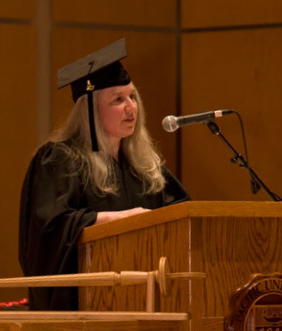
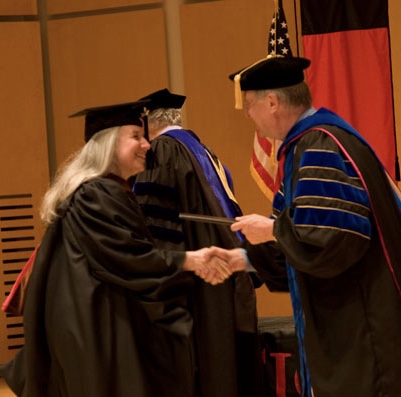
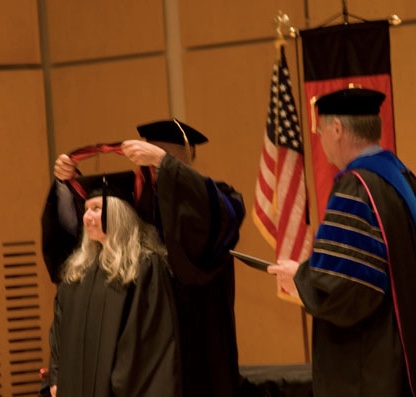
I was Class Speaker in 2007 at Pacific University’s MFA in Writing graduation.

A writer friend of mine who has taught in an MFA program for several years reported that not one of her students had become a “successful” writer by publishing a book. I shared that among students from the two years of my MFA program, only a handful had published books. Of those, most were poets and most came to the program with a chapbook already published.

Tom Jenks writes in the newest edition of his online publication:

“By 1975 the number of graduate programs had grown to fifty-two, a number that in the subsequent nine years tripled to 150, and by 2017 the number grew to more than four hundred. If undergraduate programs are included, today’s number exceeds two thousand. Across approximately eighty years, writing programs have proliferated as the accepted foundation for the would-be writer’s route of entry to a life of writing, publishing, and/or teaching. …

“The 2016 AWP conference in Los Angeles hosted twelve thousand attendees, a number that represents perhaps 7 percent of an estimated 170,000 MFA degree holders and students in the US. Currently, graduate writing programs and undergraduate programs with an emphasis in creative writing turn out some fourteen thousand new degree holders each year.”—Narrative

Need I point out that we do not publish 14,000 books from “new” writers each year? The industry published a bit over 316k titles in 2010, but actual sales were down by 14 million that same year. More books, fewer buyers. A book has less than a 1% chance of showing up in a bookstore. That is a bit better odds than being published by most noted literary magazines, which rarely pay anything to their authors.

Academic life? Other than the (very) rare person who lands a tenure track position, the demand for college professors without substantial publications and research means most work as adjunct. Trust me, a high school English teacher is paid much better. A good cocktail waitress is paid much better. Retail sales at least do not result in hours spent scoring papers.

Years ago, I read that the average full-time writer earns less than $10k/year. True, Neil Gaiman, but there is only one of him. The nation does not need many new writers. They will not earn a living through creative writing of any kind. A writer I knew from years ago had this piece of advice: “Marry money.” Unlike the graduate of an engineering program or even one with an English degree, very few creative writing majors will find work relevant to their education. Their odds are about on par with the high school character actor becoming the next Cate Blanchett.

So of the majority of people who graduated with me in 2005, what are we up to? Several are not writing at all. They have stopped pursuing “writing, publishing, and/or teaching” altogether. Some have moved on in their academic careers. At least half published work in literary journals or books, but several of those are not actively writing now. Only two that I know of have new books out in the past few years. They are not making even $10k/year from those books.

I am mostly retired from teaching but still writing. I am publishing in journals. According to Duotrope, an online resource I use to locate markets and track my submissions, my publication rate has consistently been “higher than the average for members who have submitted to the same markets.” My acceptance ratio has varied over the years from a low of around 5% at the start to a brief high of 14%. Just now I am at 8.5%. I submit to journals than accept less than 1% of submissions recorded by Duotrope. At no time have I made a profit on my writing. I have been published in fine journals (without pay) and have presented to regional and national conferences (for zero pay). I have been paid for technical writing, but I was better paid freelancing graphic design, which was not my major, or drawing plans for an architect, for which I had no educational preparation at all. Even when I was judging field trials across the West, a hobby, I was paid travel expenses and was housed and fed. Writing and presentations on writing? Not a chance. I have never actually been paid for any literary work, though I do expect a small check to arrive in the next month from a paying market. Maybe.

So why the degree?

I had promised myself an MFA. I assumed it would be in the visual arts since my undergraduate degrees were in the visual arts. I have BFA degrees in ceramics and metal and a BA in Arts Education. I came to writing relatively late in life because I wanted to return to teaching and there were no arts jobs available. I thought I would teach Social Studies, those classes where I learned to write essays, but instead I began teaching English, where all writing is taught these days. I did not need an MFA for that job.

My MFA cost me $20,000 and I will never see a return on that investment in any job. I had already written three novels and published essays, stories, and poetry before I began the program.

So why?

There were people in my program who only wanted to write a book, people who needed a terminal degree to advance in academia, and people who left the program and became musicians. I have kept writing and reading and writing and reading. Why the MFA? I was already productive and growing.

It was that promise to myself. Self-indulgence really. Just as most the other actual writing is self-indulgence. My sons had graduated from college and I found that the frugal habits I had developed when we were a one-income family and throughout our sons’ education were not as easy to break as I once thought they would be. I was at the top of the pay scale as a teacher, my husband was also working, and we went no where on vacation, drank only cheap wine and good homemade coffee, used no drugs, and ate out rarely at restaurants labeled with one fork, for “cheap eats.” I could afford $20,000 spent over the course of two years.

The degree was for me. I hoped to become a better writer and to find a writing community since my efforts at finding a writing group had failed again and again. (There was the group where the poet-leader declared fiction “annoying.” The group that wanted mostly to gossip. The one that wanted to get high. The one that self-published horrible trendy fiction.)

Jenks assures me that I didn’t need that MFA degree, that I will likely join the tens of thousands who will never “use” their degree to be a “successful author,” a term even he finds it difficult the define. Did I enjoy the program? Yes, very much. Would I do it again? Absolutely. Did I find the writing community that I desired? Not really. Did it make me a better writer? Perhaps it did. Did it help me to become a published writer? No, it did not. That is something else again. I got something from the program, made a few friends, and often consider how to return. That is enough.

Were I today in my early 20s, a white girl, even a white girl from a modest upbringing _MG_0049and married to a man raised in poverty, what value would I bring to fiction? What story do I offer? It is a question I ask myself even now.

“Some things can be taught, some learned—so much depends on the character of the writer.”—Tom Jenks

SaveSave