My husband and I have a lot in common, things you can’t see, and a couple you can. We once lived a half mile apart, and we graduated from the same large suburban public high school, though we did not meet until before my senior year. Our DNA is largely Northern European. Gary has more African; I have more Native American. We both look White. At one time our hair was the same color. It’s the same color now.
We met through mutual friends, the Edmonds Unitarian Church, and rock music. Gary was born in Seattle but spent seven years of his childhood in Arizona. I was born in Corvallis, but lived briefly in Portland then Seattle. We would graduate, first Gary and then me, from the University of Washington with Honors and Phi Beta Kappa. We were overqualified for most of our jobs. We worked hard. We shared a commitment to doing the best we could. We shared values. We shared a commitment to our marriage.
But our backgrounds are different.
Gary’s parents met during the war in Arizona, both of them in the military, and they married in Roswell, New Mexico. Gary doesn’t know if it was in a registry office, a roadside chapel, or a church. My parents met in college at the UC Berkeley after the war and were married in a Unitarian Church in Berkeley, California.
My family had me and my brother, and debating was dinner table entertainment. Money was often tight, but Mom took art classes, and my dad worked for the Bureau of Commercial Fisheries as a research librarian.
Gary’s family had six children, they argued out loud. His mother never learned to drive, and his father scrambled to provide for his large family as a carpenter.
My dad had been married before he met my mother, but he and his parents as well as my mother’s parents were divorced. Most of that generation remarried in my family. My paternal grandmother, who raised my dad, never did remarry. My dad was raised in a household of women: grandmother, mother, and aunt. His aunt taught business courses in the LA school system.
Gary’s maternal grandfather had many children (fourteen? seventeen? I always forget), two wives or maybe three in Oklahoma, and worked his whole life as a sharecropper and day laborer. When his first wife died, he gave his children away on a street corner. His paternal grandfather was a contractor who immigrated from Finland, married a widow, and died coming home from a tavern.
My dad was Army in France and Germany, Gary’s dad was Air Force stateside. They both began smoking Camels in the military. Both died of lung cancer. My dad the week before Christmas, Gary’s dad on Mother’s Day. Our mothers did not remarry.
One of our struggles as a young couple was about “discussion” because his family yelled, mine debated. Each of us found the other’s yelling/debating distressing and argumentative. We shared concern with ethics, liberal politics, appreciation of art and music and theater and cultures around the world. We shared a determination to stay together. Both of us worried, but about different things. We “took turns” being sad. [“You can’t be depressed, it’s my turn to be depressed.”] Like any couple, we had our disagreements and misunderstandings. I think, together, we made a good couple. We balance and support and love one another.
My mother actively disliked her in-laws. And that was too bad. We spent all our holidays with Mom’s family in Portland, which was wonderful. Gary’s father’s family never thought his mother was good enough—truly unfair. Once he died, most of the family cut off all contact. Still, his is an enormous family and Gary feels close to siblings, nephews, nieces, and a cousin.
Gary’s family was kind to me. I was a little out there, but they were good to me and I love them.
We thought for a time that we would not have children at all. It was not part of our plan when we married. But then, like a decision to marry, one day it felt right. We talked and made a series of decision about moving back to Oregon and having children. Two children. We love them both and their families. We are proud of our sons.
My parents didn’t like Gary much early on. Fifty or so years ago, my father said he didn’t think Gary was “tough enough.” [I can picture him saying that, a cigarette in his bruised arthritic fingers, and how I thought wtf? at the time.] But it was Gary who stuck it out with me, who was the stable member of his family, who took care of the home front when my dad was dying. It was Gary who made my mother coffee and cleaned her kitchen and stopped by the house three times a day for years, caring for her like a son while her own son was away. In the end, Mom appreciated him. After she died I went through her papers and found written notes to change her will, favoring Gary in the months before she died.
I favor him myself. He is a good man, a good father, and has made me a better person. We will have been married for 46 years a couple of weeks from now. We were together as a couple for five years before that. I just heard from a former student who seems to married her high school sweetheart this spring. It’s rare that such relationships last. Sometimes they do. Our first date was in August too, in 1969. Lucky. Lucky. Lucky.
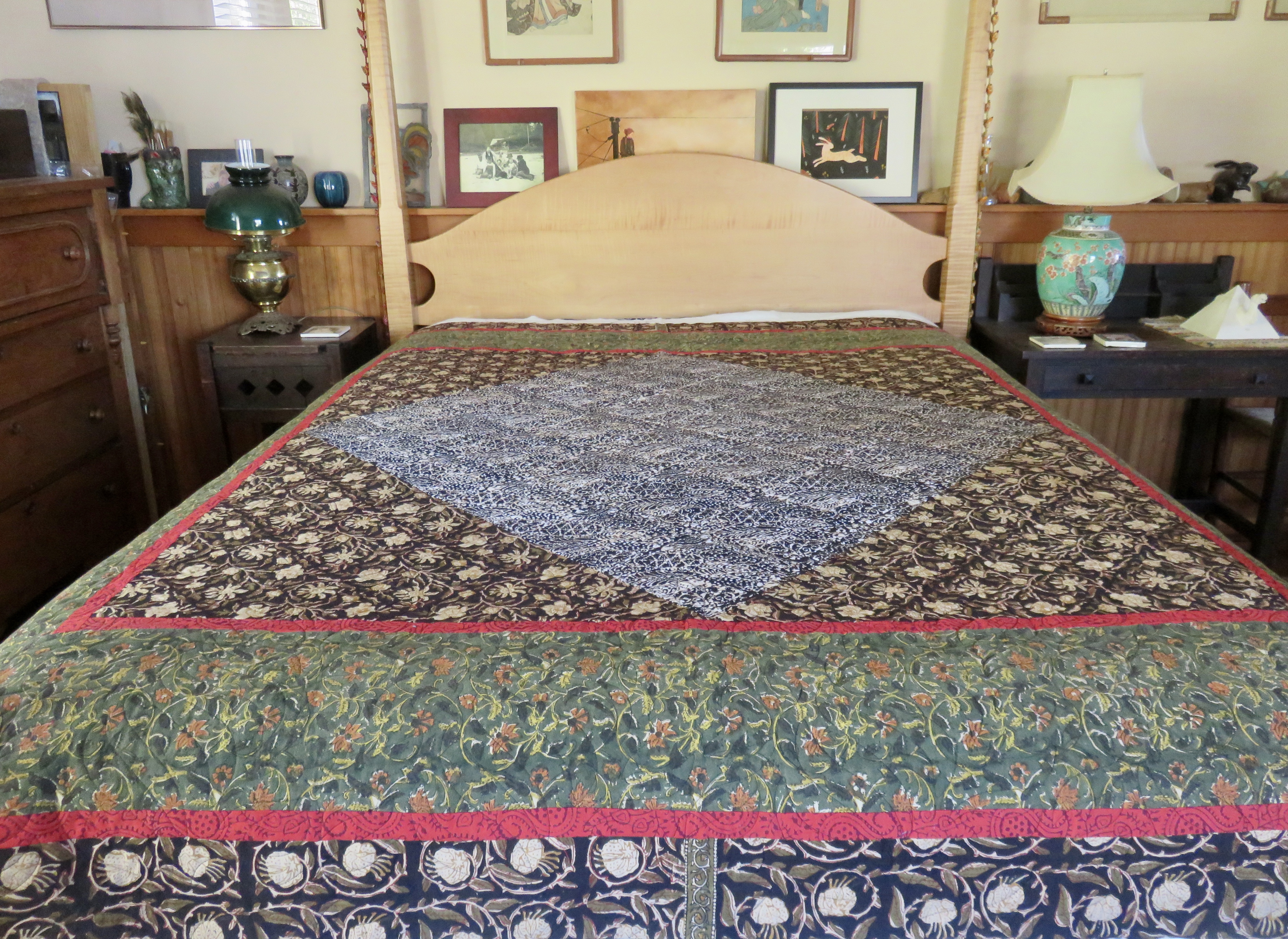
Once I had the eighty-one squares pieced, I opened the package with the quilt I picked up from Linda Pinkstaff last week. It is hand block-printed vintage Indian cottons from Cargo. This is the top, with the center diamond a true batik. I still have to bind it.
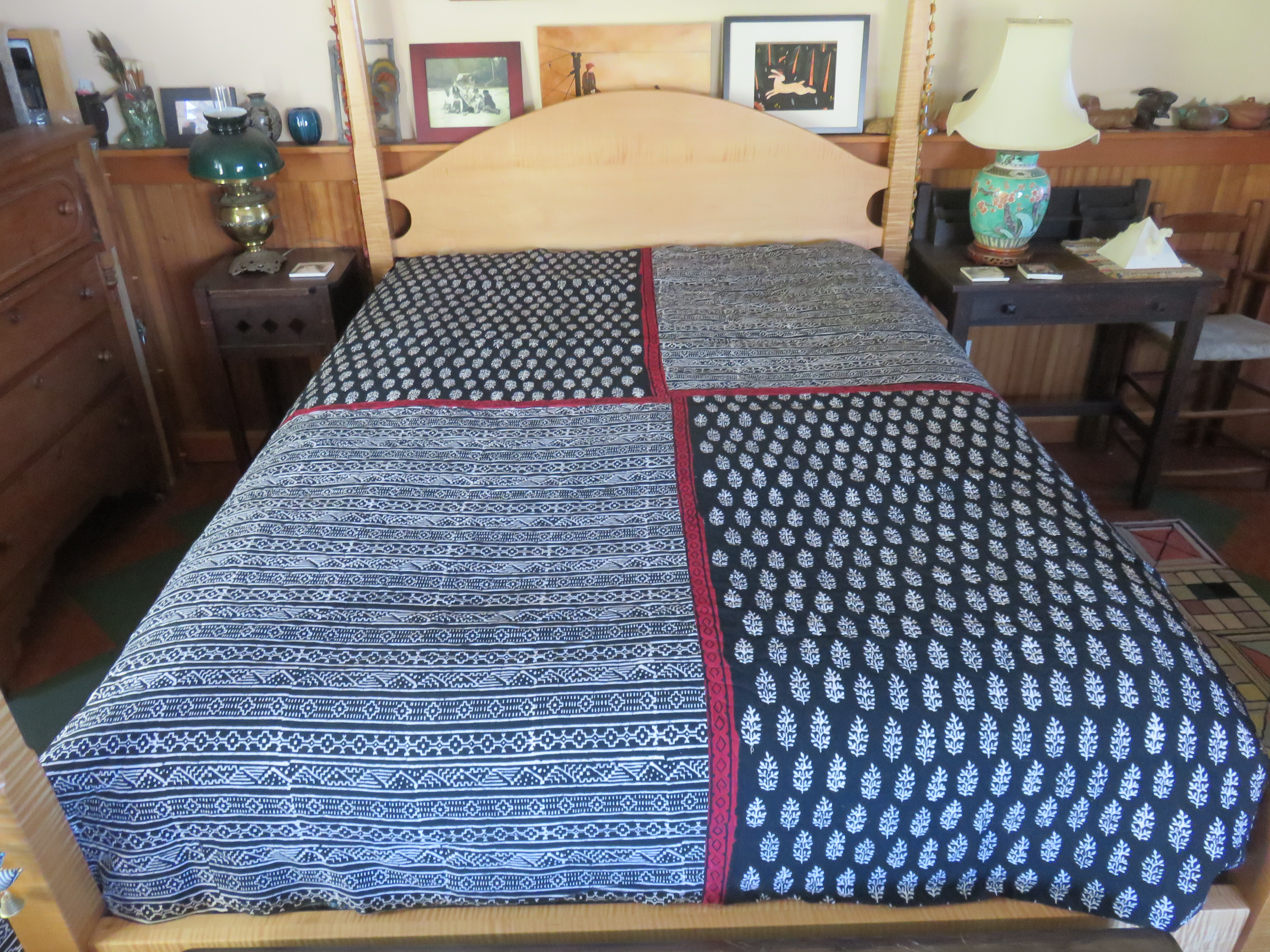
The back is black and white a red, a completely different set of block-printed cottons. There was only red on one selvage, so I cut and pieced the back to take advantage of that. It is a special piece and Linda was right about the quilting pattern. [84″ square]
•
•
•



 IMPERFECT PATIENCE