An imperturbable demeanor comes from perfect patience. Quiet minds cannot be perplexed or frightened, but go on in fortune and misfortune at their own private pace like a clock during a thunderstorm.—Robert Louis Stevenson
Our 52nd anniversary is coming up in twelve days. We’re going out for an early dinner that night because I have to be home for a Zoom meeting of a nonprofit. That’s okay. We are nearly always together. He’ll probably go for a walk during my Board meeting, and return in time to watch a show and the next day we’ll drive back to the beach. We figured out long ago that no one else will make time special, that’s on us. We tried for a “special” vacation for our 50th, and when we discovered our favorite restaurant had closed and our favorite hotel had new owners, we laughed and drove home. We spent at least three anniversaries in the ER with my mom. Those special days are unreliable, I’d say. It’s my husband I rely on.
Every time.
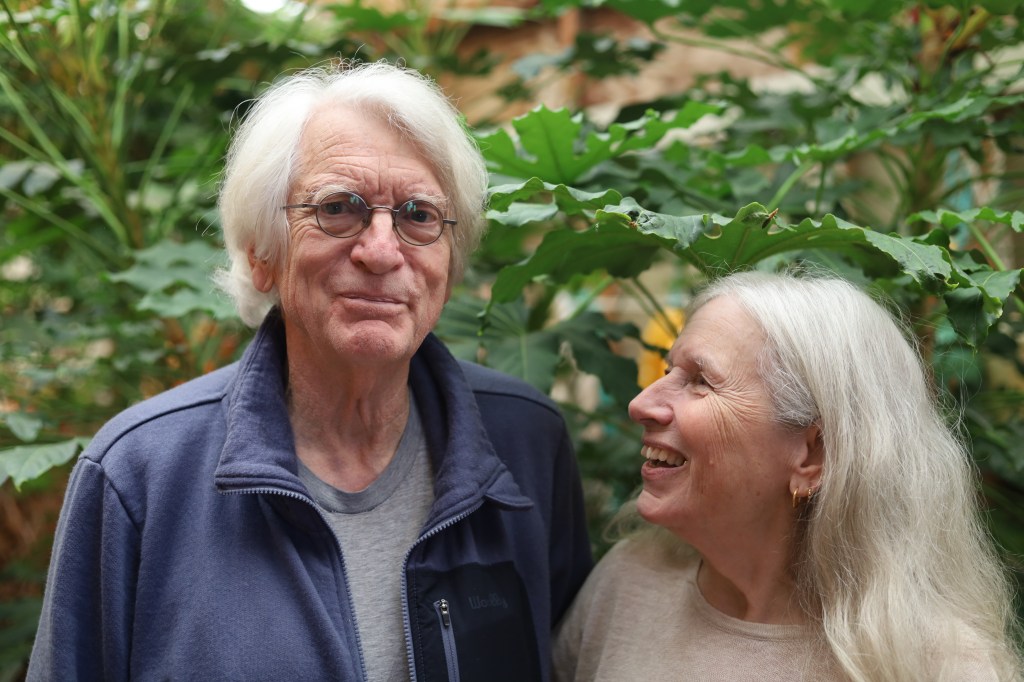
Two old people who still love one another. Gary’s straining not to pull another face, and look! Our hair is the same color. I tease him because when his hair was as long as mine in the early 1970s, women used to cross the street to pet it. He needs a haircut.Continue reading →
On beach runs, I cannot resist the amber agate, striped limpet, or rare bit of glass. I circle, bend to pluck them from the ground, and bring them home. I pile stones on the coffee table, line limpets on the kitchen counter, and upstairs too, beside the sink and on either side of my computer—the irregular translucent quartz and smooth flat ovals of jasper and agate. The baby sand dollars. Eventually, they find their place in bowls and jars. A couple of decades ago I collected more than a dozen Coach bags by bidding on Ebay. I carry a flat red bag on weekends. I pack another large bag for overnights. But there is also the brown bag I bought for my first teaching job. The rest were pointless accumulation. My mother would have understood.
Do you see the eagle at the headland a mile and some north of our home? She used to rest in a snag, but lately she’s chosen a higher perch.Continue reading →
Illustration: Ula Šveikauskaitė at Synergy/The Guardian; used here without permission. This is a not-for profit site.
It is a healthy and generous story, rich with laughter and grief and kindness and family support. I wish my experience had been like hers, but it wasn’t.
A couple of people have commented that I have not been posting. My husband comments about that every couple of days. [It’s been almost a month, I think.] Gary is worried about me, and maybe I have even been a little worried about myself.
Yesterday, there was a young seal playing in the tide pool at the base of the sea stack we call “the seal.”
Not a fish trapped by the tide, or one of the sea lions or sea elephants we see more often. A true seal, and young though not a “baby.”Continue reading →
Yes, that’s just the way the beach foam was. Gary told me I should take a photo.
From romance to plastic trash to how we can all be in this together. I’ll try to explain.
When I was a graduate student studying literature, I first heard the theory that romantic love was an invention of European novelists. People felt lust and loyalty, but actual love between two people—sexual and romantic love—was a figment of playwrights’ imagination. (It’s a silly theory.) Canadian psychologist Nathaniel Brandon claims that “in primitive cultures the idea of romantic love did not exist at all.” Even Margaret Mead declared: “Romantic love as it occurs in our civilization, inextricably bound up with ideas of monogamy, exclusiveness, jealousy and undeviating fidelity does not occur in Samoa.” Freemason Lewis H. Morgan proposed the concept that marriage was the earliest human domestic institution but also judged “the passion of love was unknown among the barbarians. They are below the sentiment, which is the offspring of civilization and super added refinement of love was unknown among the barbarians.”
[Gary argues that most of what we have assumed about physical and cultural anthropology and archeology has been turned on its head in this century.]
However, a few decades ago this idea that romance was an invention of Western culture was taken seriously enough by an anthropologist that he decided to construct a research project. He used the archetypal story of star-crossed lovers—two people who abandon convention and family in order to be together. We might argue that such passion does not necessarily lead to a golden anniversary. Even Shakespeare, after all, was poking holes in the relationship between R & J. Nevertheless, the star-crossed lover story is not merely the story of lust or friendship, but of a passionate devotion that creates more than inconvenience, where two people defy their community, faith, and family to be together. He considered such stories might provide a warning, but their existence also demonstrated emotions that most of us would not hesitate to describe as romantic love. He searched for traditional stories and folktales from all over the world. Surprise! The star-crossed lovers story exists everywhere. In ancient Greece and the forests of Brazil and Madagascar and India, China, Europe, the Middle East, and the South Seas, such traditional stories exist everywhere. Individuals do fall in love and occasionally make enormous sacrifices, even of their lives, in order to be together. They fall in love and sacrifice for their devotion. The story exists in non-literate and literate cultures in every inhabited continent and within island cultures all around the world, even in cultures that otherwise seem to have no “romantic” tradition.
It’s possible that people lied. Maybe anthropologists, like everyone, found what they wanted and expected to find. More likely, love exists.
We are human beings and part of our shared humanity is that some stories persist in all cultures, in every corner of the world, and throughout time. Like the hero’s journey, the star-crossed lovers is likely a universal narrative. Lovers who defy convention and are willing to sacrifice safety and comfort in order to be together might be one of them.
Did I need an anthropologist to prove that to me? No, I actually did not. It is what I want and expect to find is true. It is Eurocentric hubris that inspired some foolish English-speaking academic to claim that romance was invented in Northern Europe. It is shallow to assume that the only way couples stay together is reproduction, envy, jealousy, rivalry, habit, boredom, or convention. Romance lives!
So. Take-out food.
“Few of us are equipped or inclined to cook three meals a day for ourselves.”
—Tom Sietsema, food critic for The Washington Post
Tom Sietsema wrote about his discovery that the take-out food he was eating during the pandemic creates a lot of trash. He was shocked, shocked to discover how much plastic his food required.
The article was titled “All my takeout has delivered a mountain of trash. So I asked experts how to minimize it.” Apparently he had not noticed how much trash his occupation as a food critic created until he was personally responsible for disposing of it. “For three weeks this summer, I saved every scrap of takeout packaging… The cups from cold-brew breaks and the cartons from sushi and burrito runs that used to be tossed out at the office and forgotten about are now our responsibility, up close and personal — in our faces. The problem is literally knocking at our door. We have to answer it.” (I want to know where he found grass to spread out his trash in Manhattan?)
How he had not known this already?
Soda and milk products came in glass when I was a girl. But the oil industry looked for a larger market and chose plastics, spending millions to convince us of a lie—that plastic was safe, cheap, and recyclable. Ultimately it is none of those things. The lesson here? Distrust the profit motive?
People were particularly irritated by this line: “Few of us are equipped or inclined to cook three meals a day for ourselves.” Commenters pointed out that preparing three meals was exactly what they did every day. We do not need to actually cook three meals because what about cold cereal and leftovers? A survey conducted in 2019 found that only 6% of Americans eat out daily. Gallup found that dining habits have been stable between 2003 and 2016 and close to 40% of those surveyed had not eaten out for even one meal in the previous week. Apparently even Sietsema’s readers don’t all eat the way he does. We should use containers made of materials that break down completely and quickly, he says. We should use our own flatware and reusable shopping bags.
Romantic love and plastic take-out containers—we assume that others’ habits and passions are just like ours. Maybe a literary critic had a bad break-up that lead to his cynicism about romantic love. A food critic assumed most everyone ate the way he does. We assume that what we do and value and desire is the same for everyone.
When I was in college, all shopping bags were still paper and the world did not come to a screaming halt because there were no plastic bags. The produce at Safeway was not continually misted with water and I put my veggies in paper bags. Milk only came in glass or waxed paper cartons. And in 1973, I carried my groceries home in a cotton canvas shopping bag imprinted with “Save a Tree.” I used that bag for years.
Today is Valentine’s Day and my husband is downstairs making coffee as I type. How we care for and feel about one another is not like anyone else. But love and passion, friendship and simple affection, loyalty and kindness, compassion and decency are all human emotions. We are all capable of changing our minds. We are all capable of fairness and altruism. We can figure things out. Maybe we fail sometimes. Perhaps all those good things are not functioning fully all the time or for everyone. But our best can be very fine indeed. We do not need to become a culture of outrage. Anger can drive needed change, but as a steady diet, love is healthier.
Take it easy on yourself today. Everyone needs a break sometimes. The human heart is vast; it contains multitudes.
The Reading Under the Gun (or RUG” was a timed writing assignment. I gave students a limited period of time, a short text, some provoking questions, and required them to write until I said stop. The assignment was worth five points. Even if you answered the questions wrong or went off topic, so long as you wrote, you got the points. Sound simple? It was harder for some than you would think. Some didn’t want to do more than the minimum, they filled a page and then wanted to stare into space. I could be sticky about it.
It was a grade-builder, rewarded for effort. If I did my part well enough, they learned how to read quickly and think deeply about texts. They observed and recorded the obvious. They took risks and made personal connections. They didn’t always appreciate it. Regardless, they almost always liked the particular reading below. It was often their favorite of the year.
Some of my students were lucky people and had been protected and blessed all of their lives. But that good fortune doesn’t last for anyone. We do not get to live pretty lives all of the time. All of us suffer and change happens and we grieve for what is lost or never arrived. But every one of us has moments worth treasuring. The snapshots we hope are true.
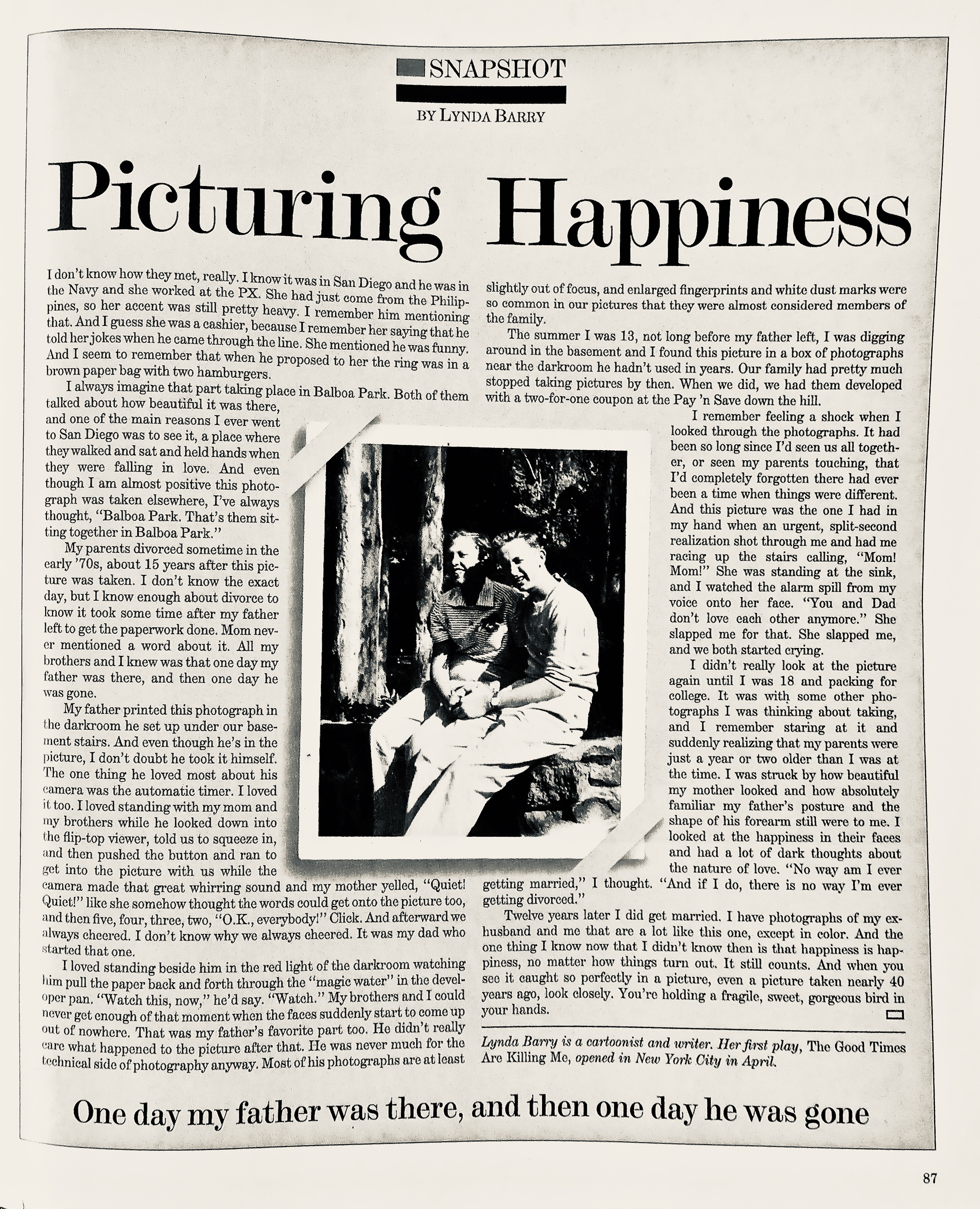
From Life magazine, September 1991, “Picturing Happiness” by Lynda Barry:
“Happiness is happiness, no matter how things turn out. It still counts. And when you see it caught perfectly in a picture taken nearly 40 years ago, look closely. You’re holding a fragile, sweet, gorgeous bird in your hands.”
We saw the black oystercatcher baby yesterday morning and it’s doing fine, my center panel is joined together and the 3″ frame is cut and pieced, the next quilt is already in planning, and I made blueberry crisp.


 IMPERFECT PATIENCE