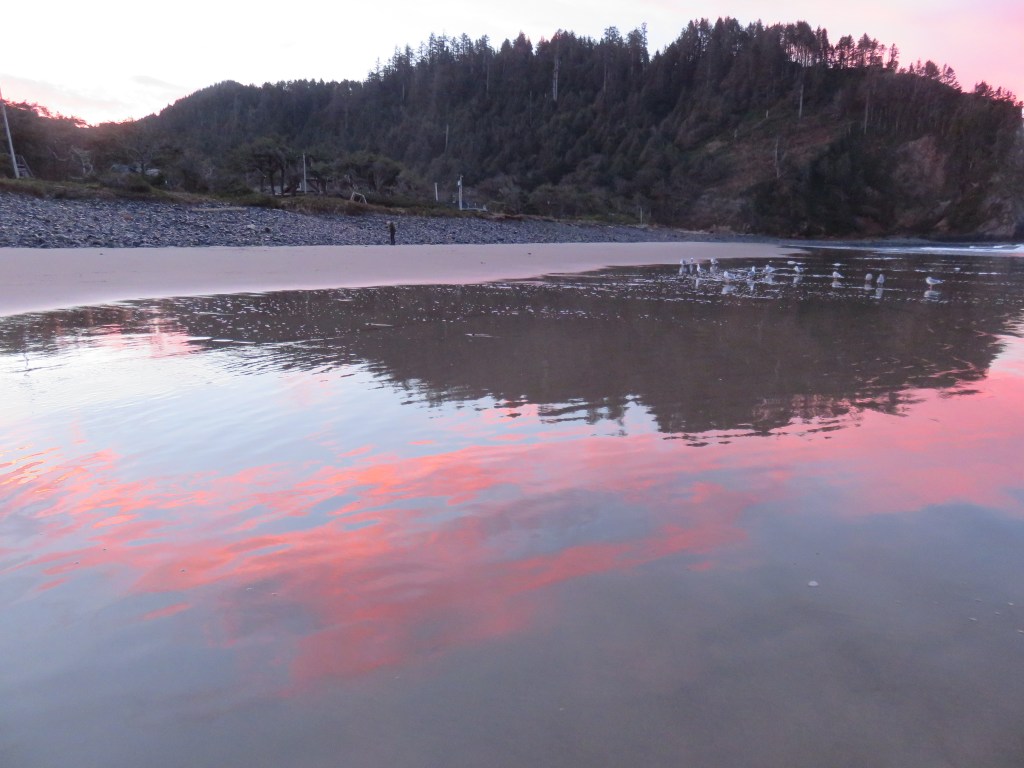
We try to walk out at first light. The sand is washed smooth, gulls rest onshore, and no one else is out—most people are still sleeping.
Continue readingWe try to walk out at first light. The sand is washed smooth, gulls rest onshore, and no one else is out—most people are still sleeping.
Continue reading

According to a 2018 map from Wikipedia, the blue shows DST in the northern hemisphere, and orange DST in the southern. Most of the rest of the world, the gray areas, ignore it. The dark gray indicates nations that once used DST, but gave it up.
People are arguing again about DSL. They are talking about it in Congress.
We went to bed late on Sunday night, hoping to trick our bodies into more quickly accepting the time shift to Daylight Saving Time. I had set my watch forward before going to bed on Saturday and Gary was still correcting the clocks the next morning. The clock in the kitchen resets itself, which results in it going a little crazy twice a year. The hands spin around the hours a couple of times, maybe wind backwards and eventually settle on what the nation insists is the correct time.
I feel a little bit like that clock myself.
The last two nights I woke once in the night and then again in the too-early morning, On Sunday I tried to convince myself that 5:33 was really the time I might normally wake. It felt like 4:33. The sun would not be up for another three hours. With my laptop in bed, I waited for light and considered that for the next week before Spring Break I will not be getting up in the dark and leaving for school in the dark and arriving at school… in the dark. That’s only because I fully retired the other day.
DST doesn’t give me more daylight. The best it can do is give me more daylight at the end of my day while stealing it from my mornings. Maybe that works for some people. They go for hikes or something after work. I used to run before going to school and DST messed that up. At the end of a nine or ten hour workday I never feel like going out for that run or otherwise enjoying daylight recreation. The best I might manage at the end of a long day is a few minutes at my loom or a glass of wine on the deck. I’d like the sun to be setting about then, along with my energy.
In 1895, a New Zealander who collected insects in his spare time, wanted to shift his work schedule so that he would have more daylight hours after work to collect his bugs. Eventually, beginning at the outbreak of WW1, most of the world would adopt the plan (the blue and orange areas on the map above), and while many countries have more recently abandoned the practice (the dark gray areas), still more than half the world’s population shifts their clocks forward in the spring and back in the fall.
When America first adopted the policy in 1918, it was so unpopular that it went away 7 months later, after the war. But “War Time” was reinstituted in 1942 by FDR. Nixon signed the Emergency Daylight Saving Time Energy Conservation Act of 1973 and even then it wasn’t consistent throughout the U.S. DST was extended in 2005 under the second Bush’s watch, beginning a week earlier in the spring and ending later in the fall, which is out of sync with most of the rest of the world. Not everyone is happy about all of this. Some U.S. states still refuse to shift their clocks forward and back.
The stated goal for DST is to save fuel and thus money, but with modern heating and cooling and the use of electric lighting and so forth, the practice probably does not save a dime, and several studies have shown that DST actually costs the U.S. as much as billions of dollars each year. Worse, its affect on sleeping patterns may be damaging our health and safety.
Ask anyone with small children what it’s like to turn those clocks forward in the spring. The following week is a mess for children who did lose an hour of sleep and often must wait for busses in the dark. Among high school students I see only negative results. They are driving to school in the dark, which can’t be a good thing. Though teenagers often fail to get the sleep they need and have erratic sleep patterns, they respond badly to the shift to DST and we teachers gear up for short tempers and impatience among our students, not to mention ourselves. We are all adjusting to one hour of lost sleep.
This adjustment to change in our internal clock can take only a few days for up to a week and some scientists blame the difficulty of this shift for a national increase in accidents, heart attacks, and suicides during the week following the spring shift to DST. This surge in deaths and near-deaths doesn’t happen in the fall. Apparently getting an extra hour of sleep doesn’t do anyone much harm.
They are arguing in Washington DC again about DSL. There are proposals to make Daylight Saving Time permanent or to eliminate it altogether. Though their interests were often cited when I was a girl, farmers generally don’t like losing morning light. Some business interests such as “the golf industry and the barbecue industry have been big promoters” of DST because there might be profit at stake. The PTA is more worried about children’s disrupted sleep and the danger of darkness on their way to school. I automatically side with children over profit.
By 7:30 on this morning, I felt like getting up. There was, finally, light in the sky, light I was used to seeing an hour earlier, according to the clock. I am normally an early riser—the result of living most of my life with a husband who is a morning person. I like to tease about how I “trained him” but the truth is he’s trained me too. I like the morning and I like having daylight to start my day.
I don’t like getting up in the dark. I don’t need time after work to collect bugs or golf. If, like me, you’re feeling a little tired or out of sorts this week, blame Daylight Saving Time.
This is one problem with a clear cause and a clearly negative effect. Unless you are selling barbecues.
I don’t know. Turn on the porch light and have your BBQ burgers anyway?
 IMPERFECT PATIENCE