ON NOT WRITING

IMG_3497

The process is frightening, this writing process. Unlike the performance, the meal, the quilt (I am knitting just now) there is no clear completion. We can only rarely say with any lasting conviction that we are finished writing.

We merely choose to stop at some point.

We live with our writing for such a long time (even if that time is only a pair of years) and there is no precise point where we can stand back and say with confidence: It is done. The work itself makes these demands upon us. It makes us doubt in return for only slivers of certainty. Those slivers, however, those instants when we feel with certainty, however rare, are slender payment for time and purpose. Our book is worth that. At the least, I would like to believe the work is worth this. In any event, I am driven to it and even when I am not writing, I dwell upon that writing process.

I have been down these past few months, not making much headway though determinedly planning to write a novel next month. This next week will be “next month” and I am unsure.

Of course I can write a novel in a month. I can rack up 75k words in four weeks. I have done it more than once. But there is that terrible doubting voice shrieking at me: What is the point? It hammers and whispers and questions and whines, yes but? until I think of setting everything aside.

I have been told often enough that I seem certain, that I appear absolutely confident and sure of my course. Yet, as I was told during a wonderful class on world religions, years ago, faith is a willingness to live with doubt. Why should anyone be surprised to learn than the future does not feel so certain from my side?

When my husband and I decided to have children (we wanted two), it took me a year to become pregnant. There was no reason I should not have conceived immediately. I had taken the pill but that was years before. I was healthy, in good weight. We certainly tried. After a year, and because I had been reading right along, and because friends had struggled to become pregnant, I knew there might never be the planned baby. We might not have children. I accepted that possibility.

During that infertile year, I considered that my husband and I had been happy together for a long time (ten years by then) and should certainly continue to be happy without children, if it came to that. I knew individuals and couple with good lives and no child. I reasoned with myself that we would be fine.

This was not a matter of planning, but of acceptance of the inevitable. It was a matter of dealing with what I could not control.

And then I was pregnant with Alan. I like to say that Ian took three days.

Writing is not childbearing. But in some ways, I feel the connection between birthing a child and a novel. It is true that childbirth could kill me, but I never feared for that. I was in labor three days with our first child, and that pain is no more vivid that the agony I have experienced writing. Both child and book must eventually be allowed to leave.

That is the struggle I feel just now. Our sons are grown and off on their own. We are grateful for phone calls and visits. They will never be so close as they once were, and that is painful at times, but also as it should be. We raised people capable of managing their own lives, not permanent infants but adults now who come to us as equals.

The novel, however, that I am setting aside . . . that remains an infant, remains dependent and with no external life.

We had dinner the other day with the owner/editor of a small press. She urged me to pursue digital publication and build a platform with followers. She also confided that her own digital sales were down from over a hundred to fewer than a dozen a month. I cannot help but feel her advice might have worked a few years ago.

I do not even own a Kindle. A friend self-published without great success. So I have my doubts.

This morning I read a comment to Allison K. Williams at the Brevity blog post:

This is spot on and infinitely encouraging. But “Two years of generating material, two years of dicking around, four years of fallow time where the manuscript reproaches me from my desktop every time I open the laptop, and two years of getting down to business” had me laughing out loud in appreciation and recognition of my own process.

I had a mentor (painting, not writing, but it applies) who told me, when I was complaining about not painting as much as I thought I should: “you’re still doing the work, even when you’re not working.” After a long dry spell, a friend came back to his work beyond where he’d left it.

There might be something coming next, but I do not yet feel it. I am not writing anything just now, except these lines. Perhaps I am only in a period of rest, The quandary has stopped me cold. As if I had managed birth only to find the baby perfect and perfectly dead.

It is time to allow this novel-child to slip away, and move on.



FLYING ON

IMG_3370

When I prepared my application to the MFA (Masters of Fine Arts in fiction) at Pacific University, I needed a short story, a very brief literary analysis essay, and a personal statement. This was 2004. My mother had been dying for over two years, and my brother had declared me “the most disfunctional person” he knew.

I had recently unshouldered the yearbook and left the high school cross country team, but I was teaching high school English full time, and visiting my mother at least three times a day since her collapse in 2002. My husband, too, carried this burden, stopping on his way to work to get Mom up and make her coffee, at lunch, and again on his way home. I have my annotated calendars from those years. They do not list these and other daily tasks or fun events as they would have during my working-my-way-through-college years. They note my mother’s hospital visits.

There was a four day period that included my high school Open House and three visits to the ER. I never missed school. I trudged on.

It’s true that I felt disfunctional. I was overworked, but I did not have the leisure to alter my obligations. I loved my mother and she was too stubborn to change. I was only halfway through the most stressful and painful and emotionally destructive period of my life, but I was doing the job. All the jobs of teacher, wife, mother, and daughter.

In the midst of this chaos, halfway through what would be the five years of Mom’s dying, I began to carve out a new life for myself. Our older son had completed his first college degree and our younger son, despite taking time out for commercial and regional theater and a leading role in a film, was completing his degree. I was, I see now, adjusting to my life chaos, struggling to regain space for myself as an individual.

My application to an MFA program, then, was essentially a survival strategy. I have absolutely no memory of what I wrote in my personal statement. I wrote my literary analysis about how Edward P. Jones details events without reflection in The Known World. And then, because I had never written a story longer than ten pages, I set out to write a story of close to twenty.

“The Promised Hour” was based on a pair of a true events, one of personal experience in college when I believed a child was being molested and I confronted the man after the Seattle Police said they could do nothing. The other, more recent event, concerned a local doctor, a man I knew whose daughters had gone to my sons’ grade school before moving out of the area. After his wife left him, the doctor deliberately bankrupted his practice and then seized and murdered his children and killed himself.

These deaths were reported in the newspaper and had a devastating impact on my community, on the people who knew the girls, teachers who had cared for them in the classroom, neighbors and school friends. I kept trying to understand how that mother could ever recover.

That was the story I told, the story of a woman carving out existence after devastating loss. I told it badly, I was later told, but well enough that someone thought I might have potential as a writer of fiction.

The story itself went through endless revisions. I mostly stopped keeping track after the first forty or so rewrites. I moved events into and out of chronological order, added and deleted scenes and details. Removed characters and created them. The story has since been submitted to literary journals a few dozen times. Sometimes it is summarily dismissed. A few journals kept it for months past their normal review time. Some wrote back with admiration and perhaps even sincere regret, but always rejection.

Then, in 2016, I turned it into a novel, which allowed me room to explore this woman’s life after death, the years of clawing her way back to life. Only fourteen drafts of the novel, and I am done rewriting. That novel has done no better than the story in submission. Mostly, it does not get past the query letter.

Everybody’s Mother Dies, a literary novel of about 78k words, follows a woman’s odyssey through grief. 

Thena Justice was building a new life near Seattle after the death of her mother and breakup of a terrible marriage when her former husband murders the neighbor-babysitter and their daughter before committing suicide. Lost in grief, Thena first hides in a friend’s converted garage, then in a tiny cottage on the Pacific coast, thrashing her way through apathy, anger, and routine. Instead of returning to Puget Sound, she moves to the city where she was born, takes the bus to a retail job each day, and keeps her head down until a child crying in the night wakens whatever it is that gives existence meaning. 

One agent wrote:

But no, I’m sorry.  . . . I read this query letter, it’s thoughtful and well-written. I don’t, however, have the mental energy to read a novel of this description, the world has become such a violent and angry place, I find myself unwilling to read fiction which deepens that impression. I’m sure there are others who will disagree with me and toward that end, best of luck.”

Though I rewrote the query, too, others do not disagree with her. Even the reader who read the entire work and liked it ultimately said no,

“I would love to take your manuscript on and work with you in placing it, but I’m afraid my current workload simply wouldn’t do it justice. This project requires care and attention – because it is no doubt a beautifully quiet yet impactful story – that I don’t feel I can give. I say this with a heavy heart.” 

Whatever care and attention it requires is beyond me. Though the bulk of my story is about recovery, not the devastating loss that demands it, I cannot help but respect these views. The world has become too angry and violent. And I have written my story badly.

Two agents and seven* small presses have sample pages, and then I will regretfully put this work aside permanently.

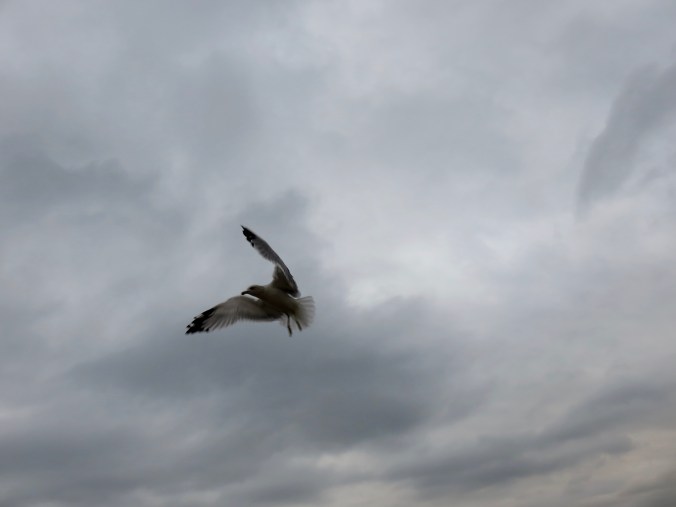
Sometimes the only way to survive is just to fly on.

IMG_3390

*I had to go look this up. Not four, seven.


THE WORDS I WANT

IMG_1157

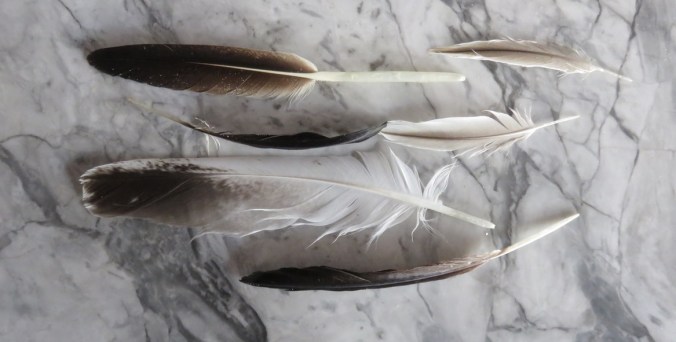
Most days I find glass during my walk on the beach, but I always find agates. Rarely I will pick up a feather. I lean down slowly, sliding my hand down my thigh, and even so my head throbs when I pluck a treasure from the sand.

Ten days ago I suffered a concussion in a fall that threw me hard on my back. Two days ago I sat on the edge of a too-soft chair, leaning forward while I played Scrabble with a friend for an hour. That has my back acting up.My head hurts when I wake. I drink plenty of water. Today I will try to stay off my feet and off the computer, but here I am typing.

Sometimes you just do what you want, what you might even pretend you must do. I could be knitting now or winding a warp. I could be watching television or reading. There are other satisfying, creative outlets. None of them reward me as writing does.

I have completed many stories, I could not even guess how many. Novels, and collections of writings, children’s stories and a novel probably suitable as YA, craft essays and creative nonfiction. Poems.

On the other hand. (She had warts.)

On the other hand, writing troubles me. Writing takes longer than anything else I do, longer than baking, knitting, piecing a quilt top, planning, teaching, a long walk on the beach. Reading a book. It is less certain. There is no absolute I-am-done point with writing. There is no clear reward, in most cases there is no reward at all. Few people ever see my knitting, weaving, and few eat my baking. Fewer read my words.

The novel that I have been sending out since last winter has been rejected 68 times. So far. Is that enough? Am I done? May I set this writing aside and move on? Should I?

But still, it is the words I want.

WE MISS THE CAT

IMG_3959

One of our sons just adopted two kittens. They are adorable and I got to hold and pet them the other day.

We are in the midst of “Swedish death cleansing” known as döstädning. “It’s what people are doing before somebody passes away so that the relatives don’t get left with the big chore of sorting out their personal things.” Except we do not plan on dying soon. 

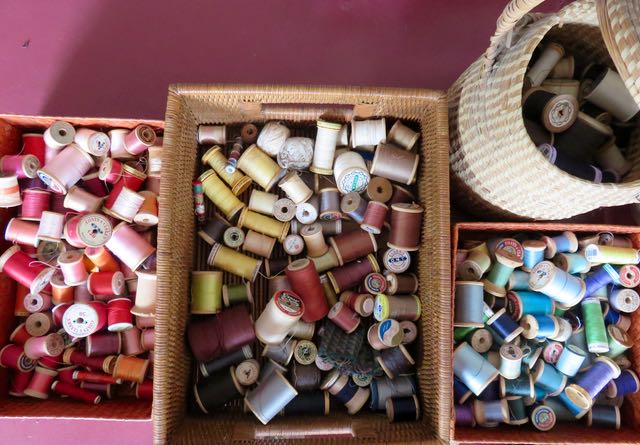
Perhaps this is “Oregon reverse gathering”. I am 65 and I do intend to live another twenty or thirty years. It is not an unreasonable expectation. What I do not expect to do during that time is use all of the hundreds of spools of thread I inherited from my mother and grandmothers (also my aunt and my step-grandmother’s second husband’s brother who is responsible for an oversize spool of heavy black cotton thread). The four baskets are shown midway in my sorting and contain only about a half dozen spools of handquilting thread that I actually purchased. The rest found their way to me through no effort on my part. The effort is in using or disposing of them. The sewing notions are taking me longer than anything else. Elastic, zippers (when was the last time I put in a zipper?), thousands of needles and pins. I found two darning needles I had been looking for. I found all the missing pincushions. Too many pairs of scissors. Sewing machine parts I do not recognize and that may not fit the 1940s sewing machine I use. Just separating all these into sorted containers has taken me a week. And I am not done.

IMG_3116

No worries. I have a plan.

The sewing notions will be used or donated. The car is presently stuffed with other items for Goodwill. There will be more drives north to the donation site. There will be projects organized and stashed. I will compile sewing kits for each grandchild, and I will restock the drawers of my sewing machine and the little sewing chest downstairs. Both were emptied while I sort. I will find places to donate the rest. Perhaps each of my writing students would appreciate a sewing kit to take away to college?

Clothing, because I keep everything, has been a challenge. I finally researched Eileen Fisher’s program offering $5 in credit for each used EF garment. To think of all the Ebay purchases I wore for a time and then donated to Goodwill! I went through my stashed/binned clothing and garment that have hung in my closet for years without being worn. I held back the burgundy velvet skirt and two silk tank tops for the fabric. The rest goes. I plan a trip to an EF store. I hope to half pay for a pair of shoes. In the mean time, what had been three large bins is now just one, and I have space to hang something new. (I will resist that last temptation.)

The furniture is more of a problem. There is still plenty that needs an exit strategy. Chairs, a low cabinet with sliding glass doors, an Ikea desk, a farmer’s dining table with a drawer, a 4-drawer file cabinet. These are all free for the taking unless we can find a way to load and take them to a charity. None will come to collect them, not even for a price.

We still have a plan.

All this work will not all be done in time for our family reunion this weekend, but enough will be sorted that the five children can safely play and that two cars can park in our garage. It will be done soon enough, the attic is completely empty, bins await delivery to family, and then I will sort other gatherings of clutter: the desk, the linen closet, the Kitchen Queen. There is a still a great deal to go. I have a list, and I assume that once I have ticked off all that I know to sort, I will begin again.

Nest week we are rewarding ourselves with a night at the Sylvia Beach Hotel. We are staying in the Shakespeare room. There is no WiFi, no phone or television. We have our reading planned. We will eat dinner out and Gary will have Guinness at the Irish pub down the street. Maybe, just maybe, I will take along some knitting. There will be no hurry about getting home as there was when we had pets.

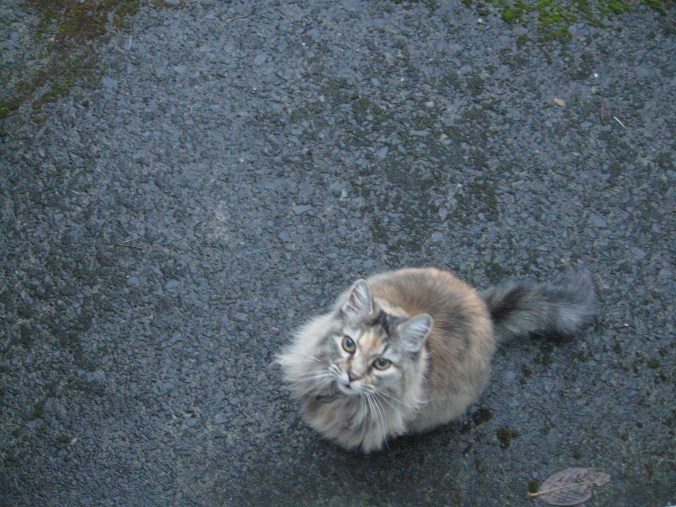
Our cat suffered when we were gone for more than a few hours, and as a result, we are only now becoming accustomed to the freedom and leaving for overnight stays. Clearing the house lightens our lives, provide a freedom of some sort, a mental decluttering along with the physical decluttering. Letting go is not only a human problem.

But still, we both miss the cat.