SUGGESTIONS for 2026

It’s New Years Day, the day we make promises to ourselves about how to have a good or better year. But I’m not making promises, only suggestions for myself. Here’s the short version:

  • dress crazier
  • watch what I eat
  • vacation even if it’s just for the day
  • walk long and run short distances, no hurry
  • write and create objects to please myself
  • try
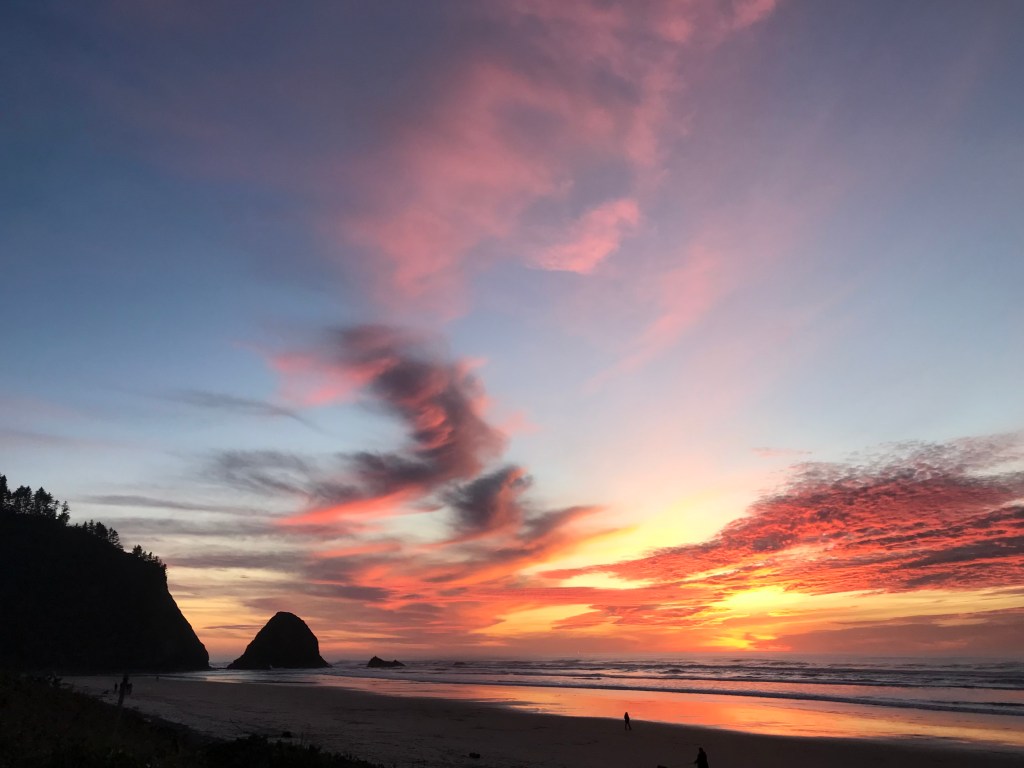
This sunset was photographed by most everyone we know. It changed and got brighter, more magenta than orange.

In 2025: I went through dramatic changes with my novel, the most notable of which was sending back the advance, cutting it to 60k words, and recognizing that if it’s going to be published I will do that myself. We stopped drinking altogether in October as a result of observation of a friend’s disastrous decline. I injured my foot in May and recovered enough by November to run.

Gary and I quit drinking in October. He was having a beer or three each day, and I averaged a glass of wine. Then our tenant totaled his car and left his home in filth to go into assisted living—that was September and we’re still repairing the damage caused by incontinence, smoking and drinking, and neglect. We were surprised by how easy we found our choice to quit drinking, we don’t miss the alcohol or the hangovers, and we’ve noticed we’re saving more than a hundred dollars each month, which is particularly welcome.

The national news was mostly awful, but we are well.

One more personal suggestion for this coming year… I was once an eight-hours-sleep-a-night person. When I was still a child in the early 1960s, an article about sleep made me determined to get my eight hours of sleep each night, and I maintained that excellent habit all through college and parenting and teaching Art and English and writing. But in the 2000s, I found teaching while caring for my mother did not leave me much “free” time to write, so I deliberately cut an hour from my sleep schedule. Seven hours allowed me to write novels and complete an MFA, but I’m now down to an unhealthy six hours of sleep and I’m missing those other two hours.

I really want that sleep back, and I will be taking steps.

I’ll probably read at least 50 books in 2026 and worry too much. We’ll pick up litter on the beach, hopefully find someone to rent our rental, and visit family and friends. I’ll bake and cook and make stuff. Gary will do kindnesses, remember, listen to music, and garden. No promises, but we’ll try not to do anything stupid while staring into the face of fascism and maintaining some level of optimism because we are hopeful people.

May it be enough.

.

SHOOT

In 1972, I drove across the country with my grandfather’s third wife Genevieve to a sheep farm in Kansas. I had never been over the Rockies before that. Vietnam was at war, I learned to spin wool that summer, and when I got back Gary and I moved in together on the 4th of July. We would both be Juniors at the University of Washington that fall.

But in June, Gen and I crossed the plains. It felt foreign-strange to me to see no mountains on the horizon in any direction—no mountains at all in the last days headed to Kansas. All around, open sky. At one point, we pulled over to the side of the highway while a storm passed overhead.

I spend a lot of time looking at sky, have done for most of my life. When I was young, I didn’t want what my dad teased my mother about: Five secluded acres in the middle of town. I wanted to be far away in forest. But then we moved to the edge of the continent, and I began watching the sky.
Continue reading

OutHorse

The best advice my mother ever gave, and these were words she said to me hundreds of times: Think how the other person feels.

She meant to help me be a kind person. As a child I went to Unitarian Sunday school. Later I attended worship at many churches and temples and houses of worship. Though not religious, I wanted to be a good person. I wanted a clean conscience and self respect. I think that’s what my mother hoped for. Mom meant for me to consider the struggles, trials, and pain of other people and how that influences their actions toward me. She did not mean that I should consider myself last, but thinking how others feel has helped me consider motivations and sometimes allowed me to be kinder to myself. It certainly has forced me, sometimes, to behave better.

I thought I was done posting. I hid my posts in April, then opened them again a month later. And now I try to post. Gary says it’s good that I post. This past week has been especially…. hard? painful? heartbreaking? Is there a word strong enough to explain? Lately, as I walk Portland streets and see someone smoking, I have said out loud: You have known your whole life that cigarettes are poison. These are times when saying anything to a stranger might result in being shot in the face. Safer to post here.

Throughout my life, I have been prone to periods of profound sadness. This is one of those times. I think it is a rational response to the situations just now. 

The greatest advantage to living long is knowing things will be better, that I will feel better after a while. I know this, though I do not feel it. I know it’s true.

I will feel better. Maybe nothing will improve, but I will manage.

There are people in the world who built a cellphone large enough for a horse. They taught horses to use it to text messages. (There’s a video showing all this on the website.) The horses might not see the point, but horses play. I suspect most animals have a sense of humor.


We did not walk to the Portland Rose Garden today, as we often do, but I saw a huge cascading rose outside a flower shop. Flushed with tiny white single blossoms, it grew twelve or more feet up and arched over the door of the shop and the sidewalk. The owner of the shop had no idea what variety it was. “It’s a volunteer that’s come up through a crack in the pavement.” She says it sets hips, tiny and red. I will return to collect seeds.

Below, a poem.

BOTANY LAB
by Jan Priddy

A generation ago in my Botany lab,
my partner bends over specimens, scalpel
poised like a paintbrush. He slices flowers
perfectly in half; my turn to peer
through the microscope. I count stamens
and ova. As I draw diagrams, search
for proper names in the text,
I do not notice silence

until it’s broken. Someone,
also hunched over high black counters
and flower parts, asks the air, What sets
human beings apart from the lower animals?
Tools comes an answer from across 
the room. Aren’t we the only species
which makes and uses tools? We decide
not, since Goodall documented chimpanzees 
fishing for termites. Playing, I hear my partner 
assert. Man is the only animal that plays. 

I look up from the sexual organs of plants
and smile. I think he’s wrong, though I am
not the first to say it. My dog plays with me,
says another Botany student. But my partner
argues with pets. They are domestic animals,
tainted by association. Fawns, we offer,
adolescent lions. Juveniles, he shakes his head.
Adult otters swim purely for fun, we counter.
Porpoises leap in the wakes of ships, squirrels
play tag in trees, foxes pounce on dandelions.
His forehead puckers, scalpel painting the air.
Really? 

Under my microscope, a five part flower,
many stamens, fleshy calyx-tube.
Family Rosaceae,
genus Rosa,
species multiflora,
precisely like
the illustration in my text—
a local flower I see each day.

“Botany Lab” was first published in StringTown, 2001