My dad used to tell a story about his first job at a California aircraft company. The new head offices had a problem. The roof leaked on the President’s desk and the famous architect who designed the structure refused to address the problem. “It’s a work of art,” he is supposed to have said. The CEO tore the entire building down.
I was reminded of this while reading an article in The Washington Post about how office layouts might change to ensure distancing and a healthier work environment.

A student took a photo of me into Hagia Sophia so I could say I’d been there.
Gustav Pundt was among my favorite professors at the University of Washington. Hermann Johannes Gustav Pundt (28 August 1928 – 15 September 2000) was a leading architectural historian and Professor in the University of Washington Department of Architecture. I took his architecture history series in 1971, I think, and he introduced me to such wonders as Hagia Sophia (in Istanbul, Turkey), which is among the beautiful buildings in the world. His photographs of the interior, taken at a time when it was forbidden to take such photos, completely captured my imagination. Light flooded from a circle of windows at the base of the main dome. Magic. I have wanted to visit ever since. I really did love the guy for that.
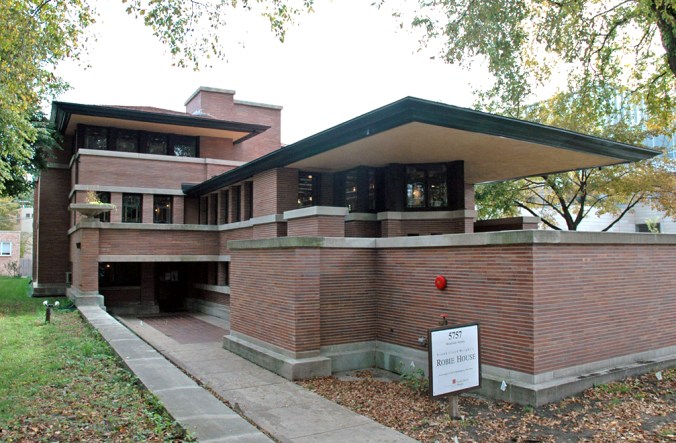
As a student himself, Pundt participated in the restoration of Frank Lloyd Wright’s Robie House (1909, above) in Chicago, a beautiful building in the Arts and Crafts style, showing the influence of his Mentor, Louis Sullivan (the “father of skyscrapers”, but also a designer who appreciated detail). True, the Robie House was designed to have no blinds or curtains on any room, the leaded patterns dividing the glass was intended to ensure privacy. How did that work for the occupants? You decide.

Windows in the Robie House. Most of the window is clear with only small bits of colored glass.
I was not a fan of the architect. The Johnson Wax Headquarters (1936) was a nightmare to my way of thinking: too many specialized brick forms (over a hundred molds which looked less innovative than inefficient to my 19-year-old eye), the glass tower continuously leaked (this was later corrected by the Johnson Wax company’s innovations, not Wright’s), Wright’s special three-legged chairs fell over, and it included the dehumanizing “open office” plan he’d used in an earlier office building.
The Larkin Administration Building (1906) is touted as the “first modern office” with entire floors left wide open for secretarial pools. If you have seen The Apartment with Shirley McLaine and Jack Lemmon, the open space where Lemmon is working at the beginning of the film is Wright’s fault. This “regimented approach, where workers sat in lines of desks with managers in offices surrounding them”—what fun. Today it’s blamed for the spread of colds and other viruses in offices. How to prevent the spread of covid19 in such wide open spaces?
The saddest part of this might be that I know all this because Pundt told his students all about Wright, warts and all. He loved the guy whose architecture placed function below innovation. So I did not agree about Wright. I want to have my cake and eat it. Give me a beautiful building that is also a pleasure to live and work in.
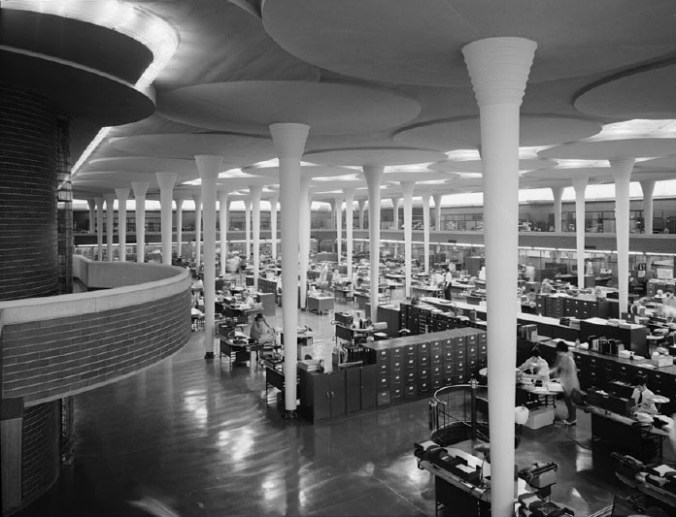
Wright proved that his beautiful reverse “lily pad” columns could support weight. He did not prove that people enjoyed working in what he envisioned would resemble a “factory floor.”
Don’t even get me started on Falling Water, with the dysfunctional stairs to the water and unremitting damp (again, a detail thanks to his admirer—it was an unliveable house). Beautiful site and stonework, but, like so many of Wright’s designs, it fails its primary purpose. It’s a showcase, not a functional building. The Solomon R. Guggenheim Museum is showy too and notable for forcing visitors to look at art from a slanted floor. Yeah, I’m sure it looked spacey and futuristic in 1959. Now, to me, it’s just an ugly airport parking garage or an out-of-scale child’s toy.
Speaking of frustration and scale: We are waiting for two and a quarter pounds of chocolate to arrive.
I bought three bars of Theo baking chocolate back in December. Organic, gluten- and dairy-free, Fair Trade, and made in Seattle. Practically local. I meant to make vegan chocolate pots de creme when our sons and their families came for Twelfth Night. I ran out of cooking motivation before I got to the pots, however, and the chocolate remained in my baking cabinet until last week. I used two huge chocolate bars and pecans to make brownies last week. They came out so thick it was hard to get my mouth around them, and dark, very dark. I love dark chocolate. We each had a square the other evening and again yesterday because I put some in the freezer before we could gorge.
There is also a single 4-ounce bar left in the drawer, so I went to the Theo website to order more baking chocolate. It’s sold out. I checked Amazon, but they only have the same high cocoa content in 3-ounce bars. Back to Theo. Sadly, this Seattle company sells their candy cheaper on Amazon than directly from their own website. I ordered a dozen bars last weekend. Yes, I am weak.
Amazon Prime shipped FedEx. You probably see where this is going. Oakland. Seattle to Oakland, so far. Had it shipped USPS, I’d have my chocolate by now. It would have gone Seattle to the regional center in Washington, to Portland, and here. Three days. Instead, it shipped right past Oregon to California. If it were in Oregon by now (630 miles back north), that would not be so bad, but you know FedEx doesn’t work that way.
This is my current entertainment: watching FedEx ship my chocolate around western states. It left Oakland yesterday afternoon. Idaho next? Eastern Oregon? I was actually looking forward to finding it had gone to Wyoming, but this morning it is in Portland. There is still time for the order to wander through a few small towns or head back to Washington state. FedEx can prove that the meandering delivery routes are actually functional. Unlike some of Wright’s designs that were unusable, my chocolate will arrive at my house after it takes a tour, and is functional. I will make more brownies.
I am easily entertained.
 IMPERFECT PATIENCE