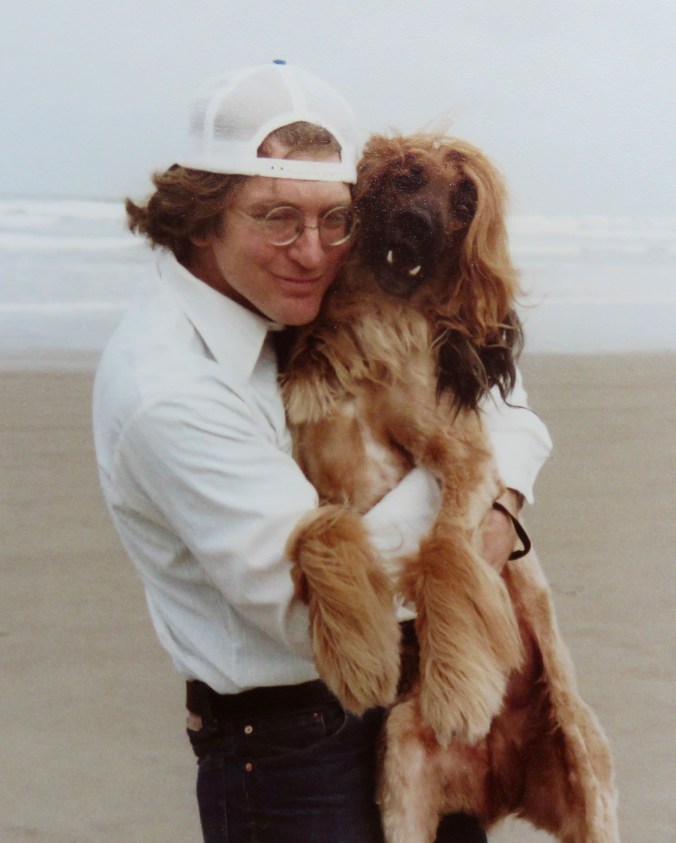
Gary with his dog, “Manny.” He’s clipped down after we moved to the beach in 1979. Manny was an American and Canadian Field Champion.
We went to Canada last month for two nights. It was a lovely time, made lovelier, I suspect, because we took no photos and accomplished nothing but rest of the best sort: we ate well, walked, napped, and read.
The point was to use our passports, that were a week or two shy of expiration and had never been used.
Gary and I used to travel to Canada often, back in the days when all we needed was a rabies certificate to bring the dogs we were showing back into the US. I showed our Afghan Hounds in dog shows and judged field trials and the dogs ran in them. For a time in the 1970s and 80s, our dogs were well known by the running crowd.
Gary was known.
Some terminology: Sighthounds are dogs that hunt primarily by sight—they chase what they see moving. Greyhounds are the sighthound most people know, but recent genetic testing finds that Afghan Hounds and Salukis are among the oldest dog breeds, existing for thousands of years in the Middle East. Lure coursing allows a formalized “hunt” of a shredded white plastic garbage bag. The dogs are smart enough to know it’s a lure, but most enter fully into the game.
The sport of lure coursing began with the American Sighthound Field Association which probably owed its existence to Lyle Gillette, a dog fancier best known for his Rancho Gabrielle Borzoi, the hounds also know as Russian wolfhounds, which were actually used in packs to hunt wolves in the Steppes. Lyle was a sweet man and I stayed with him while I was participating in a field trial in northern California. I was traveling with my friend Heather Loube, a citizen of Canada. This was the early 70s.
The previous year, I had traveled with Heather and her husband Jeffrey and assorted dogs to Colorado for the inaugural Colorado Grand National. One hundred and four dogs of various breeds ran that day. I slipped Wielki Sezlem of Nightwatch who was a show and field champion. I yanked the slip collar toward me when I released him (a mistake), the heavy brass ring hit me in the face, and a hour or so later I had eight stitches in my upper lip. I could show you the scar.
The upshot was that when Gary picked me up from the airport, he was tall enough to look right down under my bandage and see my stitches, and he about freaked out right there in the airport. I had not warned him.
This was not the first time I’d had an injury to the face. One of Heather Loube’s dogs had jumped up to kiss my face, while I was backing up and Heather was trying to pull him away. His tooth met my tooth and my tooth lost. Heather’s dentist came into the office on his day off, treated me gently and at no cost.
[Don’t ever tell me that the Canadian health care system is inferior to ours. Years later our youngest son, then not four years old, had an abscessed tooth and our dentist would not come into the office to treat him. He had no emergency care referral in place, and I called every dentist in the county before I found one willing to see my sobbing child. I got better care from a Canadian who owed me nothing.]
Heather and Jeff Loube founded the Canadian Sighthound Field Association with help from a few other early enthusiasts, including Gary and me. Gary and I were ourselves instrumental in starting field trials in the Pacific NW.
All of this to get to Gary mowing an eight acre field with a push mower.
We liked running hounds on rough ground, but grass approaching two feet made visibility of the lure near impossible. The field in a local park had to be mowed. No one in our breed club would help or even offer equipment. After the first day, word got around, and Denny showed up. Whippet and Borzoi and Deerhound fanciers showed up. Five or six people with gas-powered mowers. Eventually someone got ahold of the parks people and the park manager came out to see what was happening, shook his head, and lent us the sitting mower, and the mowing was completed in no time. Four days of hard labor and then no time at all.
That first meet used a drag machine. The lure was attached to the end of 100-pound braided dacron fishing line, which was connected to a spool that wound up the line. The course made a huge S shape with a long straightaway in the middle, cornering on pulleys set flat on the ground, over a total distance of about 900 yards. That course was strung by hand. Someone took the lure in hand and ran around the huge S, catching the line on the cornering pulleys. That someone was also Gary.
Most clubs used a motorbike to string the lure. Later, continuous loop machines ran the line with one end of the S joining up to the other in one continuous loop. (I was present at the first use of a continuous loop machine, also in California. My girl, Onika, skinned the inside of leg running right along the line—a rubbed patch the size of my palm inside her stifle. We learned to keep a continuous loop tacked down close to the ground to avoid these injuries.) Some courses were different shapes of course. I designed many.
Gary ran the lure around for each course at our first meet. Three dogs running in each and wearing identifiable jackets in yellow, pink, or blue. (We used red, black, and white, in early courses, but this caused confusion—was it the red dog in the black jacket? or the black dog in the red jacket?)
Gary ran many miles. The Canadians brought beer for after.
Over the years, we met semi-pet raccoons, rare sighthound breeds, people from all over the world, because of our dogs. I went into labor the first time while on Vancouver Island BC, judging a field trial. I drove all the way home and was in the hospital a few hours later. You might not believe it, but that is one of my favorite memories.
I miss the dogs terribly sometimes. We had sighthounds and were active showing and running for decades. Gary still misses Manny.
We traveled across the U.S. and to Canada for dog shows and the far more entertaining field trials. You can guess which events the dogs preferred.
 IMPERFECT PATIENCE