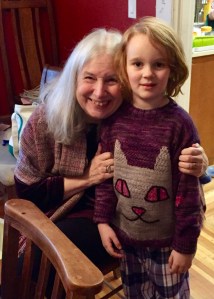
with my first-born grandchild.
“Marriage still ain’t equal, y’all. It ain’t equal. I tell women that whole ‘you can have it all’ — mmm, nope. Not at the same time. That’s a lie. It’s not always enough to lean in, because that s— doesn’t work.”
— Michelle Obama
Some would consider me a second-wave feminist. This is because I was born in 1952 and have always insisted men and women are the same species, generally need the same things in life (food, air, purpose), and that women should have the same opportunities, rights, and respect accorded to men.
Crazy me.
The day my high school announced that girls were allowed to wear pants to school, I was already wearing jeans. I expected to attend college on my own steam. I expected to work. I expected to make my own choices. I chose to be a “Ms” as soon as that option came to my attention. Neither my husband nor I changed our names when we married nearly 45 years ago. I have opinions. I speak up.
But back to that line above about having it all, all at once. I never believed that.
Raising children is an enormous job. In the past, families, extended families were available to help with child rearing, and that was how parents managed is the days when everything everything about getting by was harder. Laundry took days and reddened hands, cooking required lighting a fire first, and getting to work was either right outside, a long walk, or saddling a horse. Letters written on paper. That’s where we were a hundred years ago. We had to clean the chimney’s of lamps once a week. Everyone worked harder to do things we now complain about when we have to stuff dirty clothing into a machine, pull a frozen meal out of the fridge, drive, compute. But people pitched in and most Americans had lower expectations.
I don’t remember horse-drawn vehicles, but my childhood included party telephone lines and black-and-white television and typing. Dinner on the table ever late afternoon. Mothers at home. Things are easier now, most daily chores anyway. Raising children is still an enormous responsibility. A person needs help.
My husband and I discussed who would stay home with our children. I wanted them in my twenties because physically that seemed the best time. I was working and so was Gary, but he had insurance, and that was why we decided I would stay home with the children. It’s almost an impossible option for most parents today. Even then, it was hard and money was very tight. We scrambled to pay bills and did not expend much on entertainment, but we managed. Children in my twenties, back to work in my thirties, graduate school in my early forties. That was my plan.
I thought, in my twenties, that once my children were grown I would return to school and earn a Masters of Fine Arts in the visual arts, probably in enameling, thus continuing my undergraduate trajectory.
Things turned out differently. I earned an MFA in writing fiction in 2007. I mostly retired in my sixties though at one time I hoped to teach into my seventies. In 2015, I could no longer manage the long hours as a full time English teacher. I was tired and had been sick for weeks the previous winter. I was unwilling to spend less time working full time, and part-time was not an option. Now I teach two classes a year. I set goals for writing and other creative work.
Beginning as a girl, I have always set goals for myself. I wanted to raise children (usually), live in a beautiful countryside, raise horses, keep a garden, love. Most of those early goals came about differently than I expected when I was a teenager. I raised Afghan Hounds until I had children, our garden is mostly wild, and the countryside is right out in front of me every day. And I love. I never expected to have everything I wanted at once, but I have always kept my eyes on the heart of my life goals.
Marriage is not equal from the outside.
(Not yet, but someday. I am not among those cynics who excuse inaction by complaining that this or that will never happen. Wonderful things happen all the time.)
Women are still paid less than men by every sort of measure (as are many other marginalized peoples). I am sorry that white men find discussion of their advantage offensive. They do not necessarily have anything easy, but all other things being equal, they have things easier. The rest of us work at a disadvantage. We are accorded less respect outside our homes, and too often inside our homes. As one example, I saw this working with occasional contractors who simply could not talk to women as people. Their work was primarily with other men, and they assumed that their advantage is “natural” and fair, that their opinions should always have precedence, unquestioned by women. They were irritated by a woman saying most anything, particularly if they were expected to take directions from a woman. I always feel sorry for their wives, assuming they are still married, and so often they are not. It is pathetic that the only way some men manage is by pretending they are superior to others, including to women they promised to love and cherish.
Yes, I know there are bad women in the world, selfish people of every stripe. But I speak from my own experience. Here I want to speak of marriage as a bonding of equals.
My own marriage is built that way. It is solid. My husband and I care for one another, take care of one another. We hear one another.
I am most fortunate about that. A friend posted a meme listing the qualities of a good and lasting marriage. Love was strangely missing from the list, but a lot of other things were there—respect, kindness, sharing, compromise. It is the determination of two people to make things work, because being alone os not the way people are supposed to live. It is not in our DNA to be solitary in life. Most of our existence today is solitary and alone, but human beings need connection with other people. Maybe these relationships are with spouses, or siblings or cousins or offspring or friends or some combination of people we treasure as family.
Michelle Obama is correct that women are not playing on a level field, that we cannot have everything all at once, but neither can men. We need to prioritize. We need to plan a life we can be proud of. We need to make the best of what comes. We need to treasure relationships.
We need family, all those people we are given by chance or by choice.



 IMPERFECT PATIENCE