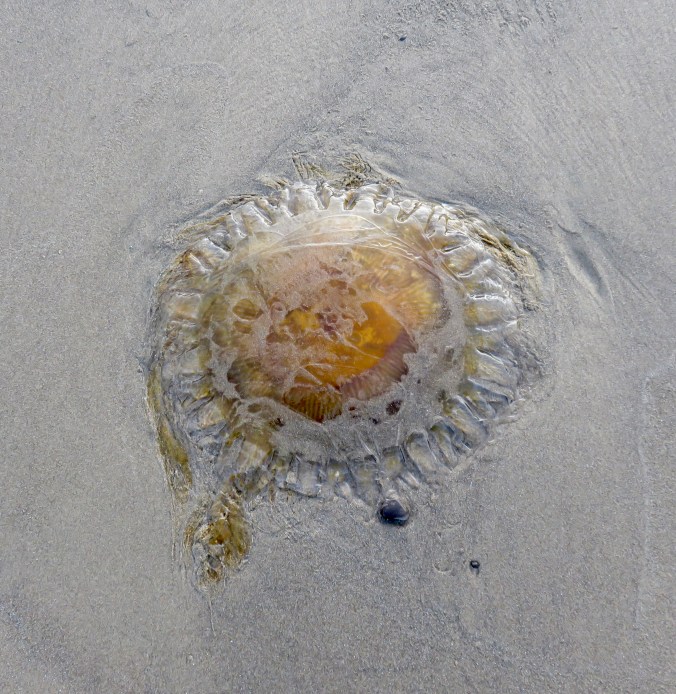
It was the orange jellies I was warned against as a child. The clear ones tended to be a couple of inches across when I was young. The orange ones were six or eight inches. This one is closer to eighteen inches. No, Daddy, I didn’t touch it.
We had such a wonderful Thanksgiving that I am embarrassed to think of it. I told Tammy on the beach this morning that I didn’t feel I deserved such a lovely day. She said, “It’s best not to connect the dots.”
Our drive over was uneventful—good news given forecasts of snow and ice. We walked in Forest Park with our younger son’s family, checked into a hotel, had dinner with our older son’s and his wife’s family, and then went back to the Kennedy School for a long soak in their pool. It was very cold and the soaking pool is outdoors. Bamboo and fats and palms rustled overhead, but the water was perfectly warm. We slept well, had breakfast and drove home again. Snow on the verges but no ice on the pass.
We also had an opportunity to drive in the city. Always an adventure. We were honked at twice, each time while waiting for a pedestrian in a crosswalk. People gave us exasperated looks for driving too slow—barely over the speed limit. (I have come up with a new safety rule about speed: drive at the posted limit plus 20% and other drivers will not throw up their hands.)
Today I received a link to a fascinating history of automobiles in the U.S. Apparently our “love affair with the automobile” began where Groucho Marx declared it so in a documentary financed by the car industry. Early on there were perfectly functioning electric cars and people walking, on horseback, or driving were not in such a rush. Most hated the new cars that only the wealthy could afford. All Americans would pay for the roads these drivers demanded.
In his 1896 essay making the case for electric vehicles, Salom decried the fumes associated with the internal combustion engine: “Imagine thousands of such vehicles on the streets, each offering up its column of smell . . . and consider whether such a system has general utility or adaptability.”
Instead of thousands of such vehicles, we now have more than a billion. Had the desire of working Americans for safety been prioritized and their enthusiasm for public space been respected, transport might have designed on the basis of public good rather than private enrichment. If that had happened, the planet would look very different today.
Instead, a relatively small number of entrepreneurs successfully campaigned to reorganize the country—and subsequently the world—so that their particular business model might succeed.—“The Car Culture That’s Helping Destroy the Planet Was By No Means Inevitable: On the Relentless Campaign to Force Americans to Accept the Automobile” by Jeff Sparrow
Today is the last day of NaNo and I have over 53 thousand words. I think they are mostly in the right order, though I might have to flip chapters 19 and 23, which are both flashbacks and probably need to be in chronological order. I have marked the five chapters I need to develop further. Overall, it is way too short, but I think once I develop another plot thread (plot!) and those five short chapters, I might get to a more desirable length. I aim for 70-80k words.
 This morning we went out for our beach walk on last night’s high tide line where we expected to find trash. We did and brought it home, and I found three pieces of glass, some shells and frozen jellyfish. When I was a girl, jellyfish were rare. I might see one orange jelly six or eight inches across in a half mile walk. These days we see dozens or hundreds, both blue and orange and ranging from an inch up to two feet across.
It was sunny and cold this morning, and we were glad to be out and home.
 IMPERFECT PATIENCE