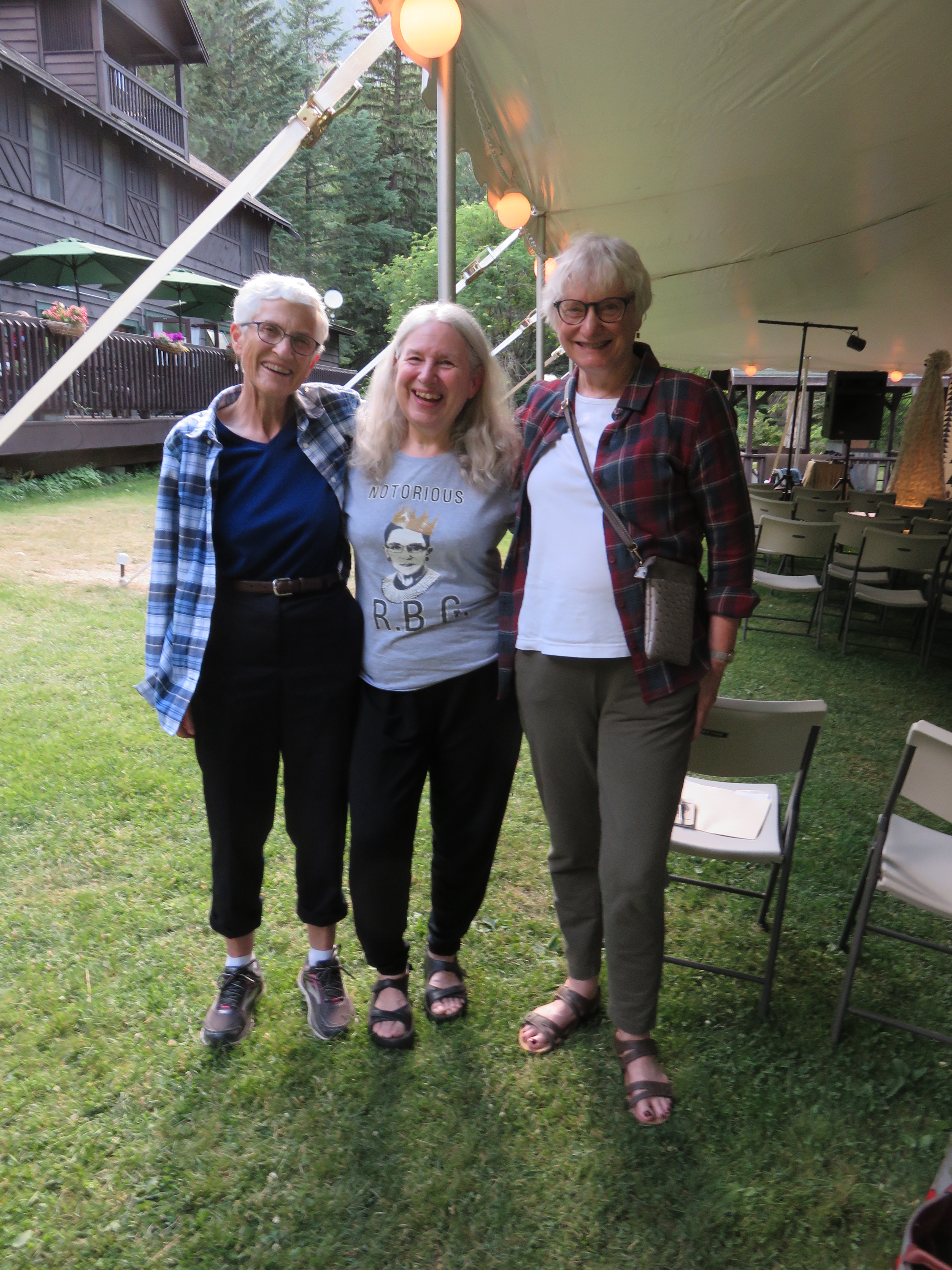
In good company: brilliant Bette Husted, me, and magnificent Molly Gloss. [Cheesy, perhaps, but such excellent cheese.]
“Those who build walls are their own prisoners. I’m going to go fulfill my proper function in the social organism. I’m going to go unbuild walls.”
— Ursula K. Le Guin, From The Dispossessed
The review of a book about mental illness in the Brevity blog this morning reminds me about American obsession with competition and our “country concerned with triumph.”
I have been thinking a great deal about gaming and about competition, the basis for survival according to most these days. Winning is everything. I saw it in education, the work of my yearbooks staff that created groundbreaking design and content, but only received notice when I shared a “win.” Those certificates for cover design and deadlines never meant as much to me as the students who found work based directly on skills learned in class. We were not in competition, we only wanted a good book at the end of the year. By “good” we meant a distinctive, complete and compelling record of the year that we’d managed to pay for. No one had to lose in order for us to “win.”
That’s not how we look at things, is it? For there to be a winner there must be losers, the more losers, the bigger the win. It is the most essential understanding and assumption of how the world works.
People making a great deal of money believe they are winning and thus are superior to those of us who are not. We have accepted dollars as the mediator for morality. That and being white seem to be the only focus for our current nation’s executive branch.
I am thinking about this especially because of “The One Who Walk Away from Omelas” by Ursula K. Le Guin. (First published in 1973, it won the Hugo for short fiction in 1974 and is collected in The Wind’s Twelve Quarters in 1975.) We spent the weekend participating in the final act of a yearlong tribute to Le Guin. Many people referenced her most famous story, the perfect joy of a utopian society “a shimmering city of unbelievable happiness and delight” held aloft by a single suffering child locked in a cellar. “The terms are strict and absolute; there may not even be a kind word spoken to the child.”
In the biographical film presented Saturday, students offered three solutions, one beyond what Le Guin herself seems to suggest. One would tolerate the injustice for the child for the sake of paradise, another would fight to free the suffering child, and the third would walk away. In Le Guin’s thought experiment no one chooses to free the child in Omelas, they accept the inevitability of the child’s suffering, and a few walk away as unwilling to participate in such a society. The story demands we consider the moral option, that we choose. “The place [those who leave] go towards is a place even less imaginable to most of us than the city of happiness. I cannot describe it at all. It is possible it does not exist. But they seem to know where they are going, the ones who walk away from Omelas.”
I have taught the story many times. My students, like the students in the documentary, like every adult I know, see the three options. Most will claim that they will walk away. That is presented the most moral choice.
“The only winning move is not to play.”
—War Games
My own view of Le Guin’s story is somewhat different. The story begins with Le Guin offering the reader utopia, perfect joy and celebration, conceding trains and drooz “as well as exciting the pleasure of sex beyond all belief; and it is not habit-forming. For more modest tastes I think there ought to be beer. What else, what else belongs in the joyous city? The sense of victory, surely, the celebration of courage. But as we did without clergy, let us do without soldiers. The joy built upon successful slaughter is not the right kind of joy; it will not do; it is fearful and it is trivial.”
Perfection.
And yet she questions the reader mid-story: “Do you believe? Do you accept the festival, the city, the joy? No? Then let me describe one more thing.” And it is here she introduces payment for perfection.
The child suffering is necessary for the perfections of this city.
And then she asks: “Now do you believe them? Are they not more credible?”
She knows that we demand payment, that we assume there must be pain as some sort of balance to pleasure, that sorrow inevitably balances joy, that evil must balance good.
Once we are given the balance of pain for pleasure, we believe absolutely. Le Guin know this. Within the context of her thought experiment even Le Guin herself insists that someone must pay for our happiness, that there must be losers if we are to win.
No.
Despite my own superstitious belief in a balance, I have not found that this is true. Driving away from Fishtrap, I thought a great deal about the story of Job. For decades I detested that story of God proving to the evil angel that his “good servant Job” would be faithful despite hardship. Why did God need to prove anything?
It has only been later in life that I understood that the story of Job does not exist to prove anything to anyone within the story. It exists to demonstrate to me, the reader, that terrible error of assuming balance. Though God returns all of Job’s lost fortune seven-fold, restoring the previous life, it is not the point of the story. There is no win, no lose in life that represents moral justice. We cannot expect overt success to represent spiritual triumph.
There is no battle raging between good and evil with the winner proved righteous. Thousands of years ago, scripture impressed that truth upon us. Winning is not virtue. It is belief, not truth, not a factual representation of the world I live in. In fact, terrible things happen to good people, and evil people become president of the United States.
Those who live deplorable lives are not made to inevitably suffer in their lives. People who are good do not necessarily achieve a good life. People who are kind and generous and deserving of long life and happiness often do not achieve fraction of what goodness should balance the sorrow in their lives.
I have been supremely fortunate in my life, I know this despite some ordinary grief and disappointment, occasional despair and sorrow. My life, I might want to say, is “blessed.” But I am not in competition. No one lost to give me joy and my “win” is not deserved. As a thought experiment, “Omelas” is an extraordinary gift, but its message is more complicated than how I choose to respond to injustice.
No. And again, no. I know there is no perfection, but I do not believe my joy must be taken at the expense of anyone’s sorrow. I do not accept that a child must suffer in the basement.
Molly was right: Gary photographed our feet first.

 IMPERFECT PATIENCE