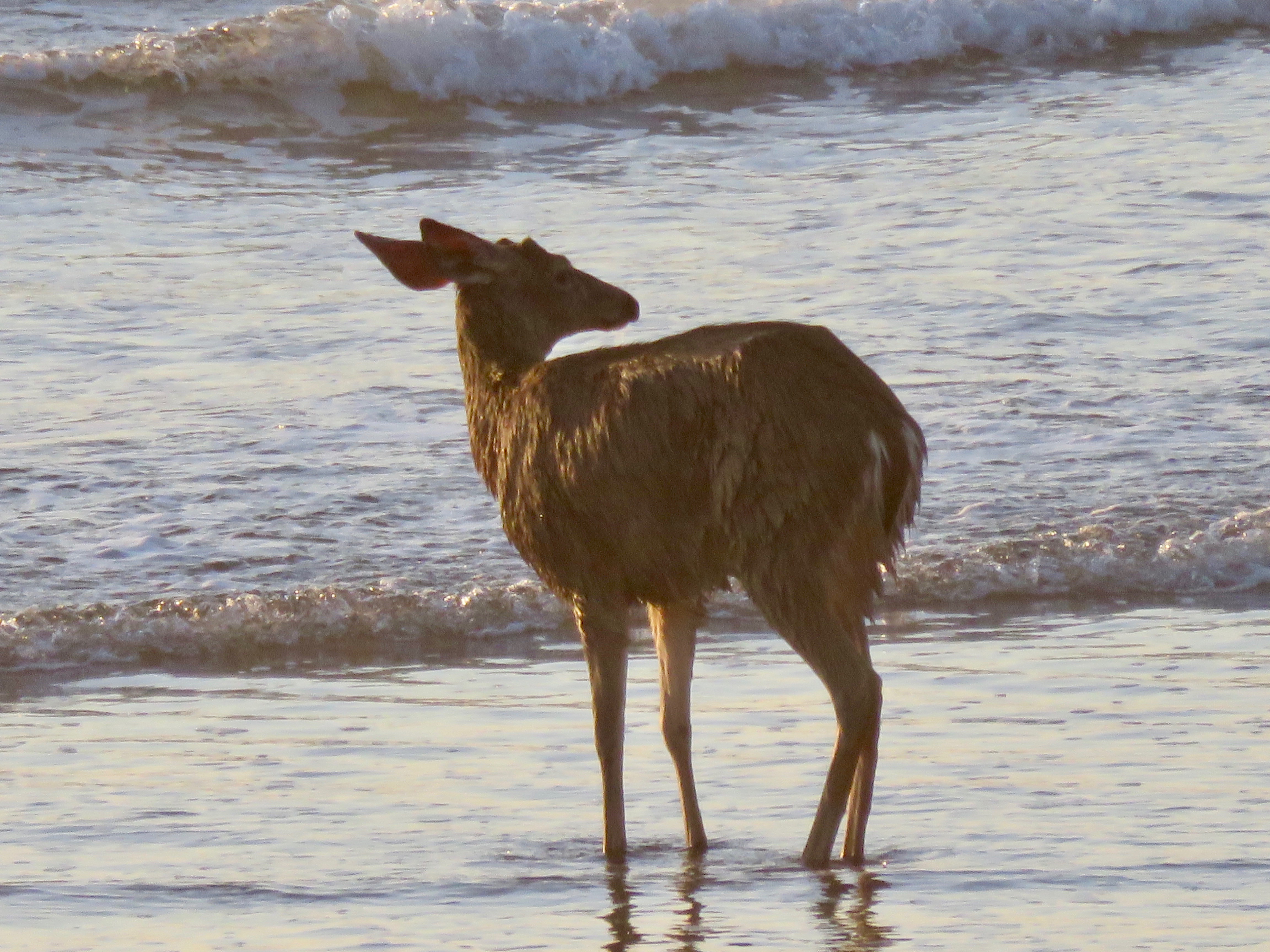
 Last night, just before sunset, a deer appeared on the shore. Not a good thing in daylight. She was wet and confused and kept to the surf line. We see deer tracks frequently in the sand on our morning walks, but never the two deer themselves. This one moved along just fine, though she did not look happy, and the tourists with their dogs had all gone home. Local dog-owners came out on the beach, saw the doe, and leashed their dogs. Perhaps she had been separated from her companion, which I assumed from its smaller tracks was a yearling fawn? She stood right in front of our house, trotted north and then back south. And then the sun went down.
This morning, I dreamt we were living in our first house in Seattle again. Our dog Volant Sequoyah (“Bowzer”) had jumped the fence into the neighbor’s fenced yard and I’d left him there for a day and a half to teach him a lesson. Ian and Kerris showed up with packages of ground beef and hamburger buns just as I brought Bowzer home, and we didn’t want it because we’re vegetarian, but I thought about feeding Bowzer the meat. He was hungry. There was also a sequence of visiting the local school, which had been temporarily housed in an upper floor of a fancy office complex.
Well. Dreams are like that sometimes, a mixture of what we know and wish and experience muddled with places we have been, people we care about. Alan commented on the phone that the house yesterday that the house he and his wife first bought was up for sale and that set me thinking about our old house in Seattle. Online it is valued at nearly a million dollars. We paid less than twenty thousand for it in 1975.
At the beginning of 1978, Gary had left the zoo job and was tutoring American Indian students in the Edmonds School District. He had just been accepted to a grad program at the University of Washington’s School of Education for the fall. He planned to teach elementary school. I think he would have been wonderful at that job, he enjoys goofy humor and his impulse toward soothing and calming others would have served his students well. I was teaching art classes at Forest Ridge, an elite girls’ prep school on the other side of Lake Washington. We had six Afghan Hounds then, including Bowzer and his sister, and were active in showing and lure trials. I was a licensed field trial judge and we traveled often across the PNW and to Canada for shows and field trials. Instead, Gary’s father was dying of cancer, his family was falling apart and he quit school to support them. My grandfather’s third wife died and Genevieve left me the family house at the urging of her second husband. We thought we might buy land outside the city.
Instead we decided to have a family. We moved to my grandfather’s beach house in Oregon, the state where I was born. Gary took a job in a farmers’ co-op because he had worked in the Woodland Park Zoo commissary before he started back to school. we had our children, and I became an English teacher.
All in all, the dream seems more likely than that doe in the waves.
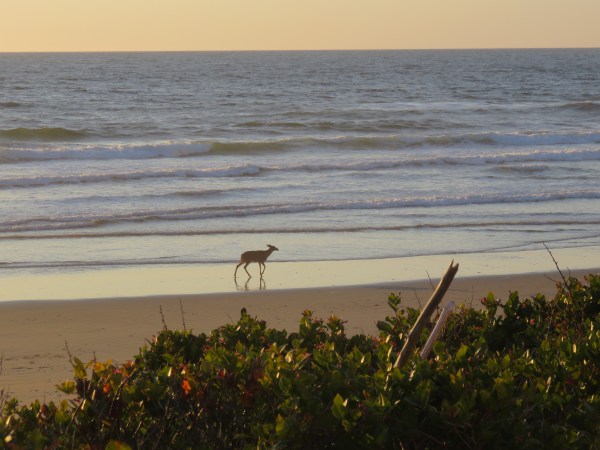 I should note that I took the photo above with a zoom from our deck. We are careful to avoid approaching wild animals. It is distressing for the animal and can make a bad situation deadly. Locals understand it is best not to “help” a wild thing.
Oh! I should have put up Assignment #3, only because I said I would do five. No one seems to be writing them, but I will post “The Idyllic Place” tomorrow.


 IMPERFECT PATIENCE