An imperturbable demeanor comes from perfect patience. Quiet minds cannot be perplexed or frightened, but go on in fortune and misfortune at their own private pace like a clock during a thunderstorm.—Robert Louis Stevenson
We’ve been having an exciting spring so far, which reminds me of that Chinese curse: May you live in interesting times. It’s an English translation of a genuine Chinese curse, but I heard it when I was still quite young, perhaps in my 20s. Wikipedia reminds us of the obvious that the “expression is ironic: ‘interesting’ times are usually times of trouble.” I would add complication and challenge. Today’s interesting times mostly seem concerned with graft and bullying and self-aggrandizement. Alas, I am not the one profiting, gaining power, or advancing my image.
I was often the smallest person in any group, often the youngest too. That age difference changed decades ago, but I am still surprised to discover I am the oldest in a group. I am still often the smallest (my friend Madora is smaller than me, but she’s the only one).
I have fantasized about living in a smaller space at least since our sons became teenagers. Our home requires work and money to remain healthy. Retirement and not having pets has allowed us the time and money to do that upkeep, but it requires more attention than I will be able to spare. I could copy and paste the list of all the upkeep expenses coming for our beach house, but I’m pretty sure that’s a bad idea. Suffice to say that as I watched my father die of cancer and my mother age, I considered how best to handle my own aging.
Hardly anyone will recognize the letters I used to title my thoughts today. “Any Solid Color Other than Black” is a class in AKC shows for American Cocker Spaniels (ASCOB is pronounced ass’ cob). For the record, I have never owned or shown American Cocker Spaniels of any color, though I do have a scar on my upper lip from being bitten by one when I was a small child.
This is not a post about bites or even dogs. There are no assignments or exercises. A few crows. Trees. Our condo news.
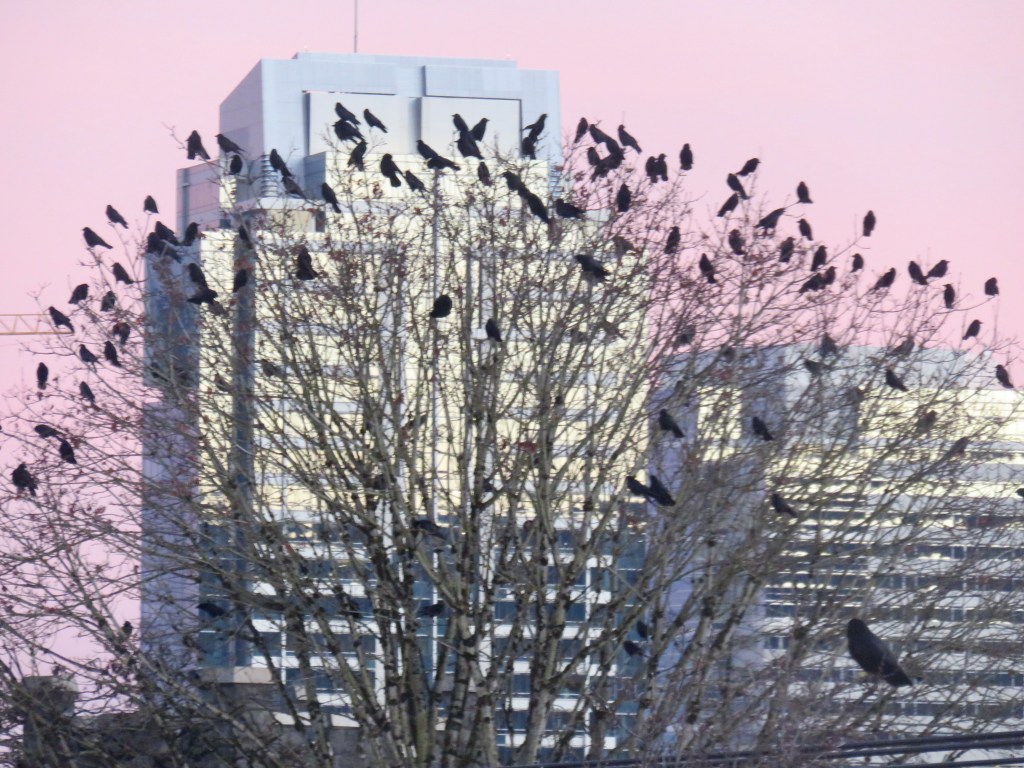
We like crows. Above is a tree with over a hundred crows, but there might have been a thousand nearby when I took this photo. (HINT: this was not the only tree, and most of the birds were flying.) There are “local” birds, but they gather as a massive flock (“murder” seems unkind), usually in late afternoon but on their own schedule. Continue reading →
Florida beach condominiums need serious work. One condominium building collapsed and suddenly people [insurance companies] are paying attention to a problem that has been “building” for decades. The Florida building boom really took off after WW2, and for a long time there has been inadequate oversight of building on land that is itself artificial. That’s because “a lot of inspection practices in the boom years were ‘a fiasco, a joke’ and not ‘worth a damn.” And owners have been reluctant to address structural issues because of the costs involved.
Ours are the five windows in the middle top, shown on the east side at right here. The main entrance is on the south. There is almost no brick or fancy concrete detailing on the west, north or courtyard facades.
I have a photographic negative showing my grandmother, Fay Fletcher Jackson (before she married Gordon Keays Smith), standing on a Mount Hood glacier that mostly isn’t there anymore. This would be in the early years of the 20th century. She carries a small backpack because she is a very small person and wears heavy boots, thick leggings (no skirt), and a broad grin. She set no records, made no history, but she climbed.
We attended the meeting about replumbing, “re-piping,” our condo. I knew the cost would be bad; I did not expect it to be overwhelming. I never believed the claim by the listing agent that the plumbing was okay. In theory, I was prepared. (I should have rejoined Facebook and asked to be a member of the condo group. Maybe I would have had a better notion of what was coming.) So imagine the terrible number I actually feared but was resigned to and multiply it by four and a half; imagine the worst number I could conceive of and multiply it by more than two. Yeah, that’s about it. Except your guess is still not close to what it will actually cost. To say we do not have the money is laughably inadequate. To say this makes the cost of the condo outside our reach is about right. Would we still have purchased the condo if we’d known? Absolutely not.
This is the view from living room to kitchen, around the corner.
Spilled milk, as they say. There are many financial errors I have made over the years. (No fear, I will not list them here.) We will survive this one too.
In the mean time, I have faithfully begun writing first thing each morning for the five first days of November so far and have completed 14,023 words for National Novel Writing Month (NaNo). To achieve the official goal of 50k in 30 days, I am supposed to average over 1600 words each day, but I set my personal goal at 2000 words (and I am counting the 1800 words in this blog post begun two days ago, but 2k each day of noveling). It looks like I’m doing fine so far, but I cannot see how I can keep going at this rate since I have no plot. None. Plot is always my weakness. What happens next? I have absolutely no idea. I had thought to use Adventures of Huckleberry Finn as a frame for the story, but I chose to set the story in a place I do not know well enough to write about. I have been the places I describe so far, but not long enough to know, to really know. Research is (was) necessary and I probably should have been doing that for the past six months (or two years?). A little late now.
Ans in the mean time, running two miles in a morning, two or three times each week is going fine. Going to Portland for two or three or even four nights a week is fine. (The plumbing assessment, not so much.) The beach is still gorgeous. I found a marvelous piece of agate the other day, rough amber stone and with a hole at one end. I will find a place to hang it up.
It could be worse.
How?
It could be raining.
…and then it is.
At least we did not invest money in our attorney Fred, who would have put it up his nose. Fred was good to me, eventually providing excellent advice when I needed it. “Don’t sign anything without calling me first,” he told me. But early on he offered to have me sign over my house to him so that he could sign it back over to me, side-stepping a complicated legal issue, and I said no thank you. We did it the hard way. It was a wise caution, as it turns out. Other people put their money and trust entirely in his hands and he snorted it all away. Fred’s shenanigans represented the worst case of a lawyer cheating clients in Oregon history, according to his former wife, who told us the story because she was writing a book about him.
So that was one example of money saved that I will insist makes up for all the mistakes.
My aunt’s San Francisco house is gone. My mother’s house that I drew and labored to complete is gone. I am not homeless by a long shot. But I see homeless people everywhere in Portland. They lie down on the corner beside buildings, they plant their blue tarps in rows that extended a full block downtown. There is litter everywhere in a city that used to be immaculately groomed, like a house proud mother’s.
In “Quietly Big Idea on How We Think About Homeless People” Jay Caspian Kang explains: “Are the unhoused a ‘people’? If the answer is yes, then don’t they deserve equal protection under the law? These questions were broached last week by the American Civil Liberties Union of Southern California in a long report titled ‘Outside the Law: The Legal War Against Unhoused People.’ Rather than think of homelessness as a condition, the authors argue, lawmakers should protect those who live on the street in the same way that the Constitution and California law protect groups based on race, gender or religion. The report calls for ‘state legislation prohibiting discrimination based on housing status.’ … If, say, a city enacted a policy that made it illegal for homeless people to use public bathrooms, advocates for the homeless could then sue.”
The homeless in Portland are not, in my limited experience harassed or unfairly discriminated against in this or other ways. Toilets have been provided in some places by those who either feel pity or exasperation or both for the filthy alternative. I have seen people piss on buildings, men shit beside businesses, people sleeping in doorways and blocking entire sidewalks with tarps and crime tape. Commercial buildings leave the homeless alone so long as they do not block access. One local national retail chain store pays a guard to stand outside their door. This to discourage anyone from sleeping there. They really have no choice but to be nice about it, given the potential for retaliation.
A recent conversation with a person even older than me revealed her distress, but any complaint that begins “I worked hard all my life” is not going anyplace useful. She did work hard all her life, it’s true, and only retired in her 70s, but it’s also true that many people work hard all their lives and never get off the streets.
Still, I knew what she meant. I have seen my once beautiful city turned halfway to a garbage dump, every green space, alley, and landscaped highway entrance littered with tents and trash. Don’t get Gary started about dog poop. Even Haight was never this bad, he says.
Yes, they are mentally ill, homeless through financial hardship, alcoholic, drug-addicted, juvenile runaways (and studies make clear, most children who run away have reasons to feel safer on the streets), or some combination of desperation and illness. I do not want to blame them. They are human beings. No one in our wealthy country should be deprived of housing and services because such housing and support is unavailable to them. People have existed on city streets since I was a girl in the 60s, and especially after Reagan closed many state-funded mental hospitals (a good thing) without providing alternative support (a callous oversight).
Some of these “unhoused” people, given access to decent housing, would eagerly abandon their blue tents, tarps, and trash. A few would not. Some consider that their right to sit, sleep, and defecate in public places is absolute. The man who lived for two years on the sidewalk three blocks west of me is one example. His compound spread from building to street, completely blocking the sidewalk. We crossed the street to avoid walking near him. This was a necessary choice. “Robert” threatened and even attacked several people before being caught on film doing it. He was arrested, but another man moved into his spot with a small tent. He was arrested too and later bailed out. Now there is a bigger tent again blocking the sidewalk.
Something needs to be done.
Public spaces should be accessible to the public. I should feel free to enter a park without worrying about walking too close to an aggressive man in a tent parked beside the path. Though I am willing to wait with others until the man screaming with his mask off leaves the entrance of the grocery store, I should feel safe as an elderly woman walking on sidewalks to the grocery store—that’s not too much for me to expect.
It is difficult fo me to believe that simply relabeling these people lying on sidewalks as “unhoused” or “a people” is enough to repair anything. Recognizing that all of us, every citizen of our nation, and the noncitizen we exploit to keep costs down too, deserve a home.
It seems to me, we must find a way to provide at least dorm-room-style housing for every one of these homeless people, mental health care, and other support, and then deal with the “culture” of homelessness as a separate issue. If there is such a culture—and it’s likely there is—it is one completely out of step with our society at large. Taking over public property as personal space is not allowed. The Mafia is a culture unto itself too—an extreme comparison but worth noting that many subcultures also feel free to violate commonly accepted rules of behavior. Our legal system exists to ensure we can agree about the basics. And before anyone gets incensed about the Mafia comparison, instead consider how wealthy people assume they should receive special treatment … and often do receive it. Shall we label the Bill Gates of the world a social group deserving of special consideration and protection? Certainly the 0.01% of the world behave is if they were a law unto themselves. As if with enough hard work, with the right values and industry, any of us could be Trump. If we wanted to be. As if. As if making money were proof of something honorable and decent.
I’m not sure I can swallow that one either.
Billionaire Charlie Munger is bankrolling an eleven-story college dorm to house over 500 students/floor. It will cost the University of California at Santa Barbara nothing but bad press. There’s a catch: with no formal training whatsoever, Munger insisted on designing it himself. Another catch: 94% of the rooms he has had drawn have no windows. A typical suite has a long central dining table, a small kitchen, split baths, eight tiny sleeping rooms (about 6.5 feet by 8 feet), one door from the suite to the hall, and not a single window. “He wanted the dorm rooms to be tiny and windowless to encourage residents to spend more time outside in the common areas, meeting other students.” At the end of the hall with eight such suites is indeed a common area dominated by four even longer tables, “game room,” larger kitchen, a laundry room, seven windows on one side, and a pair of stair wells. It’s worth noting that in a private home there are strict code requirement about a room, including an accessible egress window, for it to qualify as a bedroom. Munger didn’t have to follow those guidelines.
This is just one pod, there would be many of these stacked side by side. It is constructed in such a way as to make direct access to the outdoors impossible—that is, once build without windows as designed, it can’t be fixed.
Munger thinks he can control other people as if we were children and he the only adult in the room. He is rich enough that he has actually gotten away with this sort of thinking, and the conviction that he knows what’s best for everyone. This is the definition of entitlement.
Our condo building has sixty-nine small units ranging from studios of barely 400 square feet to the largest corner units of less than 900 square feet. (Ours is a mama-bear, right in the middle at 576 square feet.) The all have windows, plural. The building was cleared for occupancy in 1925, is built of concrete, and was considered virtually fireproof—a major plus in those days. There are two elevators, two stairwells, a fire escape on our side of the building, and a galvanized and cast iron plumbing system that is past its pull date. Perhaps a hundred people live here. Across from our front door is a glass panel and a heavy iron mallet to “break glass” in event of fire. There is a fire hose a few feet away. These features function. They are code. Our unit has five windows.
Considering homelessness and windowless rooms help put our re-piping assessment into some sort of perspective. Someone will finish making those new assessment payments after we die, and though it’s true I have worked hard all my life, it is also true that I have been lucky.
Food, clean water, shelter, medical care, companionship, meaningful and useful work, respectful treatment—all human beings deserve this. Access to light and air and earth and green space is necessary, not a nice add-on. Some privacy is necessary, not as punishment like a prison, but because sometimes we do need to be alone, even if we are lonely. People living on the streets are deprived of most features of what the rest of us might call ordinary life.
It should be our business to fix what’s broken.
Dawn over the spruce trees/snags north of the Tektronix house at the beach.
I did not mean to send the entire post out as an email, but just a stub. Gary wanted me to slice homemade cranberry bread for his breakfast and I got careless. Then, instead of eating cranberry bread myself (I get the heel), I went back to work and wrote more words both here and for NaNo. Today’s Brevity blog post by Jill Kolongowski inspired me.
Today is my oldest grandchild’s tenth birthday. I have two gifts for her. No telling if either will please her though she did say she loved the book! She is allowed to have her ears pierced now that she is ten. I am giving her a pair of pearl posts that I made when I was in college almost 50 years ago. The pearls came from a gem seller who brought boxes of lovely stones and pearls to the metal shop at the School of Art. They are very good pearls, though the posts are merely sterling and some people cannot tolerate silver posts. I sewed a silk bag to hold them, by far the prettiest I have made.
top and bottom … saving this for Christmas. Usually I have my shopping done by Thansgiving. This year, no shopping.
This is the largest “sea nettle” I have ever seen, dwarfing Gary’s size 13 shoes. It was at least 28″ across—Gary said three feet.
We’ve been busy hustling back and forth, walking our 25 miles a week (and me running a few of those), working on our second home, and admiring everything we see.
One of our tenants believes in the “good old days.” He is young. He thinks the fifties and sixties and seventies were times of idyllic freedom. I look at his long hair and think: You’d have been beaten half to death living around here in the 60s; you’d have been jailed for what you smoke. Times were only good in some ways and for some people. I had to wear a skirt to school every single day and had the bloody knees to show for it. School counselors, aptitude tests, and my own mother assumed my primary role in life was to get married and stay home with children. Gary was nearly expelled from school because his hair touched his collar and was not encouraged to pursue . . . anything beyond 9-5 employment or perhaps death in the war. (Gary graduated with honors from the UW and Phi Beta Kappa. He dropped out of grad school to care for his family while his father was dying of cancer.) Our opportunities were limited by gender and class and the draft. And we are reasonably smart and able white people. (So is our tenant, which might be another reason he’s nostalgic for a time that only looks good if you don’t look too closely.)
A crow was perched on top of what we term the “turnaround rock” because walking to and around it marks a three-mile journey from our home. That crow flew the instant I took my camera out of my pocket—the little black blot in the middle of the photo. I’ve been running a nine-minute mile three or four times a week, usually right past this rock. On the back side, the ocean goes quiet.
My 50-year high school reunion was this past weekend, about 200 miles north of where I’ve lived since soon after my undergraduate years. I did not attend. The group photo shows a fraction of my 600 fellow graduates standing shoulder to shoulder. Only a handful wear masks. A friend said she could not recall the events reported to her about shared high school experiences. But I wonder who of us can remember all events important to other people? In the group photograph she and her husband are the only people I immediately recognize.




 IMPERFECT PATIENCE