THE DOORS

One of Linde’s renderings of the Embassy.
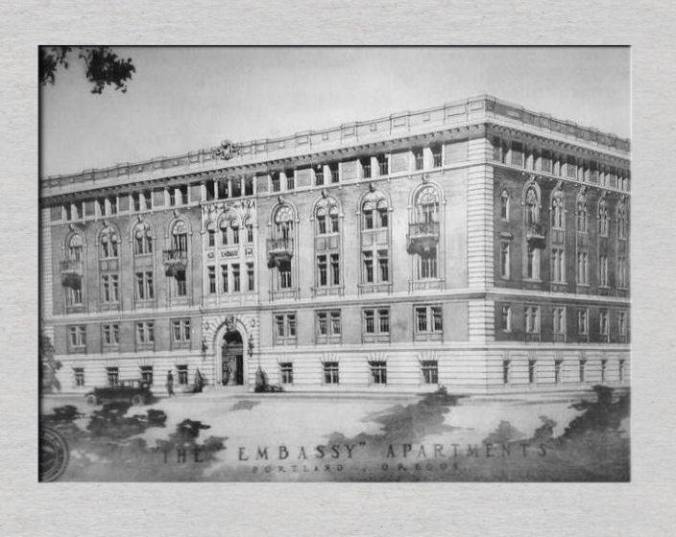
The 1923 elevation drawing by architect Carl L. Linde, a copy of which is hung opposite the elevator on the first floor, does not indicate the colors for the entry facade. The drawing does seem to show the surround as somewhat lighter than the tinted concrete and the doors as quite dark. Dark, varnished “Philippine Mahogany” was used throughout the building and survives on the back of the outer doors and the inner entrance doors, and the hall side of each apartment door. Though somewhat damaged, this woodwork remains beautiful and original. The outer doors have, aside from scratches and gouges, rot at the bottoms. Ideally, the doors should be taken down and repaired or completely rebuilt to the original design, which would be very expensive.
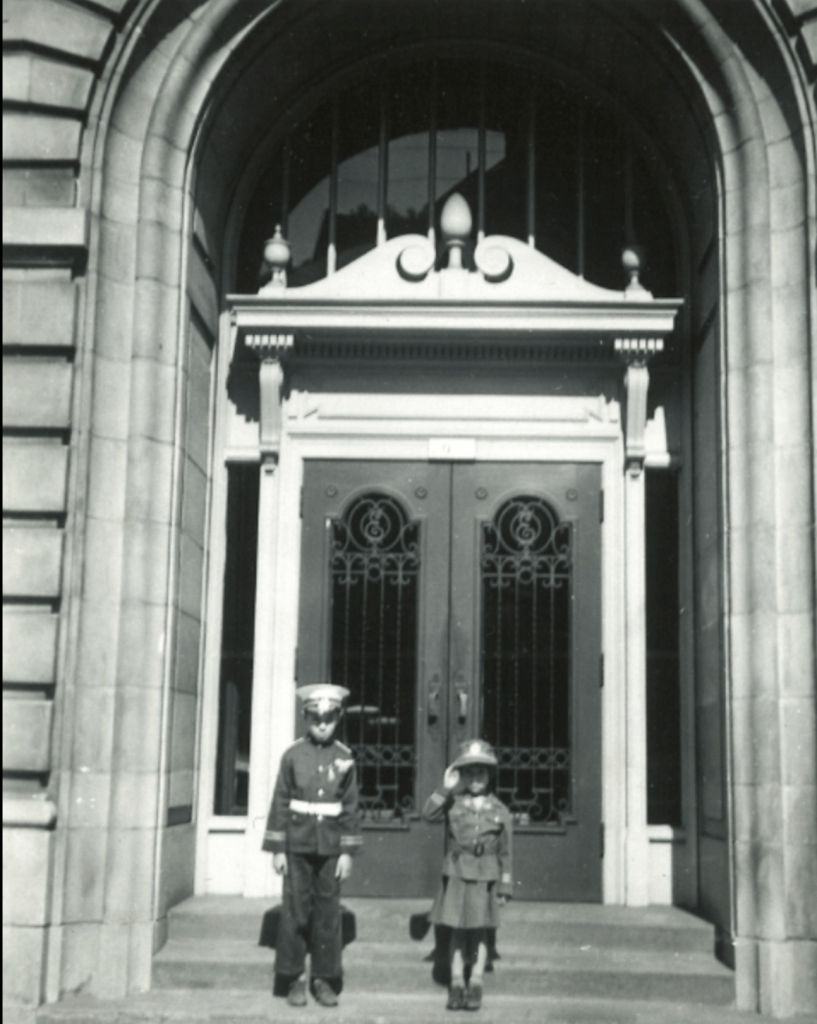
This B&W photo from WW2 shows the contrast between the very pale-painted surrounding woodwork and dark mahogany doors. The iron grillwork on the doors was removed years ago, but the Association has one as a model that could be used to replicate them.
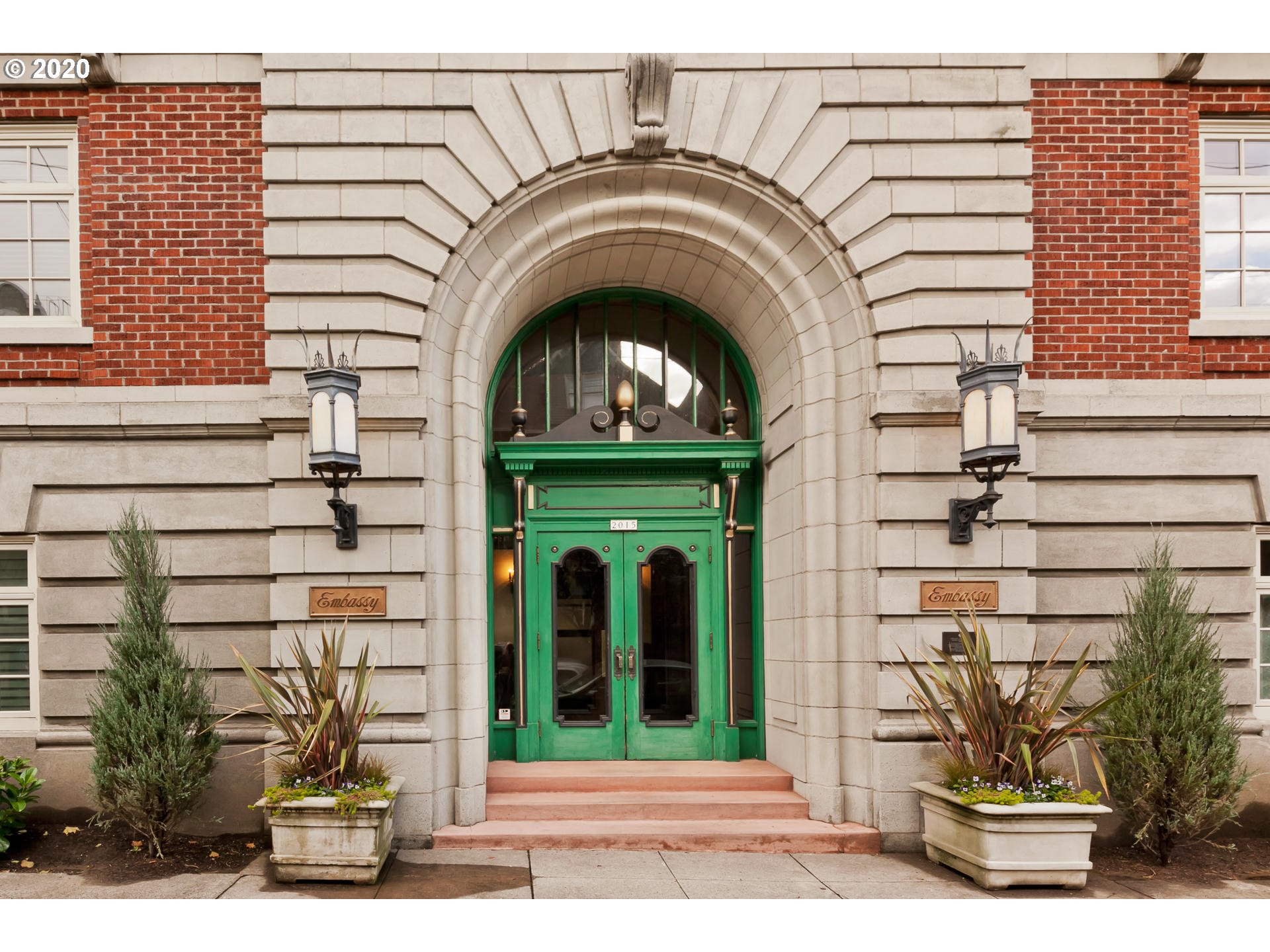

The more recent colors fail to match the values of the doors and surrounding woodwork.

LEFT: This is how the entrance looked four years ago. Many residents loved this. The painted black and gold surround and green doors were cheerful and distinctive. Nevertheless, the color choices are totally out of line for the period (1924) and had detractors who viewed them as inauthentic. RIGHT: This is the way the entrance looked yesterday. The value of the surround is closer to the original facade, but in a pale cream and a putty that’s darker than the original. The brown chosen for the doors themselves was also wrong—too light and the hue is not close to the originals of this building on the National Historic Register.

The aim was to approach with paint the hue (color) and value (darkness or lightness) of the original doors. At a local paint store someone color-matched dark-stained Philippine Mahogany, a mahogany-like color. It’s a couple of steps darker than a paint color original to the building and still found on the inside of the storage room doors, so there was some historical consistency.

That same someone prepped and put one coat on the doors. The first resident passed while walking his dog right at the start of the repaint. “What are you doing?” “Painting the doors.” He said, “Not good.” By the time it was half done, several passing people complimented the new color. A resident loved it. Another resident was expected to yell, did at first, but then said thank you.

The cost of repainting the doors and surround in green, black, and gold has been bid at least $6k. Here is a stylish upgrade for no cost to the Association at all.

The goal was to take the front doors back close to their original appearance. The very dark red-brown shows up with elegance against the putty and cream of the surrounding woodwork and plays to the color of the hundred-year-old brick.
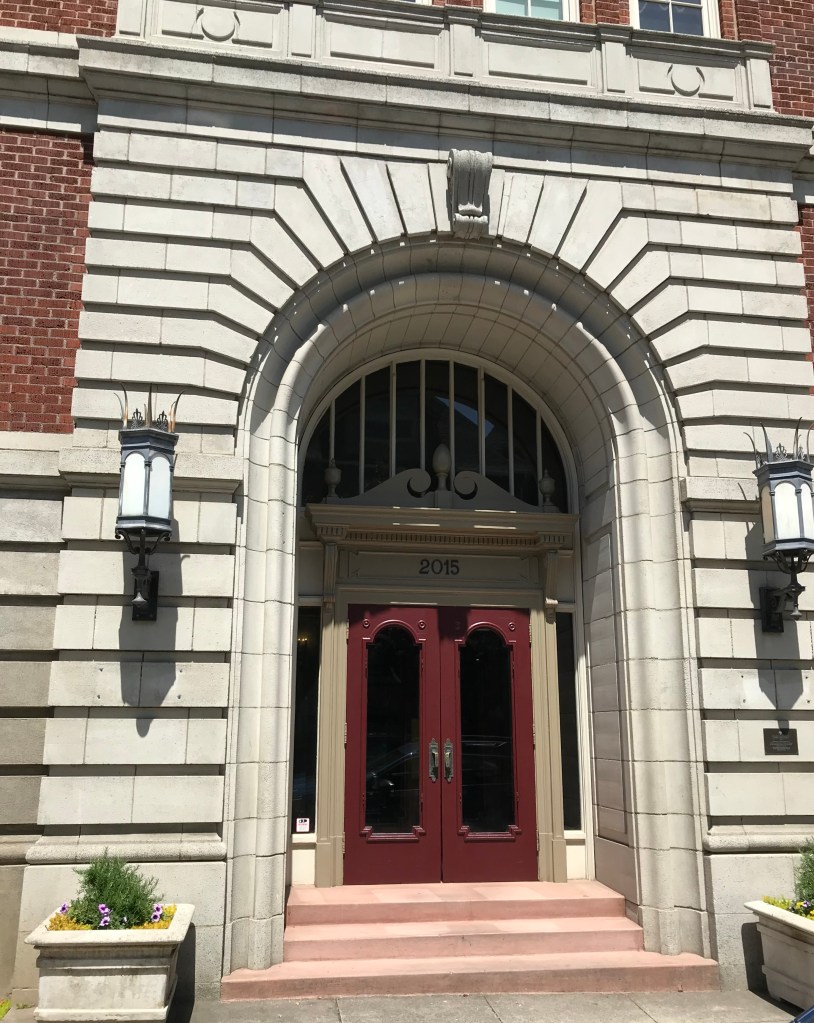
The shadow doesn’t do justice to the beautiful millwork and neither does that putty color, but it works better overall with the newly darker-colored doors. Someone would like a second coat, but maybe best to see who yells.

28 September 2025: My intention in this post was to explain what I did and why. Because I have recently been called out for failing to apologize for breaking “the rules we all agree to” I will confirm that I immediately apologized to the Board months ago, in writing, and now add to everyone in the Embassy: I am sorry for offending community standards and breaking rules.
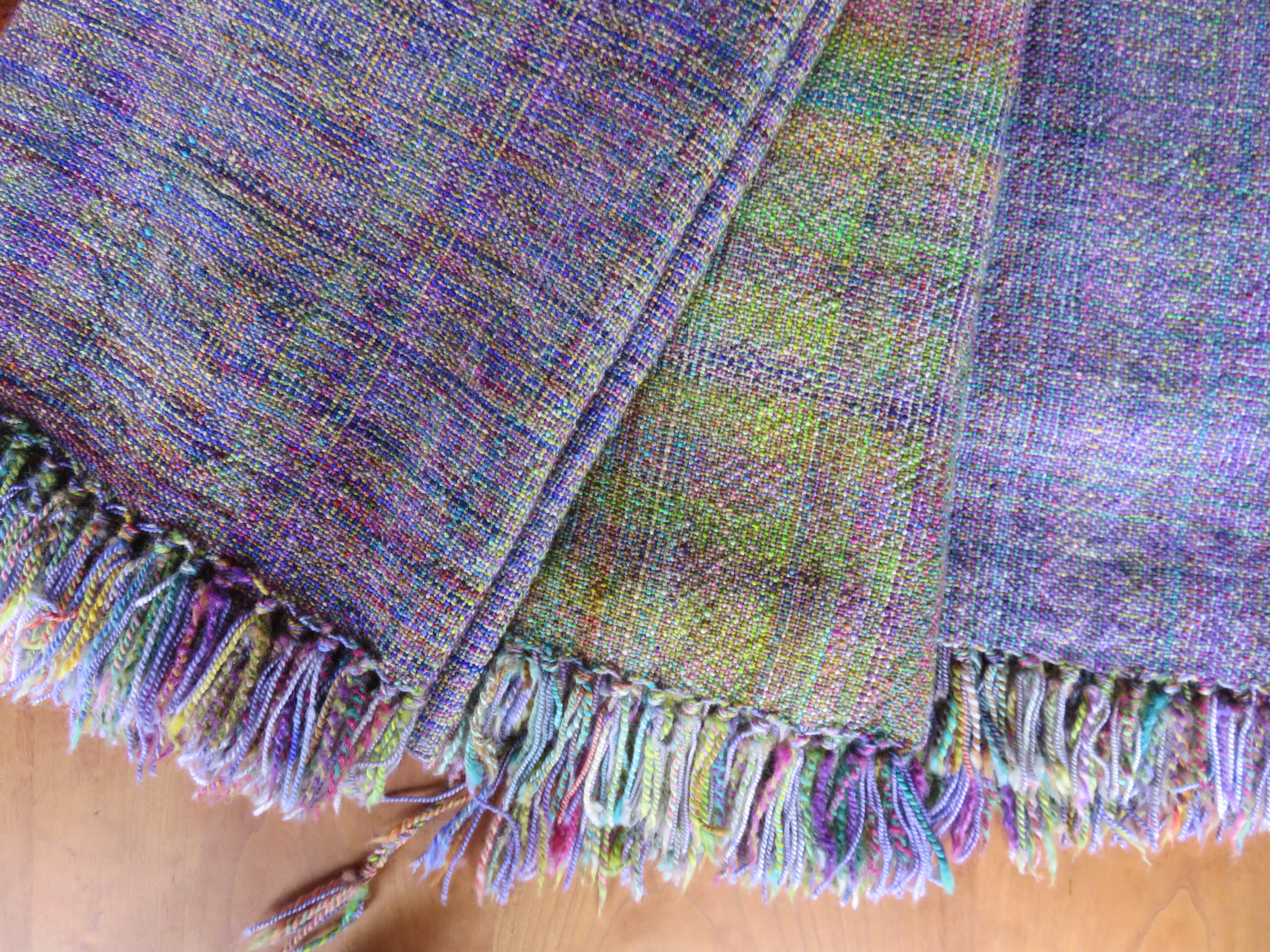
Assignment #5: color poem

IMG_5713.jpg

Three shawls woven on the “Carnival” warp.

This last assignment is poetry. Below are two 20-minute poem prompts. Choose.

IMPORTANT: My 20-minute exercises were inspired by prompts provided in the back of Dorianne Laux and Kim Addonizio’s marvelous craft book, The Poet’s Companion: A Guide to the Pleasures of Writing Poetry (W.W. Norton, 1997). Their original exercises are much better than mine. (You should buy the book.) 

1st option: Metaphor & Simile 

COLOR: What it is & what it’s like

DIRECTIONS:  Write in response to each bulleted item in order:

  • Choose a color such as blue or yellow or red, black or white, violet—whatever. Keep your color in your head for now and don’t write it down on your page.
  • Without including the name of your color, make a list of 6 things that are that color. 
  • Now stretch and add three more things to the list that are the color, then three more, but these should be more complicated things that you have to explain in a phrase—“a four day old bruise” might be yellow, but it’s not the first thing most people think of when they think of that color. (But still don’t say the color.)
  • Complete the sentence: If [someone famous—name them] had a [something—name it] it would be [write your color]. 
  • Complete the sentence: When [name someone] feels [some emotion—name it] in his/her sleep, she/he dreams [describe your color, again without naming it]. 
  • Complete the sentence: When I am [name an emotion] I feel that [describe an object or a place you care about]  is [name your color]. 
  • What does it sound like? “It sounds like…”
  • What does it smell like?
  • What is the texture of your color? 
  • When or how is it terrifying? 
  • When or how is it loving?

Revise, rearrange, & rewrite your list. There’s a poem on Bracken‘s “Hopelings” (sparks of hope in the time of social distancing, which are each lovely in themselves) that might have begun with this assignment called “A Pair of Gloves” by Rebecca Hart Olander. I urge you to click the link and have a quick read.


2nd option: Persona

The River-Merchant’s Wife

        by Ezra Pound

While my hair was still cut straight across my forehead

I played about the front gate, pulling flowers.

You came by on bamboo stilts, playing horse,

You walked about my seat, playing with blue plums.

And we went on living in the village of Chokan:

Two small people, without dislike or suspicion.

At fourteen I married My Lord you.

I never laughed, being bashful.

Lowering my head, I looked at the wall.

Called to, a thousand times, I never looked back.

At fifteen I stopped scowling,

I desired my dust to be mingled with yours

Forever and forever and forever.

Why should I climb the look out?

At sixteen you departed,

You went into far Ku-to-yen, by the river of swirling eddies,

And you have been gone five months.

The monkeys make sorrowful noise overhead.

You dragged your feet when you went out.

By the gate now, the moss is grown, the different mosses,

Too deep to clear them away!

The leaves fall early this autumn, in wind.

The paired butterflies are already yellow with August

Over the grass in the West garden;

They hurt me.  I grow older.

If you are coming down through the narrows of the river Kiang,

Please let me know beforehand,

And I will come out to meet you

   As far as Cho-fu-Sa. 

This poem is an English rewrite of an Italian translation of a Japanese translation of a very famous Chinese poem. Depending on who you talk to, it’s a mediocre translation of a great Chinese poem or a great poem inspired by a conventional Chinese original. I have talked to two Chinese-born American poets who gave me these widely diverse opinions. 

Regardless, this is a persona poem—written by a man from the point of view of a child bride who has grown to love her husband. At the end she promises to come as far as it takes (Cho-fu-Sa might as well be the moon) to reunite with her now beloved husband.

Write a poem in which you briefly describe defining moments in your relationship with another person. You might consider choosing a parent or friend as well as a lover. You might choose, as Pound does, to inhabit the character of someone other than yourself. In any case, these moments you describe should demonstrate an evolution in your relation to that person. Your initial response, how you came to know the person, how you came to care for and miss their absence. Address that person directly as “you” in your poem.

NOTE: At each stage you may improve the poem. Weird revision strategies later this week!

NAKED

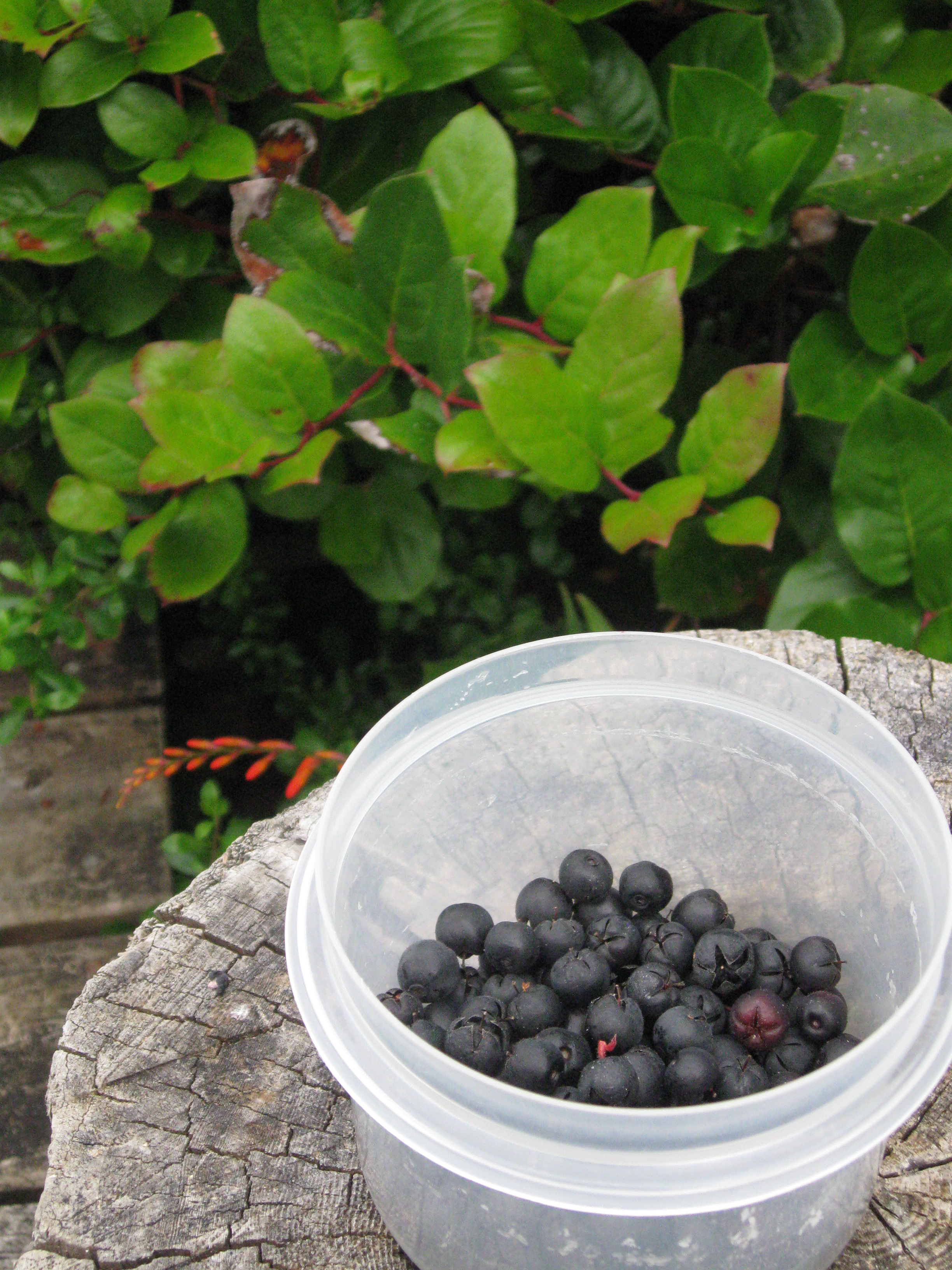
IMG_3557

I made salal muffins yesterday morning. The berries grow wild in our hedge and ripen over a period of weeks or months. The muffins were made with organic flour and eggs, butter and some maple syrup for sweetening. I had two with butter for my breakfast. That’s about 400 calories, which is allowed and also delicious.

A couple of months ago, I glanced at myself in the mirror. Then I looked at myself. Naked. I was taken aback. I see myself in the mirror every day, and I got over my cellulite decades ago. But I had intended, in February, to lose 11 pounds, and instead, I went the other way and gained 11 pounds. I had simply refused to see it.

My feet hurt and my lower back and many of my clothes no longer fit. It was one of those seeing-without-seeing periods. I would like to blame this inattention on someone else, but, you know, I just ate too much. Then I refused to see.

Last summer we went to the Oregon Country Fair for the first time. We went early on the first day, and much of what we saw was colorful and wonderful, but mostly we noticed it was hot, dusty, and insanely crowded. I caught only the end of the belly dance demo, which I would have wished to see. I found a doll-maker who turned out to be a good friend of one of our oldest friends. I bought two leather masks. An owl mark is probably destroyed by now by our grandson. I wore the plain red mask for several hours, forgetting completely that I even had it on. I just didn’t notice.

What Gary failed to notice was the nakedness at the Oregon Country Fair, which is well-known for people walking about with only body paint and glitter, at least on the upper half of their bodies and sometimes just the glitter and no clothing at all. It was warm enough. Gary insists he did not see any naked people because he was overwhelmed by the general chaos.

Life is naked chaos.

Since the first of June I have been paying attention to what I eat, and I have been drinking more water. We usually walk for over an hour each morning, and we emptied the attic and I have put a couple of gallons of paint on walls and ceilings. I have read 40 books so far this year, had 6 essays and a story accepted for publication, been rejected by 62 literary agents and a couple dozen literary magazines. I attended the memorial for Ursula K. Le Guin and in a couple of weeks we will have 13 people in our house for the annual summer reunion.

By the reunion I might be back where I started in February. I am nearly back to that weight. Not quite, but it’s been pretty painless. I can stand to look at myself naked again. My back still hurts, but now it’s because I am not sitting properly in my desk chair.

And I have begun rereading Rite of Passage by Alexei Panshin (1968), a book I have read ten times already. Panshin describes an insecure girl looking for a way forward and challenged by her study of ethics—and many more dramatic events I will not attempt to describe here. It is my favorite book, probably of all time. I enjoy each reading.

It seems I never quite let go of some goals and habits, like reading books, while others, like noting how many glasses of water I drink in a day, are acquired through time, and some, like looking in antique shops, fall away.

Just now I am close to done sorting spools of thread by color and fiber. The polyester thread will be given away. I have at least four shoeboxes filled with thread, sorted into war colors, cool, neutral, and black and white. Some are nearly empty, some full. Many are on wooden spools. It is notable that aside from half a dozen spools of hand quilting thread, I did not purchase any of this thread. My step-grandmother’s color pallet is clear as I stand over the boxes. I will probably find a way to keep the cotton and silk.

I have become less sentimental about most other accumulations. We gave away and sold the gatherings of generations. Our garage sale netted a few hundred dollars, mostly items sold for a quarter or a dollar. My one sale was two scraps of cloth for a dollar-fifty. In the next week, we will have a charity come and pick up the furniture and other reusable items. What has been moved out and now fills our atrium will not be welcome back into the house.

After purging my home of so much stuff, I am not eager to fill the vacancies. I like the slices of nakedness on my walls, the space between objects, gaps on bookcases, the way I can sweep all my clothing to one side of the closet, because there is somewhat less of it.

There are riches elsewhere.

Two little pound cakes came out of the oven. I made stock yesterday or the day before and made a lentil soup with coconut milk, vegetables, and spices. We had friends coming for dinner and a couple of nights. There is homemade ice cream in the freezer and local salad greens in the crisper. Gary vacuumed and mopped most of the floors downstairs.

There is space in our lives now that we are retired, and because both of us spent most of our adult lives working and caring for children and pets and indulging in hobbies and muddling along as best we could. There was hardly time to look around.

Home now feels a little like we just stepped out of the shower, all clean and new. Naked.