
“Not many things are orange . . .” Really?
On 10 September 2015, I created a folder on my computer titled COLORbook. My intention was to complete a series of chapters about color, an entire book of nonfiction about my personal and cultural understanding of color. The idea had been stirring in my head for a long time. My earliest essay about color I can find was created 2006 about orange. “The word itself traces its lineage from fourteenth century English, back to Old French or perhaps Spanish through the Arabic nāranj, the Persian nārang, and eventually to the Sanskrit nāranga, meaning orange tree, a word that might derive from an even earlier term meaning fragrant. Our word for the color orange and the fruit have an ancient co-existence, but the citrus fruit came first.” The color name or the name of a citrus fruit or acknowledgment of the incredible scent of fruit and flower, orange blossom.
Anyway, I meant to write a book about color. I had completed several chapters and begun thinking about sending them out when, probably in 2017, I learned of the book On Color by David Scott Kastan with Stephen Farthing. It was released last year and I have just begun reading it. I will have to stop soon. It is making me cross. The obvious reason is that I wish I’d written it and I am annoyed that I didn’t.
It’s probably for that reason that I am arguing with the book. There are marvelous lines like “The sensation of color is physical; the perception of color is cultural.” The book does a very nice job of explaining color as wound into perception and culture. Homer’s “wine dark sea” seems to trouble a lot of people including these authors who desperately want Homer to have said the sea was blue. Water has no color, but reflects the sky. Maybe saying the sky or sea were indigo blue seemed entirely unnecessary. I look at the ocean every day, for hours at a time. The color I remark upon is a deep green, which is not typical but a personal preference. Perhaps the wine reference refers not to hue, but purely to darkness, richness. A dark sea. I have seen that—even seen it dark and the color of wine. Color is very much a matter of context, both physically and culturally. The Kastan and Farthing book does a good job of introducing that confusion.
But then another sort of confusion: “Not many things are orange” the book states by way of explaining why the color orange was there, of course, but the color name of “orange” did not exist in English until the fruit arrived in England. There was no word for that color until the fruit. It was unnecessary, they suggest. (Really?) Chaucer refers to a color “betwixe yelow and reed.” (He knew how to mix paint colors? The connection is not so obvious as the authors claim. I have taught enough small children and older ones how to combine primary colors to make secondary colors to know that most do not see this without aid.) But the authors make a gigantic leap in claiming there was no need for the color name because not many things are orange? How about sunsets, rust, and hair we call “red” to name just three? “Not many things are orange . . .” Only autumn leaves, chickens and foxes, fire and flower stamens. Apparently the word was necessary in India for millennia before it reached the British isles.
[Fewer things are purple, but that word is very old in English, from the Old English word purpul from Latin purpura, from the Greek πορφύρα (porphura), the name of the Tyrian purple dye made from a Mediterranean shellfish. Maybe I will post my essay on the color.]
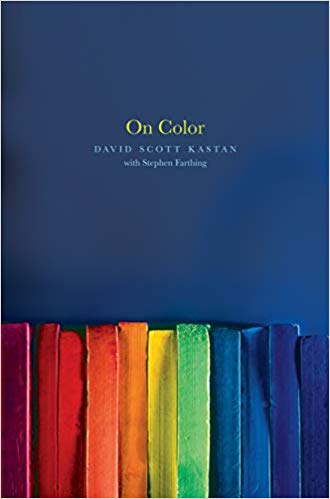 Anyway, this is probably a better book than I would have completed, had I completed mine. Twenty-two pages of endnotes, so the scholarship is solid. The stories I found in my research seem to be mostly covered here, and my copy purchased at a local bookstore is a squarer shape than what I see on Amazon. A pretty thing.
Despite Crayola crayons and poster paints, Hazel Koenig at the University of Washington introduced me to color theory. Pink is a tint of red, brown is a shade of orange. Pigment combines three primary colors and black and white in ways quite unlike color in light (which achieves all colors from red, blue, and green light). The four-color printing process (cyan, yellow, magenta, and black) has always amazed me—how do yellow and magenta combine to make pure red? Amazing.
Some of my essays are here on my blog if you searched for them. “Color Blind” and “Blue Sky” for example. I also wrote about orange and hot pink and little black dresses, ten chapters in all for my COLORbook folder.
I never got to yellow because I left off writing new chapters when I understood that someone else had written and published my book. It is not the first time.
In 1995, I completed the first draft of a terrible novel, and then I began better one. This was called Clean Away (working title was Bitch Trial) about four generations of women in family facing similar struggles over and over and perhaps doing better and better at coping. The central character, the daughter and granddaughter of older generations and the mother of a younger one, finds her grandmother’s diary behind a wall in a tiny family house in Astoria. This reveals a scandalous secret and places her own life in context. I worked on that book for a few years and then abandoned it when I learned of a new novel with a similar plot. I read all the way through that one. It was very good. My book was funny and the other was not, but mine was never published.
I used to write funny. That got lost for a while. I blame my poor mother. (Mothers so often get blamed for everything.) By 2002 my mother’s health was undeniably failing and my husband and I took care of her, someone told me I was the “most dysfunctional person” he knew and stopped communicating with me, and I lost my sense of humor.
Perhaps I only misplaced it, setting it aside for best. Perhaps it was unnecessary at that time. Not many things are funny? Or perhaps humor may be returning.
Most afternoons I watch the sky change color, the darkening sky blue overhead and shifting to orange on the horizon without passing either purple or green. Amazing. “How we are named and what we are called” is a phrase that runs around my head. It titled a story about Arizona that I wrote twenty years ago. It is the paradox of naming and valuing what we name. It explores that power of naming and of un-naming as Ursula K. Le Guin imagines in her story “She Unnames Them” where Woman lifts names off living creatures, removing the burden placed upon them. Some species insist their names are theirs and pets demand their personal names, but all are assured they are welcome to keep whatever names they believe suit them.
English is not the final word, nor the oldest in the world. Imagine a color book written from the other side of the world. China’s imperial yellow, red wedding dresses, white for funerals. I would read that.
Orange is one of the oldest words because so many things are orange.




 IMPERFECT PATIENCE