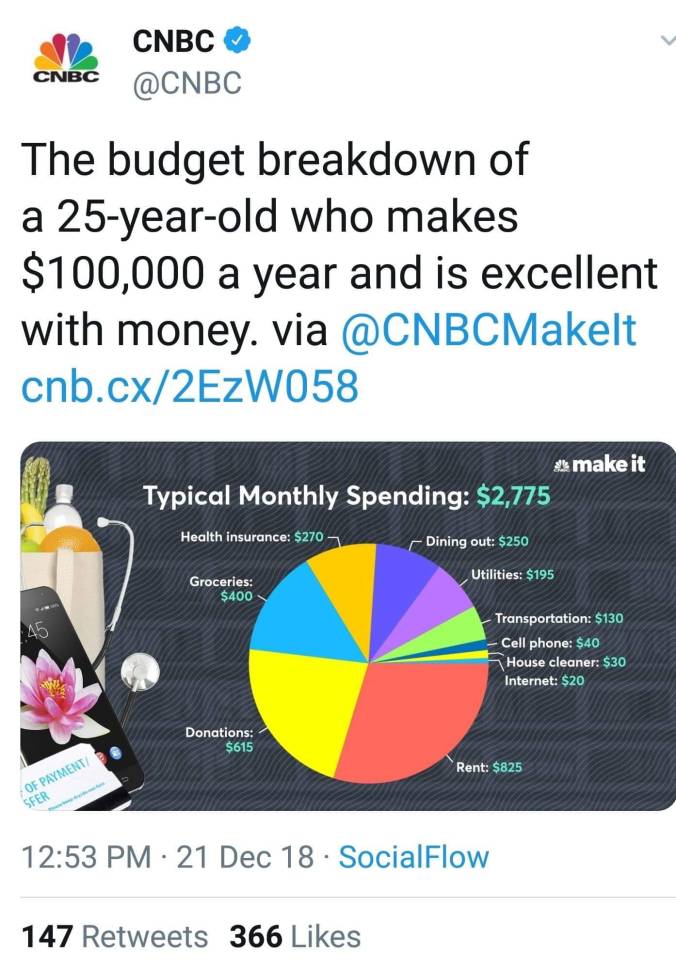
Never trust memes. Verify.
My mother first explained “where the money went” to me when I was about eight years old. “Here is how much your father earns each month . . . ” She wrote out mortgage payments, utilities, food . . .
The budget of Trevor Klee is making people hysterical. Where does some 25-year-old get off paying $825 a month in rent? There are all sorts of cruel comments all over the internet. How can he do this? A sample:
This is ABSURD.
A) how many 25 yr olds make that much?
2) where’s the student loan payment?
3) $615 for donations? 🤣🤣🤣🤣 I don’t know any 25 yr olds that do that, because they’re spending all their money on rent and student loans.
4) $20 for internet?? Since when??
5) $825 for rent?? If they make that sort of money, and only spend $130 on transport, they live in big city, big city = big rent. That amount would get you a closet in NYC if you were lucky.
So many more issues, just… wow.
“How dare he earn $100k/year! How dare he pay only $825/month in rent!” How? The answers are simple. He tutored while in college and recognized he was good at it. He worked for an exam-prep company in Singapore after graduating from Princeton before starting his own company. Though he could afford to pay more for a studio of his own, he chooses to share a house with four other people. His rent is $4125, split five ways. His actual income varies because he runs his own business so he budgets for his low monthly income. The people freaking out about this meme would know all that if they read his story. The people who made this meme know the facts because they would have had to read the article in order to compile their outraged pie chart.
So he earns a lot more than me. So?
Klee worked while he was in college and likely had grants that paid his tuition. He got into Princeton. Maybe he has rich parents, maybe not. Princeton will pay the entire difference between what students can afford and their actual costs. Many notable private universities do that. If you can get in to Stanford or Harvard or Brown and you come from a low-income family, the university will ensure you can afford to attend. That doesn’t mean students don’t go into debt.
On the Princeton website: “Students admitted to the Class of 2022 who applied for aid with family incomes up to $160,000 typically pay no tuition.”
A former student of mine who had no help whatsoever from his family. worked three jobs while he attended a private university out of state. That was nothing new. He’d done that all the way through high school. When he graduated from college six years later, he went to work for a large company and could afford the payment on a condo on Copley Square. Be very, very impressed. I am. Did he graduate without loans? I never asked, but he might have. In hard and harder times, with and without parental help, some people manage to do that. Some do not.
Even when I was in college in the ’70s and tuition at the University of Washington was a fraction of what it is today, I knew plenty of people who were paying off student loans for many years after they graduated. A friend went to Hawaii during Spring Break one year and had student loans she was paying off a decade later. When she complained about her debt, I shrugged. Hawaii must be nice, but I never went.
I graduated without loans because:
- I attended the local public university and lived at home for two years
- my husband and I managed a really trashy apartment building near the UW and that covered most of our rent
- we did not smoke, drink, or party
- no coffee
- no car unless we borrowed one from our parents. Instead we walked most days, including to the grocery store, and took the bus once a week
- no vacations
- entertainment was the $1 movie night at the Movie House, where we walked
- dinner out was the 2-for-one coupon dinner once or twice a term
- no help from our parents (other than the rare use of a car)
- our only expensive activity was getting an education
Even then, graduating without debt was unusual. I knew people who lived in dorms because their parents were helping with their expenses. They borrowed. We lived like paupers and did not mind because we knew it was temporary. We both worked part time year around. Gary worked full time in summers and during Rush at the book store. I worked in a record store and sold my art work.
I knew a woman whose monthly food allowance for two people was $30 a month. I budgeted more than that for our food, and we were still bickering about who ate the last slice of bread or drank more than their share of the milk. But my friend was more impressive than that in her spending. She donated $100 a month to charities. At the time, I could not imagine how she and her husband could do that. My family did not give to charities, perhaps because both my mother and father came from single-parent households in the Depression? But I thought about what my friends was doing and I began giving too. I started with $5/month to Public Television because I watched that channel so often in college.
This month we gave $200 to Partners In Health, $100 to Southern Poverty Law Center, $100 to Wikipedia, and $100 to Amnesty International. I can’t afford to do that every month, but during the rest of the year I donate to projects and people I believe in.
As best I can recall, my mother wrote out her monthly budget in order to prove to her young daughter that we could not afford for me to keep a horse in the backyard. I had read a British horsecare book that detailed the expenses of farrier and feed. I knew keeping a horse was expensive. Even if we’d owned the field behind our tiny ranch house, we could not afford oats. Many years later when I mentioned how early exposure to budgeting had made me conscious of the need to be responsible, Mom confessed she’d lied about the family income. Never mind. It was true: We could not afford a horse.
At age 25, Trevor Klee gives over $600/month to charities. He does it because he can afford to do it, even in the leaner months he brings in $3000. He is careful about his money, but he is also generous. He chooses to share.
Why don’t people scream about that?

 IMPERFECT PATIENCE