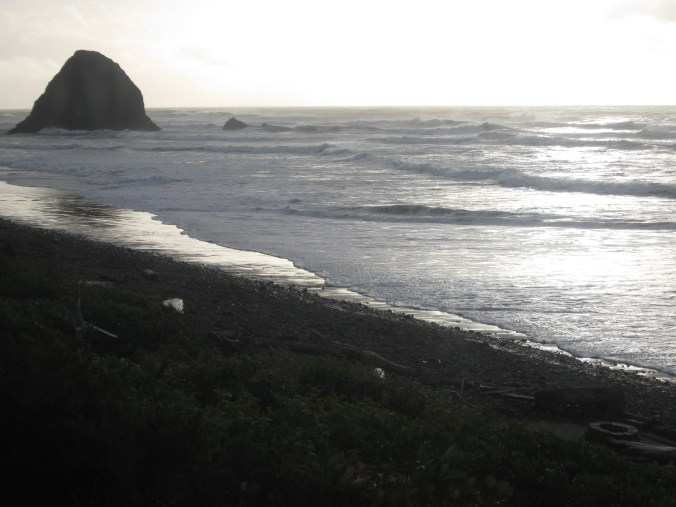
We live right onshore, just a few bare feet above sea level. Every day we watch the Pacific Ocean wash in and out just beyond our front yard. Since 1979, the ocean has slid through the path in the hedge and onto the grass just twice. The Cascadia Fault is a concern, but like most coastal residents, we are in deep, deep denial. (Not that the rest of you are not.)
When it inevitably comes, the quake will be strong enough to knock me down, unless I am already lying or sitting. It will be vigorous enough and last long enough to topple trees and drop buildings. Some areas with sand instead of soil will liquify and what was supported a moment ago will sink—quicksand. Our garage and other doors will go out of plum and refuse to open ever again.
My running shoes are beside the fireplace, where there has been a masonry pile for over a hundred years. It is the only part of our house that has not moved, not even a millimeter. I put on my runners.
I will head out what we call the front door, assuming it opens. Or perhaps the other door just twenty feet further east. Either one takes me into the atrium, a long roofed area with fiberglass far overhead. Normally I would go out the garage door, but the electricity is out and the shaking has caused enough damage that I assume the garage door will not open manually. I pull Gary’s maul from the workbench, close my eyes against flying glass, and bash the sliding glass door. The gate on the side of the yard will be hard to open, but I will manage. The shortest route would be north and then south, but that would take me through fifty feet of dense underbrush and wetland. I will run two hundred feet south, turn left, and then head for the highway, north to St. Peter the Fisherman, and then straight east and up hill.
Somewhere along the way, and aftershock will strike.
 IMPERFECT PATIENCE