SWEDISH DEATH CLEANSING

In a two-year-old article, Ann Patchett explains that as a teenager she did not consider cream soup spoons essential when she bought sterling flatware as a 14-year old. I do. I will say that I already gave away all the family silver and have bought only odd pieces which I intend to use daily in the new year—using her sterling was something my grandfather’s third wife, Genevieve, did too. Patchett wonders what to do with her dozen champagne flutes that will never find a dozen people wanting champagne, but we have kept fourteen flutes purchased over the years on anniversaries. Though we have no better idea when or if they might be used, they line a high shelf and give me pleasure every time I take down a plain water glass. Throw them on a beach after I die.

Fabrics sorted for a quilt I made for our oldest grandchild a couple of years ago.
Continue reading

POWELL’s


IMG_5541.jpeg

I love Powell’s Book Store, well, of course I do! What’s not to love about a book store that shelves used and new books, the largest book store in the United States. (Perhaps still the largest in the world?) May the store continue to thrive.

Founded in the 70s, the store was relatively good to employees until the owner claimed betrayal when workers tried to organize. That happened years ago, and the fight was bitter but the store is unionized. Later, when Michael Powell’s daughter took over the business, the corporation fought against raising what remains among the lowest corporate tax rates in the nation. Reviewing their Mission statement and list of seven “Values” the closest they come to valuing their employees is “We’re conversation starters. We’re an eclectic team of readers with broad interests and strong feelings about the books on our shelves. And we’re committed to sharing our knowledge and enthusiasm with our customers every day.”

Sadly, employees are not always as well-informed as you would hope. Gary was in the checkout line when Ursula K. Le Guin walked through the store. Gary turned to the young checker, and gestured. “That’s Ursula Le Guin.”

“Who?”

The most famous author in Oregon.

Anyway, qualified help is often an issue. Here’s the latest from Publishers’ Weekly:

“Powell’s Books announced that they have rehired some of the employees they fired earlier in the month due to strong online orders. It was widely misreported that the store has rehired over 100 people—whereas what ceo and owner Emily Powell wrote on Facebook was that ‘over 100’ people are working at the store again. The union representing many Powell’s workers clarified to the Oregonian ‘that the bookstore has only recalled 49 union workers, and said that the rest of the people now working are managers who are doing the frontline selling, shelving and shipping jobs that used to done by union workers.’ (In mid-March the store laid off roughly 85 percent of its 400 employees.)

“Note, too, that Powell wrote they will not pay vendors ‘for the time being,’ while acknowledging ‘we can’t do that forever.’ The statement goes on, ‘Our focus is on keeping Powell’s moving, keeping our community healthy, taking care of our wonderful customers, and having as many folks working with health insurance as our sales can support.’ “

Recently we have sold several hundred dollars of books back to Powell’s. Gary is the one who manages this and each time the buyer comments on the perfect condition of the books. If I have read them, they still look brand new. My family was always meticulous in our care of books. And we still have thousands shelved in our home. (Yes, you can have too many books.) There is no “free public library” that we can access. The nearest one is useless, and I have to pay to use the one fifteen miles away. And they are all closed now anyway. If I love the book, I keep it, and if not, it’s sold. I thought very highly of My Dark Vanessa, but I passed it along and Powell’s bought it, even though the cover says it cannot be sold.

Both my husband and I have ordered books from Powell’s this month. At least three books are waiting for us to pick them up during our next run to the post office.

I’m guessing that Powell’s can afford to pay their bills.

CHOOSING BOOKS

IMG_2574

Yes, you can have too many books. People who believe this is impossible? Well, that’s fine for them. I have thousands of books in my house. My husband has a thousand more of his own. I only read about seventy books a year, plus newspapers online, stories and poetry in journals and, again, online.

Sometimes I read a book I do not like. If it does not “spark joy” I do not have to keep it. I don’t have to keep it if it is one of seven copies of the same title or if I liked it somewhat but will never read it again or if I read the first chapters and felt no desire to continue reading or if have have not and never will read it for the first time.

Even so, I have thousands of books. I have more books than my 17 bookcases can hold.

How do I choose what to read?

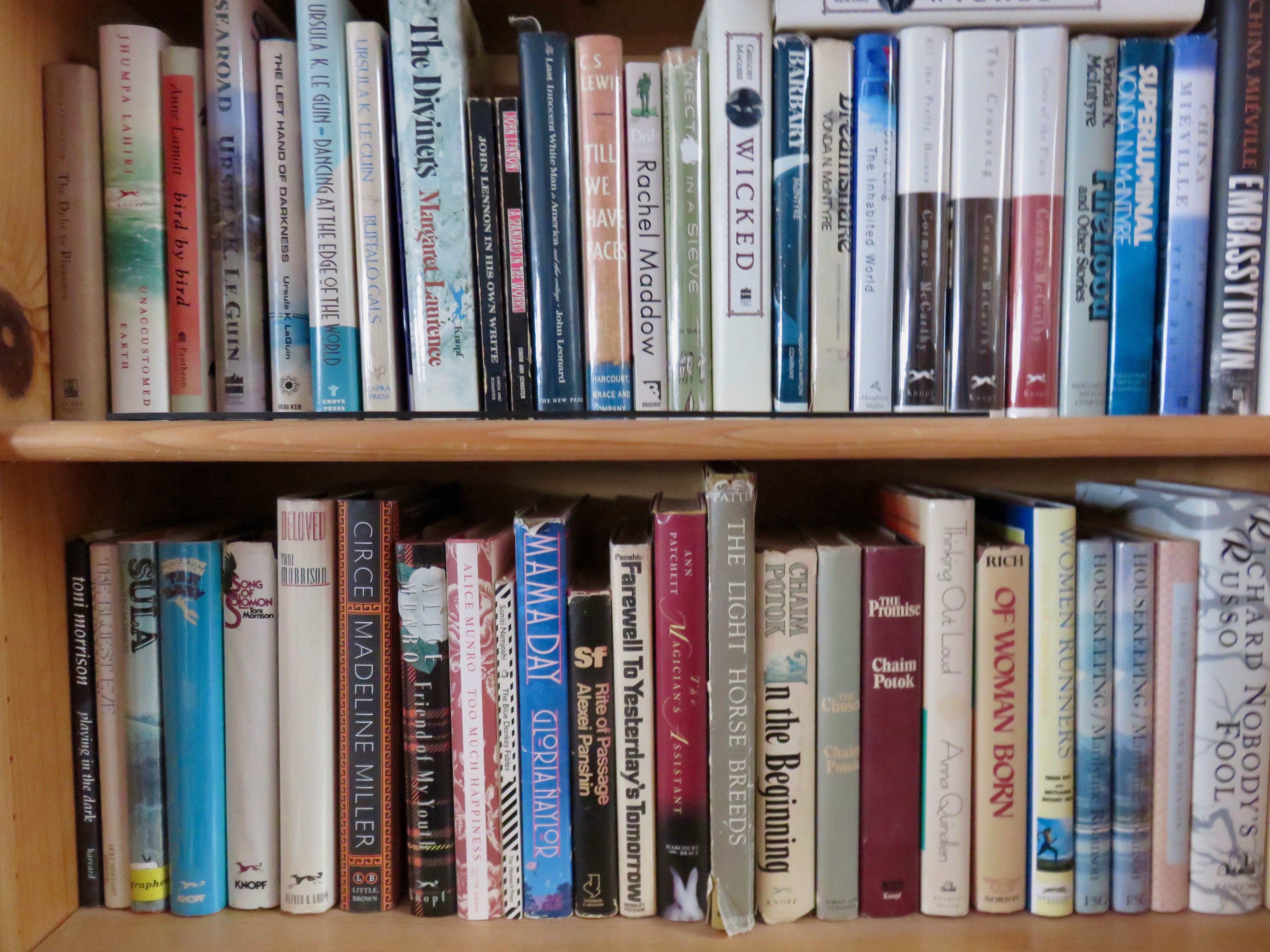
COVER. I picked up Gregory Maquire’s Wicked and David Mitchell’s Black Swan Green, both while still in hardcover, for their covers. They remain among my all-time favorite reads. I taught Black Swan Green for years. My students loved it too. There are plenty of books I have ordered online for their covers and found myself irritated because the insides did not match the promise of the outsides.

FIRST PAGE. In my hands, I read a bit. Black Swan Green had me laughing halfway down the first page. This is the safest way to choose, in my experience. I have rarely been disappointed after enjoying a five minute introductory read.

AUTHUR. Some you know you are safe. You know you will love the book because you loved the last one and the one before.

DISTRACTION. I began reading science fiction just to appease my father. Foundation is sexist and homophobic, but still . . . all through college I read SF. I chose books written by women or with a woman on the cover, so long as she was not being carried a la Conan. The Women of Wonder story collections edited by Pamela Sargent introduced me to more authors. I read SF to find a world in which my gender was not all that mattered about me.

ASSIGNMENT. I detested Mrs. Stevens Hears the Mermaid Singing required for a class by a wonderful instructor, but after considerable struggle, I was able to respectfully and usefully identify what bothered me in May Sarton’s novel. Sometimes people hand me exactly the right book at exactly the right moment. Things Fall Apart was probably the best book I was assigned as an undergrad. Though I never warmed to the recommended stories of Flannery O’Connor in my masters program, I assign “A Good Man Is Hard to Find” and both versions of Carver’s “Beginners” and “What We Talk About When We Talk About Love” and allow my students to judge for themselves.

RECOMMENDATION. I loved Middlemarch recommended by a former student and I’ve read it twice. Toni Morrison came to me as a friend’s recommendation. I have read and reread Patrick O’Brian’s 20-volume series. Currently I am in the middle of the seventh book. It is as good or better this time around. Aubrey and Maturan deserve a full shelf all to themselves and they have one.

CHANCE. I don’t remember how I found some of the books on my shelves, the ones that stay. I saw Dorianne Laux’s chapbook What We Carry at Powell’s turned out on the shelf and bought it after reading the title poem. I picked up Black Swan Green and Wicked for their covers.

RE-VISION. I change my mind. The first time I read Maxine Hong Kingston’s Woman Warrior I gave up less than halfway through. Four years later, I picked up a different edition and loved it. It was not until I arrived at the exact page where I had previously abandoned the book that I remembered how disappointing I’d found it the first time and somehow it became brilliant in th years since. I read but failed to be particularly impressed the first time I read Alice Munro’s “Meneseteung” in Best American Short Stories. A few years later, in a class exercise involving reading short stories, a student picked it out as her favorite. It won over the entire class and more than a decade later I wrote my critical essay for my MFA on that story.

The ones that fail to stay?

  • Did I enjoy reading this book?
  • Did it teach me something?
  • Do I remember the story?
  • Will I reread it?
  • Do I know someone else who will enjoy it?

It’s always about choosing.

A BLESSING FROM BOOKS

IMG_2772

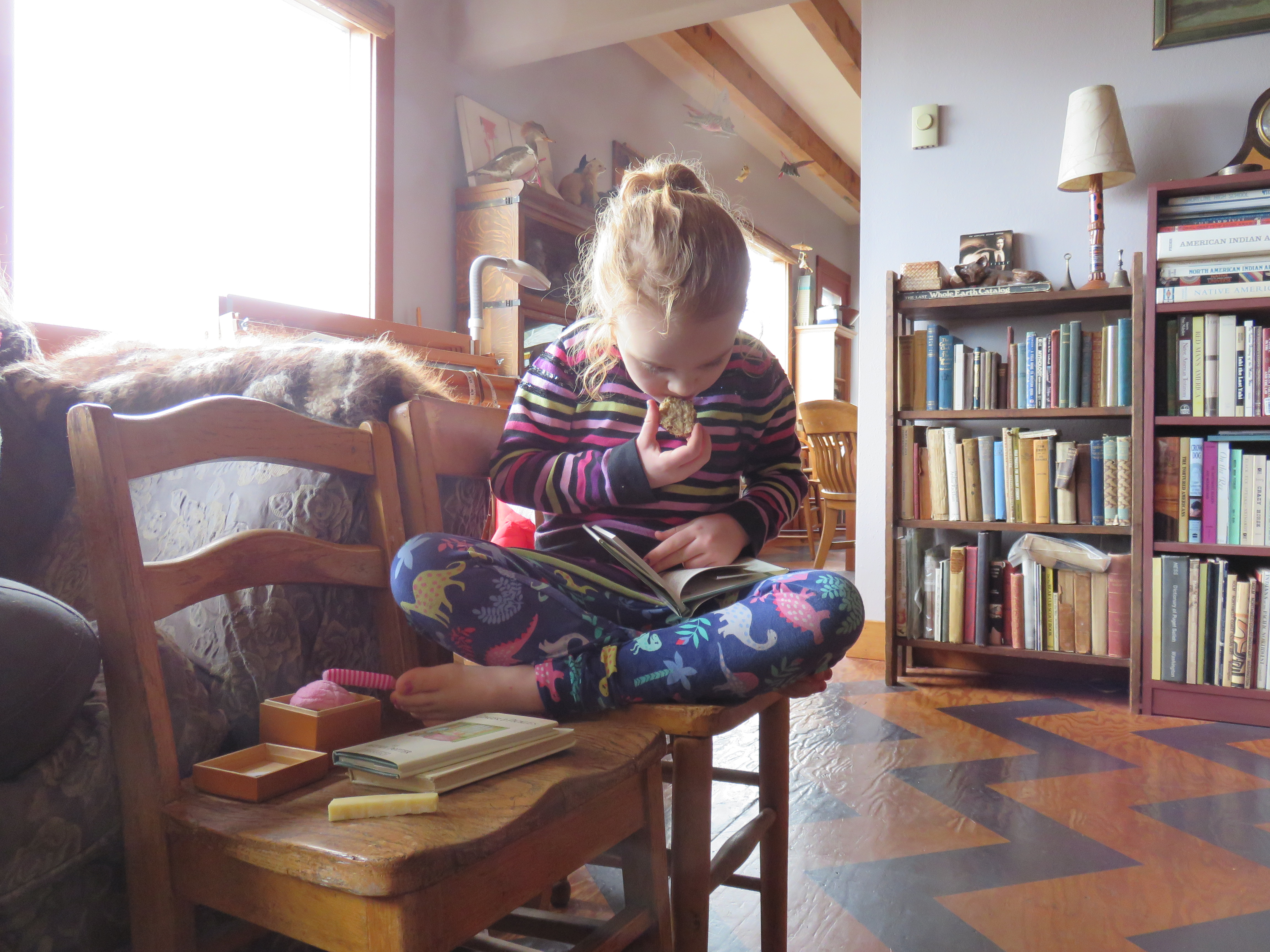
My granddaughter Ruby with her chosen books, cross-legged on a little chair, and making that one cookie last as long as possible.

I buy books. My husband buys books. We have, on occasion, vowed to stop, but we do not stop. We buy more books. Purchasing books is no cheaper than smoking or drug use, but this habit will not kill either of us.

We buy books.

We buy books from second-hand vendors and the local stores and Powell’s Book Store in Portland. We buy from independent small presses. We read about them online.

We buy books that make us suck our breath. Books for the past and future. We buy books that tell us our own story. We buy books that tell us a story we have never heard before. We buy books because we are not in district for the local lending library and the school library has a tiny collection. We buy books because we like to own books, and because the books we want will never be in our local libraries. We buy books because that is how authors make a living. We buy books to reread. We buy books because I write them. We buy books to covet and collect and loan to friends. We buy books for photographs and poetry. We buy books we cannot read because they are in Icelandic or Greek.

We look to books for laugher and tears. We look for education. Inspiration. Peace and hope and joy. Possibility. Truth.

A bird in the house is supposed to foretell death. Books are different. We buy books because research shows that just having books in a house with children will cause them to do better in school. A blessing.

We buy books to find lives we will never live.

We buy books to find ideas we do not have time to explore without help.

We buy books to find the other side.

We buy old books and out of print books and books that contain references we cannot find in the edition we already own. We order books we hear about and books we read about and books we wish we’d written ourselves.

We have books written originally in English and books in translation. We have books we still have not read. We have books bought in duplicate because we forgot we already had a copy. We have multiple translations of the same text, in order to place them side by side and judge for ourselves.

We have books we struggle to read because they are complex. We struggle reading books we do not have the training to understand. We read books that are over our heads and require additional sources to follow.

We never highlight with yellow markers or underline or dog ear—an abuse of pages. We use bookmarks and post-it note, tabs to help us back to the lines we want. We treasure and treat these books with the respect they deserve. All our dreams and goals and desires fit along their lines.

It is not true that you cannot have too many books. We have too many books. I feel a little guilty for having four pairs of black boots, but I do not feel guilty for owning the entire Patrick O’Brian series, even though I have already read them each twice.

We have filled many bookcases, sorted through and organized them by genre, subject, and author. (We do not sort books by the color of their bindings—an abominable habit we would never inflict on friends.) We give books away—we buy new copies to give. We loan them to friends who are gentle with them. When the bookcases become too tight to allow another purchase, we sort and we make the hard choice to allow some to reenter the world outside our door. Then we buy more.

We buy them so that they are ours and belong in our home.

For as long as I have had days, there have been books in my house.

We buy books.

NOTE: It was 85 years ago today that the Nazis burned books. Buy a book and let it burnish your brain instead.


SaveSave

SaveSave