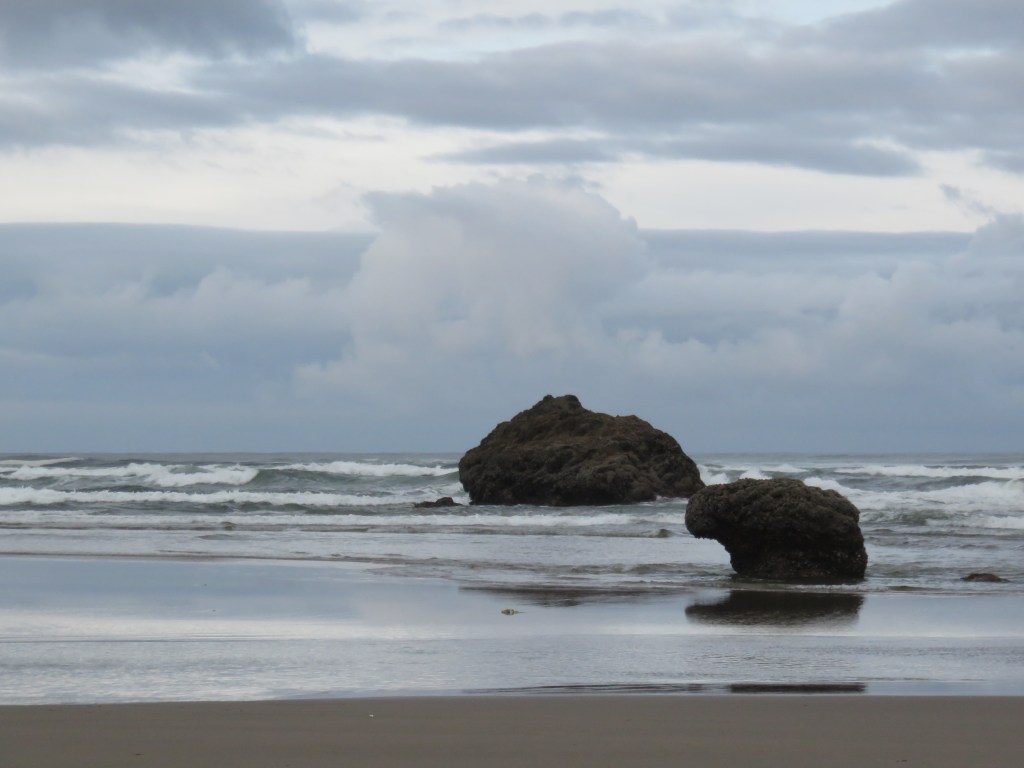
“king tide”

Years ago, a friend visiting from Colorado became impatient with our talk of high and low tides. “What does that even mean?” she cried. So I took her out at high tide and showed her the width of dry shore and the location of breakers relative to the cape. Six hours later I took her out again and showed her the difference. I have something to say about that term “king tide” and tides and sneaker waves.

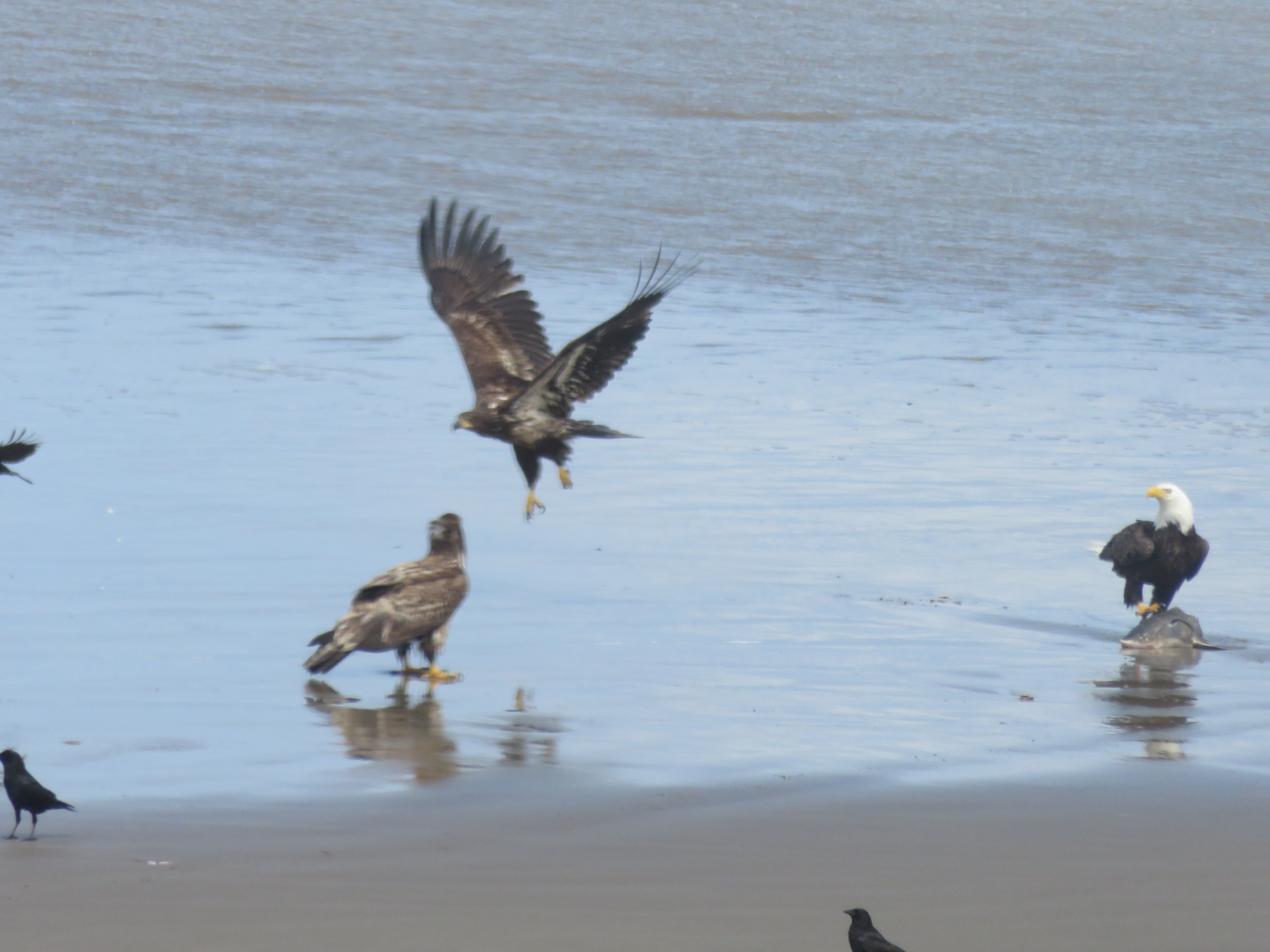
The shore in winter. Our local bald eagles are not aggressive feeders. They mostly find fish and birds that are already dead. They were not here when we first came to live in Arch Cape, but have been successfully raising children for many years.
Continue reading

COLD

We’re in Portland just now, and it’s in the 20s outside. I ran three miles here yesterday and walked a couple more, up and down NW Portland streets. I planned to walk three miles this morning, but maybe not in this cold.

We tested negative again yesterday. This means I have not been sick (with anything) for at least three years. Well, there is an issue with the blue cheese… But no cold or flu or covid. We are fully vaccinated and boosted and hopeful we will be able to see family next weekend.

Eagles, hummingbirds, teaching writing, childbirth, and life expectancy. What we saw a few days ago on the coast:

This crawfish did not belong on the sand early the other morning. I have caught, cooked, and eaten crawfish in my youth. We could have eaten him. But no. We think he’s not the invasive species, just a local critter washed down after the rain, and Gary put him back in Asbury creek.
Continue reading

LATELY BIRDS

A deer came up our path and pooped just outside our gate.

Those little round brownish pellets in the middle of this picture are deer poop.

The nearest nesting pair of black oystercatchers were out on the sand with their youngster.

The bird at left is an adult (one of the parents. The one in the middle is the other parent. The one at right, with black shading on the end of her beak, is the “baby” already as big as her parents.

The little shorebirds are a mystery. After all these years, I can’t be certain what they are, Least sandpiper (Calidris minutilla)? Or something else?

And then the new driftwood growing up out of the sand. Usually the ocean plows them right up in a high tide, but there have been such drift logs that lasted a year or more because they were well planted.

When Portland, on the east side of the coast range, experiences seasonal hot weather, we often have morning fog. It’s been foggy the last few days when we went out for our walk, clearing once the sun is high enough to burn off the mists.

The eagle flew over our heads on its way to what Gary calls the Bird Snag on the headland north of us.

Sometimes a crow perches here a couple of hundred feet above us, but this is definitely an eagle perch.
We usually walk 3-4 miles, but the other day we walked past Arcadia, more than three miles to the north of us, better than a six mile round trip according to my old running measures. And then home.

THE EAGLES

We have been on long walks lately. “Plenty of beach,” as Gary says while we walk more than two miles north. The young eagles have been around, Crows or a raven most often give warning, scattering black oystercatchers, gulls, whimbrels, and other shorebirds. Most days we see at least two of last year’s now-molting babies are overhead and sometimes their parents.

Continue reading

BRINGING TOGETHER

Eagles are doing well. We see the mated pair that live on the cape nearly every morning.

Gary complained I had not posted. It is barely raining a little drizzle, there is sand, and we will have our walk. Lately, we find we cannot get more than a mile north because Shark Creek’s runoff is too high for us to cross, but we will go out as soon as there is light. Gary is dressing in the dark, and I will have a last sip of coffee. Neither of us have yet been vaccinated and we miss our family.

In the mean time, like so many others, we listen to music and hope for comfort, conversation, and more communal days.

Continue reading

TWO EAGLES

fullsizeoutput_1219

There are eagles in the sky most days. All that beauty in the air.

I pulled out my weaving: merino baby blankets, shawls, and lap-robes out of the tansu chest and stacked them up in a chair. Twenty-three—I turned the photo sideways so they would fit my screen. More than half these soft things have been woven since we began our personal lockdown on 10 March. I have a new warp on the loom now and I began weaving the second shawl yesterday just before 8pm. I mean to stop at 4, and then I go back and work some more, and then I think 7pm is a long day when I’ve been awake since before dawn. But I wanted to see how the hands-spun I have been hoarding for a few years would work on this warp, and it’s lovely, subtle and tweedy. There will be twenty-six weavings by the end of next week. And then I will start winding skeins for another warp. Continue reading

5 EAGLES

IMG_4226

A tourist approached the feeding eagles and drove all but the least confident flier off. She told me she was afraid the non-flier was hurt. What did she think she could do to help? It remained on the sand for twenty minutes or more and then flew away south.

We had never before seen five bald eagles at once on our beach. Clutch size of eagles has been rising ever since Rachel Carson’s Silent Spring alerted the general public about the dangers of DDT. (Before we began poisoning crops, bald eagles in Chesapeake Bay had clutches of four or, rarely, five eggs. The average size clutch was 2-3. In the 60s this dropped mostly to 1 egg. Average clutch size has been slowly rising ever since the banning of that poison.*) Gary assumed bald eagle laid 2 at most “Like normal birds” (he means pigeons). I had not known eagles ever hatched 3 eggs. But here they are.

These parents, the successful breeding pair, have brought out their youngsters each late spring. Inevitably the youngster lands on the beach, finds her or his feet on flat and wet sand and stands in the shore, often for many minutes. Eagles always look a little bit pissed off. It is their expression formed by keen eyes and a downturn in their sharp beaks. I like to imagine they are unhappy with the wet and flat ground, an unfamiliar surface.

Whenever an eagle shows up, crows arrive to harass it. (Crows routinely harass the red-tails too.) We once watched an eagle harrying an injured gull, that itself was then bullied by a half dozen crows. Eventually, even gulls arrived to drive the eagle away. The adolescent eagle moved off north, stood for a time on the sand, but that injured gull would be eagle food before the day was out.

We never interfere. These are wild things and their lives should now be messed about by human being. (It is a different situation when the animal is endangered as a result of human action to begin with.)

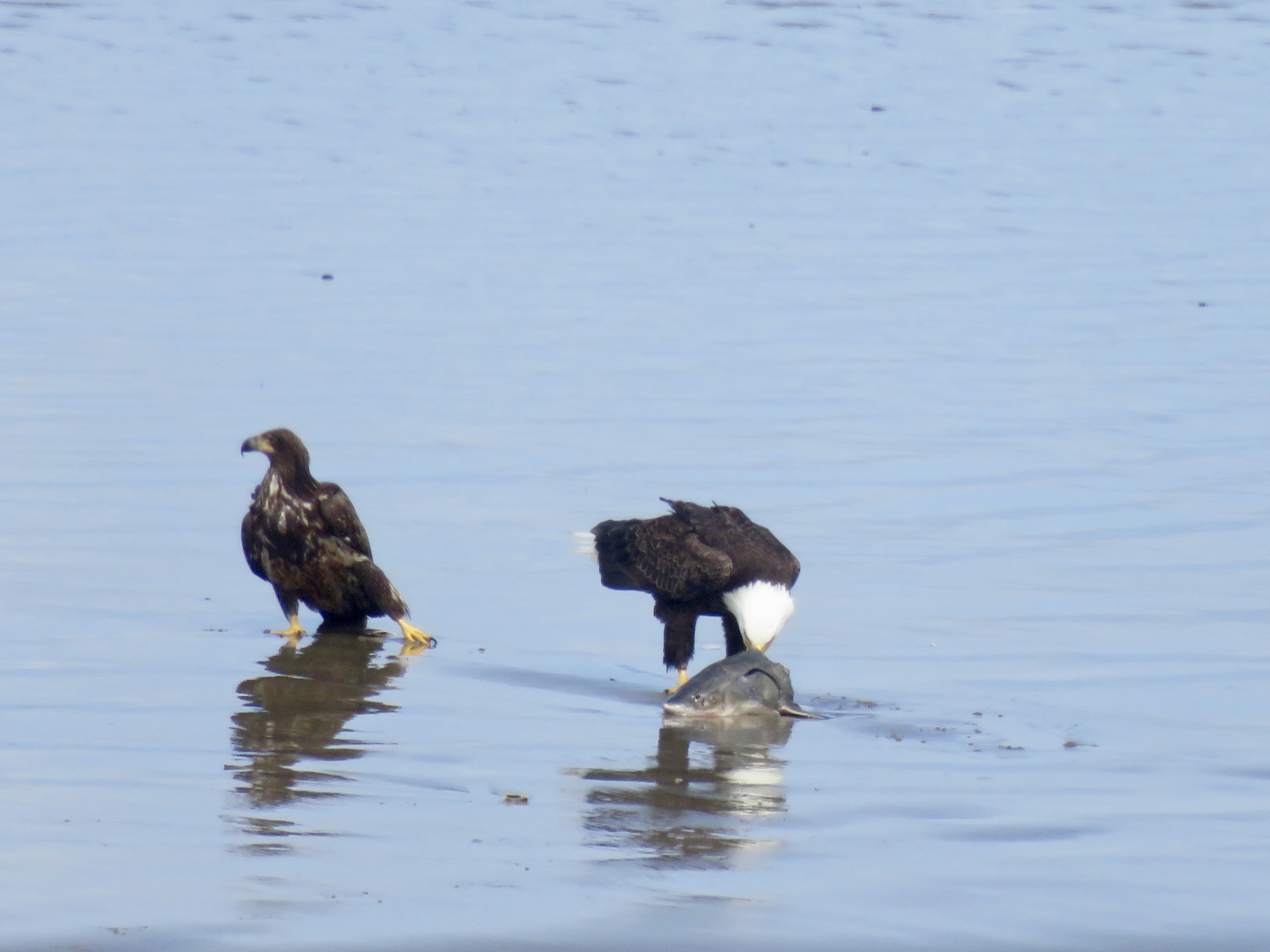
The five eagles from the other morning were eating a large fish, the remains of a huge sturgeon—head and spine were thrown up on the rocks by that night’s high tide.
fullsizeoutput_f3d

That is the head of a sturgeon, the prize that attracted ten raptors to our shore.

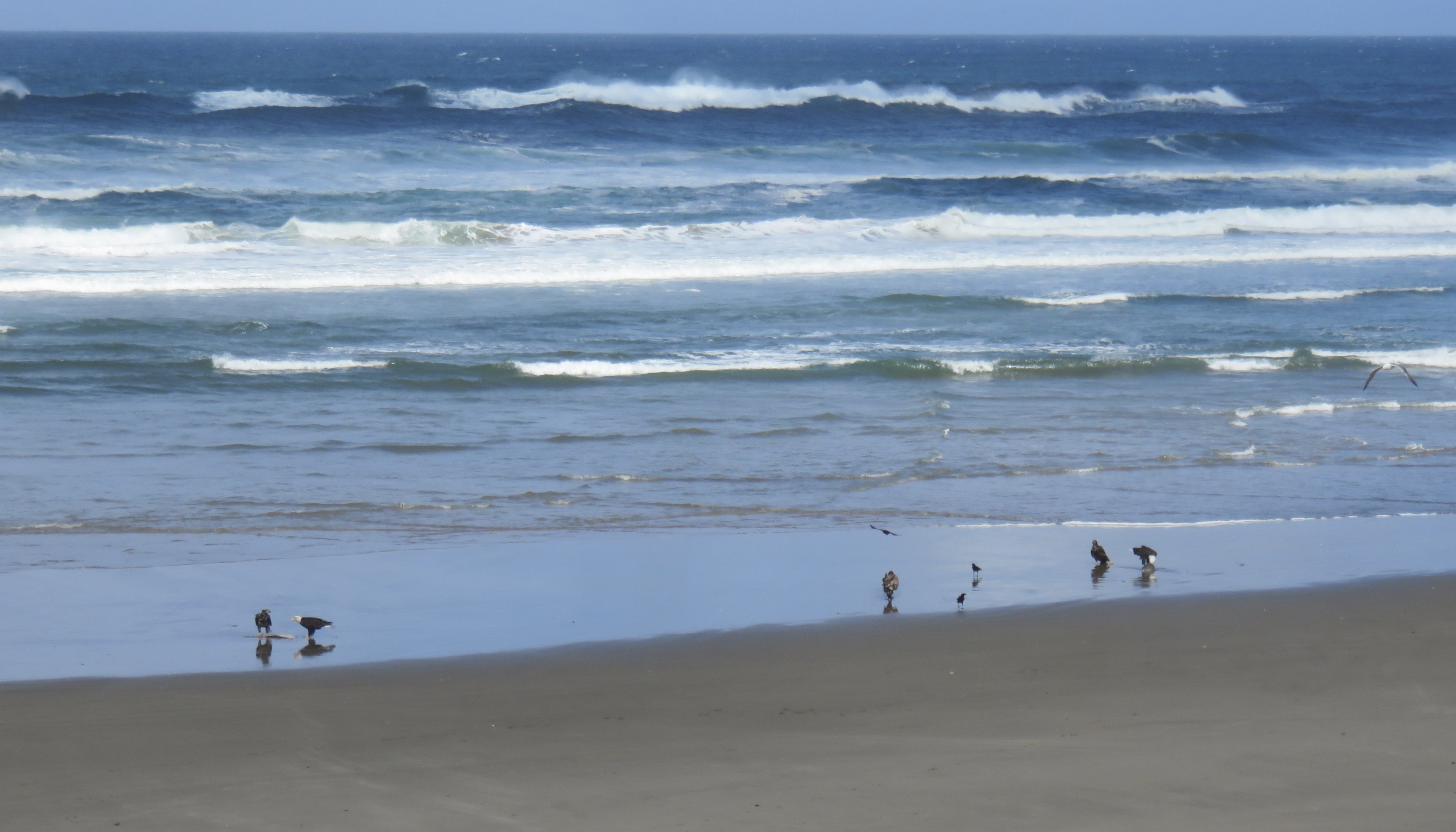
The breeding pair always appear smaller than their youngsters. They are relatively new to our area. When we moved to my grandfather’s house forty years ago, there were no eagles (no ravens then either). This pair, the ones we like to think of as “our eagles,” appeared more than a decade ago and began bringing out their adolescent children soon after. This is the first year they have successfully raised three.
fullsizeoutput_f3f

This photo shows the two white-headed parents and their three plain brown children, plus a couple of crows. This is only part of the show.

It was a spectacular day for raptors. In the sky and on the beach we counted the five eagles, three turkey vultures (also a first) and two other raptors that Gary thought might be the osprey, which we have identified recently fishing just offshore. (A neighbor claimed they were red-tail hawks and there are red-tails a dozen miles north on the other side of Tillamook Head, but we did not see the telling red tail and we know to look. We have recently identified Cooper’s hawks in our own yard, but they are smaller than the birds we saw. The pair were probably ospreys, but I do not have a photo to prove it.) The entire local murder of crows arrived, the raven pair too.

In any event, ten raptors at once. Ten.

They are one sign of a healthy ecosystem.

*I do not know any high school science teacher who routinely assigns the work of Rachel Carson, the Great Parent of the modern environmental movement. Rachel Carson was a marine biologist and already a published author when a friend wrote to her about how spraying had caused songbirds to drop dead from the trees in her yard. Because it was not her field, Carson tried for some time to find someone within that discipline to write about the dangers of pesticides, but there were no takers. The chemical industry was and remains a powerful lobby. Finally, Carson did the research and wrote the book herself, knowing full well the chemical industry would do whatever it took to destroy her. They did.