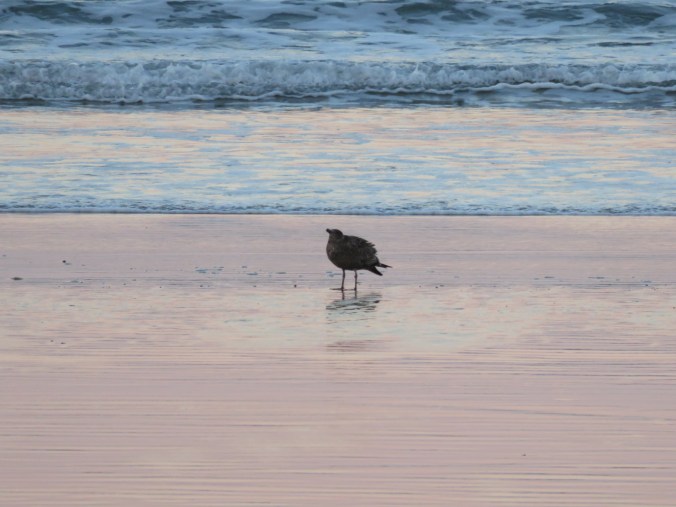
This young seagull was peeping for its parent, but that adult flew away.
When my husband was young, sometimes he would sit on the back steps in a parched Arizona payday waiting for his dad to get home with groceries. Another family of four children was left alone for the weekend that turned into a week or maybe two. The woman who told me about her childhood was not sure, only that even the mustard was scraped out of the jar by the time Child Services showed up.
My own childhood was not so deprived. I went without dental care and my mother mixed powdered milk and when I first tasted a real butter pat, it was like candy to me. In kindergarten, I had two skirts and three short-sleeved Orlon sweaters. For Easter, I had a new cotton dress. It is odd the things you remember. But we were never hungry, and my father’s mother and aunt had enough money put by that it was safe to assume we could borrow money if things got desperate, which they did on occasion.
This is to say, I was not raised poor. Raised poor is hunger and no one to turn to who is better off. “Poor” is so bad that we make up euphemisms like “economically challenged” or my students say a person is “not very rich.” No, poor is not having enough money to pay bills even though you live cheap. Poor is embarrassed because even when everyone in the household is working hard to earn money, money is still “tight” and bills are sometimes late. Poor is being blamed in our country.
And that isn’t fair. Innumerable studies show the sort of income necessary to pay for housing in different parts of the country. Recent studies are equally clear that poor children almost never receive the quality of education wealthier parents give their children. Their health care isn’t as good. What they suffer damage in childhood that their ability to improve their lives, quite permanently.
The truth is that wages have not kept up with inflation—they have been falling behind for decades. Telling someone that if they want to earn money, they should get a better job is like telling a person waiting in a wheelchair to run to the head of the line, like telling the five year old to reach something down from the top shelf, like asking someone who is starving in a third world country: “Well, for heaven’s sake, go to the store and buy some food!”
Sometimes we simply fail to pay attention.
Poverty is lousy circumstance, not a character defect.
I am reading Adrienne Rich’s essays in her new collection, Essential Essays: Culture, Politics, and the Art of Poetry, edited by Sandra M. Gilbert. Rich was a force of nature, a woman who found compassion for others when she granted it to herself. She reminds me that compassion is necessary, that affluence is not a free pass to righteousness, that everyone faces difficulties in life and it’s a good thing to remember that sorrow and trouble come to each of us.
Here is the first poem I ever read of hers:
Prospective Immigrants Please Note
Prospective Immigrants Please Note
Either you will
go through this door
or you will not go through.
If you go through
there is always the risk
of remembering your name.
Things look at you doubly
and you must look back
and let them happen.
If you do not go through
it is possible
to live worthily
to maintain your attitudes
to hold your position
to die bravely
but much will blind you,
much will evade you,
at what cost who knows?
The door itself makes no promises.
It is only a door.
Thoughts from Adrienne Rich
I believe that poetry is asking us to consider the quality of life. And it is reflecting on what makes it possible for us to continue as human. Under the barrage of brute violence, numbing indifference, trivialization, shallowness, that we endure.
Even when I was very young, I was reading poetry, looking for what it could tell me about how to live. For me, poetry has never, ever been just an escape from the world, an escape from history.
I think in this poem, what I am talking about is the choice that we can make, to move deeper into things, or simply to live worthily, maintain your attitudes, hold your position, even die bravely, but not to see what might have been seen. Not to grasp what might have been grasped. And that is a choice, for us all, whether in poetry or in life.
Our country has many truths, but certainly one of them has to be that this was never a democracy. That this was a hope of democracy, an enormous, an enormous hope for true democracy, and that it failed many people from the outset and it’s failing more people now.
I think that more and more people feel uncared for, feel that their lives are not only unvalued, but meaningless. Feel that though they may care for their lives, no one else will. Feel that the only way that they can protect their survival and their interests is by the gun. I’m afraid that many people feel an enormous desperation which plays into the propaganda of hate.
I think that poetry speaks beyond that, to something different. And that’s why it can bring those parts of us together, that are both in dread, and which have the surviving sense of a possible happiness, and a possible collectivity, a possible community, a loss of isolation.
These reflections are excerpted from an interview Bill Moyers did with Adrienne Rich in 1995 as part of The Language of Life series. Rich died in 2012 at the age of 82. You can read the transcript of her entire interview with Bill in our archive and read more of her poems at Poetry Foundation website.
 IMPERFECT PATIENCE