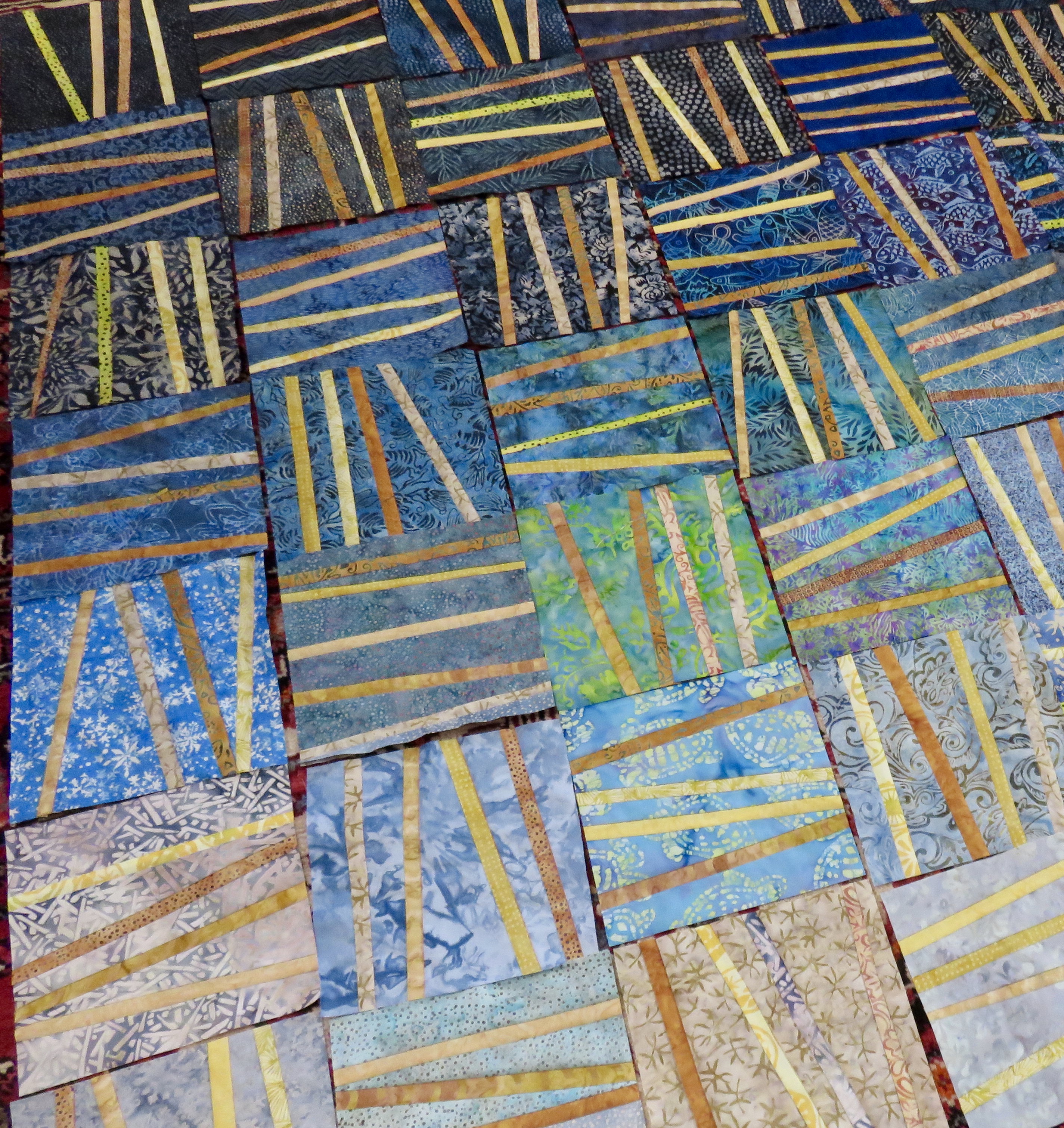
Above are a few of the forty-nine pieced square blocks laid out on the floor. The photo distorts them; they are each 8.5″ and carefully squared. So far I’ve used over sixty batik fabrics and cut over five hundred pieces of fabric. And this is only the center panel They will make a center panel 56″ x 56″ once they are stitched together, of an eighty-inch square quilt.
The second blue quilt was meant to be simple. I set specific, easy guidelines in order to piece it quickly and with a minimum of fuss. It’s that staring process, the decision-making at every cut and sewn seam. This color or that one, this way or that, rearrange and rethink the border? It was meant to be almost thoughtless but then the inevitable accidents. Most blocks were planned to be too large and I shave a quarter inch or as little as a sixteenth off the edges. A block might also too small or too dark or pushy or bland. I add another stripe or one going the wrong way, choose a different color or move the whole block to the other side of the quilt. Accident forces me to make decisions I might otherwise avoid, but accident has always served me as an artist. The writer Ron Carlson argues for something similar in writing fiction. Don’t allow serendipity to be cleaned out of writing. Let it flow. It is random chance that often hands us our finest work.
Decades ago, as a Metal Arts major, I was careless firing a base coat of enamel on square of copper sheet. The glass enamel color was called “Pigeon” a pale, perfectly transparent blue-gray. Fired over scrubbed copper it took on a lavender glow. Stenciled on copper, leaving some of the metal bare and then overfired to nearly 1700°F, the copper turned gunmetal-black, the enamel went palest blue-violet. The accidental firescale could be scrubbed off, leaving a line of black firescale on the edges of the enamel. I used that. Later, after deliberately overfiring sample tiles, I began using larger areas of firescale, enameling over the top and producing a unique metallic gleam. It was accident at first, and then a signature effect. It started by mistake.
Mistakes take time. Few are really useful. They are frustrating and not easily corrected. I have picked out stitches plenty of times making this quilt. Changed my mind in an instant. I could follow a quilt pattern or use a kit. There are plenty around that prescribe specific patterns and fabrics. I would not be constantly making choices, and choice is the hard work. But without choice, where’s the fun? I’m only barely interested in covering a bed. I am making art.
Mistakes push me, force me to reconsider, to change direction, to accept what happens sometimes and other times to fix it.
Mistake was at the first and will be at the last, so long as we don’t give up.
“The most important thing a writer can do after writing a sentence is to stay in the room. The great temptation is to leave the room to celebrate the completion of the sentence or to go out in the den where the television lies like a dormant monster and rest up for a few days for the next sentence or to go wander the seductive possibilities of the kitchen. But. It’s this simple. The writer is the person who stays in the room. The writer wants to read what she is in the process of creating with such passion and devotion that she will not leave the room. The writer understands that to stand up from the desk is to fail, and to leave the room is so radical and thorough a failure as to not be reversible. Who is not in the room writing? Everybody. Is it difficult to stay in the room, especially if you are not sure of what you’re doing, where you’re going? Yes. It’s impossible. Who can do it? The writer.”—Ron Carlson, from Ron Carlson Writes a Story


 IMPERFECT PATIENCE