I had an idea of where I was going when I started Part 1, but that got lost. The most magical thing I do is writing—making a reality that hadn’t existed before I created it. I think it through. I trust the process to yield.

I had an idea of where I was going when I started Part 1, but that got lost. The most magical thing I do is writing—making a reality that hadn’t existed before I created it. I think it through. I trust the process to yield.
Over the years I’ve experienced many unbelievable things. People have said things to me that were so shocking, I didn’t know how to respond. Then I did. I’ve given up all hope. Surprise! Things fall into place.

A lot. My injured foot is still a problem. No publisher for my novel. We’ve canceled an anniversary vacation. A neighbor is not doing well. And I am assured by a former student that, “There is hope in this world, ya know. And it’s okay to get depressed; it just means you’re paying attention. And while anyone is still paying attention, there is still hope for everyone who is not.” Walking, submission, altruism, A Christmas Carol, righteousness, and hope. The ocean of my business.

Jakey Lebwohl, Emma Park, and Zach Rausch on the Substack* After Babel published a meticulous documentation of an education system that is failing too many students. All students had been improving in pretty much every area, and then about 2010, that improvement mostly stopped. The drop in skills such as reading and math is particularly noteworthy among the lowest-performing students—the kids already disadvantaged in school. This is pretty much equally true for all races, genders, and socioeconomic groups.

I was a student in excellent public schools (ranked second in the state of Washington at that time) from 1957 until my high school graduation in 1970, and then an excellent public university (University of Washington) for six years when I graduated with 3 degrees, cum laude, and Phi Beta Kappa. One distinct advantage I had throughout my education was teachers who were highly qualified, even over-qualified for the work. Memorable teachers were women with limited opportunities (secretarial, teaching, and nursing) and men from working class backgrounds (industry, farming, service) who were the first in their families to have the opportunity to earn [safer] white-collar jobs as a result of the GI Bill. Teaching never paid well but had the advantage of offering most people a reliable income and summer weeks to take a second job. Many teachers had the advantage of being treated as professionals. The unpaid or partially-pay sabbatical year every six years of teaching encouraged teachers to behave as true academics who pursued further degrees and research projects. Travel was understood to be educational for teachers and was tax deductible. [I owe everything I know about flying buttresses to that tax deduction!] Those genuinely educational perks are gone, and in my state tenure for public school teachers was eliminated in 1997.
In every way, and especially now under an administration that wants to cut all federal funding, public school teachers are treated as factory workers. No offense to factory workers, but I could have done that job straight out of high school.
In fact, my brother earned a 2-year community college degree that prepared him for a factory job. There, he earned more in his first year than he would ever earn later as a teacher in the mathematics and science departments of the public school where we both taught.
The counselors where I taught would never have urged the future I was steered toward by my school counselors. My math and spacial reasoning scores were right near and at the top [I test well], but I was a girl so it was fine whatever I chose so long as it suited my future as wife and mother. Mom wanted me to prepare for the future as a secretary, the counselor told me my goals of architecture or interior design were ridiculous, my counselor flirted with me, and I chose the School of Art.
Beginning in 1976, I taught Art in a girls’ prep school for 3 years, subbed, and then taught English and Art and English-related electives in a rural public school on the Oregon coast, and college Lit and Writing for the next forty. All this to say, I’ve been watching the evolution of public education for my entire life.
I taught with few teachers as capable as myself, several who treated teaching as an easy job (it’s not easy if you are doing it well), and many who did not last as teachers but left for better-paying work in a cocktail lounge or industry.
Another issue was the over-emphasis on college as a necessary step in every single child’s future. That view took hold by the 2000s. Where does that leave the teen without interest or capacity for college?
But the other major factor affecting student learning that I witnessed was Common Core. Standards were based purely on multiple choice test data. “Teaching to the test” replaced innovation and adaptation to student interests with dull routine test-prep. I was discouraged from teaching anything but nonfiction. I was required to explain how each lesson prepared students for testing.
Further, though I taught the use of computers in all my classes, I never allowed cell phones in my classroom, and the shift to on-screen learning has proved to be a disaster for human beings. I was in an early cadre of teachers approached and asked to participate in training for on-line education. It was horrendous in the way it valued rote response and failed to address either student needs or creative thinking. I used to tell my yearbook students: “There is nothing that can be done on computer that cannot be done by hand with a lot more time.” That’s true of page design, but people are not yearbook pages. Yearbook pages must first be imagined by people. [Even using AI would require someone to initiate the project.]
People invent themselves and require human responses to guide them forward in a way useful and meaningful to them. That requires attention, skill, and compassion. It requires money.
CHEAPER is CHEAP. But “cheap” is not what human beings aspire to be.
The current powers that be only want education to be cheap and simple. People’s lives should not become cheap, and they are never simple.
The people who have pushed and are pushing education in this disastrous direction over the past fifteen or twenty years have a couple of things in common: They are not teachers and they don’t care much about what happens to other people’s children.
Rich people will spend a lot of money to convince the public that we [they] shouldn’t be taxed so much for public education. They will “prove” that we are wasting money and spending too much. At the same time, they send their own children to private schools with tuition costing four or six times as much [or more] as is spent on public school children. “Separate but equal” was always a myth of the caste system, and now they want vouchers and tax rebates for their exclusive and elite schools. They want to pretend they are handing over control to states. they want to pretend that Alabama will ensure its children receive an education comparable to Massachusetts’. They want to pretend that if Alabaman children are poorly educated, it’s their own fault.
People without experience in public schools insist they know how to make them better.
Pardon me while I detail improvements in cardiovascular surgery.
Pay them less, require more yearly online multiple choice tests (I was taking seventeen), and more surgeries with less time off.
There we go! It’s so simple! A child could do it.

I rarely draw, and this pencil sketch might be 30 minutes of work. (In person, the penciled eyes glint.) I work primarily as a three-dimensional artist, a preference I identified when I was 12, after I designed the school spring program cover for silkscreen printing, and printed it.
“Sit still,” the trainee told him several times with increasing frustration. “Sit still!” When he finally did sit in his chair, the little boy completed the test. He scored so very badly. The trainer took her student aside. “Try again but let him move around this time.” Do I need to tell how much better he did the second time—on a different version of the same test? He was doing Algebra at age seven. He should have been accelerated in math in middle school. So should his older brother. As a teacher and his mother, I should have insisted.

Examples of “evidence” I discount:
• Your boyfriend’s uncle’s friend survived a house invasion only because he kept a loaded gun under his pillow.
* You saw a YouTube video/Snapchat/Tweet/X post/Facebook story that proves there is a cabal of dems holding torturous events at the local pizza palace.
• You found the photo that proves how people in favor of abortion celebrated a legal victory by eating a cake shaped like an unborn child.*

Have I read these stories? Yes, I have.
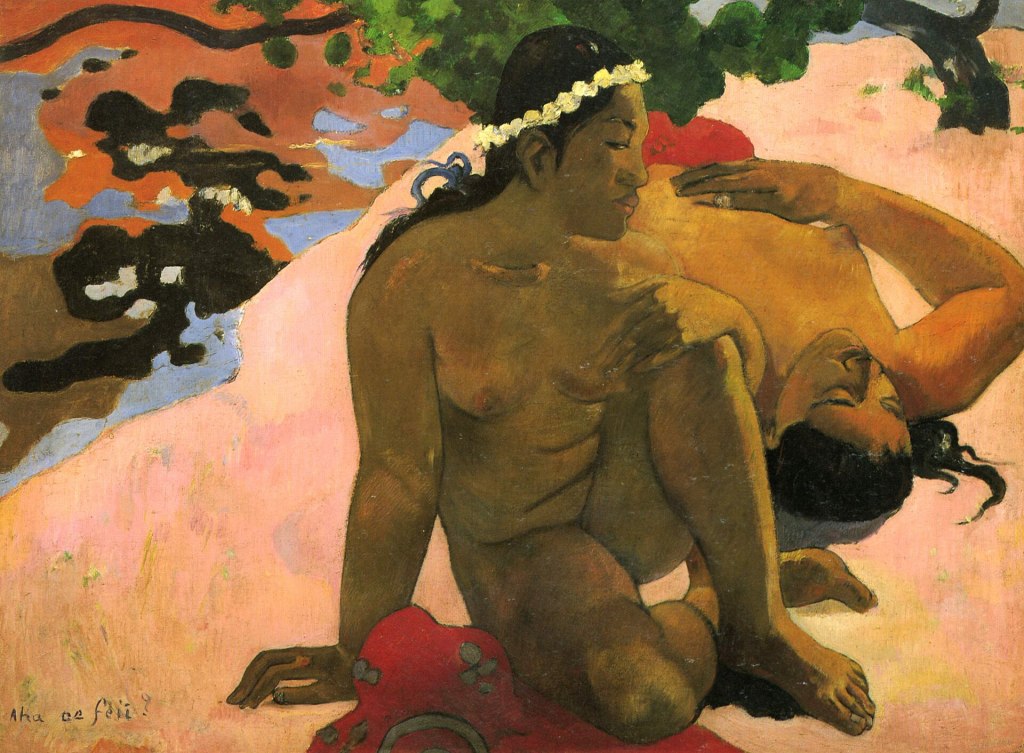
Continue readingI understand from reviews that at least some readers and professional reviewers are relieved that Sue Prideaux in her new biography, Wild Thing, exonerates Gauguin’s egregious sexual relationships with girls and women because the times were different. How nice. [The French, among others, have long struggled to recognize sexual exploitation of female children, not to mention adults, but there has never been a time when misogyny and outright cruelty were not objectionable to those who suffered. It’s one thing to acknowledge that bigotry such as antisemitism and racism and sexism were tolerated and even encouraged by those in power; it’s quite another to insist that these attitudes and transgressions went unnoticed, that such bigotry was somehow rendered benign because a few declared it was.]
The last word.
You write. You submit. You wait. You are rejected.
Only that first verb matters. Remember that. Keep going.
You write. You submit. You wait for rejection. It is tempting to believe in failure, that rejection is deserved, that it is right.
Every creative person knows this process of making and reworking and finishing, and then sharing and waiting and hoping for appreciation. We all know disappointment. Those of us in MFA programs, those sitting alone behind a desk, with a notebook on our lap, everyone with a dream of finding an audience, even those with an audience waiting and eager to read our words. We focus on we have to share, bring on every skill we have practiced, but fear our audience will not remain seated. Even our mother will lose interest.
We envy people who never doubt. We doubt.
It is tempting to believe that others never doubt themselves, that someone somewhere is writing better stories and essays and poetry, that readers respond with the same passion that writer felt while writing, that their work is snapped right up. And maybe you’ve had work that was snapped right up. Maybe you have published poetry or fiction or essays that someone somewhere told you they loved. Maybe they even told you why. Or maybe they never did. Not once.
Either way, you doubt. You write. You submit. You wait. You are rejected. Each time you start over. You want to believe others are not good enough, but you are perfect, and then hubris drops its calling card and you know you are lost. Envy scars your work, plants its ugly face between you and what you love.
It is tempting to believe that maybe this rejection is all you have, that the essay or memoir or poem or story you wrote isn’t good enough. You should revise it, set it aside for a time and revisit it, rearrange the paragraphs or stanzas, make a stronger opening, invent a new word, wrap your thoughts in metaphor or scene, reconsider what you think you are writing about. Maybe you thought this piece was about love and really it’s about hope or loss or—heaven help you—giving up.
It is tempting to give up.
You write about giving up. You write until you find the next story or scene, the new essay or poem. You find a line or a single word. And then you fall right back into writing. Hours go by, and you laugh at the memory, the paradox, the irony written before you, the odd turn of phrase, the way a character or idea does something you hadn’t expected. You might cry when you find your own blood staining the page, or laugh all over again from pure glory. You polish the line until you realize it is too shiny and you must allow the next line to shine brighter. Hotter. You might stay up too late, revise those lines a hundred times, stir that emotional pot while it boils. You might get burned, but even the rising steam belongs to you. You work with sound until the words reveal what you knew all along. You have something to say.
You glow with effort and accomplishment. You said it, you wrote it, you made it clear on the page. Hold on to this. You hold on.
You write. You submit. You wait. You are rejected.
Repeat. Repeat. Repeat.
The response you are waiting for does not arrive.
It is tempting to believe you are wasting your time and your energy and your very heart on an endeavor that you were never meant to pursue. You want to believe that someone somewhere needs your words. You fear you are wrong. It is tempting to believe you will never write better than this. Maybe, you think, I should stop. You are not good enough. Maybe it is a delusion to trust your words matter to anyone anywhere. Maybe it was never important, what you write and try so earnestly to share. You do not have it, whatever it is that is found wanting.
You want it.
It is tempting to decide that laughter —yours—and tears—yours—are small things. They’re not. It is tempting to dismiss your accomplishment. It towers over your head, this dismissal. It is a momentous thing like sliding off a mountain peak. When you found the right word, the right sound, the piece that finally fits—there is triumph in that instant before you begin to doubt.
Remember. You have struggled. You have discovered. You have created a new thing entirely your own.
Remember the process, the laughter and tears and precision. Maybe you forgot that it was the writing you loved best of all. Maybe you forgot why it matters most of all.
You wrote this. It is yours. It is important to you.
Remember that precious verb: write. Set aside submitting, waiting, rejection. Maybe those next three verbs give you nothing good, only judgment and disappointment. You are better than that.
Only that first word is good for us. We deserve to write. We need to have the last word about the value of our work.
Write.
Everything is blooming here, other than things that are already nearly done blooming. In the front yard the wild roses and rhododendron and irises are done, but Pink Grootendorst is still setting new buds and so is my favorite double white rugosa. The honeysuckle and salal are still in flower, and the ceanothus is covered in bees, and the other flowers are getting close to opening. Lucifer looks like it will pop a week or two early this year. [I try not to notice the red lines under three botanical names my computer thinks I’ve misspelled.]

In 1972, I drove across the country with my grandfather’s third wife Genevieve to a sheep farm in Kansas. I had never been over the Rockies before that. Vietnam was at war, I learned to spin wool that summer, and when I got back Gary and I moved in together on the 4th of July. We would both be Juniors at the University of Washington that fall.
But in June, Gen and I crossed the plains. It felt foreign-strange to me to see no mountains on the horizon in any direction—no mountains at all in the last days headed to Kansas. All around, open sky. At one point, we pulled over to the side of the highway while a storm passed overhead.

 IMPERFECT PATIENCE