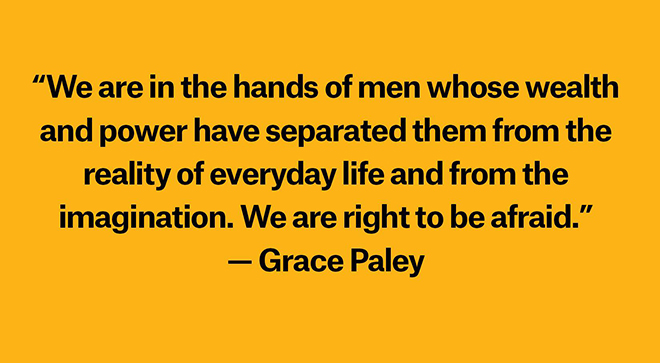
Look her up if you do not know of Grace Paley. She was brilliant.
Look her up if you do not know of Grace Paley. She was brilliant.

One of my favorite websites sent out a link to their recipe for confetti cake. It is made with artificial coloring (in the confetti), colorless artificial vanilla (for that true “box cake” flavor), egg white, oil, and cake flour (bleached). My husband and I must be the only people left in the world who have no nostalgia for cake made from boxed cake mixes. Truly, if you want those flavors, it’s easier and much cheaper to go to a (bad) bakery and order your birthday cake.
I worked in a wonderful bakery that made the Danish dough from scratch but used an “apricot” glaze packaged in gallon metal tins and took orders for “bakeoff” pies that were premade and frozen off site and merely baked in the bakery oven. The ingredients? I could not even begin to say, but by my twenties I knew enough not to eat one.
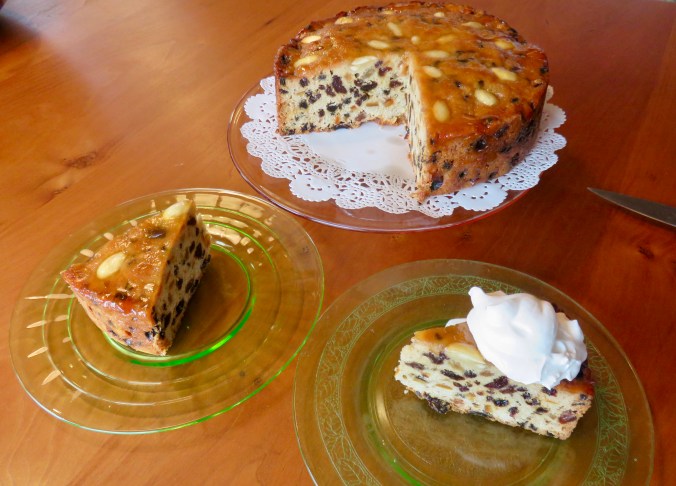
Gary loves fruitcake, even the awful gumdrop sort which I would not even use as a doorstop. I like the real thing. I made a traditional wedding cake for our wedding in 1974, a dark, aged cake from a nineteenth century recipe. This is what our family regarded as a wedding cake: fruitcake with white sugar frosting. That one was made with candied fruit from the Seattle Public Market, raisin and half orange peel punched from giant glass jars. It was a rich and aged cake, darkened with cocoa and brushed weekly with rum, but this is his favorite of all time. The Dundee cake is also made with “real” dried fruit, and a lovely golden color. Good luck aging it more than a few hours. I always use all organic ingredients.

Years ago a friend who was visiting us looked at the shore and thought he was seeing soap suds or another form of pollution. It is, in fact, life. A heavy surf and a plankton bloom combine to make seafoam. There has been a great deal of it onshore this month.
We have been experiencing some “interesting” weather. Temps dropped down and there was snow in the Coast Range. Fortunately our son had already made plans to take vacation days to stay home with his daughter last week. We no longer drive in snow when we can help it.
Here the wind gusted to strong gales and we walked the beach anyway. High surf erodes the shoreline in some places and we find raw agates released by the tide. We get half wet day after day, pick up dozens of plastic water bottles, and the usual plastic bits and bobs—over 60 pounds of trash so far in January.
 A puffin died. We find dead seabirds on every walk. This one would be opened and the entrails and breast muscle eaten by the following day. It is our first dead puffin and so particularly sad, but seabirds die every day. And there is black oil all over the sand too. Crude oil? Someone illegally emptying bilge at sea? We can’t know.
Last week we watched the helicopters flying south fast to the next beach and we knew this meant something bad. Emergency Fire and Rescue, the EMTs, three sheriff’s cars all with lights and sirens. Two young children drowned near our home. It didn’t seem quite right to mourn a puffin.
When I tried to warn a couple about the tide—they laughed when their dogs ran into the ocean—the man said “we know.” Their dogs don’t know. The next wave swept up a hundred yards over the sand and drove us, dogs too, all into the rocks.
People think they know about sneaker waves and “king tides” but they don’t. We have lived here over forty years and keep an eye on the ocean, move up shore when the surf becomes silent. (The crashing is usually safest—the sound of outgoing and incoming waves meeting. A sneaker wave is quiet and swift.) We spent most of the last week walking on the basalt rocks because even at low tide, waves swept all the way in, higher and higher. We watched waves sweep up over our pathway through the hedge, nearly to our yard. It is fascinated from the safety of our home, but we go out whenever we can. Not so very much glass has shown up, but pumice and plastic, those agates. Drowning. Death.
Lately we’ve walked the “inside” path on roads when waves swallowed sand and basalt rock whole. It’s safer than risking the shore. We often get rained-on during our walks, but we never head out into a heavy downpour. Yes, we have rain gear, and yes, we get caught in drenching showers. We see them coming but do not deliberately head out into a rainstorm. These things just happen.
Look, I have this firm belief that if America hasn’t broken your heart, you don’t love her enough.—Sen. Cory Booker
I used to require my college writing students to attend:
 The Pacific University Master of Fine Arts in Writing program hosts readings by top contemporary writers during its 10-day residency in Seaside. The series offers a rare opportunity to hear these writers read on successive evenings. Free and open to the public, the evening readings begin at 7:30 p.m. and take place from Friday, January 10 through Friday, January 17 at the Best Western Ocean View Resort, located at 414 N. Prom in Seaside, Oregon.
This year’s lineup includes Kwame Dawes, recipient of the Windham-Campbell Prize and Pete Fromm, five-time winner of the Pacific Northwest Booksellers Literary Award.
7:30 p.m. at Best Western Ocean View Resort in Seaside, OR
Jan. 10 — Marvin Bell, Claire Dederer, Pete Fromm
Jan. 11 — Ellen Bass, Jack Driscoll, Debra Gwartney
Jan. 12 — Frank Gaspar, Scott Korb, Mahtem Shiferraw
Jan. 13 — Chris Abani, Mike Magnuson, Mary Helen Stefaniak
Jan. 14 — Claire Davis, Valerie Laken, Joseph Millar
Jan. 15 — Sanjiv Bhattacharya, Shara McCallum, Kellie Wells
Jan. 16 — Kwame Dawes, Cate Kennedy
Jan. 17 — Molly Gloss, Shelley Washburn
The authors who are reading also teach in Pacific’s low-residency MFA in Writing program. For more information about the writers or the MFA in Writing program, contact Shelley Washburn, MFA in Writing director, at 503-352-1531.
The sky is raining down hard, we expect a “king” tide flood at the time I am supposed to be driving north, and I should be asleep as I type this. I am thinking backward and forward. I will not get back to sleep.
I think about war and how it is wound and stain. I wish I could explain myself better.
During WW2, my father served in France and Germany. He earned a Purple Heart and insisted he would probably have lost his leg if not for penicillin. My mother’s sister served in San Francisco, working with military personnel returning from and leaving for the Pacific theater. My father- and mother-in-law both served in the Southwest. They would marry in Roswell, where some people believe beings from outer space landed. People will believe such tales.
During the second Gulf war, we believed in weapons of mass destruction, even though UN investigators on the ground were quite certain that they did not exist. They didn’t.
During the first Gulf war, we were told babies were being tossed out of incubators in the maternity ward of a hospital in Kuwait. That lie was invented by an American PR firm and testified before Congress by a person with ties to people who had a financial and political interest in leading us to war.
It is always like this. War is great for business. War unites us. War solidifies national pride. It distracts us from what matters most. It gives us an enemy. Korea. WW2. The Great War. Spanish American War. Remember the Main. Rallying cries built on lies.
Some men such as Teddy Roosevelt believe war is ennobling, many believe that a uniform conveys automatic heroism. Such an adrenaline rush! Powerful men are eager to send others off to war because they will profit. Some advance their political futures with the blood of other people’s children. Some look forward with religious zeal to the coming Rapture. (A reminder that these last call themselves Christian.)
“May the best man win.”
The best man win? He won’t. He almost never does. I have heard that line spouted all my life, but it’s true only in the narrowest sense. Fastest on the day in a race (unless he’s using drugs, unless, unless unless), perhaps, but fighting is an irrational determiner of righteousness. War does not determine the “best” of anything, merely the biggest, best armed, luckier.
The allies did not win WW2 because they were righteous, because they were better. They won because of superior firepower. It might have gone the other way. If Hitler had won, would that have made him “best”?
I knew someone who got all the way to Vietnam and realized he was a pacifist, successfully claimed CO status, and got home again without killing anyone. The great poet William Stafford was a CO in WW2. The actions of these men required tremendous courage. Instead of the knee-jerk reaction to praise soldiers, perhaps honor those who refuse to kill on command.
I know, I can hear the “but-what-abouts” hustling up in all our minds. The Nazi war machine was an abomination. But it is not so simple. Life is not about our team versus their team, a sporting event with clear winners. In war everyone loses, except those powerful men making money in the back room. And everyone, weak or strong, win or lose, everyone sins. The Allies also committed atrocities. Warriors always do. Brutality, murder, rape, theft, torture—always in war. War makes us mad. War makes us ruthless. War makes us cruel. We commit unspeakable acts in order to win. We always do. We should admit that. Instead, we make excuses, we praise and hand out medals. We hide truth. We should acknowledge what war means to other people’s children. And to our own.
You cannot trust battle to reward the “best” of anything. War hurts everyone it touches. Those defending their homeland will go beyond what seems possible in acts of sacrifice. Those with bigger bombs will kill them anyway. Superior firepower is not determined by who is better, but it determines who wins. And both winner and loser suffer destruction.
Allow me to say it again: War destroys good people. War is a violent crime. Fighting in any war is damaging. Monstrosity does not happen to everyone, but those who fight are invariably injured even if they come home walking because we ask them to do something deeply immoral: kill other human beings. We struggle afterward to justify killing, to tidy away the inconsistencies, to hide our horror at our actions, to deny our trespasses, to minimize awareness of lingering destruction. (My student’s father came home whole-bodied but forever lost in his mind.) The uniform does not convey heroism to those safe playing music in Utah, recruiting in Seattle, training pilots in Arizona. They are free to pump themselves up for their service. They are safe. No one escapes battle unwounded.
We are all supposed to admire those who “sacrifice” to keep our country safe. But now, late in my life, I want a greater sacrifice. I want us to abandon this ridiculous notion that battle serves justice. I want an end to the pretense that all members of our military are automatically heroes. The lives of those who fight are ruined. I want that ruin recognized, that lasting ruin of those who survive. I want an end to the destruction of people’s children.
Ada Limón – 1976-
Say tomorrow doesn’t come.
Say the moon becomes an icy pit.
Say the sweet-gum tree is petrified.
Say the sun’s a foul black tire fire.
Say the owl’s eyes are pinpricks.
Say the raccoon’s a hot tar stain.
Say the shirt’s plastic ditch-litter.
Say the kitchen’s a cow’s corpse.
Say we never get to see it: bright
future, stuck like a bum star, never
coming close, never dazzling.
Say we never meet her. Never him.
Say we spend our last moments staring
at each other, hands knotted together,
clutching the dog, watching the sky burn.
Say, It doesn’t matter. Say, That would be
enough. Say you’d still want this: us alive,
right here, feeling lucky.
I have read Berkeley Wellness Letter for years. In their latest report they applaud the new Canadian dietary recommendations.
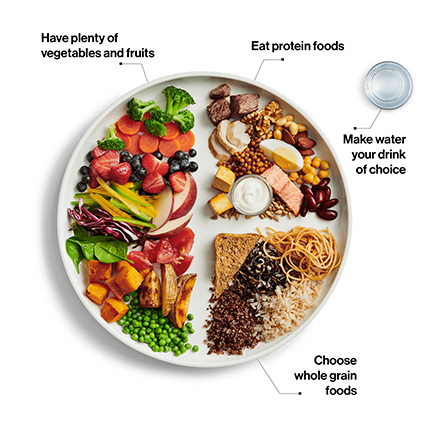
“Canada has done away with the dairy category altogether (instead including dairy as just one of many sources of “healthy protein foods”) in favor of reminding people that water is the best beverage overall. Its previous guide advised two to four servings of milk (or milk alternatives) a day, depending on one’s age.”
The USDA continues to emphasize meat and dairy in diet because “unlike Health Canada, whose sole mission is to improve the health of Canadians, the mission of the USDA is not only to safeguard the health of Americans but also to promote agriculture production (including meat and dairy foods)—which is a conflict of interest.”
Intense lobbying has created the plates Americans are encouraged to eat. Advertising supports the industry paying for it. Advertising and industry-biased research has fed us a pack of lies.
We have lost faith in dieting as a way to control or lose weight because the soda industry has devoted millions to convincing us, often through bogus research, that changing what we eat (and how much) will not work. Hello. What we eat matters. What we eat, how much, and when does impact our body weight. Exercise is critical for a healthy body, but what we feed ourselves matters most of all.
I share this in full knowledge that I eat badly, that I should lose weight, and that baking rugelach and cake is one reason I have gained weight over the past year. We have been vegetarian/pescatarian for decades, and there is little chance of our abandoning dairy any time soon (cheese!) but we hope for small stage changes toward more vegetables.
The colorful illustration above does not represent how my husband and I eat. It is entirely different from how my family ate when I was a child. In those days our plates were half brown (meat), a quarter each green or yellow or orange (peas, corn, carrots) and a quarter white (potatoes). In my childhood a salad meant chopped iceberg lettuce and Catalina dressing (sweet). Dessert was something large, sugary, and baked, cut into four pieces. Sweet drinks vied with whole milk (or powdered milk in lean times). It was a diet driven by culture and industrial interests, not health. Our meals were all too valid and sweet.
“Eat food, not too much, mostly vegetables.”
The very concept of meals has disappeared in our country. We eat all day, though recent research strongly suggests that we are meant to feel a bit hungry each day. Breakfast is intended to break a fast of at least 12 hours. We are meant to feel and to be empty. People all over the world literally starve, but Americans are deeply afraid to feel hungry and so we snack and nibble and “graze” all the hours we are awake. We encourage our children to develop lifelong habits that will impact their health and shorten their lives.
The way we eat is not healthy. I should have seen this coming when the sleep surveys I have been completing online began asking me not only about hours of sleep, sound, lighting, and how quickly I got out of bed in the morning, but also how many nights I went to bed a bit hungry. Never, I responded. But then I wondered and sure enough the research began to come out.
Eat within a 10-12 hour window, between 7am and 7pm, for example. Or between 7am and 5pm. Fill our plates with vegetables. A little grain, a little protein. (Protein is actually easy to come by. Almost everything we consume contains protein.) One large meal, ideally earlier in the day. One very light meal, ideally the last of the day. (Or first like the French, back when we envied how they were all so slender.) Give your gut a rest overnight. Feel genuinely hungry for a few hours. No, you are not “starving” when you feel a bit hungry. Each day I hope to experience just a little “hunger” because my body needs a rest from eating.
Berkeley Wellness Letter also warns that by midcentury “the world will have nearly 10 billion people. One looming challenge will be how to feed them healthfully and without wreaking even more havoc on the environment. Our current eating habits, especially in wealthy Western countries, are responsible for creating an excess of greenhouse gas emissions that contribute to climate change, largely due to our penchant for red meat and other animal foods. What’s more, the typical Western diet plays a major role in obesity and other chronic health problems; meanwhile, millions of people elsewhere are undernourished.”
I need a break from feeling full.
I need a different fullness: Full of hope. Full of passion. Full of intent and wonder and admiration and love. I am hungry for conversation and compassion and kindness. I am hungry for productivity and purpose.
on another note: Today is Zora Neale Hurston’s birthday.
 IMPERFECT PATIENCE