ASSIGNMENT #4: The Idyllic Place

IDYLL:  a simple descriptive work in prose or poetry that deals with rustic life or pastoral scenes or which suggests a mood of peace and contentment.  
IMG_5687One of the things going on in The Adventures of Huckleberry Finn, perhaps the main thing, has to do with the essential decency and indecency of human beings. Huck himself is an innocent, accepting the bigotry of his time because he assumes his “betters” are actually better. Even so, he will risk his soul for Jim. And the grown man and father, Jim risks his freedom and life to safeguard the life of a child, which makes him the most moral person in the novel.

Okay, set that aside. (You might not even agree with me.) It is a (failed) Hero’s Journey and safety is generally found only when Jim and Huck travel, danger in staying in one place and with other people. The most peaceful passage in the entire mad run is Jim and Huck drifting south together on the river.

Connection to landscape often provides a vivid sensation of peace and contentment. Twain’s Huck Finn finds easy living and contentment on the Mississippi. Huck’s idyllic description of life on the river begins with the final three sentences of Chapter 18 and continues through the first few pages of Chapter 19 (below). Notice how he continues his conversational style, and utilizes description which includes all his senses—touch, taste, smell, sound, and sight. Twain gives the reader a specific event—the sunrise—and makes this experience live, a written “picture postcard” of a happy place and time.

This was an experience Samuel Clemens knew well personally. He worked the river—it was his childhood ideal, an adult accomplishment, and the source of his pen name: mark twain=safe water. I like to think he carried that memory of life on the river with him throughout his life and travels. If you can visualize a peaceful place, it is yours to visit whenever you have need.

The assignment: Describe such a peaceful vision from your own life—make your vision draw the reader into your experience. Use informal language but no use of 2nd person/direct address!  Search your memory for a complete picture, gather it up, using all of your senses. Make this place breathe using a specific time or event. There is no plot, no cause/effect relationship, no character development; this is not a true story, but is a true description of an experience.

Spend some quiet time thinking.  Choose a real place which was peaceful for you—on the ocean, in the woods, up a tree, hiking in the hills, or walking on the beach. I have also read wonderful “idyllic” papers which bent the rules a bit to talk about personally moving places—the locker room after a football game, scouting hunting trails, shopping with an aunt, on stage waiting for the curtain to open (my personal nightmare), an entire day up in a treehouse, driving to visit grandparents, surfing. List some features, details, and then ponder. Give this idyllic vision a chance to grow in your head before trying to get it all down on paper. The idyll is a personal description rather than a narrative or academic essay.

I have written about waiting for my sons to fall asleep before filling their Christmas stocking (they were in college at the time), hitting the magical three and a half miles and felling runner’s high, walking the beach, and weaving shawls.

This is a “SHOW,” not a “TELL” paper, but showing with all your senses. It is important that your description demonstrate the sensory experience of your idyll. Don’t tell the reader how happy and peaceful it is—detail the sounds, tastes, smells, sights, and textures that cradle those feelings.

DIRECTIONS:  This is a descriptive paper with a very personal slant, as if speaking to someone you want to be there with you. No character development or plot, but your description may move through space, sensation, emotion. This is about a PLACE, not a person or event!  Personally meaningful setting, no significant dialogue (except perhaps to get you there), full and complete description. As always, write long and carve back. Revise it to a standstill.

NOTE: a weird revision strategy will follow later this week. Really it will.


The Adventures of Huckleberry Finn by Mark Twain

the end of Chapter 18 and the beginning of Chapter 19

We said there warn’t no home like a raft, after all. Other places do seem so cramped up and smothery, but a raft don’t. You feel mighty free and easy and comfortable on a raft.

Two or three days and nights went by; I reckon I might say they swum by, they slid along so quiet and smooth and lovely. Here is the way we put in the time. It was a monstrous big river down there— sometimes a mile and a half wide; we run nights, and laid up and hid daytimes; soon as night was most gone we stopped navigating and tied up—nearly always in the dead water under a towhead; and then cut young cottonwoods and willows, and hid the raft with them. Then we set out the lines. Next we slid into the river and had a swim, so as to freshen up and cool off; then we set down on the sandy bot- tom where the water was about knee deep, and watched the day-light come. Not a sound anywheres—perfectly still—just like the whole world was asleep, only sometimes the bullfrogs a-cluttering, maybe. The first thing to see, looking away over the water, was a kind of dull line—that was the woods on t’other side; you couldn’t make nothing else out; then a pale place in the sky; then more paleness spreading around; then the river softened up away off, and warn’t black any more, but gray; you could see little dark spots drifting along ever so far away—trading scows, and such things; and long black streaks— rafts; sometimes you could hear a sweep screaking; or jumbled up voices, it was so still, and sounds come so far; and by and by you could see a streak on the water which you know by the look of the streak that there’s a snag there in a swift current which breaks on it and makes that streak look that way; and you see the mist curl up off of the water, and the east reddens up, and the river, and you make out a log-cabin in the edge of the woods, away on the bank on t’other side of the river, being a woodyard, likely, and piled by them cheats so you can throw a dog through it anywheres; then the nice breeze springs up, and comes fanning you from over there, so cool and fresh and sweet to smell on account of the woods and the flow- ers; but sometimes not that way, because they’ve left dead fish laying around, gars and such, and they do get pretty rank; and next you’ve got the full day, and everything smiling in the sun, and the song- birds just going it!

A little smoke couldn’t be noticed now, so we would take some fish off of the lines and cook up a hot breakfast. And afterwards we would watch the lonesomeness of the river, and kind of lazy along, and by and by lazy off to sleep. Wake up by and by, and look to see what done it, and maybe see a steamboat coughing along up-stream, so far off towards the other side you couldn’t tell nothing about her only whether she was a stern-wheel or side-wheel; then for about an hour there wouldn’t be nothing to hear nor nothing to see—just solid lone- someness. Next you’d see a raft sliding by, away off yonder, and maybe a galoot on it chopping, because they’re most always doing it on a raft; you’d see the axe flash and come down—you don’t hear nothing; you see that axe go up again, and by the time it’s above the man’s head then you hear the k’chunk!—it had took all that time to come over the water. So we would put in the day, lazying around, listening to the stillness. Once there was a thick fog, and the rafts and things that went by was beating tin pans so the steamboats wouldn’t run over them. A scow or a raft went by so close we could hear them talking and cussing and laughing—heard them plain; but we couldn’t see no sign of them; it made you feel crawly; it was like spirits carrying on that way in the air. Jim said he believed it was spirits; but I says:

“No; spirits wouldn’t say, ‘Dern the dern fog.’”

Soon as it was night out we shoved; when we got her out to about the middle we let her alone, and let her float wherever the current wanted her to; then we lit the pipes, and dangled our legs in the water, and talked about all kinds of things—we was always naked, day and night, whenever the mosquitoes would let us—the new clothes Buck’s folks made for me was too good to be comfortable, and besides I didn’t go much on clothes, nohow.

Sometimes we’d have that whole river all to ourselves for the longest time. Yonder was the banks and the islands, across the water; and maybe a spark—which was a candle in a cabin window; and sometimes on the water you could see a spark or two—on a raft or a scow, you know; and maybe you could hear a fiddle or a song com- ing over from one of them crafts. It’s lovely to live on a raft. We had the sky up there, all speckled with stars, and we used to lay on our backs and look up at them, and discuss about whether they was made or only just happened. Jim he allowed they was made, but I allowed they happened; I judged it would have took too long to make so many. Jim said the moon could a laid them; well, that looked kind of reasonable, so I didn’t say nothing against it, because I’ve seen a frog lay most as many, so of course it could be done. We used to watch the stars that fell, too, and see them streak down. Jim allowed they’d got spoiled and was hove out of the nest.

Once or twice of a night we would see a steamboat slipping along in the dark, and now and then she would belch a whole world of sparks up out of her chimbleys, and they would rain down in the river and look awful pretty; then she would turn a corner and her lights would wink out and her powwow shut off and leave the river still again; and by and by her waves would get to us, a long time after she was gone, and joggle the raft a bit, and after that you wouldn’t hear nothing for you couldn’t tell how long, except maybe frogs or something.

After midnight the people on shore went to bed, and then for two or three hours the shores was black—no more sparks in the cabin windows. These sparks was our clock—the first one that showed again meant morning was coming, so we hunted a place to hide and tie up right away.
DREAMING


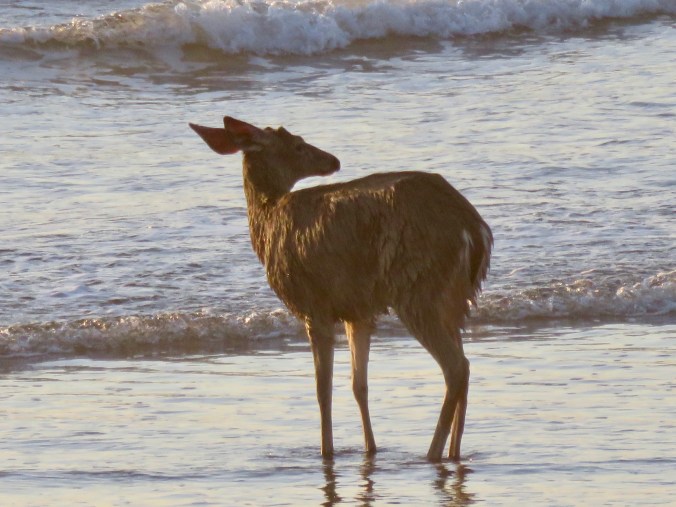
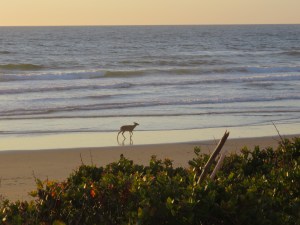
IMG_5660.jpegLast night, just before sunset, a deer appeared on the shore. Not a good thing in daylight. She was wet and confused and kept to the surf line. We see deer tracks frequently in the sand on our morning walks, but never the two deer themselves. This one moved along just fine, though she did not look happy, and the tourists with their dogs had all gone home. Local dog-owners came out on the beach, saw the doe, and leashed their dogs. Perhaps she had been separated from her companion, which I assumed from its smaller tracks was a yearling fawn? She stood right in front of our house, trotted north and then back south. And then the sun went down.
This morning, I dreamt we were living in our first house in Seattle again. Our dog Volant Sequoyah (“Bowzer”) had jumped the fence into the neighbor’s fenced yard and I’d left him there for a day and a half to teach him a lesson. Ian and Kerris showed up with packages of ground beef and hamburger buns just as I brought Bowzer home, and we didn’t want it because we’re vegetarian, but I thought about feeding Bowzer the meat. He was hungry. There was also a sequence of visiting the local school, which had been temporarily housed in an upper floor of a fancy office complex.

Well. Dreams are like that sometimes, a mixture of what we know and wish and experience muddled with places we have been, people we care about. Alan commented on the phone that the house yesterday that the house he and his wife first bought was up for sale and that set me thinking about our old house in Seattle. Online it is valued at nearly a million dollars. We paid less than twenty thousand for it in 1975.

At the beginning of 1978, Gary had left the zoo job and was tutoring American Indian students in the Edmonds School District. He had just been accepted to a grad program at the University of Washington’s School of Education for the fall. He planned to teach elementary school. I think he would have been wonderful at that job, he enjoys goofy humor and his impulse toward soothing and calming others would have served his students well. I was teaching art classes at Forest Ridge, an elite girls’ prep school on the other side of Lake Washington. We had six Afghan Hounds then, including Bowzer and his sister, and were active in showing and lure trials. I was a licensed field trial judge and we traveled often across the PNW and to Canada for shows and field trials. Instead, Gary’s father was dying of cancer, his family was falling apart and he quit school to support them. My grandfather’s third wife died and Genevieve left me the family house at the urging of her second husband. We thought we might buy land outside the city.

Instead we decided to have a family. We moved to my grandfather’s beach house in Oregon, the state where I was born. Gary took a job in a farmers’ co-op because he had worked in the Woodland Park Zoo commissary before he started back to school. we had our children, and I became an English teacher.

All in all, the dream seems more likely than that doe in the waves.


IMG_5656I should note that I took the photo above with a zoom from our deck. We are careful to avoid approaching wild animals. It is distressing for the animal and can make a bad situation deadly. Locals understand it is best not to “help” a wild thing.

Oh! I should have put up Assignment #3, only because I said I would do five. No one seems to be writing them, but I will post “The Idyllic Place” tomorrow.


PEACEFUL DAY

fullsizeoutput_11dd

We each have our favorite colors of sea glass. Gary almost never finds the dark orange “brown” glass. Cobalt blue (the piece above is more than 50mm across and 6mm thick) is cause for celebration.

Today I will bake rolls and roast green beans. My mother would have made lamb, but we are vegetarian and I have a casserole of mac&cheese already made and ready to go in the oven. I found fresh blueberries on our weekly grocery run, so there will be a pie. No ice cream, but blueberry pie. We will sit at table and remind ourselves of our good fortune. Continue reading

CARNIVAL

IMG_5639

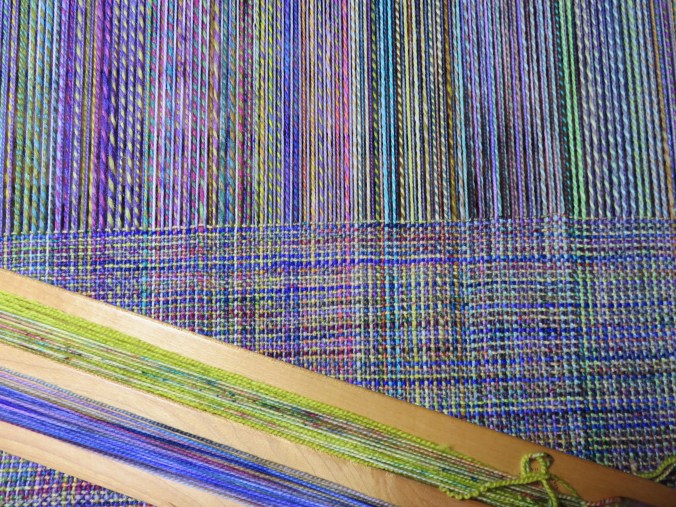
My third day working on the “Carnival” warp with just ten inches woven. (I discovered that the acid green I’d hoped to use was from a very old first dyelot of the color and the yarn itself thicker than the others. I finished off a very old blue skein like that in the recent blue warp.) Twenty or more inches today, I hope, and I will bake bread. We had salad last night for dinner! Such a relief after no fresh greens for a week. Salads for the next couple of weeks, and I have leeks to make leek soup, potatoes to go into the soup or for oven fries, cheese!, green beans I will roast tomorrow. Potato chips are a treat.  Continue reading

TEACHERS & other essentials

Nurses, doctors, firefighters, the EMTs who answer calls, ambulance drivers, therapists, technicians, and pharmacists.

A local hospital administrator must leave her infant son to ensure medical care is available for the rest of us.

Like other essential services, children need education and local teachers are still at work, striving to accomplish what they can without actually having students in front of them. It is a challenge. One teacher, working from home in her basement, commented, “As you can imagine, it is not best practices just to put your assignments online and think they will be able to do them.” She has always done so very much more than that. And every day.

A local trucker friend who delivers fuel is also working, often with people who do not think any of this is a big deal. He worries about his mother, in her 90s.

The nearest grocery is five miles from us and having trouble keeping supplies in stock. Their employees are gloved and masked, but they are still open.

Our favorite bakery in Tolovana delivers bread at their door.

No one wants to take cash, but we are not spending much either. We stay close to home and do not sleep well the night before we must go out. But there are invisible people still plugging way and keeping things moving, people who still go to work each day, people who log on to their computers and do the job, people who are old themselves but still taking care of older relatives, people who fill my yarn and book and CD orders, people who gather to sing virtually.

Thank you. Thank you every one.

SPRINGING

IMG_5606

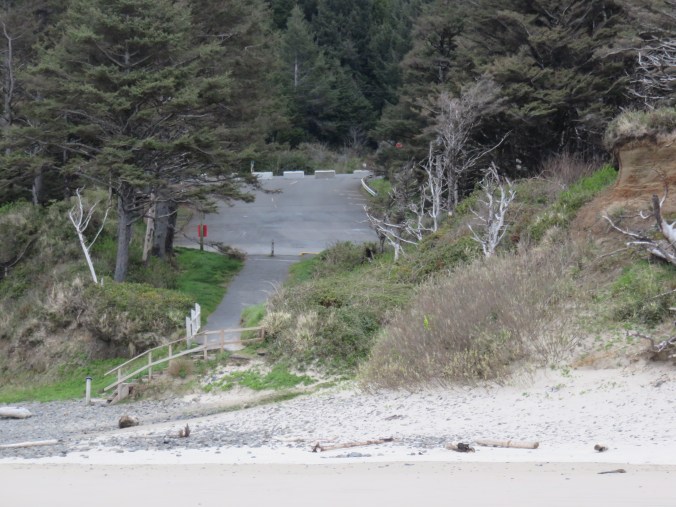
Gary and I used to run up this hill. I’ll call it a 30° angle, but I’m just tossing out a number. It felt like pretty much straight up.  (At top you can see the concrete barriers blocking the parking lot.)

We went for a long walk the other day—two miles from home and then back with another mile or so of up and down shore to hunt for agates and sea glass. I finished the pair of socks I’ve been knitting and washed and blocked them. I should have baked bread but we got by with the last slices. The moon really was lemon that night. Continue reading

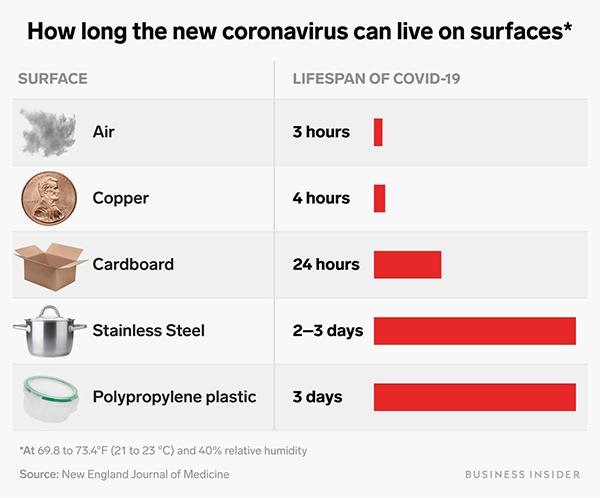
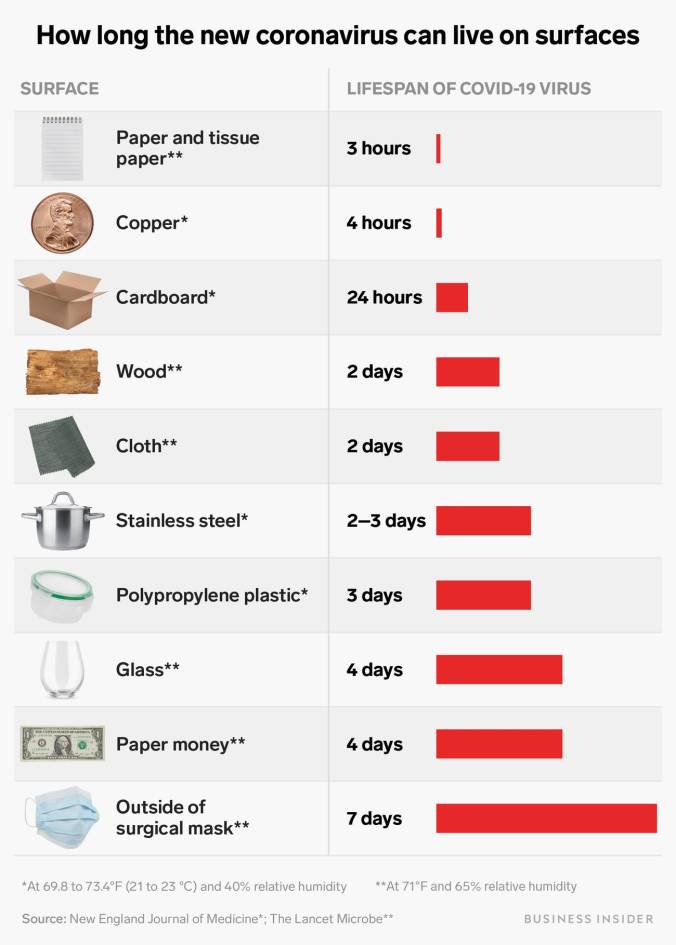
HOW LONG? 2 charts

5e7787ee1378e37a8a67d1925e8cdb448427e964fd756ce6.jpeg

“How long the coronavirus can survive on surfaces

“The researchers behind the new study tested the virus’ life span in a 71-degree-Fahrenheit room at 65% relative humidity. After three hours, the virus had disappeared from printing and tissue paper. It took two days for it to leave wood and cloth fabric. After four days, it was no longer detectable on glass or paper money. It lasted the longest, seven days, on stainless steel and plastic.*

“Strikingly, the authors wrote, the coronavirus was still present on the outward-facing side of a surgical mask on day seven of the investigation. That’s the longest duration of all the materials they tested.”

NOTE: It lasts longer on cooler rather than warm surfaces. Some research has also suggested that increases in relative humidity reduce how readily the virus can spread between people. Your mail is most likely safe on delivery according the the article.


Gary wiped down a wine bottle with alcohol wipes, but we’re mostly avoiding bleach. Mostly, we allow things to sit for days. We wish freezing or refrigeration made a difference (no). We wish vinegar killed it (acidic—wouldn’t that be nice? but no). We wish we didn’t have to think about this at all.


from Business Insider. https://www.businessinsider.com/coronavirus-lifespan-on-surfaces-graphic-2020-3?utm_source=DI20B8U3&utm_medium=email&utm_campaign=20_feb_corona&utm_term=04_06

RLP: Idiot Drivers

Idiot Drivers

I drive a small car, my husband’s little red Honda Civic hatchback, and one thing I that makes me crazy is when drivers of giant SUVs come right up behind me and tailgate.  A couple of days ago I was driving home from work and an SUV merged from highway 26 onto highway 101 right behind me.  I could tell the driver was mad at me that I didn’t brake to let him in in front of me because he waited till his merging lane ended before he slowed and cut in about five feet behind me.  The speed limit changes to 55 mph right about there and I was speeding up but I kept speeding up to a little above the speed limit and even so he tailgated me all the way to the passing lane.  He whipped on by me in the left lane and then moved back into my lane about a hundred feet ahead of me and slowed back to the same speed he was going before he passed me.  So what was the big deal about passing me if he didn’t actually want to go any faster?  He just had to be in front of me.  It just shows America is a dangerous place to drive.  I am more likely to die on American roads than in most nations of the world.  There are 15.2 deaths/100,000 in the U.S. compared to 6.0 deaths/100,000 in the United Kingdom.  In fact, a German data base survey of twenty-eight participating countries showed most reporting death rates in the single digits with only Portugal, Poland, Greece, Korea, and Luxembourg showing higher death rates than the U.S. (“Selected Risk Values”).  We’re all a little crazy on U.S. roads. Something must be done to make the road safe from crazy drivers.     

There should be some way to safely respond immediately to the stupidity of drivers who tailgate, cut people off in traffic, or drive way too slow or too fast.  My solution is to issue an “idiot pistol” to all drivers in good standing.  This gun would be turret mounted on the top of my car and respond to verbal direction.  I would simply say the license number or describe the location of an offending driver’s car and say “fire.”  The idiot pistol would shoot a dart directly into the back of the car where it would harmless attach itself and release a large two-foot orange and purple flag saying “IDIOT!”  I would feel revenged right away and for a month the driver would have to drive around with a sign proclaiming him an idiot.  There would be no permanent damage to the car, but if a single driver accumulated four flags in a four week period while offending four drivers in four separate incidents of stupidity, the car would be impounded.  Of course, everyone makes mistakes once in a while and this would act as an immediate reminder and lesson to all drivers, while seriously punishing drivers who consistently drive like idiots.  

I like the idea of punishing offenders on the spot and firing darts into the back a cars could certainly make me feel better when I’m cut off in traffic, but even I can see there are problems with my plan.  I’m as susceptible as anyone to irritation, bad temper, and error.  My goal is to make the roads safe from foolish drivers, but shooting at them could be counterproductive.  I could end up acting like an idiot myself and chase down another driver, succumb to road rage, or pay more attention to getting even than driving safely.  I might overreact to an honest mistake or choose to pick on someone I have a grudge against.  Four friends could gang up on a common enemy in order to cost him his car.  Most people can’t afford to rush right out and replace an impounded car.  I know I would be in a bad spot if that happened to me.  Finally, aside from issues of safety and fairness, this system would definitely be expensive to set up and monitor and there isn’t any existing technology to safely shoot the harmless but non-removeable darts in the way I recommend.  

Nevertheless, idiot drivers are a real and ongoing problem and all sorts of strategies should be considered in order to address the problem.  There are laws dealing with these things.  We all need to respect the need to abide by laws designed to guard us against our own deep, sincere need to drive like fools at time.  I think it should be against the law to use cell phones on the road as it is in many other countries.  All drivers need to more considerate of existing laws regarding speed limit and other traffic signs, as well as use common sense about recommended speeds, spacing on the highway, and demonstrate courtesy when merging and passing.  We could brand or tattoo notice of traffic violations on people’s foreheads.  That would certainly get their attention.  Maybe it’s not legal or nice, but driving like a creep isn’t very nice either.  Too many people behave as if laws apply only to criminals and not to them.  Maybe more police on the road would help, better education when learning to drive, remedial classes for people with bad driving records.  Maybe some rock star, Sting perhaps, would take up the slogan, “Don’t be an idiot, drive sensibly” and make it cool to be a cool driver.  

In desperate moments I’ve considered desperate measures to get even with drivers who scare the pants off me.  I would like them scared too, and at least publicly embarrassed by their poor driving habits if not thrashed and arrested.  But I drive a little car and I’m not interested in declaring war on the highway.  The truth is that I can’t make others drive better, I can only practice what my husband suggests:  “Drive like they’re all crazy, because some of them really are, you know.” His attitude is international.  The Chief Superintendent of Police Traffic Headquarters in Hong Kong said just the other day: “smart drivers always assumed that other drivers were inexperienced and careless.”  After a widespread courtesy campaign, death rates in Hong Kong dropped to the record low of only 3/100,000, a fraction of what they are in the U.S.  So I think I’ll be safer if I listen to the experts and my loved ones and take care of myself without seeking revenge. I will be polite. If someone wants to merge in front of me I’ll try to let them.  If they want to drive faster, I’ll look for a place to pull over. If some motorhome is creeping along at 35 mph in a 55 zone with no passing lane for a mile, I’ll take a deep breath and ask myself why I’m in such a hurry. I don’t want to get so bent out of shape about other people’s idiocy that I become another idiot myself. Though I can’t change the rest of the world, I can try not to let the rest of the world ruin my day.      

ASSIGNMENT #3: Real Life Problem

IMG_5573

Essayist and memoirist William Kittredge was born in Portland, Oregon but lives now in Missoula, Montana, I think. He did a presentation at my first MFA residency about writing an essay. He insisted that he couldn’t tell anyone how to write an essay, and then he did. Define a problem by telling a story about it. Then propose a solution by telling another story. Explain why that solution won’t work with another story . . . at least that’s how I remember it.

This assignment works a lot like that and is straight out of my high school playbook. I have written it many times and I can always make myself laugh because it’s silly and satisfying. It can be written in one sitting, but I like to do it one paragraph at a time. In a classroom, we draft the first paragraph on a Monday in twenty minutes, and I would allow students a few more minutes to complete it—working on a new step each day, by Friday students had a complete draft. They had to count their words and meet the minimum. Two hundred words is not a long paragraph and most students wrote closer to two-fifty words. It doesn’t matter too much.

ASSIGNMENT:  Write an essay of five or more paragraphs humorously addressing a minor real life problem (no pornographic or vulgar problems or serious problems like world hunger), propose a silly or ridiculous solution, identify the flaws of your solution, review other silly and reasonable options for solving the problem, and conclude what is being done and should be done to address the problem. We’re joking!  One step at a time. 


#1 the PROBLEM Hook your reader and explain the problem you are concerned about by telling a true short story about your personal experience with this problem—an anecdote. Explain why it bothers you, maybe explain why it’s bigger than it looks—show the big picture. State the overall problem in a sentence at the end—your thesis.  The toughest thing about this paragraph for many people is telling too much of the story. Write about 200 words.  very short story, big picture, thesis sentence

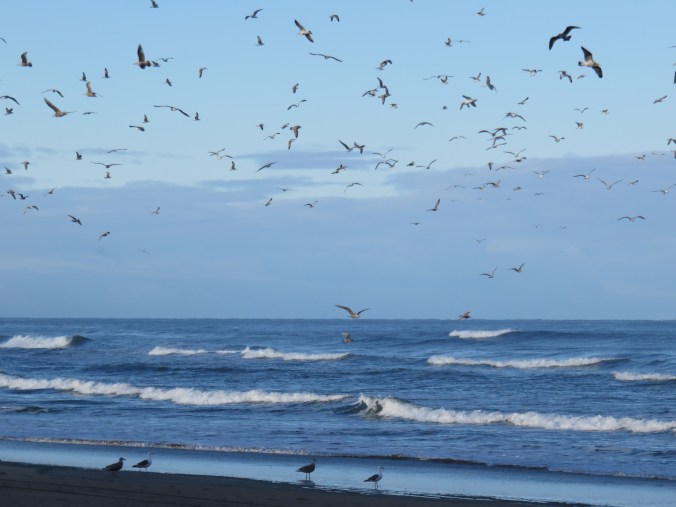
#2 a SOLUTION Propose a satirical “ridiculous” solution to your problem, one that is not vicious (no decapitations!).  This solution is not realistic, it must seem both sincere and silly.  Explain how your solution would work. Make it sound as reasonable as you can, step by step, in detail. Don’t hurt anyone with the solution, not even as a joke. In paragraph #2, I have proposed an “idiot gun” that shoots darts into the back of bad drivers’ cars with a huge banner proclaiming the driver and idiot. I have commandeered a flock of trained seagulls to poop on the spotlights shining on the beach. A student imagined a trap door that would open under his mother’s feet and drop her in a pile of dirty laundry when she asked if he had any homework. None of these solutions in possible or practical, some are completely unfair and foolish. No worries. You’ll be admitting that in paragraph #2. Have fun with this, explain why it is a satisfying solution. In my experience this is at least a medium length paragraph. Write about 200 words.   

#3 the HOWEVER Explain the problems with your ridiculous solution. Think hard and enumerate them all. Be specific. Consider safety, expense, practicalities, legalities, fairness, other considerations. Perhaps even some of the problems with the solution are silly! You should have at least four problems with your solution. In my experience this is medium length paragraph. Write about 200 words.   concede the flaws in your silly solution

#4 other OPTIONS What else could be done or is being done about this problem?  Again, be specific, briefly describing each option in a sentence. These options may include both realistic and silly possibilities. You should have at least six options with your solutions, each explained briefly and carefully. This is usually my longest paragraph, sometimes I must break it into two.  Write  about 200 words.  consider many options [NOTE: sometimes this one gets out of hand with too many options. You can carve back to the best one later or make two paragraphs.]

#5 CONCLUSION Redefine your problem. Summarize the good, the bad, and the ridiculous. What has been done, is being done, will be done, should be done? What are the consequences of this “real life” situation? Revisit your anecdote at the beginning—what did you do in that situation and how did it turn out? Are you satisfied with your on-the-spot reaction or could you do things differently? Step back from your rage, frustration, and spite—be sensible here.  In my experience this is a medium to long paragraph. Write about 200 words.  recap, reconsider, get real [NOTE: again, sometimes this gets out of hand. You can carve back or make two paragraphs.]

You can add to your satire after the first draft that explain the problem, offer a solution, agree or disagree with your solution. The sources themselves can be ridiculous. Write long, butcher back.

The most important part of any essay is our ideas and what we write, but an essential part of this assignment is to eventually acknowledge that this really is a trivial complaint. And even though we’re kidding, the joke goes over better if we “tell it with a straight face.” 

And, of course, I won’t be looking over your shoulder or giving you a stamp when you achieve content and word count for each paragraph. Bill Kittredge advised aiming for the same length of paragraphs throughout. You don’t have to do that. You don’t have to do any of this.

But if you write this assignment, it will make you smile. I think I can promise that.

And a reminder that this is National Poetry Month—a reminder to me since I have ignored this for almost a week. (for several years I used to post a poetry prompt each day of April). I think it might be fun to write this as a poem. Maybe “fun” is the wrong word. Engrossing? Better than watching a bad series on Netflix? A form poem would be particularly challenging. Villanelle? Sestina? Anyone? Anyone?

STATS

Explain this, as of 4 6 April:

219,564 residents in Jackson County; 2133 2269 tests; 33 confirmed cases, still no dead

346,868 residents in Marion County; 1567 1716 tests; 188 198 confirmed cases, 5 dead

In Jackson county, as of 4 April, Oregon had managed to complete 1 test for each 102 residents.

In Marion county, Oregon had tested 1 in 221 people. Yet Marion has many more cases and five people have died.

In our most populous county, Multnomah, as of 6 April there have been 4209 4603 people tested with 209 233 confirmed cases and six seven dead. There are 811,880 people in Multnomah County, which means Oregon had tested only 1 on 193 176 people in our most densely populated county, but six seven have already died.

There are 3,831,074 people in Oregon, 18,925 19,556 have been tested (one person in 202 195), and 999 1068 are confirmed positive, 27 have died.

What’s the deal with Jackson County? And while I’m at it, what’s the deal with that person with Marin County, California plates shopping at the local grocery?

Yeah, I should be nicer, but Gary says my mother would be proud of me: “Going through everything, trying too make sense of the puzzle. That’s what your mother did.” It’s true, Mom cared about numbers and fairness.